In 2016, the Broadcast Research Council of South Africa (BRCSA) changed its policy about giving away TAMS and now only monthly reports, highlighting the top 20 or 30 primetime shows on several popular channels, are available.
The Broadcast Research Council of South Africa (the BRC) is a non-profit, industry body that was incorporated in 2015 to cater to the audience research needs of the radio and television industry in South Africa.
by Veli Ngubane (@TheNduna) This month we interview Queenstown-born Amahle “Jaxx” Jaxa (@Jaxx_Amahle), who is currently chief of operations at Until Until while studying towards a BA in politics, philosophy and economics through UNISA. The 25-year-old shares her opinions on how the industry is doing in terms of transformation and how women are portrayed in the media.
Amahle “Jaxx” Jaxa
Veli Ngubane: Tell us more about yourself: where did you grow up and what did you want to be when you were growing up? Amahle Jaxa: I grew up in Queenstown in the Eastern Cape riding bikes and climbing trees, being the complete opposite of what a girl should be. My weekends were spent in the rural area of eJojweni with my grandparents, milking cows, going on adventures and cooking outside — a contrast of what my week looked like in the suburbs. When I was younger, I was convinced I was going to be president; I had a keen interest in politics from a young age.
VN: Tell us what you do and what does a typical day look like for you? AJ: I am chief of operations at Until Until and a typical day for me is doing the finances and admin of Until Until. When there is an event, I am an events manager and help with the planning and coordinating of the event with two assistants from Until Until who are part of the events team. I also study, so half of my day is dedicated to my studies. I am in my third year of a BA (politics, philosophy and economics) through UNISA.
VN: Tell us more about Until Until and its future plans. AJ: Until Until is a marketing, brand activations and events company. It is divided into three parts: Until Until Events, which is self-explanatory in that we host our own events and host events for brands; Until Until Thinking, which does strategy and marketing for brands; and, finally, Until Until Ambient, which does activations for brands. We have established ourselves as an events agency and now we look to establish ourselves as an advertising agency helping brands though honest creativity. We look to support brands in their attempt to tap into the youth market.
VN: There is a buzz word, “culture”, in referring to the youth market: what is “culture” and how can brands align with the “culture”? AJ: I actually hate the word “culture” because I feel like it’s being used for any and everything and no one can actually tell you what they mean when they say, for example, “Do it for the culture.” Who is the culture? What is culture? Who is the message directed to? it is misleading. Brands need to pick their target market and market to them instead of trying to capture everyone under the guise of “culture”.
VN: What are brands doing right in their pursuit to win over the youth? AJ: Coca-Cola’s collaboration with Rich Mnisi and others is not only empowering young designers but making luxury items made by these designers affordable. Castle Lite is also doing well in bringing international acts that resonate with the youth.
VN: How can the creative industry attract and keep more black female creatives? AJ: The creative industry first needs to hire black women before they can work on strategies to keep them.
VN: Why do you think the advertising industry is struggling to transform and what do you think should be done to fast-track transformation in the advertising and events industry? AJ: The advertising industry is struggling to transform because the people [who] are hired do not reflect the majority of the country and therefore, they cannot market to the majority of the country. The industry hasn’t understood the South African market and that leads to the failure of properly articulating their message to the market. Black people are known to love music and dancing, but that does not mean every cellphone company advert or washing powder advert should have black people dancing. The way to transform it is to hire more young, black people who understand the South African market.
VN: I’m interested in your thoughts on how women are portrayed at events, on TV and in adverts and what you, as a female creative, are doing to change how women are represented? AJ: Women in events are always sexualised and objectified. On flyers, their bums are exposed; in clubs, they are dancers dressed provocatively; and, when they hold positions of power like myself, they are undermined by their male counterparts. On TV they are always portrayed as a housewife or looking for a man; very few adverts target an independent woman. As a female creative, I hope I represent a woman who can not only lead women but men as well. I represent independence in that no man in my life has ever given me anything and that I have gotten to where I am on my own merit. I do not conform to the ideas that woman should be in heels or wear makeup every day because that is unrealistic. I hope in the future to employ only women and teach them that their beauty is but an aide to their brains.
VN: What advice would you give someone completing their high-school education this year and looking to follow a career in the creative industry? AJ: Any young person should know that, without an education, life is harder. Patience is needed in the creative industry because there are so many moving parts; it’s not like working in a bank where every day is the same. You have to be extremely reliable because the creative industry works a lot on referrals. You are easily replaceable; therefore ,you have to work hard — as you would in any job, I guess.
VN: What do you feel is missing in the creative industry today and what should the future look like in South Africa and the rest of the continent? AJ: Relatability and new ideas.
VN: Where and when do you have your best ideas? AJ: Every and anywhere; as long as I have my team with me, the best ideas come out. We could be at the club, having lunch or at the office. My creativity flows through Until Until more than an actual place.
VN: If you had a super power, what would you want it to be? AJ: I would be Superman. Everything. One is not enough
VN: Tell us something about yourself not generally known? AJ: Everyone sees me as a tough person who rarely shows their emotions and only my mom knows that I am really emotional and a hopeless romantic.
VN: What exciting projects are you working on at the moment? AJ: [At the time of the interview, we were] working on #GenesisAllBlack which [was] on 20 April 2019, and have started planning for next year’s Bacardi Holiday Club. Agency-wise, we are working on an awareness campaign about drinking and driving that will hopefully impact the youth of South Africa
VN: Brag a bit: what is your career highlight to date; awards, brands you’ve worked on… don’t be shy, tell us. AJ: My proudest moment is when we managed to pull off two gala events for BRICS, which solidified us in the corporate world and showed the masses that we don’t just host parties for young people. Another exciting moment was when we first got a stage at Ultra and Oppikoppi.
VN: Please would you supply two or three pieces of work you have been involved in?
Veli Ngubane (@TheNduna) entered the world of advertising with a passion after completing his BSocSci (law, politics and economics) at UCT and a post-graduate marketing diploma at Red & Yellow, where he’s currently advisory board chairman. He also sits on the IAB’s Transformation & Education Council, is a DMA board member and Loeries, APEX, Pendoring, Bookmarks and AdFocus. He is the group MD of AVATAR, one of the largest black-owned and managed integrated agency offering in South Africa. In his monthly column “Young, Gifted & Killing It”, he profiles award-winning, kick-ass black creative talent in South Africa.
by Kirsten Dewar.If you think about it, Bill Gates was the Gary Vaynerchuk of his era. The principal founder of Microsoft, Gates is the world’s second-richest man (Jeff Bezos is #1), thanks to the company he helped grow into a multibillion-dollar technology multinational. Vaynerchuk has built a marketing empire and an enviable social footprint that’s given his advertising business, Vaynerchuk Media, a massive boost.
“Content is King”
An early champion of content, some 20 years after founding Microsoft in 1975, Gates penned an article called “Content is King” and placed it on the company website. The writeup declared: “Those who succeed will propel the Internet forward as a marketplace of ideas, experiences, and products — a marketplace of content.” He foresaw how important content would become, two years before Google was founded; “Content is King” was written in 1996. Google was created by Larry Page and Sergey Brin two years later. Zuckerberg’s Facebook would only materialise in 2004.
What Gates knew back then, and what Vaynerchuk knows now, is that brands are built in the court of public opinion. Brands are literally the sum of what people think and feel about them. One of the best ways of trying to influence this, and impacting consumer behaviour, is through smart content that connects and cuts through the clutter.
Building brands by using content is, as Vaynerchuck says in a recent blog post, tough but really rewarding. “Mastering content strategy, creation, and distribution for your brand on social media is a difficult and long process,” the digital powerhouse writes. The great news is that, if done smartly, and strategically, can offer both B2B and B2C brands a major boost.
Very effective
Content campaigns that astutely use editorial media to build brands — particularly a new one — can be very effective. In the early days, Gates grew Microsoft in the pages of Fortune Magazine, London’s Financial Times and The New York Times. Microsoft’s mogul once famously said: “If I was down to my last dollar, I’d spend it on public relations.”
More recently, Vaynerchuck has grown a monster brand for his agency on the likes of SnapChat, YouTube and LinkedIn. As Forbes states: “In the midst of running a company that grosses over [US]$200 million in sales annually, he [Vaynerchuk] somehow finds time to create content on every available platform: He’s written New York Times bestselling books, he hosts a successful podcast, he has a popular YouTube channel, and he obsessively posts on social media.”
The competition for consumer attention has never been more fierce; today, well over 2.5 quintillion bytes of data are created daily. Given humans are creating millions of MB of content, how do you create content that engages and connects, that invites conversation but, most importantly, gives your customers what they want?
The customer is the starting point
Before setting out on your content journey, it is critical to understand what your brand and business goals are. Global brand strategy and digital disruption advisors, Prophet, conducted research to discover what underpins great content strategies: “We found that companies with successful content strategies had clarity around what they wanted the content to do for their customers and strong criteria for what they would and wouldn’t publish.”
The best content strategies are customer-centric. Prophet advises: “The first and most crucial step in creating a strategy is to know your customer. The primary questions to answer before moving to the next step are ‘Who is your customer?’ and ‘What are their biggest pain points?’ But in addition to those questions, you’ll need to gain an understanding of their content consumption behaviours and preferences in terms of format, device, timing.” (Read Prophet’s guide to content strategy here.)
The first rule of content is quality
If you’re going to go to all the time and effort of creating content — make it matter. Neil Patel says this best in his blog, The Ultimate Guide to Writing Epic Content That Will Go Viral: “Epic content is the content that rocks a reader’s world. It gives them hope and strengthens the trust they have for you.” If your brand is going to use content, your marketing department and agencies must commit to creating nothing less than the best content in the world. Creating mediocre content is simply a waste of time, effort and marketing investment.
Make more with less
Content creation can be done more effectively when you use Vaynerchuk’s “pillar content” approach. Each time a brand spokesperson does a talk, or writes a key article, use this as a core pillar from which you can create loads of micro-content. A great resource for this is Vaynerchuk’s blog and slide presentation on how to use one article to create 30 pieces of the content.
To summarise, great content is all about the customer and is a vote for quality. To achieve quality, use the Vaynerchuk pillar method to do more with less.
Kirsten Dewar started her career in data and research, before moving into technology, which took her to Platinum Seed; today, she is the managing director of the digital specialist company. She contributes the new monthly MarkLives column, Always Learning, which aims to teach marketers more about digital marketing, from how to conquer Facebook’s algorithms to what LinkedIn’s new company pages mean for B2B brands.
by MarkLives (@marklives) Today Distell is breaking its new TVC for EDGE, its new category-breaker, right here on MarkLives. We feature the “Distell EDGE — Where Beer and Cider Meet” ad from agency Net#work BBDO plus insight into the brief, creative idea and production challenges.
Client: Distell Ad agency: Net#work BBDO Title: Where Beer and Cider Meet
Information supplied by Distell.
Brief
Our brief to the agency was deceptively simple: we didn’t want to launch yet another alcohol brand; we wanted to create an entirely new category. This ad had to be a compelling and surprising touchpoint that would establish and entrench this category-breaker by intriguing consumers into discovering the unique proposition of EDGE. At the same time, it needed to be simple, engaging and provocative — with an irreverent tonality. However, we’re also deadly serious about EDGE: it’s a category-breaker that delivers the satisfaction of beer AND refreshment of cider!
Creative summary
To us, the EDGE drinker is a man on a mission, on a journey to forge his own identity. He literally lives the brand by bridging different worlds: he might live in the township but works in the city. He’s smart, charming and well-travelled. Most of all, he doesn’t allow himself to be defined by expectations of society.
What’s amazing about EDGE is that the taste is unique for everyone but consumers have consistently played back about how pleasantly surprising the drink is. That’s why we wanted to use the metaphor of the well-known beer and cider personalities meeting, and enjoying EDGE. EDGE is where beer and cider actually meet. Our tagline, “izokumangaza”, doesn’t just encapsulate the drink but also the drinker. Both will surprise those who have preconceived ideas by challenging convention in a witty and confident manner!
Resources
The process behind this ad started way back in August 2018 — ironically enough, on International Beer Day. That’s when we started building the space into which we could launch this product, and this ad, both in the market and in the consumer’s mind.
We took our consumers on our journey of discovery with us which validated the opportunity for the category breaker in the market but also highlighted the best marketing approach to get into the hearts and minds of the consumer. We have focused on bringing the brand to life in our consumers’ environment through a strong BTL approach and engaging with them in the places they hang out.
This initial phase of the launch brings the brand proposition to life on our digital and social platforms and through which we have chosen to launch this memorable and cut-through ad.
Credits
Client
Distell
Global head, RTDs: Kushilla Thomas
Global brand development manager: Vithesh Ramklown
Global Brand Development Manager: Michelle Michael
Agency
Net#work BBDO
Production
Production company: they shoot films
Updated at 11.56am and 11.46am on 29 April 2019.
#Campaigns is the new weekly MarkLives column featuring insight into the brief, creative idea, production challenges and results of South African communication campaigns, both ongoing and recent. Have a campaign worthy of being featured in #Campaigns? Submit a short motivation to and we may well be in touch. Please include links to campaign material, when it ran/is running and why you believe it should be featured.
by Martin MacGregor (@MartMacG) Sometime in the late ’90s, somebody asked Sir Martin Sorrell if he ever thought media would go back into creative agencies. His reply became the unquestionable wisdom on the matter ever since: “You can’t put the toothpaste back in the tube.”
This view has held strong ever since, and it has also been applied to most other discipline specialist agencies. Except, in the last few years, clients have started to realise that the work and effort required to manage multiple agencies and getting them to collaborate and deliver integrated solutions has been becoming increasingly onerous. Why should clients manage putting together the communications puzzle? Surely that was an agency output?
It feels as if a tipping point of sorts has now been reached.
The recent Distell pitch has been a good example. It recently announced that its brands would be split between two “integrated communications partners”, WPP and Publicis Groupe. Both groups would be setting up teams that would “manage all aspects of the marketing mix, including advertising, digital, social, PR, media and activations”.
This clearly puts the management of all communications at the integrated agency door.
Focus on outputs
It means the marketing teams can focus on the outputs, as opposed to the process. And, as importantly, it means that the agencies are tasked to deliver the full solution to any business problem. It ensures agency output is what it should be — touchpoint or discipline-neutral ideas and plans that are focused on the right thing: solving the problem.
For too long, clients have paid the price of agencies behaving like crabs in a bucket, trying desperately to come out on top. Instead, the brief now is simple: do what you think is right.
Toothpaste being put back into the tube feels a bit like going backwards — not to mention unhygienic! But, at the very least, this evolution should be seen as the development of a bigger, better tube that doesn’t allow for any spillage at all. Now that would make me happy.
Martin MacGregor (@MartMacG) is managing director of Connect, an M&C Saatchi Company, with offices in Johannesburg and Cape Town. Martin has spent 18 years in the industry, and has previously worked at Ogilvy and was MD of MEC Nota Bene in Cape Town. He contributes the monthly “Media Redefined” column, in which he challenges norms in the media space, to MarkLives.com.
by MarkLives (@marklives) This week we feature insight into the brief, creative idea and production challenges of the “The Light at the Start of Everything, Written by Iain Thomas” campaign for The Okavango Blue from agency TBWA\Hunt Lascaris. The Okavango Blue is a rare and large Fancy Deep Blue stone, owned by the Okavango Diamond Company but due to be put up on the market later this year.
Client: Okavango Diamond Company Ad agency: TBWA\Hunt Lascaris Title: The Light at the Start of Everything, Written by Iain Thomas, for The Okavango Blue
Information supplied by TBWA\Hunt Lascaris.
Brief
There are three requirements for the project:
Position Okavango Diamond Company (ODC) as an important player in the diamond seller market.
Position and profile the stone ahead of the sale later this year.
Use the stone to paint a positive picture of Botswana.
Creative summary
The film features real people of Botswana, because the stone belongs to them. The Okavango Diamond Company is a government-owned entity, so the proceeds of the sale of the diamond will go directly to the funding of hospitals, schools, infrastructure and conservation in this African country.
Knowing that their diamonds are ethically sourced has become non-negotiable for discerning consumers around the world. However, although consumers have evolved, diamond marketing has not. Since De Beers coined the phrase “A diamond is forever” in the 1930s, diamonds have become an emblem of lasting love. The category is generally based on a man-made narrative.
We wanted to disrupt the status quo by telling the remarkable, and sometimes unfathomable, story of the stone itself.
“The Light at the Start of Everything” is a visual poem written by Iain Thomas for The Okavango Blue, the remarkably rare and largest Fancy Deep Blue diamond that has ever gone to market. The film explores the stone’s origin and the magical, unspoilt land of Botswana to which it belongs. In contrast with the three-billion-year existence of the stone, it reflects on the transient nature of our human lives, and reminds us that the light inside the diamond is the same light that resides in us. We all come from the same eternal something. The Okavango Blue is a way to hold that ‘something’ in your hands.
Production
The film was shot over five days on location in Botswana by Kim Geldenhuys of 0307 Films.
Iain Thomas, renowned poet and writer
“For the poem, I wanted to find a way to talk about time and why the stone is special, because it sits outside of time. I’ve recently had my second child,and, as every parent knows, time becomes incredibly tangible as soon as you have kids. You start to notice the difference between years — they start to mean something very real — and moment to moment you notice how things change. You ask questions: How long do I have here with them? Have I done enough? Am I the person I wanted to become? These are very human questions, and I think they create a kind of existential anxiety around life. So the poem, for me, was a way to look at that and ask if something that stands outside of time, if something eternal, eases that anxiety. The poem is a way to look for peace, for reassurance that, even though our time here is limited, we are part of something so much bigger than ourselves. Our story doesn’t start with us; it starts with the first light that shone in the darkness of the universe. So our job here isn’t to obsess over time or to waste it. Our job is to forget time; to ride the wave, just like all our ancestors did. And I think, when you look at something truly eternal, it reminds you of that.”
Peter Khoury, TBWA\Hunt Lascaris CCO
“It has been interesting dealing with a client who resides in a different market while trying to get approvals of the work using various forms of technology, which are not always stable. We didn’t get to see the stone until very late in the project, and the details of the stone were also shared late, so we were relying a lot on the interpretation of information in order to be in a position to execute; however, all things turned out well.
“Shooting on location in Botswana was very special, because it is a land of such natural beauty and people.”
Kim Geldenhuys, 03:07 Films director
“Working within a visual collage of people, animals and landscapes meant we were not absolutely sure of what we would be able to shoot going into Botswana. Seasonal weather plays a role as to the location of animals and the nature of the landscapes. Even between our recces and the shoot the landscapes had altered. However, this measure of uncertainty offers opportunities within itself and we took them where we could.
“We had a strong visual treatment and a sense of the tone and wonder that the poem required. It was to this guiding principle we stuck to when finding our shots. Our shooting team was small and this kept us mobile and concentrated in our efforts. Right up to the moment we arrived at the Flamingo location, we were not sure that they would be there. But luck was on our side and we got the dawn shot we wanted.
“During our shooting process, Wicked Pixels worked on the creation of the upfront sequence showing the birth of the stone. We took creative licence on this with a focus on the visual aesthetic and metaphor for the light at the start of everything. A huge part of the final creation of this piece was always going to be music and instinctively we felt that Nic van Reenen of Field Sound would grasp the requirements and we weren’t disappointed.”
Resources
The project was briefed to the agency in the last quarter of 2018, with a media launch date set for 17 April 2019, and the sale of the stone only scheduled for late 2019. The challenge is to communicate the stone in multiple markets: Botswana, South Africa, Africa, UAE, China, India, Japan, UK, and USA.
Credits
Client
Okavango Diamond Company
Managing director: Marcus ter Haar
Agency
TBWA\Hunt Lascaris
Chief creative officer: Peter Khoury
Creative director: Steph van Niekerk
Creative group head: Coenraad Grebe
Copywriters: Iain Thomas, Steph van Niekerk
Art director: Coenraad Grebe
Agency producer: Sandra Gomes
Strategy: Candice Blumenthal
Designer: Ross Thornton-Dibbs (Grid)
Client service: Bridget Langley
Production
Production company: 03:07
Director: Kim Geldenhuys
Producer: Jo Barber
DOP: Fabian Vettiger
Post production & animation company: Wicked Pixels
Visual effects artist: Gavin Coetzee
Post producer: Gabriella Harris
Post-production company: Strangelove Studios
Editor: Xander van der Westhuizen
Post-production company: The Refinery
Colourist: Kyle Stroebel
Music design company: Field
Composer: Nicolaas van Reenen
#Campaigns is the new weekly MarkLives column featuring insight into the brief, creative idea, production challenges and results of South African communication campaigns, both ongoing and recent. Have a campaign worthy of being featured in #Campaigns? Submit a short motivation to and we may well be in touch. Please include links to campaign material, when it ran/is running and why you believe it should be featured.
by Herman Manson (@marklives)TBWA\South Africa has merged agencies Grid Worldwide and Openco after buying out remaining the minority shareholders in the latter. The combined agency will operate under the Grid Worldwide brand and have a team of around 70 people. This merger won’t result in any job losses, either.
The agency falls under the management control of current joint Grid CEOs, Adam Byars and David Cohen, and managing director Masego Motsogi. Melissa Daniels, previously Openco MD, will assume a TBWA\SA group role driving key innovation initiatives across its companies.
Full-service journey
According to Sean Donovan, TBWA\SA GCEO, this is a matter of the whole being greater than the sum of its parts. Grid Worldwide, once better known as a brand design agency, has been journeying towards full-service capabilities; Openco was known as a media-agnostic ATL agency but had been building capacity in BTL, retail and communications work. The two had often collaborated in the past and also often worked on the same clients. Openco thus emerged as the key to propelling Grid forward on its road to full-service capacity and to fully unlocking its potential.
While Grid used to take on a lot of project-based work, the combined agency will include project and retainer work. It will also have greater scale, allowing it to compete for bigger clients and thus opening up the market. As Donovan notes, it’s easier to scale a 70-person agency to a 100-person agency than to do that from 40 people (the size of Grid before the merger) but he promises that it will maintain its mobile, flexible and creative culture.
The combined agency’s biggest clients include Qatar’s tourism agency, Hollard, FNB, MTN and BMW.
Herman Manson (@marklives) is the founder and editor of MarkLives.com.
In 2016, the Broadcast Research Council of South Africa (BRCSA) changed its policy about giving away TAMS and now only monthly reports, highlighting the top 20 or 30 primetime shows on several popular channels, are available.
The Broadcast Research Council of South Africa (the BRC) is a non-profit, industry body that was incorporated in 2015 to cater to the audience research needs of the radio and television industry in South Africa.
by Herman Manson (@marklives)Hellocomputer Cape Town and FCB Cape Town have merged to create a new agency: HelloFCB+. The combined agency provides a full-service offering with a staff count of 90+ people. No jobs are affected.
The merger has been a long time coming, says HelloFCB+ managing director Robyn Campbell, previously MD at both Hellocomputer and FCB Cape Town. In the past, the two agencies collaborated on several shared clients and found that the merged teams produced better work across all channels. Not only will the merger offer scale and a more-diverse offering, it also makes sense to run off a single backbone in a tough economy — a key demand of clients, anyway.
What had previously kept the agencies from combining was conflict work through clients Distell (FCB Cape Town) and Pernod Ricard (Hellocomputer). Distell recently moved its business to new WPP bespoke agency, Liquid, and to Publicis, removing any impediment to a merger.
“Future-forward approach”
“With a future-forward approach of weaving data, technology and insight into our process, we’re able to put creativity at the heart of every piece of communication, to connect with the right people at the right time — making us an invaluable partner to our clients and their business,” says Campbell in the statement announcing the merger, which was only made known to staff late this afternoon (Thursday, 25 April 2019).
“By combining the skill sets of FCB Cape Town and Hellocomputer Cape Town, we are now, more than ever, able to address the full spectrum of our clients’ needs across the entire customer journey,” says HelloFCB+ chief creative officer Mike Barnwell, previously CCO at both Hellocomputer and FCB Cape Town. “As a result, we are building even stronger bonds between our clients’ brands and their customers at each and every touchpoint.”
The new agency’s management team consists of Camilla Clerke (@Milz_rara) as executive creative director and Lesego Masite as head of finance, as well as Campbell and Barnwell.
Herman Manson (@marklives) is the founder and editor of MarkLives.com.
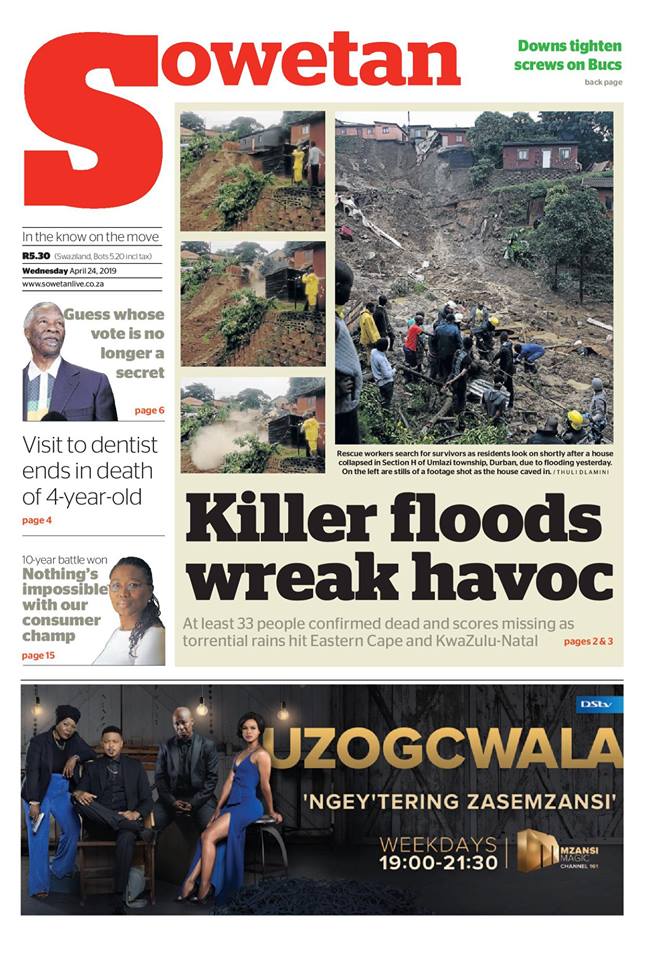
by Carey Finn (@carey_finn) Print media worldwide might be in a bit of a pickle, with circulation in freefall, but the Sowetan is forging ahead with plans to stabilise — and strengthen — its reader figures. With S’thembiso Msomi, who was appointed editor early in 2018, at the helm, the publication is focused on expansion into areas both old and new.
Boosting circulation
The main goal for this year, says Msomi, is boosting the daily newspaper’s circulation, which had dropped to 70 392 at the end of 2018. “A good thing for us is that SowetanLIVE is growing — it has a lot of followers,” he says. The data appears to back this up, with the site reporting more than 2.1m readers and close to 15.7m pageviews in February 2019. “But the advertising revenue that comes from the website is still minimal compared to print, so we need to stabilise print,” he says. “My goal is to make sure that we stay where we are, and let it grow.”
Msomi believes there is a chance for the newspaper to expand its presence in Gauteng by targeting areas that it’s “neglected” in recent years, in terms of both coverage and distribution. “We are called the Sowetan, but I think we have more readers in Pretoria than Soweto,” he says. “We need to go back. I feel that we haven’t done much in terms of news coming out of Soweto, so that the readers there can still believe that the newspaper speaks for them. We need to have a much-stronger presence in Soweto.”
Another area the paper will be targeting this year is Limpopo. Polokwane is a strong source of support for the Sowetan, according to Msomi, but other parts of the province could benefit from more attention. There’s also the Free State, where the paper is currently “very weak”, he says. He thinks that, if they can improve coverage of this central part of the country, it would be to the title’s advantage. “I cannot think of any other national newspaper that covers the Free State well,” he comments.
Expanding coverage
Expanding coverage of these areas, Msomi hopes, will bring in additional advertising revenue from organisations wanting to tap into the local markets: “What has been a weakness is that we haven’t been [very] present in those communities. There are advertisers who are interested in us, in the idea of the Sowetan as a newspaper that is present in the communities, involved in what is happening with communities. It’s an institution that communities trust.”
On the subject of channelling adspend to newspapers, whether online or print, rather than social media and other non-traditional media, Msomi says that the Sowetan’s strategy is very much driven by its sales department. “We have little input from the editorial side, but we do work together,” he says. “I am hopeful that newspapers like the Sowetan can still get advertising. For a long time, they were saying print is dying, but I feel that, as long as your data costs are as high as they are right now, print is still [the only] option for [many people].”
Strengthen reporting
With the commercial capture of journalists a hot topic, Msomi will be working to strengthen the Sowetan’s reporting — and better protect its reporters. “I’m looking at what has happened in other newspapers and saying [we need to] do thorough checks on where we’re getting information from,” he says. “We need to go back to the basics of journalism, where we insist that everyone has to speak on record unless they have a compelling reason to give the information anonymously.”
He believes that a key factor in the alleged corruption of media practitioners has been a false sense that the press is unassailable: “I think one of our problems as the media industry has been to believe that we were immune. We should always be vigilant. We should not assume that, because we are journalists, our industry is not going to be used. What we need is to create institutions within our industry that guard against manipulation by politicians [and others].”
He urges caution against rushing to pip competitors by breaking news stories first, if the scoop comes at the expense of comprehensive fact-checking. “Rather be the one who does it last but does it well,” he says.
Carey Finn (@carey_finn) is a writer and editor with a decade and a half of industry experience, having covered everything from ethical sushi in Japan to the technicalities of roofing, agriculture, medical stuff and more. She’s also taught English and journalism, and dabbled in various other communications ventures along the way, including risk reporting. As a contributing writer to MarkLives.com, her column, “Press Pass”, is a monthly feature spotlighting media leaders and their responses to the trends and tribulations in the industry.

 DStv, March 2019
 The Broadcast Research Council of South Africa (the BRC) is a non-profit, industry body that was incorporated in 2015 to cater to the audience research needs of the radio and television industry in South Africa.