Surve’s Sunday twissyfit: the start of a feud with Peter Bruce and Times Media?

grubstreet

by Gill Moodie (@GrubstreetSA)  The great thing about Twitter is that you get a direct insight into the minds of powerful people usually only accessible through an army of communications specialists or at least a very firm personal assistant – if they will let you in, that is.

In case you were chilling yesterday, you might have missed an extraordinary twissyfit from Iqbal Surve, the proprietor-in-waiting at Independent Newspapers, who instead of grumbling over his Sunday lunch took to Twitter to voice his extreme annoyance over a column written by Business Times editor Rob Rose. His first tweet went out:

I think what probably irked Surve about Rose’s column (which I must also note got it wrong when it said the M&G broke the news that the Government Employees Pension Fund, Mandla Mandela and Sandile Zungu were investors in Surve’s consortium; it was actually Business Day in this story) was this passage: Any fear that the Independent will be put to use serving the interests of its masters was only heightened by a nauseating article in the Independent on Sunday a few weeks back.

Slap bang on the front page, it starts: “Late on Friday night, Iqbal Survé phoned Mandla Mandela, the ailing statesman’s grandson: ‘Tell Madiba, Independent’s coming home.’” The cringing doesn’t stop there: “If there’s one thing that will make him get better faster, it’s this,” the younger Mandela responded. The article said the purchase was a “gift for Madiba”. Nothing like capitalising on Mandela’s illness to trumpet your ownership to the powers-that-be. Quite whether this represents the strongest front-page news was debatable. Unless Survé demanded it be run like that — which wouldn’t exactly be a victory for media independence.

And this from Rose:

When people close to the ruling party put in a pricey bid for a ravaged newspaper company, and demands secrecy, it should ring all sorts of alarm bells. Perhaps we’ll soon be reading about the “positive aspects” of last week’s Gupta report, and how “if there’s one thing that will make Jacob feel better about the Guptas, it’s this”.

But Surve didn’t leave it at his first tweet and went on to about Avusa (now Times Media Limited), the owners of the Sunday Times, copiously:


There were a few more tweets from Surve in response to others in the twitterverse – some people tweeted in support for him; some challenged him. The DA’s Lindiwe Mazibuko, for instance, waded in briefly for a polite, tongue-in-cheek interchange with Surve while Peter Bruce, editor of Business Day and publisher of BDFM (on whose website, BDLive, Rose’s column is published) stepped in with a few tweets, most notably:

Eina! Do I see the beginnings of a little feud here? Meanwhile, Andrew Bonamour, the CEO and one of the key shareholder of Times Media said only this (and it’s his third tweet ever):


Having interviewed Surve a couple of times, I think what irked him about Rose’s column is the assumption that Surve is close to the ANC and will, therefore, direct his newspapers to be ANC and government friendly when he counters he is own man and has friends and colleagues across the political spectrum.

And because Business Times is part of the Sunday Times and owned by Times Media, Rose’s column really got his goat because, as Surve has said before, he can’t understand why the industry put his bid to buy the Indie under such close scrutiny – and did not do the same when Bonamour bought Avusa.

I must say I see both points of view here.

On the other hand, it is quite natural that Rose and commentators such as Anton Harber are suspicious about Surve’s consortium because of the secrecy around the names of the investors and the structure of the consortium.

Surve says he cannot reveal this information until the current Irish owners of the Indie have their Extraordinary General Meeting on June 17 – when they will vote on the sale to Sekunjalo.

I’m sure then that there is more of this antagonism to come, which does not bode well for Surve’s intention to get the media owners in SA together to talk about nation building.

And this doesn’t end with yesterday’s Twitter event. This morning, part of Bruce’s column in Business Day – which would have been penned before yesterday – was about Surve’s speech on Friday night at the Sanlam Awards for Community Media. Bruce wrote:

His speech was a set of vacuous promises about transformation and a “new Africa” that litter most events of this kind, combined with a ringing declaration that no competitor was going to push him around. To quote one of “his” papers on Sunday: “And no editor-in-chief (that’s me) is going to tell us what to do because you are scared, because you have been appointed head of a group, and sole convener of this space,” he cried, the inner child clearly dominant at night.

“You’re afraid of real competition, real energy, real people coming into this industry, giving a voice to all South Africans,” he said, adding that Business Day was a “micro” newspaper because it sold only 30,000 copies a day. “Whereas Business Report, a supplement in Independent’s papers, had a million readers a day,” wrote the reporter. Actually, I listened to his remarks and he claimed Business Report sells a million copies a day.

He’ll get it right as he goes along.


Bruce also says:

My hope for Survé and our colleagues at Independent is that he is a man of his word and really does invest in them and that, by the time he does, he will have had the courtesy to tell them where the money comes from. Who makes up his consortium is of no interest. Where the money comes from is, because it will have to be repaid.

Owning newspapers is a sacred trust as far as I am concerned, and we would welcome competition. When newspaper houses go to war, all circulation rises, so bring it on!

Anyone checked Surve’s timeline this morning?

– SA’s leading media commentator, Gill Moodie, offers intelligence on media – old and new. Reprinted from her site Grubstreet.

Sign up for our free newsletter!

The Africa Annual 2013, brought to you by Ornico and MarkLives


ornico

The story of economic growth in Africa has been topical globally, with some of the most disappointing reports coming from leading publications. However for us Africans, the glass is definitely half full, with inspiring stories coming from the most ordinary of people. Ornico and MarkLives have teamed up to present our first ‘The Africa Annual‘, a compilation of some of Africa’s remarkable stories and resources for businesses; and media, marketing and branding enthusiasts.

In The Africa Annual 2013 you’ll find:

  • 5 countries to watch
  • Africa’s mobile economy
  • The new African consumer
  • Media Trends in Africa
  • Get Jay Naidoo’s thoughts on Media and Development
  • Nigeria’s broadcasting industry
  • The influential, must-follow Twitter list

Download the full report here

Hermaneutics: Jobs For Monkeys In Adland

Agencies

The advertising industry in focus from the editor of marketing, advertising, media and design site MarkLives.com. By Herman Manson (@marklives)

Young and want to land a job in advertising? Join a circus. That is the gist of reader feedback on an Adland.tv story featuring a recruitment campaign by DDB Brussels in which prospective employees need to submit a 6-second Vine gif (hashtag #ddbexpress) in place of a CV.

Ten ‘new’ creatives will make the shortlist and be put together on a train to Cannes. En-route they will need to solve numerous creative briefs, on which they will be judged, and eight will be sent home (dropped off at the various stations en-route – apparently). The two that make it to Cannes will be ‘rewarded by an invitation to join the creative department of DDB.’ That’s not exactly an explicit job offer, hence some of the commentary on the original story referring to internships.

The campaign has been described as a rather demeaning process to land a job. Critics also point out that to enter you need Vine, which only runs on iPhones, and so excludes a fairly large group of potential candidates, including many for whom an iPhone would be out of reach.

Says the Facebook site created for the campaign “Creative Directors are very busy people, and new creatives need to be agile. Combine those two and you get our brand new way of hiring: 6″ recruitment. You have exactly six seconds to convince our Creative Director, Peter Ampe.”

Not too busy to make the train ride and make some kids jump through hoops, or to make the awards festival for that matter, just too busy to look down and at your portfolio. The agency seems to be snorting Cannes, really, counting the award shows they can enter with this ‘creatively lead’ take on recruitment.

“This is like recruiting juniors to act as monkeys for entertainment,” commented one anonymous fella. Indeed. Dumb and dumberer as popular culture has become – recruitment as entertainment does seem to push the boat out quite far.

Talking of recruitment practices in adland – an interesting survey came out of Australia recently where trade magazine B&T found that more than 40% of interns in the media, marketing, PR and advertising industries feel they have been exploited. Many internships remain unpaid, and many interns landed up with tasks ranging from cleaning cupboards to handling deliveries.

“Working for free also appears to have become a rite of passage for job-seekers in advertising, PR, media, marketing and digital, with some believing the ‘industry has adopted an attitude that unpaid work should be mandatory’”, reports B&T. Only 26.8% of interns were paid for their time and tellingly fewer unpaid interns received offers of employment than did those in paid internships. This makes sense – if a business makes a financial investment, they are more likely to take a closer interest in said investment.

Critics of paid internships were quick to point out that ‘you shouldn’t be paid to learn’ but the fact remains that what a lot of interns do is work with demonstrable value for businesses. So they are not simply learning – they are delivering something with a monetary value.

In the UK the industry body for the PR industry, the PRCA, launched a campaign as far back as 2011 to end the practice of unpaid internships.

“The short-term benefits of free labour are greatly outweighed by the way that this practice devalues our expertise and reputation. It is unfair to ask young people to work for free, just so that in the short term organisations can benefit financially,” says the PRCA.

As employers more commonly demand not only a higher education but also work experience, and the most common reason for not taking an internship was an inability to afford them (75% of interns require financial assistance, usually from parents), it follows that a large number of potential talent is lost to the industry.

As one contributor to the PRCA intern guideline puts it: “we will find it much harder to communicate to our publics if our industry solely consists of white middle class people from London and the Home Counties.” Ahem. Chew on that.

First published on 10and5.com

– Industry news you’ll make time for. Sign up for our free newsletter!

The Real McCoy: No more staffing around

by Sean McCoy (@TheRealMcCoyTRM) If I told you that Starbucks wasn’t in the business of selling coffee, you’d think I’d lost it.  But they’re not.  They’re in the people business, selling coffee.

And that’s not semantics – it’s the fundamental difference between being a powerful brand and a non-starter.  Whether you’re selling iron ore or irons, airtime or aeroplanes, holidays or whole foods – successful brands are built around staff, not the other way around.

Much of the branding focus is outward bound.  We’re very concerned about the looks, colours, logos, clever straplines, ads, Facebook friends, Sean McCoywebsites, retail space and brochures but what we don’t realise is that those become broken promises if the people working in the business don’t match up to expectations they create.  A brand has to feel the same way that it looks.And the way it feels is all about internal branding – employee behaviour.

There’s nothing mechanical about employee behaviour at Hitachi Construction Machinery because they understand exactly what is required of them to ‘be’ the brand.  But it wasn’t always like that.  It took several months to research, develop and activate a customised employee motivation programme which HCMSA says elicited an ‘overwhelmingly positive’ response from staff and customers.  Sounds like the construction equipment business is moving heaven and earth to be the best…

First impressions count – and you’ve only got seconds to make it.

The energetic BafanaBafana fan with his huge smile and even bigger sunglasses is brand South Africa.  But the surly customs official at international arrivals is brand South Africa too.  The efficient cashier proudly wearing a green uniform and a friendly face is brand Nedbank.  So too is the silent security guard mechanically handing over the visitors’ book.  The funky barista aiming for a personal best in every cappuccino he creates is the epitome of the Vida e Caffe brand.  But when a relationship breakup or a nasty bill from the panelbeater turns him into Cruella de Vil, customer loyalty is tested to the max.  We’re influenced by behaviour – and loyalty is often greater to a person who’s given us fantastic service than to a product.

Why is Singita the best hotel in the world?  No, it’s not because of its uber luxurious safari experience.  It’s the best in the world because everyone involved, from the trackers to the travel agents, understands that the Singita brand is about its 100 year vision based on preserving rare and iconic ecosystems for future generations.  And you only get that kind of understanding by really focused, intensive and sustained internal brand engagement.

Internal brand activation is often a low-priority grudge purchase, and is the first casualty of cost-cutting.  And that can be fatal because when staff aren’t engaged with the brand values, they’re not delivering on the external promises and they’re not meeting customers’ expectations.  The result?  Customers feel betrayed and they take their patronage elsewhere.  Those betrayals erode the brand and will eventually erode the bottom line.

Look at Disney.  Even their website says ..”each of us has a vital role in nurturing the Disney brand.   People who work at Disney believe in the core purpose of the Disney brand which is to provide the world with special entertainment with a heart,” it’s not about what they do, but how they do it.  And they do it so well.  From the toilet cleaner in Orlando to Tinkerbell in Paris, from the concierge to the CEO, each of them is ‘special entertainment’ personified.  Disney invests in ‘brand-training’ and it shows.

So, if you don’t want a Mickey Mouse brand – staff up or stuff up.

– Dr Sean McCoy, MD and founding member of HKLM, is a prominent figure in the branding arena with his expertise centered on client service, brand strategy and business development. Sean has been chairperson for the Brand Council of South Africa since last year.

– Industry news you’ll make time for. Sign up for our free newsletter!

Chillibush – no pretensions or clutter

by Herman Manson (@marklives) Dale Hefer and her agency, Chillibush, are significant players in the South African ad market, but have maintained a relatively low profile in a space still cluttered with egos and an awards obsession bar none.

Hefer has avoided the awards rush, instead building an agency that isn’t precious about itself. Chillibush employs 35 people and billings recently hit R90 million, without help form a clutter of little statuettes. It is independent, management owned and BEE level 3 accredited.

Building great agencies sans-awards is being replicated by some of the hottest agencies today, think the rise of Machine, or Mike Abel’s M&C Dale - Fav 1Saatchi Abel. Neither of these agencies made the recent Creative Circle agency rankings by the way. Joe Public wins awards, but it’s not why they win business.

Hefer says she has never believed creative awards were relevant to her clients, agency or team members. The work it produces speaks for itself, in results achieved for clients, but she is considering entering awards focussed on results like Assegai (held by the DMASA) or the Apex Awards held annually by the ACA. She has never been to a Loeries event and doesn’t plan to attend one anytime soon.

So Hefer was a front-runner in many ways. She launched her agency to get rid of what had frustrated her in her first agency job – working in silos, precious creative egos and lots of agency politics. She launched the business from her Garage in Parkhurst – a one woman and dog show she calls it. With no staff, initially she built her business with a network of free agents. It’s inspiring stuff and the collaborative model she employed is being replicated by smart new outfits like The Conversation Lab in Durban and Fast & Remarkable and 2WayStreet in Cape Town.

The premises that houses the agency has no office doors – it’s an open plan environment to suit the open mindset needed for integrated work, says Hefer.

The one point Chillibush has lagged in is digital, Hefer admits, but they are rectifying this. An experienced digital creative will be brought into the agency and placed in a senior position. They will build digital capacity at the agency. Late entry into the digital game holds some advantages – Hefer would have seen other agencies struggle to digest mergers and acquisitions and digital teams stuck in silos often with a sense of being outsiders in the bewildering world of agency structures and politics.

Hefer and her agency has seen some tough times. Early on one some of her clients went belly up, leaving her in debt, and with cash flow problems. The first BEE deal she put together didn’t work out either. The agency has seen an armed robbery on its premises. The victim of several robberies when driving around Johannesburg to deliver artwork in the early days of Chillibush, she bought a blow up doll to put in the passenger seat of her car, so it didn’t look like she was driving around alone.

As a woman, she has encountered numerous cases of sexist behaviour from client side – she resigns their accounts if she believes such behaviour won’t be remedied.

Hefer is currently working on updating her book, “From Witblits to Vuvuzelas: Marketing in the New South Africa”, first released in 2010.

Clients include Old Mutual, Deloitte, Vodacom, the IDC, Mutual & Federal, Constitution Hill and iWyze. The agency recently joined thenetworkone, an international network of independent agencies.

Hefer wants the agency to grow organically, she owns the property next door to the current Chillibush premises, and wants to fill that as well. She believes proper digital integration into the agency will assist with this goal.

– Industry news you’ll make time for. Sign up for our free newsletter!

Media Future: Samsung scores big with Chelsea

A global initiative to give young boys a chance to be coached at Chelsea Football Club showed how sponsorship can go beyond return on investment, writes Arthur Goldstuck (@art2gee).

On the neon signs that flash day and night above Picadilly Circus in London, tourists have become accustomed to two brands that have dominated the iconic advertising space for this entire century so far: Coca-Cola and Samsung. This year, the Korean “newcomers” for the first time overtook the American beverage maker as the world’s biggest advertiser.

One would think, then, that the electronics giant’s tactics are all about making a bigger and bigger impact, dominating high-profile spaces like samsung Chelsea Football ClubPiccadilly Circus and Times Square.

But this week, at a training ground just outside London, Samsung was making a different kind of impact: on the lives of a small group of children from around the world.

It was the culmination of the Dream the Blues campaign, launched in January this year across seven countries by Samsung Electronics and the Chelsea Youth Academy. 1400 children took part in initial youth training camps, from which the two most passionate from each country were chosen to fly to London and spend a week being trained by Chelsea’s own youth coaches.

The children, from Mexico, Brazil, South Africa, Nigeria, Ghana, China and Thailand, spent much of each day being coached and melded into a team at the club’s Cobham Training Centre, culminating in a match against a local team.

Yesterday, they got to watch the Blues in action against Everton, in their final league match of the season. But that experience almost paled against another event last week: a personal training session on Friday with four players appointed “Chelsea Ambassadors”: Fernando Torres, Juan Mata, Oscar and Victor Moses. For two young South African players, 12-year-old Goitsemang Lengene and 10-year-old Mvelo Mvuleni from South Africa, it was more than a dream come true. It was an impossible dream unfolding before their eyes.

The Cobham Training Centre is a high security venue, with access by invitation only. Even those granted access are prohibited from taking photos or even asking players for autographs. That restriction didn’t apply to the young trainees: they had full access to the four stars.

The timing of the training camp could not have been better. When it started last Wednesday morning, Chelsea had yet to win a trophy this season. That night, Torres scored the crucial opening goal in the team’s Europa Cup Final 2-1 triumph over Benfica.

The next evening, Mata was named Chelsea Player of the Year for the second year in a row, as well as Player’s Player of the Year. Completing a hat-trick for the Ambassadors, Oscar took the prize for Chelsea’s Goal of the Season, scored against Juventus. Then, at the Everton match, Mata opened the scoring and Torres scored the winning goal.

If it had been a movie, no one would have believed those plot twists. But, as a motivational script, it could not have been better written.

“Samsung believes in supporting and motivating the youth of South Africa to discover and expand possibilities and opportunities to benefit themselves,” says Michelle Potgieter, head of Corporate Marketing and Communications at Samsung South Africa. “We are sure that this camp in London will be a meaningful step in doing so, as well as a great opportunity for the participants to get closer to their dreams.”

The “Dream the Blues” campaign is an expansion of the Samsung-Chelsea FC Youth Football Camp program that the two have been collaborating on since 2007. Originally a grassroots programme initiated by Chelsea in the United Kingdom, it has since brought more than 6000 youth from around the world to Cobham.

Chelsea officially qualified for the European Champions League yesterday, further cementing the value the side brings to the brand that emblazons the front of its players’ shirts. Samsung estimates that, in the 2009/10 season, when Chelsea won the league and FA Cup double, it generated more than $100-million in marketing value.

Will that sell more smartphones, TV sets and other electronics? Consider this: in its first year as Chelsea sponsor, in 2005, Samsung’s sales doubled in Europe over the previous year.

Bringing 14 children to Cobham is hardly going to make anything like that kind of impact. But it shows that the relationship between a sports team and its sponsor does not only have to be about a return on investment.

* Arthur Goldstuck heads up World Wide Worx (www.worldwideworx.com) and is editor-in-chief of Gadget. He is a Consulting Editor to MarkLives and our media tech columnist. Follow him on Twitter on @art2gee. Reprinted from Gadget.

Industry news you will make time for. Subscribe here. It’s free!

Magazine covers: ’16 Minutes – That’s how much time you have to save your life.’

MarkLives.com runs a regular slot featuring the best local and international magazine covers every week. We recognise well thought out, powerful and interesting (and hopefully all three in one) magazine covers and celebrate the mix of pragmatism, creativity and personal taste that created each of them. By media blogger MediaSlut.

INTERNATIONAL

TIME, 3 June 2013

TIME

“16 Minutes – That’s how much time you have to save your life. The story of the Oklahoma tornado”

I would LOVE to be in the TIME office, just to experience the rush of pulling together a magazine (and cover), after an event like this… I mean, the Oklahoma Tornado happened on Tuesday 21 May, and here, less than 2 days later, you have the latest TIME cover (and issue)! For some shocking (but amazing) photography, make sure you read their online article and video gallery “Moments of Hope in Oklahoma: One Photographer’s Story”… Can’t. Wait. For. This. Issue. To. Arrive.

Umno, Edition 2, 2013

Umno

Not the best fashion image I’ve seen before, but the element that deserves to be pointed out, is the “burning page” and flame for their “Hot Issue”. Hot!

Ponystep, Spring / Summer 2013

Ponystep

A beautiful black and white image along with great lighting (and yes, styling), along with the simple Purple strip on the left, helps it onto my list of favourite magazine covers this week.

New York, 20 May 2013

New York

New York’s annual “Television” issue (an awesome read, if you’re lucky enough to be a subscriber!) featured this bold (and camp) image of Michael Douglas on the cover. Douglas is portraying (an element of) Liberace who he plays in the new movie “Behind the Candelabra”. I read that there’s a lot of debate going around internationally about the movie being “too gay”. Watch the trailer, and decide for yourself. Personally, I can’t wait to watch it.

LOCAL

Popular Mechanics South Africa, June 2013

Popular Mechanics 6 June 2013

As they say in the press release, “In a radical departure from high-tech flying machines, intelligent robots and similarly geek-oriented cover subjects, the June issue of sci-tech magazine Popular Mechanics features an attractive fashion model perched on a white cube.” And there’s a reason for it, and a great one at that. You can read more about this stunning cover, and the story behind it, right here.

– The (for now anonymous) blogger behind MediaSlut knows way too much for his own good about media in South Africa. Magazines in particular. His mission is to show when South African magazines might fail, but most importantly, succeed. If you’re looking for a library about South African magazines and news, your one-stop pitstop is MediaSlut. #MagazinesForTheWin

– Find a cover we should know about? Tweet us @marklives and @mediaslut
Sign up for our free newsletter!

Shelf Life: World Heritage Site themed dresses designed by SA style stars

Louise Marsland’s (@Louise_Marsland) pick of new product, packaging and design launches.

Design Partnership creates with Doppio Zero; Omo washes dirty laundry in public; and dressing up South Africa’s cultural heritage finds favour on social media.

Doppio Sandton’s ‘non-design’

doppio1

“Non-designed” was the catchphrase for Doppio Zero’s brief to the Design Partnership team in tasking it with redesigning its Sandton City store. The restaurant chain wanted a simple, yet authentic look and feel that reflected its heritage of artisanal breads and foods prepared with fresh, quality ingredients.

“The store needed to appear handmade, with quality products and finishes. It had to look as though it had always been there and would last a lifetime still, referencing Doppio’s belief in the goodness of quality,” explains Design Partnership CEO, Callie van der Merwe. “In essence, the drive here was to emphasise the food offering, because it’s unique in that all the pastas and breads are made on site, from scratch. This needed to stand in stark contrast to the envelope of the space, which had to appear non-designed and as though the owner – a family man with mama in the kitchen – had put it together with loads of passion and love.”

This look was achieved through using multiple textures, tonalities and finishes, and in the selection of the seemingly random chairs and ‘handmade’ pizza ovens. In addition, the menu was stripped back of all clutter to really showcase the food offering.

Doppio 2

A dirty laundry war

It seems the fad for mass ‘washerthons’ continues after the launch in South Africa by P&G of their Ariel brand, as Omo is also now washing taxi commuters clothes. It takes ‘direct marketing and experiential brand’ concepts to whole new, err, depths!

ComutaNet assisted Omo with launching its two-in-one product ‘Omo with a touch of comfort’ in an interactive campaign that saw Omo brand ambassadors collecting up to five items of clothes eachfrom taxi commuters for washing.

The Omo ‘Washa Nathi’ drive is also sharing over 300 000 samples with commuters and Omo branding is being erected at taxi ranks.

MojaNation’s cultural exchange

MojaNation - SA Heritage & Culture Pavilion Artist James Delaney & designer Sivan Portal

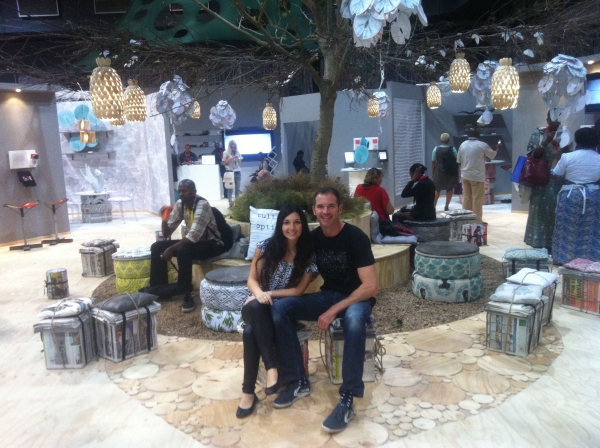
Bloggers at the annual Tourism Indaba, voted the South Africa Heritage and Culture Pavilion, conceptualised and developed by Joburg-based creative agency, MojaNation Exchange, as one of the best stands at Indaba this year.

A collaboration between artist James Delaney and designer Sivan Portal for MojaNation Exchange, the stand was based on the concept of a traditional circular village, dominated by a giant central tree.

It also featured themed dresses designed by SA style stars including David Tlale, Marianne Fassler and Stoned Cherrie’s Nkhensani Nkosi, which were themed interpretations of each of SA’s UNESCO World Heritage sites.

The stand included comfort areas where visitors sipped Rooibos tea.

MojaNation – One of the 8 World Heritage Site dresses, designed by Thula Sindi:

MojaNation - One of the 8 World Heritage Site dresses, designed by Thula Sindi

Louise Marsland– Shelf Life by Louise Marsland is a weekly column on MarkLives. Tweet new product, packaging and design launches to @louise_marsland or email her at louise.marsland at gmail.com.

– Want to sponsor Shelf Life? Contact us here.

Louise Marsland has written about the FMCG, media, marketing and advertising industry for 18 years of her 25 year media career as a former Editor of magazines AdVantage, Marketing Mix and Progressive Retailing; as well as websites Bizcommunity.com and FMCGFiles. She currently edits the weekly Wednesday Media & Marketing Page for The New Age newspaper; and is the co-founder and Publishing Editor of SA’s newly launched industry trendwatching portal, TREND. at www.trendlives.info, in partnership with MarkLives.com.

– Industry profiles you’ll make time for. Sign up for our free newsletter!

Millennial Ad-Grad: How to impress in post-recessionary adland

by Faheem Chaudhry (@FaheemChaudhry) ‘Never waste a good recession’ were Warren Buffet’s witty words of advice during the financial downfall of recent years. While this sort of philosophy has become synonymous with his unrivalled investment and business success, many business leaders will argue it’s easier said than done as they still fight the battle to full financial recovery.

As the next generation entering the advertising game, we are entering the industry at a time when marketing budgets are under the spotlight and need to prove their full worth in the boardroom.faheem

This has certain knock on effects on an industry where ad-employment isn’t exactly available in abundance to young people. And for those beginning their first gig, it’s pretty tough out there.

But fear not, my friends. Being in an industry at such a time simply means a greater responsibility on the shoulders of those who will carry it forward. It’s an opportunity to take ownership of the current dynamic, and help steer it to calmer waters. But what are clients and advertising bosses looking for from their next generation? And what will we need to be well versed in to reach advertising stardom?

Here are my thoughts as a member of the next crop.

From creative supplier to business partner

As the next generation we should look at taking a fresh view on how we are shaping ourselves around marketing problems. Are we too focused on solving surface level briefs rather than being driven to mine out the niggling issues that our clients actually face?

My view is for us to re-look what exactly the core problems sitting behind our clients’ communication issues are. They no doubt stem from top-line business problems. Let’s start asking the right questions, to build the hardest working creative solutions.

In brainstorming, cracking and creating big, beautiful ideas around these issues, we’ll be solving the communication needs of our clients in ways that will really impact their businesses. At a time of financial recovery, the young creative thinkers who can consistently deliver this will be the standout ad-grads of the next decade.

T-shaped thinkers

Perhaps the most significant shift in the ad-industry over the recent years is the move from advertising in silos to weaving communication with total integration. Many of us as the next generation were born in the middle of this progression.

The role brands play in our day-to-day lives is now far beyond the hour of TV we watch every evening or the radio channel we listen to in the mornings. Brands appear everywhere, at every time and in many different forms from the moment we wake up to the moment we hit the sack. Communication is now consumer centric.

With this, comes the need for us to become general specialists. T-shaped thinkers. Having the ability to be brilliantly proficient in our chosen craft while able to understand the total touch point landscape of our clients. Being a PR specialist for example, won’t cut it anymore. We need to have the ability to understand what the role of PR is to social media, customer service, advertising and so it continues.

It goes a little deeper too. Not only do we need to understand the total role of brands in people’s lives; but also an integrated approach will be a sought after characteristic of the next generation. At a time where marketing budgets need to deliver to their full value, clients want to know that their ad-advisors understand the complete role of their businesses at their core. T shaped thinking across all moments of connection with consumers is a core competency we’ll need to bring to the table to give them this confidence.

Think quick

These days consumers are saying more about brands than brands are saying about themselves. Advertising campaigns alone no longer make up the sole communication that influences consumer perception. Being continuously connected to brands allows consumers to expect the highest levels of product, service and relevance. They’ll tweet you and let you know about it too.

As the next generation of ad grads, we’ll need to become more agile than ever before. Agile in our thinking, agile in our ability to execute communication and agile in our understanding of what consumers truly want on a day-to-day basis. This is how we’ll be able to foster meaningful relationships between people and brands. As technology continues to provide us with new and innovative ways of talking to people, we’ll need to be quick in realising how to maximise relevance with consumers.

Where previously ad-campaigns were built over months of churning through what consumers might want, taking prolonged periods to figure out consumer relevance will just not be good enough going forward.

The ad-grads of our generation who can think fastest and deliver real time utility to consumers will be of most value to brands fighting for their moment of attention.

A generation of enablers

We’ve all heard the opinions that the data- nerds will be taking over the industry soon. Our exotic mad-men predecessors must be turning in their graves. Aint nobody got time for that.

While we may not be wearing tuxes to work anymore (a moment of silence here, please) I’d like to argue that creativity will always be the lead over technology when it comes to marketing success. And that is because technology is an enabler of creativity, not a leader in true connection.

In marketing, technology is a tactic. It allows us to reach and speak to consumers in ways that bring them the most utility. As technological capability continues to develop and sprint ahead, the choices that consumers have to engage with brands are multiplying at a rate like never before. Only real relevance will breed marketing success. Relevance is grounded in the right ideas with technology delivering these ideas in just the right places.

As ad millenials, we will absolutely have to have a complete grasp of the technology at our disposal; but creative ideas will always be the lead. Storytelling will always lead data.

Marketers will be investing their precious budgets more and more in the latest technologies, in the hope of better connecting and deepening the relationships they have with consumers. Young creative thinkers need to understand which technologies will best enable creative solutions to be delivered with the most impact. It’s a delicate skill, but safe to say, a competent generation of enablers, is what we’ll need to be.

Guys, as millennial ad-grads, we’re entering the industry at a complex, critical time. Budgets are going through a period of recovery, but marketing seats in the boardroom are under the spotlight. While this may add to the challenges we face in starting and propelling our careers forward, the opportunity is ours for the taking.

I believe those who begin focusing on consistently delivering the above for clients, will be the ad-grads leading this charge. It’s not all we’ll need to do, but it’s nice to have some core organising principles for success. It might just be what gets the likes of Uncle Buffett to swing some more money our way.

– Faheem is a passionate marketer at M&C Saatchi Abel. With a focus on the future, his aim is to better entrench the importance of creative thinking to solving critical business problems.

– Industry news you’ll make time for. Sign up for our free newsletter!

Ad of the Week with Oresti Patricios – Sta-soft’s ‘tough guys’

MarkLives Ad of the Week with Oresti Patricios – Sta-soft’s ‘tough guys’

sta soft 2

Who’s tough? Who’s the roughest, meanest dude you can think of? Chuck Norris? Rambo? Hulk Hogan? If your answer was all three, say “Whoo-hah!”

And what do all tough guys need? Softness, of course, because when it comes to creating an advert to show how effective a fabric softener really is, only the toughest guys make the cut and the tougher you are, the softer you need your clothes to be.

That’s the message from Sta-soft’s new ‘tough guys’ print campaign that uses Sly Stallone, Norris and Hogan look-alikes made out of the softest cloth to drive home the contrast between what’s soft and what’s hard. All kidding aside, I’m glad to see a fabric softener brand go for something a bit cleverer (and a little less obvious) that the usual cute baby (or kitten) to illustrate its USP.

The cloth caricatures in the new Sta-soft ads were created by Shaun Hill of Says Who, a Johannesburg-based branding, design and illustration sta soft 1studio. The fabric versions of the world’s most popular ‘tough guy’ personalities are beautifully rendered through the use of different materials, and the clever use of light and shade which creatively adds to the depth of the ad. O&M is the agency behind this simple but oh-so-effective campaign.

The lack of copy is a notable feature of the ad. Everybody knows the brand; it’s not necessary to labour the features and benefits of the product that almost every South African has grown up with.

The simple Sta-soft bottle, with the pay-off line, “Softens even the toughest” is powerful in that it plays on the tough/soft dichotomy of the bold visual used in the ad. A subtle but clever variation is the use of different backgrounds to reflect the different scents of the product.

It’s not the first time that humour has been attempted in Sta-soft advertising. In 2010 Y&R created the “Love your clothes” campaign, which featured a superhero who couldn’t bear to remove his shirt, the Queen of England in an ‘I love NY’ T-shirt, and a few others. It’s probably one they would rather forget, as the humour in the images was often obscure and open to misinterpretation.

But this campaign is simple, striking and really works: the choice of iconic characters is quite obvious; after all, you don’t want people to be in any doubt, given the fairly abstract, mixed media method used. I must admit that for a moment I thought the Chuck Norris character was Desperate Dan – but maybe that’s just me.

I think the campaign has legs, and can be extended into other media, such as an animated TV commercial, art exhibition or even collaborative engagement with customers. To refresh the campaign, more characters could be adopted.

One criticism I have for the brand is that it still seems stuck in the conventional, ‘old style’ mode of advertising, and doesn’t seem to have gone digital. The ‘Facebook Generation’ is not limited to schoolkids, and even FMCG brands should have a social media presence. It’s not that print is dead—far from it—but there has to be more consumer engagement to build brand loyalty (even if you are the market leader). Housewives use Facebook too, you know.

Overall, the campaign is single minded and elegant in its simplicity, leaving no room for confusion in the consumers’ minds. It’s a bold, striking and strong message that hits home.

Ogilvy & Mather credit the following people for the campaign:
Creative Director: Louw le Roux
Creative Group Head: Andrew Pearson
Art Director : Darryn Rogers
Copywriter: AndileKhambule
Artist/sculpture: Shaun Hill, Says Who
Photographer: Jurie Potgieter
Client Service Director: Bianca Rogers
Account Director: TelanaBotes
Client: Marketing Director Colgate Palmolive South Africa, Del Levin

See the process shots here: http://10and5.com/2013/04/26/staysoft-print-campaign-ogilvy-jhb-and-says-who/

The Y&R 2010 campaign: http://adsoftheworld.com/media/print/palmolive_stasoft_lineup

Ad of the Week archive

Ad of the Week is published on MarkLives every Wednesday. See past selections here.
Oresti Patricios is the CEO of brand and reputation analysis company Ornico.

– Industry profiles you’ll make time for. Sign up for our free newsletter!

Online CPD Courses Psychology Online CPD Courses Marketing analytics software Marketing analytics software for small business Business management software Business accounting software Gearbox repair company Makeup artist