eMarketing: the essential guide to marketing in a digital world

by Herman Manson (@marklives)  If titles told the story, this would be a particularly interesting one. Now in its fifth edition, the emarketing handbook published by Rob Stokes and his team at Quirk (the current edition edited by Katharina Scholtz), has been evolving from “eMarketing: The Essential Guide to Online Marketing” (published in 2008) to “eMarketing: The essential guide to marketing in a digital world“.

Cover of Quirk's "eMarketingeMarketing: The essential guide to marketing in a digital world" 5th editionSoon the ‘e‘ in ‘eMarketing‘ will be dropped also, predicts Stokes, to just read ‘Marketing‘.

Punch well above its weight

The handbook helped Quirk to punch well above its weight as schools around the world picked it up as part of their curriculum. It has been downloaded more than 800 000 times and moved 12 000 print copies.

In the introductory pages of the latest edition, the book’s editor notes that the tweaked title “reflects our insight that digital is more than just a channel and that the basic principles of marketing remain the same; we simply have an ever-evolving array of technology to apply them through”.

Quirk, in which WPP recently acquired a majority stake, has been working hard to establish itself as an agency able to do through-the-line work.

A quick aside, the agency nearly went to Publicis instead, with Stokes suggesting that the deal was its to lose, as in fact it did, after WPP agreed to the terms set out by Quirk.

Four core pillars

The handbook is set on four core pillars, namely:

  1. Think: research and strategise
  2. Create: build assets and content
  3. Engage: drive traffic to those assets
  4. Optimise: use data and analysis to improve all our marketing efforts

The agency, which structured itself around the four pillars outlined above, recently adopted a matrix structure, with the client sitting horizontally and teams split into brand teams. This was done to end organisational silos and to shift the focus to clients, rather than niche disciplines.

In terms of the impact of data upon marketing, Stokes believe there has been a lot of talk to date but its impact have been far from revolutionary. In fact, Quirk has been doing more data work offline than online. The correlation between the web, CRM and sales data is yet to be fully understood by marketers.

Partly this is a factor of skills (both on agency and client side) and partly because applying maths and stats to a real commercial environment isn’t as easy as it might sound.

Rob Stokes, May 2014
Rob Stokes

No value if you can’t extract insight

Big data offers no value to marketers, says Stokes, if you cannot extract insight. Where organisations are expending 80% of their energy on capturing data, they should instead be exerting 65% of their energy on analysis (and 15% on data capture).

The new handbook covers content strategy for the first time. Stokes expects marketers will consolidate their output into fewer, higher quality pieces of content, while using media to push these to a broader audience. Stokes says it’s important for marketers to reposition their offering from ‘content’ to a brand-relevant value layer.

Advertising school Red & Yellow was behind the compilation of the current textbook, Stokes reveals, with its editor sitting at the school. They had free rein to access Quirk IP. The agency and the school will soon be moving into a 6 500 m2 property in Salt River (Quirk’s sale to WPP excluded Red & Yellow).

Stokes believes commercial businesses need to play a far larger role in academics — especially when it comes to remunerating top talent to teach the next generation. Lecturers at Red & Yellow receive the same remuneration they would have outside of academia, says Stokes. Poor lecturers result in poor students, so it makes sense for the industry to put resources into its schools. The shared premises will allow students to view agency life up close, although steps to protect client information, and the independence of the ad school, will be set in place.

Frequent updates

The handbook is being updated roughly every 18 months. By edition seven or eight, the handbook will be fully applicable to marketing as a whole, with a name to reflect and mirror the change wrought as digital falls out of the silo.

To download a free copy of eMarketing: The Essential Guide to Marketing in a Digital World, click here.

— MarkLives’ round-up of top ad and media industry news and opinion in your mailbox every three work days. Sign up here!

Smart Africa TV: Tuluntulu – the new low bandwidth mobile streaming service

by Russell Southwood (@BalancingActAfr)  Founder of Tuluntulu, Pierre van der Hoven, talks about:

  • the launch of the Tuluntulu service; Tuluntulu
  • the kind of content channels that it is offering;
  • planned new channels in the near future;
  • its business model;
  • and its future growth predictions.

Smart MonkeyRussell Southwood is the founder of Balancing Act and the web TV channel Smart Monkey TV, and has been an analyst in telecoms, internet and broadcast in Africa for the last 14 years. Smart Monkey TV aims to capture the energy at the crossroads between African culture and technology. MarkLives is syndicating content from Smart Monkey TV on a weekly basis for the column “Smart Africa TV”.

— MarkLives’ round-up of top ad and media industry news and opinion in your mailbox every three work days. Sign up here!

Heroes & Zeros: DStv & SAA — best & worst brands of the week

Andy Rice (@ricecommaandy) talks about his best and worst brands of the week — DStv and SAA — with Jenny Crwys-Williams (@jcwLIFE) during The Ad Feature on Talk Radio 702 (@Radio702).

Find out why these feature in this week’s Heroes & Zeros webisode by watching below:


For a fresh look at the world of advertising, Jenny Crwys-Williams of 702 Talk Radio chats to advertising critic Andy Rice on The Ad Feature, every Wednesday 2.30pm — 3pm. The filmed Heroes & Zeroes will appear on MarkLives every Friday morning as a webisode.

— MarkLives’ round-up of top ad and media industry news and opinion in your mailbox every three work days. Sign up here!

MagLove: Aping a fashion model

by MediaSlut (@MediaSlut) My choice of the best international and local magazine covers in MagLove this week:

  • Midwives
  • Newsweek
  • Shortlist
  • Time Out (London)
  • Elle South Africa

INTERNATIONAL

ShortList, 17 July 2014

ShortList, 17 July 2014This is Caeser. Caeser from Dawn of the Planet of the Apes. Caeser is looking very stylish on ShortList’s cover.

Caeser continues his epic style sense by showing other luxury tailored suits in the issue, but you can view his amazing modeling right here.

Midwives, Issue #4, 2014

Midwives, Issue #4, 2014Yes, Midwives is a real title which is published on behalf of the Royal College of Midwives in the UK.

Although the topic discussed on the cover (yes, female genital mutilation) is not something that pops up in discussions everyday, the title has illustrated this topic in a respectable and captivating way, perfect for its market…

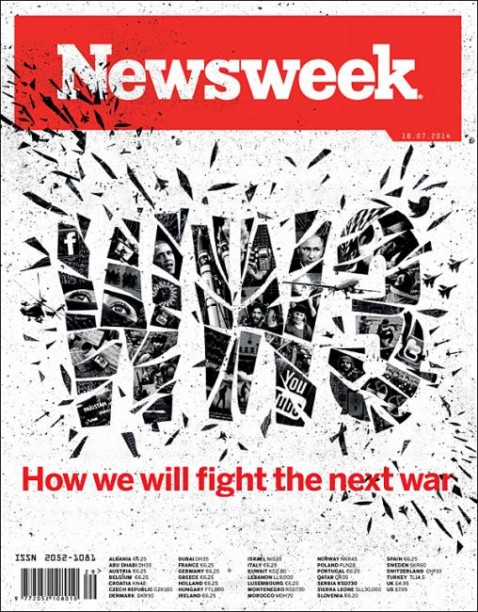
Newsweek, 18 July 2014

Newsweek, 18 July 2014What with the issue dated 18 July 2014, and the MH17 catastrophe that happened on 17 July 2014, I’m not sure if this cover has any relation to it, but may well have.

I got shivers down my spine when I saw the cover, as the possibility of another World War seems that more probable after every similar catastrophe.

Time Out (London), 22 July 2014

Time Out (London), 22 July 2014Are the creatives at Time Out London smoking something special, because its covers are really rocking lately with creativity!

For its Cheap issue, the team produced this little (cheap) gem. Do yourself a favour and read it all…

LOCAL

ELLE South Africa, August 2014

ELLE South Africa, August 2014ELLE South Africa is all about fashion, so it doesn’t happen regularly (or ever?) that it has a muted cover which doesn’t scream “FASHION!”.

But for me, this August 2014 issue, with the darkish black-and-white picture of Angelina Jolie, just works. And with a hint of the colour red…

Hope this big leap/change doesn’t scare people off but I doubt it will.


Find a cover we should know about? Tweet us at @Marklives and @MediaSlut.
Want to view all the covers at a glance?
See our MagLove Pinboard!


MediaSlutMagLove by @MediaSlut is a regular slot featuring the best local and international magazine covers every week, recognising well thought-out, powerful and interesting (and hopefully all three-in-one) covers and celebrating the mix of pragmatism, creativity and personal taste that created each of them. The (for now anonymous) blogger behind MediaSlutknows way too much for his own good about media in South Africa, magazines in particular. His mission is to show when SA magazines fail but, most importantly, also when they succeed. If you’re looking for a library about SA magazines and news, this is your one-stop pitstop.

— MarkLives’ round-up of top ad and media industry news and opinion in your mailbox every three work days. Sign up here!

The ‘peculiar’ radio habits of Kenyans

a The Africa Annual feature by Carole Kimutai (@CaroleKimutai) Radio is one of the most powerful media in Africa — it is relatively inexpensive to set up, it can be customised for regions in terms of language, and it is ubiquitous.

Michael Joseph, the first chief executive officer of Kenya’s largest mobile phone company, Safaricom, described Kenyans as having ‘peculiar’ habits. One of the many peculiar habits we Kenyans pride ourselves in, is listening to the radio.

Radio in Kenya graphic from The Africa AnnualRadio is an obsession. It competes for space with books, garments, cutlery, penholders and diaries on desks and cupboards in many Kenyan offices, homes, shops, markets and restaurants. In a remote part of the country like Turkana County in Northern Kenya, three out of every five Turkana men trekking through the wild are likely to have a radio tucked under their armpit.

FM radio in Kenya has become one of the avenues through which contemporary society tells stories, a means to both complement and compete with the traditional fireside storyteller. A sulking spouse in the passenger seat does not even have to pretend to be reading the paper: there is enough ‘filler’ coming from the car’s FM stereo. In streets, homes and offices, it is increasingly common to find people wearing earplugs, listening to the FM radio stations on their cell phones.

So obsessed with radio are Kenyans that The Daily Nation, a Kenyan daily newspaper with the highest circulation in East Africa, published an editorial cartoon on Monday 17th June 2013 describing what a typical morning in Nairobi, Kenya’s capital, looks like. Motorists in their personal vehicles and passengers in Public Service vehicles are all shown tuned in to FM radio.

Facts and numbers

Radio is the leading source of news, current affairs and gossip. According to the Kenya Audience Research Foundation 2012 report, on average 93% of the Kenyan population listens to radio at least once in seven days, while the average time spent listening per day is 6 hours. The popularity of the radio medium is followed by television and newspapers respectively.

According to the Communications Commission of Kenya (CCK), in the last quarter of 2013, the average monthly audience for radio broadcasts was 16.9 million, while television recorded only 2.13 million viewers. “Radio has a lower barrier to entry plus there are a many radio stations, including vernacular [stations], people can listen to,” explains Joe Otin, Managing Director MediaCT at Ipsos Pan-Africa.

A 2010 National ICT survey showed that 78.1% of rural and 83.1% of the urban population own radio sets compared to 29.2% of rural and 66.1% of the urban population that own television sets. “Although more people in urban areas own radio sets, in Nairobi people watch more television. This trend has a lot [more] to do with access to electricity than the ability to purchase a television set,” says Otin. Many parts of rural Kenya are yet to join the national power grid, which makes radio a preferred medium because it can run on battery or solar power.

The Hague-based International Criminal Court (ICC) seems to have noticed the peculiar radio listening habits in Kenya. Radio journalist Joshua arap Sang became the first journalist in Kenya to face charges at the ICC for using his morning radio show, Lene Emet (which means ‘What is the world saying?’) to gain support and also communicate by code to members of the network about when and where to commit attacks, during the 2007/8 post-election violence. Sang was a presenter at a Kalenjin vernacular radio station, KASS FM.

History of radio in Kenya

The love for radio in Kenya goes back half a century. Prior to independence, radio was a key medium in keeping the British settlers and local citizens informed about what was happening around the world. Through Kiswahili broadcasts, ‘natives’ were instructed on how to be good subjects by dutifully paying taxes. After independence, radio, and specifically the state broadcaster, remained the most trusted source of information. People tuned in to find out the latest on cabinet reshuffles, what the President had been up to, and events across the borders. Every day, Kenyans would engage in the ritual of switching on the gadget at 9am, 1pm and 7pm.

Liberalisation of the Kenyan airwaves in the 1990s allowed more media players to set up radio and television stations. The radio The Africa Annual graphic‘mediascape’ has since then seen a growth of radio stations, including vernacular, targeting people from various ethnic groups. FM radio suddenly became an alternative to the state radio broadcaster which was seen as a mouthpiece of the then ruling political party KANU. These FM stations distinguished themselves by the genre of music and content they broadcast, in the process munching away portions of the large audience share that the state radio broadcaster enjoyed.

Understanding the radio market

The new FM radio stations have continued to grow, further segmenting the audience landscape. There are currently 163 radio stations in Kenya serving a population of 40 million. This growth has also fuelled the popularity of talk radio across the country allowing Kenyans to call directly and get their voices heard. Radio has united Kenyans separated by distance and natural geography allowing them to publicly share information, experiences and opinions.

Without a doubt, Kenya is a country of radio listeners. This is the reason why, compared to other media, radio enjoys a significantly large portion of the advertising spend. Many media buyers and advertisers in Kenya prefer spending on radio because it is much cheaper than television and print, yet it has significant reach. That has forced FM radio stations to aggressively compete for audiences so as to win advertising. In the last seven years, media advertising in Kenya has been growing steadily, especially for radio. The only hiccup in ad-spend happens during an election year. “This is because of the jitters around the elections. Business activity reduces due to lack of confidence of improved economic indicators, and advertising is affected,” explains Otin.

Any media manager will tell you that a media organisation is first and foremost considered as a commercial operation.Secondly, even if they claim not to be in the business of generating profit, their success is measured by their capacity to deliver large or well-defined audiences to advertisers or sponsors.

The social composition of the audience reached, as sold to advertisers, is important because of differences in purchasing power and in type of goods advertised. There is a logic in the advertising-based mass media that favours a convergence of media tastes and consumption patterns (i.e. less diversity.) The argument is that homogenous audiences are usually more cost-effective for advertisers than heterogeneous and dispersed audiences (unless they are very large mass markets for mass products.) The only time that diversity is considered to work (from a commercial perspective) is when a medium is able to accurately deliver a small but profitable niche market. This is one factor that has worked very well for radio because of how it has segmented radio audiences in Kenya.

Kenya is still highly rural. Literacy levels are low and poverty levels high compared to urban areas where people have some form of income, can read and have a television set at home (because they have a power connection.) This makes radio an excellent way of reaching both urban and rural audiences.

It is worth learning lessons from the Royal Media Services (RMS,) the largest private national broadcaster in Kenya with 14 radio stations, 2 of which broadcast in English and Swahili respectively. The rest are vernacular stations spread across Kenya, targeting ethnic groups based on regions. For example, Inooro FM broadcasts in the Kikuyu language, targeting Kikuyu listeners who mainly live in Central Kenya. Another station is Ramogi FM that broadcasts in Dholuo and targets the people living around Lake Victoria.

In Kenya it is said that if you want to touch the heart of a person, speak to them in their own language. RMS identified this gap in the market: a big part of the population of Kenya does not converse fluently in English or Swahili, and the best way to reach them is through vernacular radio.

The RMS commercial model involved heavily investing in communication masts, broadcast frequencies and state-of-the-art broadcast equipment. With the internet and mobile technology, journalists broadcasting for the various vernacular stations in the counties  do not have to be based in Nairobi.

The future

There is a lot of room for growth in Kenya’s radio space. Neighbouring Uganda, for example, with a population of 33 million, has 192 operational radio stations. A lot of radio stations in Uganda are located outside the capital, Kampala. In Kenya, many radio stations are concentrated in Nairobi and other major cities like Mombasa, Kisumu and Eldoret. This will make the radio market highly competitive, as radio stations fight for advertising spend.

We are most likely going to see more radio stations being set up in the 47 counties around Kenya. This will attract both local and international investors. Already, South African Times Media Group has bought a 49% stake in Radio Africa Group Ltd, which owns highly successful urban FM radio stations – Kiss 100 and Classic FM, and a few others.

The single biggest business opportunity in Africa, says McKinsey, is the continent’s rising consumer market. McKinsey’s Rise of the African Consumer report cites several attributes of the African consumer: they are brand conscious and demand quality, plus they also spend more on food than their counterparts in Brazil, India or China. This presents a major opportunity for Kenyan radio. The Ministry of Finance projects Kenya’s economy to grow by 5.8 per cent in 2014. This is happening as the government implements devolution. Urbanisation will be a central feature of this new landscape, and will influence how goods and services are marketed to audiences. Considering the role radio plays in the lives of Kenyans, my bet is we have not seen anything yet!

africa annualCarole Kimutai is a journalist based in Nairobi, Kenya with over 10 years of experience. She currently heads the Publishing and Creative Services Division of the Kenya Institute of Management. She has a BSc Journalism and Communication from Moi University Kenya, and an MA New Media and Society from the University of Leicester, UK.

This feature first ran in The Africa Annual, published by Ornico with MarkLives.com as its official media partner. Read or download the full magazine via Issuu.

— MarkLives’ round-up of top ad and media industry news and opinion in your mailbox every three work days. Sign up here!

Julian Ribeiro new CEO at Lowe

by MarkLives (@marklives) Julian Ribeiro is the new CEO of Lowe South Africa. Ribeiro earlier this month announced that he had left Ogilvy & Mather Johannesburg after eight years as CEO. Both the Cape Town and Johannesburg offices of Lowe will now fall under him.

Lowe+Partners SA blue logoCurrent Lowe CEO Adelle Wapnick is stepping down and it’s not yet clear what her future plans are.

In a statement released to the media, Jeremy Hine, president of Lowe and Partners, EMEA, says: “We are sad that Adelle has decided to leave Lowe. Adelle evolved the culture at Lowe South Africa, creating an environment for the focus to continually remain on our clients.

“We have worked together in finding her successor, and we both feel very excited about the impending arrival of Julian.

“Julian is a seasoned professional with a proven track record of growth and integrating new capabilities into agencies. Above all, like Lowe, he values creativity.”

Lowe South Africa clients include Unilever, SABMiller, Prudential, Nestle, PioneerFoods, AFB, Development bank of South Africa and Sasol.

— MarkLives’ round-up of top ad and media industry news and opinion in your mailbox every three work days. Sign up here!

#Top40TVratings: There’s a Schuster on my stoep!

by SAARF & MarkLives (@marklives) So, the 2014 FIFA World Cup is done and dusted, and has vanished off our SAARF/MarkLives #Top40TVratings national and DStv charts, but Leon Schuster’s There’s a Zulu on My Stoep (1993) is still tickling the rainbow nation’s funny bones more than 20 years on, having made it to no. 16 nationally and no. 26 on DStv for the week of July 14–20!

There's a Zulu on my StoepA collaboration between the South African Audience Research Foundation (SAARF) and MarkLives, this SAARF/MarkLives #Top40TVratings column is a weekly roundup of South Africa’s TV audience viewership.

It reveals the best-watched shows of the week before, where it ran and how many South Africans tuned in to watch.

We offer two tables, the first covering all households — free-to-air viewing (the various SABC channels and e.tv) as well as the DStv platform — and the second charting the best-watched shows on the DStv network of channels only.


SAARF/MarkLives #Top40TVratings Chart: 14–20 July 2014

Market Target Activity
National Total Indv (incl guests) Live + VOSDAL
Counter Description (grouped) Channel Level 1 Level 2\variable (r) AMR % AMR SHR %
1 GENERATIONS SABC 1 Soap opera Local 22.9 9 810 199 67.18%
2 MFOLOZI STREET SABC 1 Drama Drama 16.2 6 940 570 50.89%
3 STICKS AND STONES SABC 1 Drama Drama 15.2 6 525 880 45.93%
4 SHREDS AND DREAMS SABC 1 Drama Drama 14.7 6 303 193 44.64%
5 SOUL CITY SABC 1 Drama Drama 14.6 6 255 529 48.16%
6 MUVHANGO SABC 2 Drama Drama 12.3 5 261 950 41.48%
7 SCANDAL e.tv Drama Drama 10.5 4 514 627 31.55%
8 SES’TOP LA SABC 1 Sitcom Sitcom 10.5 4 513 575 31.07%
9 ZAZIWA SABC 1 Variety Variety 10.2 4 390 572 30.22%
10 IHAWU SABC 1 Drama Drama 9.6 4 098 773 29.59%
11 SELIMATHUNZI SABC 1 Variety Variety 9.3 4 003 972 29.02%
12 ZULU NEWS SABC 1 News News 9.1 3 921 904 28.40%
13 POWERBALL SABC 2 Variety Variety 9.1 3 904 910 35.79%
14 XHOSA NEWS SABC 1 News News 8.7 3 740 623 28.82%
15 RHYTHM CITY e.tv Drama Drama 8.6 3 710 290 28.79%
16 THERE’S A ZULU ON MY STOEP e.tv Movies Comedy 8.5 3 640 331 30.34%
17 SPY KIDS III:GAME OVER e.tv Movies Family 8.3 3 550 448 33.06%
18 FRIENDS LIKE THESE SABC 1 Variety Variety 8.0 3 444 378 31.96%
19 REAL GOBOZA SABC 1 Magazine Magazine 7.9 3 378 395 28.14%
20 SKEEM SAAM -R SABC 1 Drama Drama 7.5 3 222 932 50.81%
21 SKEEM SAAM SABC 1 Drama Drama 7.2 3 076 288 23.90%
22 EMZINI WEZINSIZWA -R SABC 1 Sitcom Sitcom 7.1 3 038 404 47.29%
23 STUMBO STOMP AMAPANSTULA SABC 1 Variety Variety 6.8 2 912 830 27.78%
24 MUVHANGO -R SABC 1 Drama Drama 6.7 2 859 977 46.34%
25 NEWS e.tv News News 6.5 2 793 721 20.88%
26 NEXT OF NEXT WEEK e.tv Advertisement Advertisement 6.4 2 742 601 22.65%
27 LOTTO DRAW LIVE e.tv Competition Competition 6.4 2 730 988 25.37%
28 KHUMBUL’ EKHAYA SABC 1 Magazine Magazine 6.2 2 675 393 21.98%
29 MODERN FAMILY e.tv Drama Drama 6.1 2 599 886 19.86%
30 WWE MONEY IN THE BANK e.tv Sport Wrestling 6.0 2 576 850 37.63%
31 SPEED e.tv Movies Action/adventure 5.9 2 552 554 22.60%
32 K’SHUBILE SABC 1 Reality Reality 5.8 2 500 540 21.66%
33 GENERATIONS -R SABC 1 Soap opera Local 5.8 2 470 672 44.50%
34 SKWIZAS SABC 2 Sitcom Sitcom 5.7 2 452 384 19.33%
35 WWE WRESTLING RAW e.tv Sport Wrestling 5.6 2 416 966 30.10%
36 SUNDAY LIVE SABC 1 Actuality Actuality 5.6 2 402 243 18.36%
37 GA BOSE GANGWE SABC 2 Drama Drama 5.5 2 344 858 21.83%
38 7DE LAAN SABC 2 Soap opera Local 5.5 2 343 433 18.26%
39 BEETHOVEN’S 4TH SABC 2 Movies Family 5.4 2 327 243 28.35%
40 SPEAK OUT SABC 2 Actuality Actuality 5.3 2 290 500 21.12%

DStv platform only

Market Target Activity
DStv Total Indv (incl guests) Live + VOSDAL
Counter Description (grouped) Channel Level 1 Level 2\variable (r) AMR % AMR SHR %
1 GENERATIONS SABC 1 Soap opera Local 16.6 2 243 896 48.15%
2 MUVHANGO SABC 2 Drama Drama 9.3 1 256 373 29.80%
3 ISIBAYA Mzansi Magic Variety Variety 7.6 1 029 867 23.03%
4 SCANDAL e.tv Drama Drama 7.0 952 332 20.49%
5 POWERBALL SABC 2 Variety Variety 6.5 874 189 23.10%
6 RHYTHM CITY e.tv Drama Drama 5.7 774 946 17.89%
7 ZAZIWA SABC 1 Variety Variety 5.7 774 214 16.03%
8 SES’TOP LA SABC 1 Sitcom Sitcom 5.6 754 719 15.90%
9 IDOLS YR 10 Mzansi Magic Reality Reality 5.5 747 228 19.23%
10 MFOLOZI STREET SABC 1 Drama Drama 5.4 735 326 16.43%
11 SHREDS AND DREAMS SABC 1 Drama Drama 5.4 728 292 16.63%
12 STICKS AND STONES SABC 1 Drama Drama 5.2 700 771 15.58%
13 SPEAK OUT SABC 2 Actuality Actuality 5.0 669 373 18.24%
14 NEWS e.tv News News 4.7 636 628 14.19%
15 SELIMATHUNZI SABC 1 Variety Variety 4.6 623 646 13.81%
16 7DE LAAN SABC 2 Soap opera Local 4.6 621 165 14.38%
17 SOUL CITY SABC 1 Drama Drama 4.5 610 630 13.42%
18 XHOSA NEWS SABC 1 News News 4.3 584 440 13.12%
19 KHUMBUL’ EKHAYA SABC 1 Magazine Magazine 4.0 546 203 13.61%
20 ZULU NEWS SABC 1 News News 4.0 545 516 12.10%
21 NEXT OF NEXT WEEK e.tv Advertisement Advertisement 4.0 542 058 12.72%
22 IHAWU SABC 1 Drama Drama 3.8 513 979 11.39%
23 REAL GOBOZA SABC 1 Magazine Magazine 3.7 500 690 12.19%
24 GA BOSE GANGWE SABC 2 Drama Drama 3.6 481 409 13.57%
25 OUR PERFECT WEDDING (MAG) Mzansi Magic Magazine Magazine 3.5 471 121 10.75%
26 THERE’S A ZULU ON MY STOEP e.tv Movies Comedy 3.4 455 846 11.46%
27 SPY KIDS III:GAME OVER e.tv Movies Family 3.0 406 886 10.76%
28 FRIENDS LIKE THESE SABC 1 Variety Variety 2.9 396 251 10.26%
29 LOTTO DRAW LIVE e.tv Competition Competition 2.9 395 513 10.77%
30 WWE MONEY IN THE BANK e.tv Sport Wrestling 2.9 392 896 14.98%
31 ISIDINGO:THE NEED SABC 3 Soap opera Local 2.9 387 623 8.54%
32 SKEEM SAAM -R SABC 1 Drama Drama 2.9 386 879 18.01%
33 THE BOLD AND THE BEAUTIFUL SABC 3 Soap opera International 2.8 381 705 10.06%
34 SPEED e.tv Movies Action/adventure 2.8 377 653 10.24%
35 MUVHANGO -R SABC 1 Drama Drama 2.8 374 633 18.24%
36 VODACOM MILLIONAIRES e.tv Competition Competition 2.7 366 012 9.39%
37 SKEEM SAAM SABC 1 Drama Drama 2.7 365 077 8.44%
38 CARTE BLANCHE M-Net Actuality Actuality 2.6 354 836 7.77%
39 SKWIZAS SABC 2 Sitcom Sitcom 2.6 354 181 7.83%
40 NOOT VIR NOOT SABC 2 Music Music 2.6 351 947 7.92%

How to read the tables:

AMR% refers to the number of people in a target market who were watching an event ie programme, expressed as a percentage of the population for that demographic: “On average, 16.3% of adults aged 15+ who watched TV from 28 Jan-3 Feb 2014 watched Society on SABC 1”.

AMR is the number of people in a target market watching a specific event ie programme per minute, expressed in absolute figures: “On average, 1, 541, 066 adults aged 15+ who watched TV from from28 Jan-3 Feb 2014 watched Society on SABC 1”.

Share % (SHR %) is the share or proportion of the available audience (people watching TV at that time) that a specific channel/programme has achieved at that time: “Society achieved a share % of 52.59% from 28 Jan- 3 Feb 2014 on SABC 1″.

saarf 150SAARF is the name by which the South African Audience Research Foundation is familiarly known. SAARF’s main objective is to direct and publish media audience and product/brand research for the benefit of its stake-holders, thereby providing data for target marketing and a common currency for the buying and selling of media space and time. SAARF has thus the responsibility to measure the audiences of all traditional media such as newspapers, magazines, radio, television, cinema and out of home media.

— MarkLives’ round-up of top ad and media industry news and opinion in your mailbox every three work days. Sign up here!

The Millennial: Start-up or step up?

by Faheem Chaudhry (@FaheemChaudhry) From graduates to those who have been in the industry for several years, many youngsters in advertising often find themselves at a crossroads: should they work at a small/specialist agency or one of the bigger players in the game? What are the potential consequences of either choice?

For young talent, this decision ultimately comes down to what type of value they are looking to receive in exchange for their daily endeavours.

Faheem ChaudhryLet’s further investigate each path:
Small/specialist agencies

Smaller shops have their own unique charm. Many begin their journeys as ambitious start-ups, looking to find their unique positioning in the industry and ambitiously wanting to take on the bigger players. So what do they have to offer?

An intimate environment

A benefit many smaller shops have is the intimacy of the way they conduct their business. Often a large continent of the company work together across various projects. As a result, young people have a higher access to the more senior members of the team. At a stage in their careers when learning as much as possible is a top priority, day-to-day interaction with management is of massive value.

Secondly, smaller agencies often start from a romantic belief the founders have in the type of company they can create. The organisational culture of such agencies, therefore tends, to be much like that of a family business, as people at various levels of the company have a large influence on the company’s ethos.

Rather than being swallowed up in the corporate machine of larger organisations, an intimate family of colleagues is often a powerful platform from which young people can start to practise their trade.

The deep end

Such is the nature of smaller companies that responsibility needs to be shared among a limited amount of people. This is purely due to the resources available, as all members of the team are expected to play a bigger role in campaigns.

The result for young people is a working environment where pressure and responsibility are demanded at an earlier stage. For high performers and early achievers, the opportunity to do senior work earlier in their career is an attractive proposition to a generation impatient and ambitious to progress.

The major players

Young talent has a burning desire to achieve. To deliver on their potential. To find out what they’re really made of. And large organisations offer the platforms to do so.

The ultimate competitive environment

There is no better test of one’s ability than going up against the best. Positions in the major players in the ad industry are tough to come by, and highly competed for.

Even once graduates land said positions, they find themselves among a number of equally ambitious peers, all looking to leave their mark. The result is a working environment that is face-paced and fiercely competitive, where only the very best work and talent make it to the top.

It demands exceptional effort from young recruits and therefore pushes young people to dig deep to make their mark. To get to the top, good isn’t good enough.

The longer the climb, the better the view

Unlike smaller companies, the climb within larger organisations is usually a longer haul, but the reward is increasingly satisfying for those who excel. With various levels within an organisation, young people need to prove their worth throughout their journey, and step by step make their influence and abilities felt.

To those who successfully do so, being identified as future leadership within large organisations can often set them on a fast track to the top.

To management, tasked with managing and leading a generation often facing these crossroads, it’s useful to keep tabs on what you feel your key players are after.

If you can pin this down and offer them the platforms and opportunities to derive the value they’re looking for from their workplace, you can turn an at-times puzzled workforce into an engaged, ambitious force for your business.

Faheem Chaudry (@FaheemChaudhry) is an account director at M&C Saatchi Abel. His monthly “The Millennial” column on MarkLives aims to give a voice to the industry’s next generation, giving insight and guidance into how to navigate the increasingly complex and changing tides of today’s communication industry.

— MarkLives’ round-up of top ad and media industry news and opinion in your mailbox every three work days. Sign up here!

Shelf Life: Dove calls on all South African ‘real’ women

Louise Marsland (@Louise_Marsland)’s weekly pick of recent product, packaging and design launches:

  • Dove calls on all South African ‘real’ women
  • Philips unveils a portable shockproof speaker
  • Liqui-Fruit takes to the roads and social media, and
  • Jockey takes to the streets in Botswana

Are you a ‘real’ woman?

Dove Wants You posterOkay, what makes a ‘real’ South African woman? Dove aims to find out in a local version of its internationally acclaimed ‘real woman’ campaign series.

Dove South Africa launched its new campaign this week with a Facebook page and a poster campaign, inviting real South African women to be featured in its latest advertising campaign. Women are invited to upload pics of themselves after they’ve taken the ‘Dove Beauty Bar 7 Day Test’ to the “Dove Wants You” App on the Facebook page. The result will be a mosaic of positive photo entries in the shape of a Dove logo to “inspire” women to celebrate their beauty — and try Dove soap of course.

Dove marketing manager Kate Swan explains that, by encouraging women to leave their comfort zones and reveal their natural radiance in public, the brand hopes to create a mosaic of positive photo entries that will inspire and motivate other women to try the Dove Beauty Bar for themselves:

“We’re doing our bit to boost women’s confidence and create a community of celebration and support.”

And sell more product, of course!

Philips gets Shoqed

Philips Shoqbox SB7200 - in useIn a latest new product announcement from Philips Lifestyle and Entertainment, the brand has unveiled its new wireless portable Philips Shoqbox SB7200 speaker, which is touted as both drop- and splash-proof.

It is powered by two neodymium drivers which are meant to offer loud and clear sound; Bluetooth streaming; a swipe sensor to skip songs; a built-in microphone for speaker phone; a voice prompt for feedback; and a built-in lithium battery – and is hardy enough to be dropped and splashed on, too!

It is being promoted to outdoor enthusiasts and rugged types, who also want their music with them, but with a ‘big sound’ and clarity that promises to be “exceptional”.

The motion sensor allows you to swipe to the next track, and two Shoqbox speakers with the smart sensor can be paired up for a house-party experience.

Recommended retail price is R1 299 and it is available from this month at select stores nationwide.

Social adds to vehicle branding

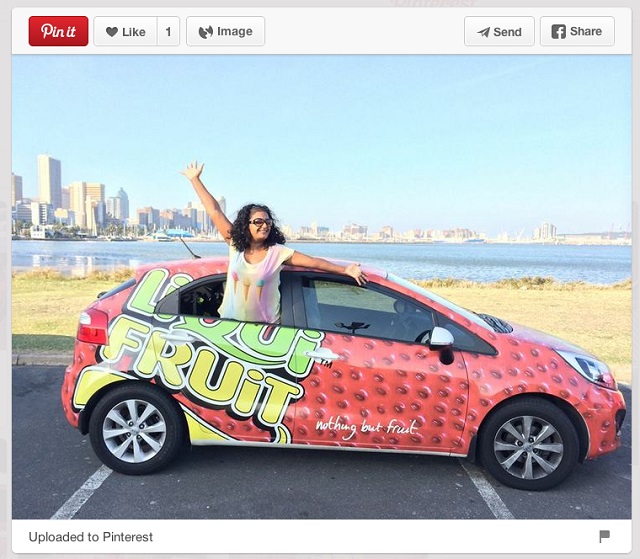
Brandyourcar.com: social media - PinterestMobile and transit media specialists, Brandyourcar.com, has ramped up the exposure offered by this type of out-of-home (OOH) transit media by linking brand ambassadors and social media influencers with brands.

Advertiser Liqui-Fruitis the latest to brand cars and use the drivers as brand ambassadors to post about the brand on social media platforms.

“In the past, Liqui-Fruit has used taxi advertising around national CBDs to communicate [its] ‘Nothing but Fruit’ advertising campaign. Now the brand has extended [its] out-of-home efforts by using Brandyourcar.com branded consumer vehicles,” explains Brandyourcar.com’s Pieter Groenewald.

Drivers aged between 22- and 28 years, who are outgoing and socially (virtually) well-connected, were preselected by Brandyourcar.com; and only drivers approved by Liqui-Fruit, as the perfect target market, were used. They were requested to upload comments onto their various social media profiles, upload pictures of their vehicles at their various points of convergence and start conversations around the brand. Through this, the traditional reach nationally around suburbs, CBDs, beaches, malls/shopping centres and gyms was multiplied for Liqui-Fruit.

“The medium gets people talking and interacting with the advertiser through the brand ambassadors and their access to fans and followers on their personal social media sites,” adds Groenewald.

Jockeying for position in Botswana

Jockey taxi branding in Botswana - Jockey or nothingUnderwear-brand Jockey has also used transit media to get its brand message across in Botswana, partnering with Provantage Media Group’s Africa division in a multimedia campaign, from billboards to taxi advertising.
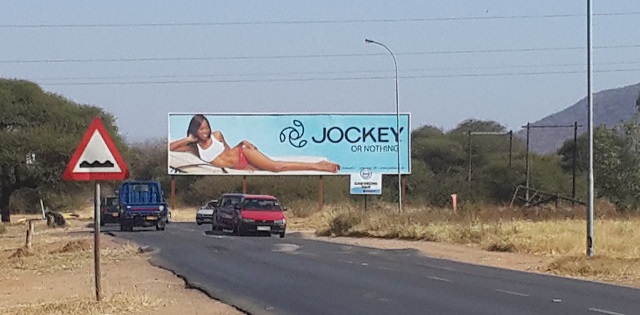
The OOH campaign has 15 Jockey-branded taxis travelling on major arterial routes around Botswana, ensuring that the brand and the brand messaging are visible to commuters, pedestrians and motorists. To add to the taxi campaign, a huge billboard on a main road in Gaborone is meant to bring additional brand visibility.

Jockey billboardin Botswana - Jockey or nothing“In Botswana, many people use taxis as a daily mode of transport, whether it’s going to work and back or going to a retail hub. The taxi environment presents Jockey with the opportunity to communicate and engage with the commuter market, allowing the brand to be part of their daily lives,” says Hannes Joubert, account manager Provantage Media Group.

Each taxi operates for 12 hours every day, completes 11 trips per day and covers 8000km per month.


Louise MarslandShelf Life is a weekly column by Louise Marsland on MarkLives. Tweet new product, packaging and design launches to @louise_marsland or email her at louise.marsland at gmail.com. Want to sponsor Shelf Life? Contact us here.

Louise has written about the FMCG, media, marketing and advertising industry for 19 of her more-than-25-year career as a former editor of magazines AdVantage, Marketing Mix and Progressive Retailing, as well as websites Bizcommunity.com and FMCGFiles. Until its cancellation, she edited the weekly Wednesday Media & Marketing Page for The New Age newspaper. She is currently the publishing editor of industry trendwatching portal, TRENDAFRiCA,for consumer insight, research and trends in Africa.

— MarkLives’ round-up of top ad and media industry news and opinion in your mailbox every three work days. Sign up here!

Ad of the Week: When you hear the beep…

by Oresti Patricios (@orestaki) Do you remember the era ‘BC’ — Before Cellphones? I can still visualise those fancy answering machines that allowed people to actually dial in and retrieve their messages. Some would take a lot of care with their greetings, mixing in some music, or putting on funny voices.

What about the heady rush when you got a message from that ‘special someone’? You would save it, and play it over and over… well, that’s if you were the romantic type. When cellphones came along, a great feature was that you now had your very own answering service, on the go, and an opportunity for more silliness, romance and invention.

Maximise airtime

Now, 20 years on, personal answering ‘machines’ have lost their novelty factor, and leaving and retrieving personal voice messages is viewed as an inconvenience. I mean, how many times have you phoned someone only to hear: “Please don’t leave a voice message. If you want me to call back, send me an SMS”?

Obviously, it’s in a cellphone company’s best interests to maximise airtime spent so, when Cell-C recently noted an increasing trend for people to drop calls instead of leaving messages, it wanted to sell the idea that leaving and listening to voicemail is something special.

*drumroll* Enter stage left the charming new advert by 1886 FCB Johannesburg, which aims to remind us all about what we adored about sending and receiving voice messages. The love. The pride. The excitement.

1886 FCB Johannesburg TVC for Cell C: “Don’t hang up — it’s more than a message”


Cell C – Voicemail from Jonty Pressinger on Vimeo.
The television ad has three or four short scenarios that are juxtaposed with relevant messages on the soundtrack; and the central theme of all of them, I suppose, is love. Not just romantic love, but also parental love and friendship.

The first scenario shows a young man as he goes about his first job in the ‘big city’. He is young and fresh-faced, and the montage takes us from early morning catching a train in the township, to working in town, to back home where he cooks for himself. One has a sense of a lonely but challenging lifestyle, although he is clearly doing well.

Juxtaposed

The voiceover juxtaposed with this story is that of the voice message being left by an older man — the young man’s father: “Just wanted to find out how things are going for you in the big city. You know, your mom and I and everyone, we’re just so proud of you, Son,” the voice says, before pausing to say, “I love you, Son. I know you can do this.”

Cell C Don't hang up screengrab 3This last sentence is over a poignant shot of the young man wiping steam off a bathroom mirror and looking at himself.

The second two scenarios are more upbeat, of youngsters getting together at a bowling alley, and another group getting into a car. The voice is that of a young man’s message to a friend, exhorting him to meet. “I haven’t seen you in ages, man, and… you know who’s going to be there… just saying, bro.” The shot at this point is of some pretty girls, so the implication isn’t lost.

Cell C Don't hang up screengrab 8The third scenario is of a solitary man getting into his car. It’s evening and the city lights sparkle in the background. He glances over his shoulder. On the soundtrack, the woman’s voice in the message is probably his girlfriend. She says, “I just called to say… I’m sorry. And I can’t wait to see you again.” At this point, the image of the man cuts to a young lady running into view and we see the two lovers reconciled against a backdrop of city lights.

Payoff line

The payoff line is “Don’t hang up. It’s more than a message.”

In its press release, FCB Johannesburg claims: “The results. Less people hung up, resulting in an increase in revenue for our client.” Whether this is just an uptick or a lasting change will be revealed in time; after all, the receiver of the message should want to listen to the message: communication is a two-way process.

The creative directors on this ad are Matthew Barnes and Toni Hughes, with art direction by Mark Livni and Leon Curling-Hope. Executive creative director is Stuart Stobbs and the director, Helen Raine.Kim Hinrichs’s cinematography and Mbeu Kambuwa’s copy support each other beautifully, providing a glimpse of ‘real’ people’s lives. They smartly illustrates how voicemail is more than just a message — it’s a way of showing love.

Now that’s what I’d call a powerful call to action.

A convincing message

I think this ad manages to tap into that most powerful of human emotions without descending into sentimentality. It cleverly delivers a convincing message that could change behaviour and have more people leaving messages instead of merely hanging up.


Oresti PatriciosAd of the Week, published on MarkLives every Wednesday, is penned by Oresti Patricios (@orestaki), the CEO of Ornico, a Brand Intelligence® firm that focuses on media, reputation and brand research.


If you are involved in making advertising that is smart, funny and/or engaging,
please let Oresti know about it at info@ornicogroup.co.za.


— MarkLives’ round-up of top ad and media industry news and opinion in your mailbox every three work days. Sign up here!

Online CPD Courses Psychology Online CPD Courses Marketing analytics software Marketing analytics software for small business Business management software Business accounting software Gearbox repair company Makeup artist