Media Future: BlackBerry rolls dice again with emerging market play

by Arthur Goldstuck (@art2gee) BlackBerry has joined the trend of producing high-end phones for emerging markets but will the gamble pay off?

The new BlackBerry Z3 is a remarkable phone not because of its features or even its price, but because of what it says about a company listening to its most loyal customers. Released in South Africa at the start of July 2014, it is the first device from the smartphone pioneer that was not only built for emerging markets, but also priced for these markets.

Blackberry Z3On top of that, it’s the first phone from a global brand to target a specific Third World country, based on its citizens’ loyalty to the brand. No, not South Africa. The Z3 was built for Indonesia, hence its nickname, Jakarta. On launch day in the city of the same name in May, customers lined up in stores and all available Z3 handsets were sold out.

Similar lines were not expected in Johannesburg when the device is released here. That partly explains why South Africa had to wait in line for the device. The gradually declining user base here is sending a clear “We’re-just-not-that-into-you” message to BlackBerry HQ in Waterloo, Canada. However, those who remain loyal – and there are still more than 4 million BlackBerry users in South Africa – will have a great incentive to upgrade.

The features do matter: a 5” touch display is rarely heard of in a phone costing less than R3 000. Access to a range of Android app stores was previously confined to, well, Android phones. The Z3 runs on BlackBerry 10 OS version 10.2.1, which well and truly lets the Android genie out of the BlackBerry bottle.

Yudi Moodley, managing director of BlackBerry for Africa, was upbeat at the recent announcement of the Z3’s pending release here, saying it “extends the BlackBerry 10 platform experience to a new generation of South African customers at an attractive price point”.

Some will see the phone as BlackBerry’s last roll of the dice, a calculated gamble to target customers outside the brand’s early strongholds in North America and Western Europe. Having all but given up on the high-end users who’ve migrated to Apple and Samsung devices, BlackBerry is relying heavily on the fact – a constant surprise to Americans – that it is still an aspirational brand in emerging markets.

To press home its advantage in Indonesia, it’s also believed to have received a local manufacturing incentive there. The result is a sub-US$200 phone for that market. Enthusiasm for the device is expected in India, too, where the price is around US$250.

So, while the R2999 price in South Africa will amaze those who are used to a lot less for the same money, it’s the equivalent of almost $300. The early 2013 BlackBerry flagship, the Z10 has fallen in cost to about R2500 and, at that price, is a better buy than the Z3. However, the phone is almost sold out, and is no longer coming off the production line. Nevertheless, consumers will be puzzled that the new low-end phone costs more than the old high-end phone at launch time. Fortunately for BlackBerry, that confusion will dissipate fast, along with then last remaining stock of the Z10.

Of course, BlackBerry is also betting on features, price and loyalty resulting in the same jackpot it just won in Jakarta.

Arthur Goldstuck


Arthur Goldstuck heads up World Wide Worx (www.worldwideworx.com) and is editor-in-chief of Gadget. He is a consulting editor to MarkLives and our media tech columnist. Follow him on Twitter on @art2gee. This article has been republished from Gadget.

— MarkLives’ round-up of top ad and media industry news and opinion in your mailbox every three work days. Sign up here!


The Switch: Perils of the inside track

by Alistair Mokoena (@AlistairMokoena) One of the lessons one picks up in business school is the importance of environmental scanning as a business practice. I agree with the notion that all things are good as long as they are done in moderation but I think our industry takes competitor intelligence and understanding our clients too far.

Mumbai train tracks by Alistair Mokoena

Being aware of one’s surroundings helps one anticipate and prepare for eventualities. The environment needs to be scanned for trends, innovation, threats and opportunities. After all, no organisation wants to be caught unawares like the proverbial ostrich with its head in the sand.

Competitor intelligence

Competitor intelligence is one form of environmental scanning. In the advertising industry, this means understanding the following questions (and I know many agency heads who grapple with these on a fairly regular basis):

  • how other agencies run their businesses
  • how they are organised and structured to make money
  • what capabilities they are likely to invest in next
  • what gaps exist in their client portfolio and therefore whom they are likely to go after
  • which of their people have itchy feet and are susceptible to poaching, and, lastly
  • which of their clients are unhappy and looking for a new suitor

Yes, competition is a good thing and must be celebrated — but not when it encourages espionage and back-stabbing:

  • I don’t agree with employing dodgy tactics to find out about my competitors’ vulnerabilities and using these to entice their clients and staff members to stray from the path of virtue.
  • I have a dim view of people who wish failure on others and I stay away from those that celebrate other people’s misfortune.

Not at the expense

Don’t get me wrong; I love competing for business and for talent, but not at the expense of good neighbourliness and fair play. The world is too small for you to burn bridges and, as we know, karma is a witch with a capital b.

It warms my heart when other agency heads pick up the phone to say, ‘Sorry to hear about your loss, you’ll bounce back.”

My heart leaps with joy when I receive a bottle of Veuve out of the blue from a competitor for winning a new business or much-coveted double-breasted silverware of a feathery kind.

Understanding our clients

Another form of environmental scanning that we, as advertising professionals, take too far is understanding our clients.

Of course we must get to know our clients intimately so we can achieve success together and build strong, enduring relationships with them. I encourage doing a Google or a LinkedIn search ahead of meeting clients for the first time. It gives you a sense of who you are dealing with, what their background is and who they know.

Phoning around for references is also an acceptable thing to do.

What do you do?

The issue, as with all intelligence, is what do you do with it once you’ve gathered it?

  • Do you use this background information to charm clients? Some find this these stalker tendencies to be forward, over-familiar and creepy.
  • Do you use it to prepare your team for what’s to come? Sometimes, this inside track only serves to breathe fear into your agency to the point where it paralyses you into semi-comatose compliance when dealing with the client. As Shakespeare wrote, “Cowards die many times before their deaths”.
  • Do you use it pre-empt and therefore counter your client’s character flaws? My advice is walk into a new relationship without any pre-conceived ideas because you just might bring out the best in your client.

Every broken relationship has two sides. What you hear via the grapevine might not be the gospel according to the New Testament.

Soliciting the inside track

In the spirit of understanding our senior clients better, some of us solicit the inside track from unsuspecting junior clients. Again I ask, “What do you do once you hear that your client doesn’t like you, wants to fire you and is flirting with your competition?”

  • Do you confront the senior client with this information?
  • Do you give your competitor the evil eye at the next industry function?
  • Do you retaliate by going after your competitor’s clients?
  • Do you up your game and start over-servicing your seemingly disgruntled client? Don’t you worry that you might freak them out by being overly nice, nimble, cheap and super quick all of a sudden? It seems odd that you would address all the complaints they have never raised with you. Some clients will react with great joy but others will get pissed off and dismiss this new resolve to fix issues as “too little, too late”.

As I said in the beginning, intelligence gathering is important and necessary. The trick is to use this information wisely and constructively.

Handle with care

Espionage can be addictive and harmful and must therefore be handled with care. Don’t be a slave to the grapevine. Create your own reality and stick to your game plan.

The best you can be is yourself. That’s what your client fell for in the first place.

Alistair Mokoena

Alistair Mokoena (@AlistairMokoena) is a Unilever-trained Chartered Marketer with lots of blue-chip marketing experience who is currently MD of FCB Joburg. One of his favourite pastimes is driving around in the bush, photographing wild animals. Alistair contributes the monthly “The Switch” column, covering relationships inside agencies and between agencies and clients, to MarkLives.com.


— MarkLives’ round-up of top ad and media industry news and opinion in your mailbox every three work days. Sign up here!

Grubstreet: Kuier’s secret to success

by Gill Moodie (@grubstreetSA) Media24 announced recently that it is launching a new fortnightly women’s magazine called mine! – a move which tells us as much about the state of the magazine industry as it does about the clever team behind this new title.

The English-language magazine, which is aimed at LSM 6-8 women and launched at the start  of August, is coming from the same people who do the Afrikaans-language fortnightly, Kuier.

Kuier magazineLed by editor Kay Karriem, Kuier is something of a publishing phenomenon in this country.

While many magazines are suffering circulation decline, Kuier has bucked the trend in a spectacular fashion. After launching in 2009, it has been the star performer in almost every ABC circulation release in the past three years as it keeps picking up readers in its expansion across South Africa from its Western Cape heartland. Aimed chiefly at coloured middle-class Afrikaans-speaking women, the magazine boasted 106 335 circulation in the most recent ABCs – for the first quarter of this year – compared with 95 846 a year earlier.

The real genius of Kuier has not been snapping up the gap in the coloured women’s market but to offer something of value in these tough economic times – something that is little bit cheaper (R10 cover price) and more real (no supermodels) and with lots of useful information such as recipes, health advice and human-interest stories born out of the reader community.

There are few consumer-magazine publishers in South Africa today who are not feeling the effects of a reduction in consumers’ discretionary spending. People are cutting back on buying magazines, they say, and more people are sharing copies. Coupled with advertisers holding back on spending and the ever-rising costs of printing and distribution, times are tough for magazines right now.

However, just like Kuier, mine! is setting out to talk to the consumers who are feeling the pinch.

The thinking behind the new mag, Karriem told Grubstreet, is to “have a genuine offering catering to the needs of middle-class South African women from all walks of life, who feel a little neglected. Most glossies are aimed too high and are beyond her reach – very aspirational – but rarely attainable. mine! aims to be practical and relevant, at the right price point, offering incredible value for money.”

mine! will sell for R12.50 and is targeting women between the ages of 35 and 45.

“Content will be easy to read and realistic on every level, offering plenty of practical advice,” a company press release said last week. “There will be excellent health, relationship and lifestyle advice, top tips to make your life easier, delicious yet affordable food, plenty of décor and craft ideas, a bumper games and entertainment section and much more – all delivered in an upbeat, informal tone every woman will be able to relate to.”

With Kuier’s successful sister publication, Move (135 611 circulation), aimed mostly as black women, is mine! aimed mostly at white women?

Karriem, who will edit both Kuier and mine!, says it is “more of an inclusive affair as the common thread will be their economic reality more than a specific cultural identity”. It will differentiate itself from Media24’s existing weekly title, You, by being “totally female focused – not family – and no celebrity; only real woman and real issues”.

Kay KarriemDoubtless Karriem is going to find the English-language market very different to the Afrikaans one but the way she has taken Kuier out of the Western Cape to the rest of the country demands respect.

“The Western Cape was a natural fit and it was so needed,” she told Grubstreet, “but the fact that the brand is now growing legs in the rest of the country is, for me, something that took a long time and a lot of work went into it.

“Gauteng is going very well for us now. It’s growing at a slower pace than when we first started but this is where our main expansion is coming from… It’s also LSM 5-7 because that’s the gap we fill and it’s this group that’s falling off from the bigger brands because there is a question of affordability and relevance in content. Value for money, the advice that we give and engagement with the community with our real-life stories are the cornerstones of the brand.”

Kuier’s growth in the country’s northern provinces, where Afrikaans readers are loyal to the biggest existing brands, has been slower than in the Western Cape but Karriem believes because so many people in LSM 5-7 are taking financial strain, it will still find more readers.

“We see it especially in the Combo (an annual brand extension with mostly recipes),” she says. “It’s the only extension that’s over 100 000 (sales) in the country. It’s priced at R18 and we find that especially in the non-core market, if they don’t know Kuier that’s the one they pick up. That’s how they get introduced to the brand.”

This year the Combo will be expanded into two editions – a summer and winter Combo.

The main challenge for Karriem with Kuier has been advertising. “Our content is different and the way that we present it – even the language we use – is particular to us and we serve a particular reader. When it comes to advertisers, it’s still a job to convince them that there’s a need to speak to this market separately. And it’s not like we’re selling a niche market in LSM 9 and 10.

“But our advertising income is growing. We are winning – too slow for my liking – but we are getting there.”

Karriem says she judges engagement with the product by letters, chat on social networks such as the magazine’s Facebook page and Kuier’s events such as the Mother’s Day and Women’s Day events, which sell out within an hour of tickets going on sale.

“It’s not R500 a ticket but in this LSM (group), R200 a ticket is still quite a lot,” she says. “And they sell out so I know the readers want to be seen at our events.

“Our big annual event is Women’s Day in August. This year we’re going to have about 700 women for the event and the ladies dress up like you wouldn’t believe. We sit down and eat and the mayor, Patricia de Lille, normally speaks. It’s one helluva party.

“With the content, I keep coming back to the recipes,” says Karriem. “The readers don’t just look at them; they make the recipes and comment on whether it was a flop or fantastic.

“We’re not just a glossy, coffee-table title. The women are actually making our food and I find this very encouraging.”

GrubstreetSouth Africa’s leading media commentator, Gill Moodie (@grubstreetSA) offers intelligence on media, old and new. Reprinted from her site Grubstreet. This piece was published first on Journalism.co.za, the website of Wits University’s journalism school.

— MarkLives’ round-up of top ad and media industry news and opinion in your mailbox every three work days. Sign up here!

Africa Dispatches: #RespectAfrica

a Mark Magazine: Africa Dispatches feature Meet the change makers and the disrupters. Africa’s visionaries who dared to dream big and to turn their ideas into reality. These are amongst the most respected people on the continent. These are the people to know. Curated by Mandy de Waal (@mandyldewaal).

Respect AfricaKoos Bekker

Former CEO of Naspers, Bekker helped transform the company from a national press operation into one of the world’s largest media companies in the world, with operations in some 133 countries and a revenue in 2013 of over R50-billion. Bekker took a sabbatical in April 2014, after 17 years as CEO, to travel the world. On his return in April 2015 he will become chairman of Naspers.

Mo Ibrahim

Sudanese-British mobile entrepreneur and billionaire. Founder of CelTel, which he sold in  2005 for $3.4 billion. Founder of the Mo Ibrahim Foundation and creator of the Mo Ibrahim Index — both of which aim to evaluate leadership and governance at a government level. Founder of the Ibrahim Prize for Achievement in African Leadership, which celebrates excellence in African leadership, and is awarded to a former executive head of state.

Dambisa Moyo

@dambisamoyo
Author of the New York Times best-seller Dead Aid: Why Aid Is Not Working and How There Is a Better Way for Africa which earned her the moniker: ‘The Anti-Bono’. Moyo also authored Winner Take All: China’s Race for Resources and What It Means for the World and How The West Was Lost: Fifty Years of Economic Folly – And the Stark Choices Ahead. Named by @TIME in 2009 as one of 100 people who most affect the world.

Mamadou Toure

Founder of Africa 2.0, an advocacy group aimed at developing and implementing strategies to produce positive outcomes for millions of Africans. Managing Director with General Electric Africa. Formerly with KPMG Audit France, Fortis Group (Paris) and the World Bank Group.

Amadou Mahtar Ba

@AMahtarBa
Chief Executive of the African Media Initiative. Co-founder of AllAfrica Global Media. Member of the World Economic Forum’s Global Council for the Future of Journalism. Member of the Advisory Committee of the Knight International Journalism Fellowship, as well as a member of the Africa Policy Advisory Board of ONE.

Trevor Ncube

@TrevorNcube
Zimbabwean media owner and champion of investigative journalism and a free press. The publisher of The Mail & Guardian in South Africa and The Zimbabwe Independent, The Sunday Standard and NewsDay in Zimbabwe.

Ory Okolloh

@kenyanpundit
Director of investments at philanthropic firm, the Omidyar Network. Former manager of policy for Google in Africa. Co-founder of crisis crowd-mapping initiative, Ushahidi.

Chinedu Echeruo

Former investment bank and hedge fund analyst. Founder of HopStop, an online city transit guide that offers door-to-door subway and bus directions for over 140 cities around the globe. HopStop was sold to Apple in 2013 for a price reportedly in the billion-dollar range.

Alex Okosi

@AlexOkosi
Senior Vice President & Managing Director of MTV Networks Africa. The man credited with bringing MTV Base to the continent.

Isis Nyong’o

@inyongo
Formerly head of Africa operations for the global mobile advertising giants, inMobi, Nyong’o was part of MTV Africa’s start-up team. She also worked for Google. Listed as one of Forbes’ 20 Young Power African Women.

Lupita Amondi Nyong’o

Kenyan-Mexican actress, and the first Kenyan to win an Oscar, for her role in Steve McQueen’s 12 Years A Slave. Music video director. Documentary film director.

Print

This feature first ran in Mark Magazine: Africa Dispatches — the sister print magazine of marklives.com. Sample or buy the launch issue of Mark: Africa Dispatches #1 here.

Mandy de Waal

Mandy de Waal. Curious scribbler. Born-again atheist. Author on training wheels. Thought activist. Amateur human. Collector of stories. Lover of the long form. Consulting editor to MarkLives.com. Editor of Mark Magazine: Africa Dispatches.

— MarkLives’ round-up of top ad and media industry news and opinion in your mailbox every three work days. Sign up here!

Smart Africa TV: Nollywood Radio — the radio station that started as a magazine

by Russell Southwood (@BalancingActAfr) In this video interview, Cyprian Josson talks about Nollywood Radio: nrf

  • how the radio station started as a magazine;
  • the partners he has for his online radio channel;
  • the size of its audience; and
  • his plans for the future.

Smart MonkeyRussell Southwood is the founder of Balancing Act and the web TV channel Smart Monkey TV, and has been an analyst in telecoms, internet and broadcast in Africa for the last 14 years. Smart Monkey TV aims to capture the energy at the crossroads between African culture and technology. MarkLives is syndicating content from Smart Monkey TV on a weekly basis for the column “Smart Africa TV”.

— MarkLives’ round-up of top ad and media industry news and opinion in your mailbox every three work days. Sign up here!

BrandsRock and Saatchi & Saatchi to merge

by Herman Manson (@marklives) BrandsRock and Saatchi & Saatchi are merging. Publicis Groupe is acquiring 100% of BrandsRock, founded by Mike Joubert five years ago, to launch a new brand in South Africa’s advertising universe, called Saatchi & Saatchi BrandsRock.

According to Joubert, Publicis is investing in strengthening its Africa network and the new SA agency will spearhead growth in sub-Saharan Africa.

The merger will also infuse Saatchi & Saatchi with new leadership and energy, and will build upon BrandRock’s strong SA client base, SSBR-1combined with Saatchi & Saatchi’s internationally aligned business.

Who’s who

John Dixon, who recently joined BrandsRock from FCB, will be Saatchi & Saatchi Group CEO as well as CEO of Saatchi & Saatchi BrandsRock. Joubert will remain as chief strategy officer at Saatchi & Saatchi BrandsRock, Jonathan Beggs as chief creative officer, and Heidi Nelson as chief operations officer. At group level Ayanda Mbanga, deputy group CEO at Saatchi & Saatchi, remains in place as deputy group CEO and Graham Reynolds remains as group financial director. While former Saatchi & Saatchi group CEO Gail Curtis left the agency after nine years in May 2014, she has been advising the agency on the merger process through July.

Saatchi & Saatchi South Africa will have four divisions: Saatchi & Saatchi BrandsRock (ad agency), Amp Experiential (experiential agency), Ayanda Mbanga Communications (employer branding and recruitment advertising) and Saatchi & Saatchi Synergize (SEO).

BrandsRock employs around 40 people, and clients include Harley-Davidson, KWV, eBucks and Sharp. The agency recently won Momentum. Saatchi & Saatchi currently employs 120 people. Key clients include brands owned by Mondelēz International, Novartis and Procter & Gamble. The new agency will combine current offices into single spaces in Johannesburg and Cape Town.

Africa as an investment destination

Dixon says the deal made sense to BrandsRock because clients are no longer just talking about Africa as an investment destination — they are actively moving budget here — and Saatchi & Saatchi has a number of internationally aligned clients with growing interest in the continent.

Publicis recently bought out digital agency Synergize to create a new unit within Saatchi & Saatchi South Africa, called Saatchi & Saatchi Synergize. Dixon had been impressed by the Synergize team and its ability to disseminate content produced by the agency through expertise in SEO, web and mobile development, and content management development.

BrandsRock, meanwhile, brings to Saatchi & Saatchi activation and experiential skills, an established local client list and a newly energised leadership team.

Had always intended to sell

Joubert bootstrapped BrandsRock since its launch in 2009 and says he had always intended to sell the business after five years; he is six months early on his self-imposed deadline. BrandsRock went with Publicis because of Joubert’s profound admiration for BBH, which is also part of Publicis Groupe (BBH does not intend building an African network, says Joubert), as well the level of integrity he felt was on display during negotiations with the group.

The addition of BrandsRock into the local Saatchi & Saatchi brand signals fundamental change in the local agency, says Dixon.

He admits that the loss of the Guinness business in Africa to Abbott Mead Vickers BBDO and its sister agency Net#work BBDO, Johannesburg, has had a significant impact upon Saatchi & Saatchi.  Through this deal, the Saatchi & Saatchi group gains not only new leadership and energy but also a reinvigorated way of working, says Joubert, focused on agility, speed and results.

Single-agency, multiple-office approach

Saatchi & Saatchi BrandsRock will retain its level two BEE status. The agency will pursue a single-agency, multiple-office approach in SA, with a single CEO across Cape Town and Johannesburg. Dixon expects it to develop into a Top 10 agency in South Africa in terms of revenue — which  already tops R80 million. At the time of going to press no official announcement on the acquisition had yet been made by Publicis Groupe.

— MarkLives’ round-up of top ad and media industry news and opinion in your mailbox every three work days. Sign up here!

Heroes & Zeros: Pantene & PDMSA — best & worst brands of the week

Andy Rice (@ricecommaandy) talks about his best and worst brands of the week — Pantene and Print & Digital Media South Africa (PDMSA) — with Jenny Crwys-Williams (@jcwLIFE) during The Ad Feature on Talk Radio 702 (@Radio702).

Find out why these feature in this week’s Heroes & Zeros webisode by watching below:


For a fresh look at the world of advertising, Jenny Crwys-Williams of 702 Talk Radio chats to advertising critic Andy Rice on The Ad Feature, every Wednesday 2.30pm — 3pm. The filmed Heroes & Zeroes will appear on MarkLives every Friday morning as a webisode.

— MarkLives’ round-up of top ad and media industry news and opinion in your mailbox every three work days. Sign up here!

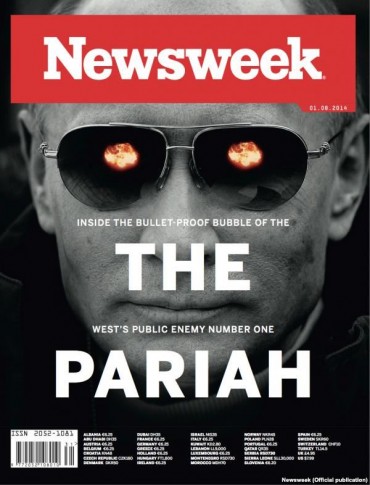
MagLove: MH17 shadows Putin

by MediaSlut (@MediaSlut) My choice of the best international and local magazine covers in MagLove this week:

  • Empire UK
  • TIME
  • Newsweek
  • Various MH17/Putin covers
  • Food & Home Entertaining

INTERNATIONAL

Empire UK, July 2014

Empire UK, July 2014After a reader poll, EMPIRE magazine has released its list of “301 greatest movies of all time”, and the subscribers will be the ones receiving this brilliant cover!

But does this image of Han Solo (Harrison Ford) frozen in carbonite refer to The Empire Strikes Back or Return of the Jedi (the second and third instalments of the original Star Wars trilogy)? You’ll have to read the mag to find out!

Whichever one it is, it’s just really cleverly done!

TIME, 4 August 2014

TIME, 4 August 2014MH17 and Putin are still on a lot of people’s minds, and TIME has brilliantly illustrated how flight MH17 is following Putin like a shadow…

Newsweek, 1 August 2014

Newsweek, 1 August 2014Newsweek also has a chilling MH17/Putin cover — Putin looks very cool, while the reader sees the reflection of ‘an object’ blowing up… Chilling!

More Putin/MH17 related covers this past week…

The Week, 26 July 2014The Economist, 26 July 2014 The Week, 1 August 2014

I thought I’d continue with a few other MH 17/Putin covers, even though they’re not as good as the TIME and Newsweek covers; yet they all tell an important story in their own right, and I thought you might also find these of interest.

LOCAL

Food & Home Entertaining, August 2014

Food & Home Entertaining, August 2014Locally, Food & Home Entertaining takes the cake for its “Salvador citrus drizzle & cream cheese cake”, which makes me yearn for summer.

It’s not just the colourful citrus pieces that draw attention — the ‘cake cutter’ on the left with cover lines is a really smart and creative move!


Find a cover we should know about? Tweet us at @Marklives and @MediaSlut.
Want to view all the covers at a glance?
See our MagLove Pinboard!


MediaSlutMagLove by @MediaSlut is a regular slot featuring the best local and international magazine covers every week, recognising well thought-out, powerful and interesting (and hopefully all three-in-one) covers and celebrating the mix of pragmatism, creativity and personal taste that created each of them. The (for now anonymous) blogger behind MediaSlutknows way too much for his own good about media in South Africa, magazines in particular. His mission is to show when SA magazines fail but, most importantly, also when they succeed. If you’re looking for a library about SA magazines and news, this is your one-stop pitstop.

— MarkLives’ round-up of top ad and media industry news and opinion in your mailbox every three work days. Sign up here!

The rise of afro-centric design

a The Africa Annual feature From the ‘shack chic’ of Soweto to the bright and bold prints of Nigeria’s Ankara and Lace, fashion design is breaking out in Africa. In this extract from his new book, “Connect with the Continent”, Terry Behan looks at how brands can connect with Afro-chic’s advance.

“The rise of the African fashion industry should come as no surprise. The International Monetary Fund has estimated that Africa will soon have seven of the 10 fastest-growing economies in the world, with the GDP growing to $29-trillion by 2050, from the current $2-trillion. As the old saying goes, “fashion follows money and money follows fashion”.

The Africa Annual graphicAfrican fashion and fashion designers have started to come into their own, selling clothes that are both locally designed and produced for African consumers and, in some cases, exporting to the international market.

Both new and established designers from South Africa, Kenya, Senegal, Mali, Ghana, Nigeria, Ethiopia and Swaziland, through institutions like Design Network Africa, are exhibiting at tops shows in London, Dubai and Miami. Their collective talent lies in their ability to be able to connect with their heritage and history, and then reinterpret and refresh it in a truly Afro-centric way.

The economic upswing across the continent has done more than put money into people’s pockets, it has helped to restore cultural confidence and thus helped people to reinterpret their heritage in a progressive and uniquely African way. This is evidenced in the wide variety of talented designers producing thoroughly unique and desirable products, with ranges that are selling out on the continent and further afield.

This revisited confidence is important and should be carefully considered. Not because it is simply happening—economic development and cultural confidence go hand-in-hand—but in how it is happening.

What’s important to see is how people across the length and breadth of the continent are reinterpreting their culture in refreshing ways. In other words, Africans are modernising, but not necessarily westernising. This is imperative because, unless you’re China, you can’t create an export market by copying or licensing other people’s goods. African design is becoming fashionable because it’s genuinely African, and offers the world something they haven’t yet fully experienced.

Brands wishing to position themselves as Afro-centric and contemporary should look to associate with this emerging trend, and should consider collaborating with the some of the many talented designers across the continent.

The trend towards cultural modernisation has particular relevance when communicating brands to a very aspirational target audience, for it is usually these consumers that become the flag bearers for cultural modernisation. The culmination of a renewed appreciation for cultural history and a developed sense of national pride fuelled by outstanding economic growth, have created the necessary conditions for cultural modernisation to flourish.

Brands wishing to emotionally connect with this audience can leverage off this developing Afro-chic aesthetic in the tangible areas of sponsorship, product design and packaging design, but also in the general tonality of messaging and overall communication style.

Thus far we have seen African mega brands such as South African Airways and GTBank use this design aesthetic to flavour their positioning as contemporary and modern.

Giving them first-mover advantage in this space and allowing them to use this Afro-chic design style as a differentiator to leverage their brands. Expect more brands to follow suit.”

Terry Behan hails from Dublin, Ireland and has lived and worked in England, Greece, Germany and South Africa. He is regularly called upon as a spokesperson for the marketing industry and is highly regarded and acknowledged as an expert on the subject of branding. Behan is a former advisory board member of the World Brand Congress, a board member of the Southern Guild Design Foundation of SA, and a member of the Aspen Global Leadership Network. He has worked extensively with many of the world’s best-loved brands and his passions lies with architecting brand experience solutions for clients globally.

africa annual

This feature first ran in The Africa Annual published by Ornico with MarkLives.com as its official media partner. Read or download the full magazine via Issuu.

— MarkLives’ round-up of top ad and media industry news and opinion in your mailbox every three wor


EXCLUSIVE: Jerry Mpufane exits Jupiter, joins M&C Saatchi Abel

by Herman Manson (@marklives) Jerry Mpufane is leaving his position as CEO of The Jupiter Drawing Room (Johannesburg) and joining M&C Saatchi Abel as group managing director, Gauteng.

Mpufane joins Gauteng CEO, Jacques Burger, in leading the fast-growing agency which, after three years in business, already employs 100 people on accounts including Edgars, EDCON and Nedbank.

Jerry Mpufane
Jerry Mpufane

Mpufane joined Jupiter (JHB) in 2012. Before that, he served as MD of Draftfcb South Africa.

“Looking for the perfect business partner”

“For the past while, I’ve been looking for the perfect business partner to work alongside myself and executive creative directors, Mick Shepard and Nick Liatos, in delivering a world-class offering to our clients and providing our people with an inspiring work environment,” says Burger.

“I have not met anyone more perfectly suited to this role than Jerry. He has inordinate smarts, a proven ability to lead at the highest level, and an irrepressible passion for partnering clients in helping grow their businesses.”

Mpufane says he enters the partnership as a significant shareholder — a core reason for his move. His mandate will be to help grow the ad agency and assist it in diversifying into other marketing disciplines.

“Pursue fresh challenges”

“Jerry has decided to pursue fresh challenges and we wish him well after his 22 months in charge of the agency,” comments Graham Warsop, who will be returning to Jupiter (JHB) as chairman in addition to his roles as chairman of the Jupiter Group and in experimental agency Utopia.

Following Mpufane’s departure, a number of changes are being made at a senior level of Jupiter (JHB) and the agency itself proposes undertaking a significant restructure.

— MarkLives’ round-up of top ad and media industry news and opinion in your mailbox every three work days. Sign up here!

Online CPD Courses Psychology Online CPD Courses Marketing analytics software Marketing analytics software for small business Business management software Business accounting software Gearbox repair company Makeup artist