The Sell: Going back to basic retail-selling principles

by Mimi Nicklin (@MimiNicklin) Mr Selfridge, a semi-fictional British series that follows the opening of a ‘first-of-its-kind’ department store in 1920 London (Selfridges), has launched recently on DStv. It occurred to me that, while much in retail has changed since 1920(!), when it comes to selling our wares in 2014, so many of the principles it was innovating with at the original Selfridges store should still form the basis of our retail innovation today.

What can we learn if we look back nearly 100 years at the original principles of selling? And, can we still use these lessons today to drive the highest-engagement possible in selling to the modern-day autopilot shopper?

Innovation persuades the shopper to do something different: to buy, to try, to move, to change, and the stakes are rising as shoppers swap between more stores than ever before.

As Philip Clarke, Tesco’s CEO, noted recently, “Successful retailers will not be those who meekly follow the customers habits like some obedient puppy. They will be one step ahead, offering people new ways to make their shopping that bit better, more engaging, and more valuable.”

Here are four lessons from 1920s’ retailing that are still relevant today:

1) Always remember shoppers are habitual and nervous — so appeal to the senses to change behaviour

Vegetables on displayWhile investment inpackaging design moves ever upwards, the tangibility of our stores becomes more and more one-dimensional as shelves become walls of confusing colour. Brands are not prepared to invest in engaging 4D displays, and the retailers that do often restrict this to flagship stores only.

Selfridges realised early on that bringing fabric out from behind the counters so shoppers could openly touch (without having to ask permission) meant it immediately sold Bicycle saddles on displaydouble. People were engaged personally with their purchase and, so, they bought more. After all, the power of emotion is infinitely stronger than that of the rational mind when shopping.

The stores that are getting rid of the layers of packaging and making products touchable, engaging and even personal again today are those which are winning.

2) It matters where it comes from

Hot chocolate display with Fairtrade organic coffeeIn 1920, people cared where their wares came from. Craftsmanship was worth a premium and local was definitely lekker.

This value disappeared for the best part of a century, but it’s back!

There is a global rise in retail to allow shoppers to engage with the “origin” of the product, openly on show — no hidden labels or ingredients but absolute clarity on where the product came from and how many miles it travelled to your basket.

This allows shoppers to reconfirm the value of the purchase and rationalise their emotional pull to purchase ie “It just looks too good to leave behind — I must try! PLUS it is supporting local business/ethical behaviour so it is a responsible purchase.”

3) Try before you buy, you “won’t regret it”

Woolworths Try meAn age-old trick used by market sellers for centuries. If you believe in your product, allow people to try before they buy.

Arguably, Woolworths and Checkers are leading the way in grocery, and Fruit & Veg City had recently claimed its achievement in reaching its mission to create ‘food theatre’ (food-making stations, fresh grocery, cafés and sushi bars) to change the way shoppers shop at its stores.

This is a trend not limited to grocery, however; it goes all the way to categories such as home décor (where stores often now allow shoppers to take products home for free trials to ensure they are making the right choice before purchase); ‘first-class free’ courses; and even car test-drive experiences that last a weekend (LandRover South Africa).

4) Give people a new reason (or occasion) to buy by inspiring a reconsideration of ingredients and products they may already know.

Woolworths vanilla custard ideasJust because shoppers normally only buy custard for Easter and Christmas, it doesn’t mean they can’t be convinced to buy on other, unplanned, missions for a new occasion.

Woolworths is leading the way here, from food to underwear and clothing; throughout the store, signage gives shoppers new reasons and benefits to look at already-known products in a different light.

Value beyond the transaction

All those years ago, what Mr Selfridge knew was that if shoppers were only interested in price, there wouldn’t be much of a lifespan for retailers — certainly it wouldn’t be the Woolworths shaper posterbehemoth ‘entertainment’ industry it is today.

The variety of retail we see in malls globally proves that different people value different things when it comes to acquiring goods. The trick is to find the value beyond the transaction.

The world’s best brands know what their customers value, and work relentlessly to provide it for them. After all, if Coca-Cola sold only on its functional product attributes (a black, bubbling, sweet liquid) or its price (higher than nearly all its competitors), it wouldn’t be getting very far!

The greatest retail skill

Retail has always served a consumer who has craved more, better and at a Woolworths chocolate and wine displayhigher value—and has been willing to go wherever necessary to get it. So, while mass retail may barely be recognisable since its earliest days, the need to differentiate from the competition through innovation is as great as it has ever been.

It is often said that retail never stops moving and today, more than ever, the need to keep moving forward — while continually looking back — is possibly the greatest retail skill to refine.

Mimi NicklinMimi Nicklin (@MimiNicklin) followed her passion and experience in the consumer, retail and shopper space from regional roles in Europe and Asia, to South African shores in 2010. Having led global brands through the line for Procter & Gamble, and two of London and Hong Kong’s top agencies, her background gives her an international perspective to add to her depth of SA understanding. She serves as strategic director and a partner at 34 Group. Mimi contributes the monthly “The Sell” column concerning shopper marketing to MarkLives.

— MarkLives’ round-up of top ad and media industry news and opinion in your mailbox every three work days. Sign up here!

Media Future: Massive smartphone shift under way in SA

by Arthur Goldstuck (@art2gee) The numbers from South Africa’s largest mobile phone retailer show, along with other fascinating insights, a massive shift happening in the smartphone market right now.

The shift from feature phones to smartphones in South Africa is happening faster than anyone could have imagined just a few months ago.

Huawei Ascend Y220Sales figures from the country’s largest mobile phone retailer, Pep Stores, reveal a radical transformation in the phone-buying habits of the low- and middle-income segments of South Africa’s population.

Pep’s own numbers, however, are equally startling. In the year to the end of June 2014, it sold no less than 6,7-million pre-paid phones – half of all phones sold on pre-paid deals in South Africa during that period, according to John Edwards, Executive: Cellular at Pep Stores.

The biggest surprise in its numbers, however, lurk in the smartphone sales figures.

In the half-year to December 2013, 1% of prepaid phones sold were smartphones. For the full year, by the end of June 2014, that number had shot up to 7%, implying a rise to 13% in the first six months of 2014.

But that’s not where it ends. In one month alone – March 2014 – the smartphone contribution was at 23%, thanks to special offers and new low-cost handsets.

“We’re forecasting that number to rise to 30% in the last quarter of the year,” says Edwards. “It’s driven by handset subsidies from the networks, but I suspect that if you took away the subsidies, the volumes wouldn’t be significantly lower.”

Edwards believes that smartphone demand has also been driven by the massive uptake of WhatsApp, the instant messaging app that is now accessible on many feature phones as well as all entry-level smartphones.

The obvious devices, sub-R500 Android phones like the MTN Steppa and Huawei Ascend Y220, made a big contribution. However, Pep also made a massive impact by introducing a WhatsApp-specific feature phone: the AG Whutz-Zappa, at a cost of R399.

Thanks to a funky name and a WhatsApp shortcut button, it’s captured the imagination of the low-income segment that aspires to instant messaging services. Camera, MP3 player and WAP browser means it’s got the basics, but it’s also, no doubt, a stepping stone towards owning a basic smartphone – which will come down to the same price in the next year or so.

That’s good and bad news for the mobile operators, who are struggling with strategies to cope with declining voice revenues.

“On the Android phones we sold, the average revenue per user (ARPU) is three times as much as on feature phones,” says Edwards. “There’s clearly a swing at the low end, from consumers who are desperate for access to Android devices and definitely to instant messaging.

“But that is only part of it. My gut feel is, if you put the tool in people’s hands, they will use it. Before I saw the ARPUs, I assumed it was all about WhatsApp. Clearly, the data wave is coming.”

That also means, however, that the operators will have to rethink their data pricing strategy. The network that is cheapest for voice calls, Cell C, is the most expensive for ad hoc use of data, at R2 per Megabyte.

“A Pep customer buys, on average, a R15 voucher,” says Edwards. “These guys live hand to mouth. You can’t give them bill-shock. If they lose R15 for an app running in background, they’re going to dump the phone.”

Arthur Goldstuck

Arthur Goldstuck heads up World Wide Worx (www.worldwideworx.com) and is editor-in-chief of Gadget. He is a consulting editor to MarkLives and our media tech columnist. Follow him on Twitter on @art2gee. This article has been republished from Gadget.

— MarkLives’ round-up of top ad and media industry news and opinion in your mailbox every three work days. Sign up here!

M&A spree even as new ownership rules loom

by Herman Manson (@marklives) The South African ad industry has recently seen a series of takeovers and mergers of high-profile independent agencies by global communications networks — WPP and Publicis, specifically — thanks to accelerated interest in the African comms landscape and a cheap rand. Some independents are worried by the Competition Commission’s seeming lack of concern regarding this acquisition spree and the increased local-market dominance.

Concerns by independents include:

  • Higher-than-industry-average salaries for key talent, against which independents often cannot compete.
  • Discounts through bulk-buying on the media side — media discounts through scale, preferential payment terms and discounts with preferred suppliers. These all cut into the profitability and sustainability of the various agencies.
  • Leveraging international relationships with global parent companies of SA holdings to manipulate whom ends up on pitch lists.

MAC Charter: 51% local ownership

Odette van der Haar, CEO of the self-regulating SA industry body, the Association for Communication and Advertising (ACA), says that its charter for transformation — the Marketing, Advertising and Communication (MAC) South Africa Charter — encourages and rewards local ownership of agencies.

“With our Charter in place, the Competition Commission has nothing to worry about,” contends Van der Haar. “The targets of our scorecard are far more stringent than the generic scorecard and, in fact, our revised scorecard — which is to be promulgated under section 9 and written into law — requires 51% local ownership of companies in our sector, which will ensure a truly SA advertising and communications sector.”

In essence the regulations, which the ACA says is currently sitting before the relevant ministry and could be enacted at any time, will require all advertising agencies in SA to be 51% locally owned by 2121. A series of timelines and milestones will be set between the enactment of the legislation and 2021, which agencies would be required to meet.

How global networks structure their local offices to meet the new ownership criteria is not something the ACA is willing to speculate on. It would however impact on their ability to consolidate financials.

More deals in the pipeline

Both WPP and Publicis, two of the largest international holding companies, have been actively acquiring agency properties in the country over the past few months, with more deals in the pipeline.

Last month, Publicis Groupe (head-quartered in Paris, France) acquired BrandsRock, which it merged with Saatchi & Saatchi to form Saatchi & Saatchi Brandsrock.

WPP Group logoPublicis Groupe also recently acquired OwenKessel (merging it with Leo Burnett) plus digital agency Lighthouse Digital (which has become part of Publicis division Starcom MediaVest Group). In December 2013, Publicis bought out digital agency Synergize to sit within Saatchi & Saatchi South Africa.

WPP, meanwhile, bought into Cerebra and Native. WPP operating company JWT acquired a majority stake in Durban-based The Hardy Boys; WPP announced that its wholly-owned operating company Grey had acquired a majority stake in The Volcano Group; and the same British multinational advertising and PR company also took a controlling stake in Quirk.

Revenues of around US$500 million

In a recent media statement, WPP revealed that it (including its associates) generates revenues of around US$500 million and employs around 4000 people in South Africa.

Publicis Groupe logoHardin Ratshisusu, manager for mergers and acquisitions at the Competition Commission, says the advertising, marketing and communications sector is not one of the commission’s priority sectors for proactive investigations; as such, there is no specific focus on this industry.

“However, with respect to merger regulation, every merger that falls to be notified with the Competition Commission is assessed on the basis of the likely competition and public interest effects it may have in the affected market(s),” says Ratshisusu.

“As such, irrespective of the industry, the Competition Commission prioritises all mergers that are notified.”

“A multi-billion rand industry”

“We are a multi-billion rand industry in terms of spend,” says Mike Abel, chief executive partner of M&C Saatchi Abel. “I would therefore imagine the Competition Commission would have a high-level view on what they believe is an acceptable level of ownership and control by any one group in our industry. If not, what level turnover or spend is required for an industry to be considered important enough for them?

“And then what percentage of ownership would they be comfortable with for any particular group to own of that sector? …Independents, such as ourselves, would see no downside in having clear and established levels of ownership to potentially curtail monopolistic behaviour in any aspect of our industry.”

Industry commentator, Chris Moerdyk, suspects that the reason the Competition Commission has not placed the ad industry anywhere near the top of its priorities is because it is an extremely difficult issue on which to come to any conclusive and objective finding:

“Decisions not made in SA”

“The biggest competition issue would be the handling of major accounts and, more often that not, these decisions are not made in SA or decided in SA but by the parent companies which, for example, pick up major global accounts and simply inform their SA subsidiaries that they have to handle the local business or give up other accounts,” he says.

“The issue that would confuse any Competition Commission findings is the fact that government might in many cases regard the ownership of SA agencies by foreign conglomerates as foreign investment while, at the same time, these massive mergers and acquisitions could be seen as very detrimental to smaller non-aligned ad agencies,” Moerdyk continues.

“I don’t believe that it would be possible for the Competition Commission to try and regulate the local ad industry — it would be a no-win exercise because, whatever the outcome, there would be howls of anguish from abroad and at home. Quite apart from which, trying to suggest that a decision made in London or New York is in conflict with South African advertising legislation would simply kill off a lot of major players.”

Often a sign of growth and economic activity

Alistair Mokoena, managing director of FCB Joburg, takes a similar view, saying merger-and-acquisition activity in any industry is often a sign of growth and economic activity, and notes the cyclical expansion and contraction all industries go through: “In the advertising industry, there has been a fair amount of mergers and acquisitions in recent times which were preceded by an expansion or explosion of small independent agencies.”

Still, Mokoena would favour additional checks and balances in the form of scrutiny by the competition authorities — not because he thinks there are problems in the industry, but because it is in everybody’s interests that large mergers and acquisitions do not result in competition or public-interest problems.

No clear view

Forming a clear and transparent view of SA’s agency landscape is a complicated issue. Many ad agencies don’t reveal SA revenue figures (although listed groups such as WPP might reveal aggregated figures for the region or the network, often they don’t break down revenue by agency brands). AdReview and AdFocus both publish annual charts that contain revenue bands and try to answer the question of which agencies are the biggest revenue spinners.

Most agencies are willing to reveal publicly approximate revenue bands for their businesses; this makes for inexact science but gives an indication of where agencies are in terms of revenue.

PwC estimates that R34,46 billion was spent on advertising in SA in 2013, with that number rising to more than R37 billion in 2014. The ACA estimates that the industry generates approximately R42 billion per annum to the country’s GDP.

Calculating revenue

Even calculating revenue can be difficult as different agencies take different views on what constitutes revenue and what should be included in this figure. (MarkLives encourages agencies to report revenue as opposed to billings: Billings is the amount of client money that flows through an agency to media, production houses and the like — what you can touch but you can’t keep = billings. Revenue is the money agencies get to keep. This is the number we are looking for.)

Agencies listed below are included based upon publicly available revenue bands in 2013 (sourced from places such as AdFocus and AdReview). Revenue bands for agency brands listed with an asterisk (*) were confirmed individually with agency management. It gives a relative overview of the dominant positions international holding companies enjoy in the SA agency landscape. (The information provided by agencies is impossible to audit and MarkLives accepts such information in good faith.)

R150–220+ million revenue band

Agency name Group
*FCB Joburg IPG
*Ogilvy & Mather Johannesburg WPP
*Aqua Group WPP
*The Creative Counsel independent

R125–150 million revenue band

Ogilvy & Mather Cape Town WPP
*JWT South Africa WPP
*Y&R Johannesburg WPP
Havas Worldwide Havas
*Native VML WPP

R100–125 million revenue band

*Volcano/Grey South Africa WPP
*TBWA\Hunt\Lascaris Johannesburg Omnicom
*Joe Public independent
*M&C Saatchi Abel M&C Saatchi
Quirk WPP
*The Jupiter Drawing Room Johannesburg WPP

R70–100 million revenue band

*DDB South Africa Omnicom
Exp WPP
*Gloo Kagiso
*The Jupiter Drawing Room Cape Town WPP owns 49%
*TBWA\Hunt\Lascaris Durban Omnicom
*Ireland/Davenport WPP
MetropolitanRepublic WPP
 *FoxP2 Group independent
*King James Group independent
* Lowe + Partners IPG

R50–70 million revenue band

*Mortimer Harvey independent
*Saatchi & Saatchi Brandsrock Publicis
*Net#work BBDO Omnicom
*Hamiltons Advertising independent
*99c independent
*The Hardy Boys WPP

R30–50 million revenue band

*34 independent
*BlackRiver FC WPP
*140 BBDO Omnicom
*OwenKessel Leo Burnett Publicis

 Note: figures are for 2013.

— MarkLives’ round-up of top ad and media industry news and opinion in your mailbox every three work days. Sign up here!

Africa Dispatches: Break-out brands

a Mark Magazine: Africa Dispatches feature There was a time when Silicon Valley dominated technology’s global brand map. Information and communications technology (ICT) brands like Microsoft, Apple, Cisco, Google and Oracle ruled this world. But — Jon Pienaar (@j0nn0) reports — the landscape is shifting, and in part big tech brands are helping make this happen.

Break-out brandsGiants like Google and Orange are spearheading a range of projects from solar-powered schools, to innovation forums, to wi-fi towns and education initiatives. Look at Africa Connected.com, the Google-sponsored initiative that showcases everyday success stories made with the global tech giant’s tools.

One of these is Obami, a cloud-based social-networking system that connects teachers, students, administrators and government to each other with a ‘Social Learning’ platform that works a bit like Facebook. Obami claims to improve learner engagement and make teachers’ jobs easier by enabling them to create and share. It’s been a hit not only in SA, but also in Europe and the USA.

Another example is Afrinolly, an Android app created by Lagos native, Chike Maduegbuna. Afrinolly plugs  into Nigeria’s Nollywood film industry, by featuring movie trailers and short films. The app already boasts over 2.5 million downloads, which has enabled Maduegbuna to create a short film competition and run master classes for young African filmmakers.

In the Kenyan town of Nakuru, UK-based telecommunications company, Orange, has spent USD2-million creating a free wi-fi zone. This has given internet access to the town’s some 308,000 inhabitants. Similar projects are in the pipeline for Cape Town and Tshwane, thanks to Alan Knott-Craig (junior) and team at Project Isizwe.

Benefits international companies bring have been proven by technologies like M-Pesa, the mobile money solution created by Safaricom and Vodacom, says Mark Kaigwa, founder of digital consultancy, Nendo. “Kenya has shown it can reach mass markets in a way that no other country can,” says the man who calls Nairobi home.

“M-Pesa and Ushahidi (the now famous crowdsourcing crisis information site) are stories that have been told time and again. We need another big talking point for our ecosystem to justify the attention Kenya currently has in the media,” he adds. Kaigwa says the next big thing to come from Kenya is One Africa Media, Africa’s largest online classifieds group by traffic, page views, ad volume and revenue.

Africa’s tech explosion is also being driven by infrastructure development, which has helped realise initiatives like Lagos’s CcHub, a tech hub for innovators with an emphasis on social responsibility. Also in Nigeria you’ll find  Gossy Ukanwoke, who has started the country’s first private online university, BAU Online.

It isn’t just the tech big guns and ICT infrastructure that’s creating these break out tech brands. Uniquely African problems have seeded uncommon solutions like the Kenyan-incubated project that  produced the BRCK – an ‘internet backup generator’. It’s a rugged internet hub that can keep a group of people connected to the interwebs, even if the power goes off for up to eight hours.

Innovation is also investment driven. Venture capitalists from around the world fund ‘hackathons’ like the ‘Startup Bus’, an initiative that takes young developers, designers and entrepreneurs on a bus tour while they collaborate on projects, stopping in various towns en route to present their ideas to the public.

And, because it has a low barrier to entry, app development is booming in Africa. From Funerally, a funeral event management tool, to Workforce, mobile planning software that allows employers to hire labor through a trusted and rated system, using basic SMS. Then of course there are games like Snailboy by Cape Town’s Thoopid, and ZWord, a spelling game by Uganda’s Kola Studios.

The Hollywood cliché that equates tech success to Silicon Valley is so old school. With Kenya’s M-Pesa now being introduced to Europe, all eyes are on Africa for the next big thing.

Print


This feature first ran in Mark Magazine: Africa Dispatches — the sister print magazine of marklives.com. See Mark: Africa Dispatches #1 here.

— MarkLives’ round-up of top ad and media industry news and opinion in your mailbox every three work days. Sign up here!


Smart Africa TV: International comedy scene discovering South Africa

by Russell Southwood (@BalancingActAfr) Evert van der Veer, Head of Comedy Central, Africa on:

  • the extent of the comedy scene and its more famous performers; comedy central
  • race and religion as two defining topics in South Africa;
  • taboos comedy tackles;
  • the kinds of venues comedy plays in;
  • international comedians’ success in South Africa;
  • the kind of local South African programmes on the Comedy Channel;
  • and opening up local comedy programmes for Nigeria.


Smart MonkeyRussell Southwood is the founder of Balancing Act and the web TV channel Smart Monkey TV, and has been an analyst in telecoms, internet and broadcast in Africa for the last 14 years. Smart Monkey TV aims to capture the energy at the crossroads between African culture and technology. MarkLives is syndicating content from Smart Monkey TV on a weekly basis for the column “Smart Africa TV”.

— MarkLives’ round-up of top ad and media industry news and opinion in your mailbox every three work days. Sign up here!


Dentsu Aegis launches experiential agency psLIVE in SA

by Herman Manson (@marklives) Dentsu Aegis Network has acquired a majority stake in experiential marketing agency Crimson Room Communications. The acquisition will serve as a launch pad to establish psLIVE in South Africa.

psLIVE is a global Dentsu Aegis Network owned experiential agency with offices in London, Milan, Brussels, Madrid, Paris, Copenhagen DawnRowlands-01and Helsinki. Clients include Twentieth Century Fox, Canon, Sony, Adidas and Allianz. psLIVE is managed by Posterscope globally.

Crimson Room Communications will continue to be led by agency founder Philippa Viljoen. The agency will be rebranded psLIVE over the course of the next twelve* months.

Dawn Rowlands, CEO Dentsu Aegis Network Sub-Saharan Africa, says Dentsu Aegis Network is fully focused on growing psLIVE globally. The experiential agency, now three years old, has seen strong uptake internationally.

Dentsu Aegis has been looking for an acquisition in SA for around two years. It picked Crimson Room because of the quality of the work they do, the processes and tools the agency already has in place, its ability to scale quickly, a reasonable cost base and a good culture fit, says Rowlands.

Crimson Room currently employs 16 permanent members of staff and has around 1500 promoters.

Posterscope and psLIVE runs as two separate entities but it is expected that they will collaborate fully to service clients. It enables the group to offer a wider range of services to existing and new clients outside just the bought environment.

Craig Page-Lee, Group Managing Director Posterscope sub-Saharan Africa, says Crimson Room offers a strategic fit with Posterscope’s South African business, the Out-of-Home business offering ambient and experiential advertising as well as shopper marketing.

Viljoen says the partnership will allow the agency to provide a broader product offering to clients and leverage global best practice.

* Information updated 2014/08/18

— MarkLives’ round-up of top ad and media industry news and opinion in your mailbox every three work days. Sign up here!

Heroes & Zeros: best & worst brands of the week

Andy Rice (@ricecommaandy) is on leave so this week Jenny Crwys-Williams gets to pick our Heroes & Zeroes. Jenny talks about her best and worst brands of the week — Nando’s and Barclays owned ABSA —  during The Ad Feature on Talk Radio 702 (@Radio702).

Find out why these feature in this week’s Heroes & Zeros webisode by watching below:

For a fresh look at the world of advertising, Jenny Crwys-Williams of 702 Talk Radio chats to advertising critic Andy Rice on The Ad Feature, every Wednesday 2.30pm — 3pm. The filmed Heroes & Zeroes will appear on MarkLives every Friday morning as a webisode.

— MarkLives’ round-up of top ad and media industry news and opinion in your mailbox every three work days. Sign up here!

MagLove: Remembering Robin Williams

by MediaSlut (@MediaSlut) This week, I dedicate MagLove to magazine covers celebrating the life and comic genius of Robin Williams (21 July 1951 – 11 August 2014).

Robin Williams (21 July 1951 – 11 August 2014)

TIME, 1979

TIME, 12 March 1979: Robin Williams

Rolling Stone, 1979

Rolling Stone, 1979: Robin Williams

Dynamite, 1979

Dynamite, 1979: Robin Williams

PLAYGIRL, 1979

Playgirl, 1979: Robin Williams

Newsweek, 1979

Newsweek, 1979: Robin Williams

Rolling Stone, 1982

Rolling Stone, 1982: Robin Williams

Esquire, 1984

Esquire, 1984: Robin Williams

Rolling Stone, 1988

Rolling Stone, 1988: Robin Williams

Esquire, 1989

Esquire, 1989: Robin Williams

EMPIRE, 1991

Empire, 1991: Robin Williams

Rolling Stone, 1991

Rolling Stone, 1991: Robin Williams

New York, 1993

New York, 1993: Robin Williams

Cinema, 1996

Cinema, 1996: Robin Williams

People, August 25 2014

People, 25 August 2014: Robin Williams

Entertainment Weekly

Entertainment Weekly, 22-29 August 2014: Robin Williams

Time, August 25 2014

Time, 25 August 2014: Robin Williams


Find a cover we should know about? Tweet us at @Marklives and @MediaSlut.
Want to view all the covers at a glance?
See our MagLove Pinboard!


MediaSlutMagLove by @MediaSlut is a regular slot featuring the best local and international magazine covers every week, recognising well thought-out, powerful and interesting (and hopefully all three-in-one) covers and celebrating the mix of pragmatism, creativity and personal taste that created each of them. The (for now anonymous) blogger behind MediaSlutknows way too much for his own good about media in South Africa, magazines in particular. His mission is to show when SA magazines fail but, most importantly, also when they succeed. If you’re looking for a library about SA magazines and news, this is your one-stop pitstop.

— MarkLives’ round-up of top ad and media industry news and opinion in your mailbox every three work days. Sign up here!

People, 25 August 2014

Shelf Life: Krone Night Nectar

Louise Marsland (@Louise_Marsland)’s weekly pick of recent product, packaging and design launches:

  • A new Krone sparkling wine released
  • an innovative app for mobile brand research launches and
  • Mantis Collection updates its destination.

Nectar of the Gods

Krone Night NectarKrone sparkling wine has added a Demi-sec to its range of Méthode Cap Classiques. The new Krone Night Nectar 2011 is a slightly sweeter version of this classic combination.

Krone is located at Twee JongeGezellen Estate in the town of Tulbagh and has a long tradition of blending the classic Champagne varieties, Chardonnay and Pinot Noir.

In this instance, the Krone Night Nectar is a sophisticated Cap Classique, bottle-fermented and lees-matured sparkling wine blend, named to mark the once practised Krone tradition of night harvesting.

It is described poetically as having “a creamy, fine mousse with expressive aromas of baked golden apples and almonds…” while “refreshing lemon curd and subtle marzipan flavours linger in the aftertaste…” That description makes me want to eat the label.

Krone Night Nectar 2011 will be available nationally from September at R110 a bottle.

Apt app for mobile research

ovatoyou

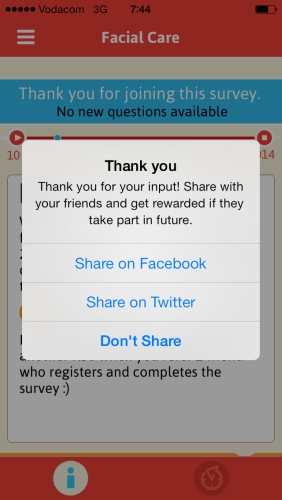
There is increasing innovation on the mobile front to aid marketers and retailers in consumer research. SA mobile company, Ovatoyou, has launched an app to invite consumers to share their thinking or images with a tap of their mobile – to anyone who asks – and be rewarded for it.

Amanda Reekie identified a gap in the mobile research space for the independent research app that harnesses the instantaneous, every-day, real-time accessibility that comes with owning a smartphone.

The ovatoyou app can be loaded onto an iOS, Android or Blackberry handset, and is an intuitive experience that allows brands to ask users up to 25 open or closed-ended questions or rate an experience on a sliding scale of one to five.

Consumers are incentivised in either cash, vouchers or eWallet cash.

Amanda Reekie, founder of mobile research technology, ovatoyou, says it adds a new dimension to traditional research as brands are now able to ‘see’ what people think. “So for instance, if a FMCG brand wants to know what a family eats for dinner Monday to Friday, an ovatoyou user simply takes a photo of their meal and shares it on the platform. This provides invaluable data in a snapshot.”

The core advantage of a smartphone research app, says Reekie, is that it is quick, instant and affordable. It also allows a panel of consumers who keep the app live on their phones, to share their opinions visually by uploading photographs.

Destination Mantis

Mantis

The Mantis Collection of luxury and eco-destinations around the world has launched a new website interface to enable booking tracking and other consumer-facing brand extensions.

Mantis is working hard at building its consumer-facing brand and the new website aims to reflect this with the calendar, integrated search function and tracked enquiry form systems. Over the next few months Mantis will be rolling out a booking tracking function too, to make online booking through the Mantis site easier.

Mantis is a family run collection of privately owned, five star properties located around the World, across all seven continents. Its specialist areas include Boutique Hotels, Game Reserves, Eco Lodges, Ski Lodges and Chalets and Boutique Cruises.In 2013, Mantis launched Mantis eXtreme which offers an online collection of authentic, once-in-a-lifetime encounters and experiences worldwide.

Louise MarslandShelf Life is a weekly column by Louise Marsland on MarkLives. Tweet new product, packaging and design launches to @louise_marsland or email her at louise.marsland at gmail.com. Want to sponsor Shelf Life? Contact us here.

Louise has written about the FMCG, media, marketing and advertising industry for 19 of her more-than-25-year career as a former editor of magazines AdVantage, Marketing Mix and Progressive Retailing, as well as websites Bizcommunity.com and FMCGFiles. Until its cancellation, she edited the weekly Wednesday Media & Marketing Page for The New Age newspaper. She is currently the publishing editor of industry trendwatching portal, TRENDAFRiCA,for consumer insight, research and trends in Africa.

— MarkLives’ round-up of top ad and media industry news and opinion in your mailbox every three work days. Sign up here!

#Top40TVratings: Idols season 10 makes Top 40

by SAARF & MarkLives (@marklives) Idols is back and has made it into our Top 40 DStv chart – on Mzansi Magic rather than M-Net interestingly. On the soccer front Orlando Pirates vs. Moroka Swallows hit both the national and the DStv chart.

A collaboration between the South African Audience Research Foundation (SAARF) and MarkLives, this SAARF/MarkLives #Top40TVratings column is a weekly roundup of South Africa’s TV audience viewership. It reveals the best-watched shows of the week before, where it ran and how many South Africans tuned in to watch.

We offer two tables, the first covering all households — free-to-air viewing (the various SABC channels and e.tv) as well as the DStv platform — and the second charting the best-watched shows on the DStv network of channels only.

SAARF/MarkLives #Top40TVratings Charts: 5 August– 11 August 2014

National

Market Target Activity
National Total Indv (incl guests) Live + VOSDAL
Counter Description (grouped) Channel Level 1 Level 2\Variable (r) AMR % AMR SHR %
1 GENERATIONS SABC 1 Soap opera LOCAL 22.5 9 649 192 69.67%
2 Soap opera 22.4 9 609 710 71.77%
3 MFOLOZI STREET SABC 1 Drama Drama 16.9 7 247 744 54.77%
4 SOUL CITY SABC 1 Drama Drama 14.3 6 145 696 47.66%
5 MAMA JACK SABC 1 Movies COMEDY 13.2 5 658 054 48.86%
6 SHREDS AND DREAMS SABC 1 Drama Drama 12.8 5 486 183 44.09%
7 STICKS AND STONES SABC 1 Drama Drama 12.5 5 365 395 39.76%
8 MUVHANGO SABC 2 Drama Drama 12.4 5 314 216 45.49%
9 SES’TOP LA SABC 1 Sitcom Sitcom 11.4 4 903 891 35.83%
10 ZAZIWA SABC 1 Variety Variety 10.2 4 360 605 33.69%
11 IHAWU SABC 1 Drama Drama 10.1 4 346 295 36.84%
12 ZULU NEWS SABC 1 News News 9.8 4 202 320 32.71%
13 XHOSA NEWS SABC 1 News News 9.7 4 179 170 33.63%
14 SELIMATHUNZI SABC 1 Variety Variety 9.7 4 147 912 31.18%
15 SCANDAL e.tv Drama Drama 9.6 4 101 614 30.92%
16 FRIENDS LIKE THESE SABC 1 Variety Variety 8.9 3 834 533 36.76%
17 1’S AND 2’S SHOW SABC 1 Music Music 8.4 3 598 482 28.60%
18 SKEEM SAAM SABC 1 Drama Drama 8.4 3 590 632 30.01%
19 POWERBALL SABC 2 Variety Variety 8.3 3 542 710 37.02%
20 REAL GOBOZA SABC 1 Magazine Magazine 7.7 3 306 977 27.73%
21 RHYTHM CITY e.tv Drama Drama 7.7 3 295 977 27.49%
22 SUNDAY LIVE SABC 1 Actuality Actuality 6.7 2 882 609 21.97%
23 MPONENG SABC 2 Sitcom Sitcom 6.7 2 856 558 23.69%
24 WWE WRESTLING RAW e.tv Sport WRESTLING 6.6 2 840 377 29.72%
25 STUMBO STOMP AMAPANSTULA SABC 1 Variety Variety 6.4 2 749 553 27.13%
26 SPEAK OUT SABC 2 Actuality Actuality 6.2 2 653 486 33.16%
27 WWE BATTLEGROUND e.tv Sport WRESTLING 6.0 2 567 204 37.11%
28 SKEEM SAAM -R SABC 1 Drama Drama 5.7 2 463 878 54.99%
29 100% YOUTH SABC 1 Variety Variety 5.7 2 452 993 24.00%
30 NEWS e.tv News News 5.7 2 425 432 19.12%
31 K’SHUBILE SABC 1 Reality Reality 5.7 2 424 721 21.50%
32 DATE NIGHT e.tv Movies DRAMA 5.6 2 421 011 22.50%
33 KHUMBUL’ EKHAYA SABC 1 Magazine Magazine 5.6 2 413 303 22.26%
34 MUVHANGO -R SABC 2 Drama Drama 5.6 2 403 129 37.87%
35 THE PRINCESS & THE FROG (MOVIE) SABC 2 Movies ANIMATION 5.6 2 402 846 27.29%
36 FAN BASE SABC 1 Music Music 5.4 2 327 712 25.03%
37 MUVHANGO -R SABC 1 Drama Drama 5.4 2 321 421 51.89%
38 WIPEOUT SABC 2 Competition Competition 5.3 2 280 397 19.42%
39 EMZINI WEZINSIZWA -R SABC 1 Sitcom Sitcom 5.2 2 250 084 51.15%
40 THE LINK (MAGA) SABC 1 Magazine Magazine 5.2 2 229 058 22.67%

DStv platform only

Market Target Activity
DStv Total Indv (incl guests) Live + VOSDAL
Counter Description (grouped) Channel Level 1 Level 2\Variable (r) AMR % AMR SHR %
1 GENERATIONS SABC 1 Soap opera LOCAL 16.3 2 201 202 49.80%
2 Soap opera 16.1 2 180 566 49.97%
3 MUVHANGO SABC 2 Drama Drama 9.5 1 282 083 33.62%
4 MAMA JACK SABC 1 Movies COMEDY 7.5 1 013 267 25.80%
5 SCANDAL e.tv Drama Drama 6.8 924 040 21.31%
6 MFOLOZI STREET SABC 1 Drama Drama 6.7 911 198 20.97%
7 ISIBAYA Mzansi Magic Variety Variety 6.7 904 378 21.48%
8 RHYTHM CITY e.tv Drama Drama 5.9 802 183 20.17%
9 POWERBALL SABC 2 Variety Variety 5.8 787 283 23.75%
10 SES’TOP LA SABC 1 Sitcom Sitcom 5.7 773 206 17.43%
11 ZAZIWA SABC 1 Variety Variety 5.6 757 243 17.74%
12 SELIMATHUNZI SABC 1 Variety Variety 5.4 735 910 16.24%
13 SPEAK OUT SABC 2 Actuality Actuality 5.3 711 790 25.72%
14 XHOSA NEWS SABC 1 News News 5.2 707 356 16.84%
15 SHREDS AND DREAMS SABC 1 Drama Drama 4.8 645 343 16.05%
16 SOUL CITY SABC 1 Drama Drama 4.6 626 978 14.42%
17 STICKS AND STONES SABC 1 Drama Drama 4.6 623 910 14.65%
18 NEWS e.tv News News 4.5 609 518 14.44%
19 ZULU NEWS SABC 1 News News 4.4 593 707 14.01%
20 KHUMBUL’ EKHAYA SABC 1 Magazine Magazine 4.3 580 988 16.76%
21 7DE LAAN SABC 2 Soap opera Soap opera 4.1 559 661 14.31%
22 FRIENDS LIKE THESE SABC 1 Variety Variety 4.0 542 299 14.40%
23 7DE LAAN SABC 2 Soap opera LOCAL 3.9 523 321 13.20%
24 REAL GOBOZA SABC 1 Magazine Magazine 3.6 491 183 12.25%
25 1’S AND 2’S SHOW SABC 1 Music Music 3.6 490 148 12.30%
26 ISIDINGO:THE NEED SABC 3 Soap opera Soap opera 3.6 483 822 11.83%
27 SKEEM SAAM SABC 1 Drama Drama 3.5 476 723 12.01%
28 OUR PERFECT WEDDING (MAG) Mzansi Magic Magazine Magazine 3.5 469 748 11.16%
29 MUVHANGO -R SABC 1 Drama Drama 3.2 436 937 28.59%
30 WWE WRESTLING RAW e.tv Sport WRESTLING 3.1 425 179 11.87%
31 IHAWU SABC 1 Drama Drama 3.1 423 617 10.74%
32 ISIDINGO:THE NEED SABC 3 Soap opera LOCAL 3.1 422 233 9.96%
33 ABSA PREMIERSHIP ORLANDO PIRATES VS MOROKA SWALLOWS SuperSport 4 Sport FOOTBALL(SOCCER) 3.1 421 929 12.24%
34 GA BOSE GANGWE SABC 2 Drama Drama 3.0 409 444 14.34%
35 SKEEM SAAM -R SABC 1 Drama Drama 3.0 408 164 26.65%
36 SAINTS AND SINNERS[DRAMA] Mzansi Magic Drama Drama 3.0 401 444 10.33%
37 THE BOLD AND THE BEAUTIFUL SABC 3 Soap opera Soap opera 2.9 395 692 11.81%
38 CARTE BLANCHE M-Net Actuality Actuality 2.8 381 979 8.44%
39 GENERATIONS -R SABC 1 Soap opera LOCAL 2.8 373 129 26.01%
40 IDOLS YR 10 Mzansi Magic Reality Reality 2.7 369 887 8.98%

How to read the tables:

AMR% refers to the number of people in a target market who were watching an event ie programme, expressed as a percentage of the population for that demographic: “On average, 16.3% of adults aged 15+ who watched TV from 28 Jan-3 Feb 2014 watched Society on SABC 1”.

AMR is the number of people in a target market watching a specific event ie programme per minute, expressed in absolute figures: “On average, 1, 541, 066 adults aged 15+ who watched TV from from28 Jan-3 Feb 2014 watched Society on SABC 1”.

Share % (SHR %) is the share or proportion of the available audience (people watching TV at that time) that a specific channel/programme has achieved at that time: “Society achieved a share % of 52.59% from 28 Jan- 3 Feb 2014 on SABC 1″.

saarf 150SAARF is the name by which the South African Audience Research Foundation is familiarly known. SAARF’s main objective is to direct and publish media audience and product/brand research for the benefit of its stake-holders, thereby providing data for target marketing and a common currency for the buying and selling of media space and time. SAARF has thus the responsibility to measure the audiences of all traditional media such as newspapers, magazines, radio, television, cinema and out of home media.

— MarkLives’ round-up of top ad and media industry news and opinion in your mailbox every three work days. Sign up here!

Online CPD Courses Psychology Online CPD Courses Marketing analytics software Marketing analytics software for small business Business management software Business accounting software Gearbox repair company Makeup artist