Grubstreet: Business Day managing audience shift from print to digital

by Gill Moodie (@grubstreetSA) Songezo Zibi is an unusual editor for unusual times.

Instead of working his way up through newsrooms, he spent many years in corporate communications before joining the Financial Mail and then becoming Business Day’s editor in May last year when Peter Bruce stepped aside after 13 years at the helm. Now he must lead SA’s premium business title through its roughest time.

Songezo Zibi, new editor of Business DayRetrenchments, declining circulation, falling ad revenue and minus the income from JSE company notices are some of the challenges facing Business Day – while trying to grow online advertising revenue and managing audience shift from print to digital.

What is striking about Zibi is how he is able to look at the paper very clearly from the outside, from a reader and advertiser’s perspective.

Take his explanation for Business Day’s recent revamp, for instance.

While the paper was due for a freshening up and it was necessary because decline in advertising has meant fewer pages, the most important reason for the revamp, Zibi told Grubstreet, was to align the paper with a more accurate idea of the Business Day reader that will make it a better sell to advertisers.

Zibi says that the general assumption has been that Business Day is read by older male executives at the very top of the organisation: the “decision makers”.   Yet market research and Zibi’s own experience working in the corporate world tells him that it is younger middle managers and professionals who are the quintessential reader.

“For example, when I moved to mining [from Volkswagen], the entire business-development team read the paper because they had to and none of them were GMs or executives.

“This partly explains the drop in circulation as there is a cost issue because it’s companies that subscribe to Business Day and when they cut costs, they cut the number of subscriptions.

“Another reason [for circulation decline] is that the new reader who should be picking up the paper because it talks to him or her just isn’t… As an example, Business Day has for a long time had a wine column, which is fine, but there is an explosion of whisky consumption in the country and Business Day doesn’t think it’s important.”

There is also growth in women middle managers, he says, to which the paper has not paid enough attention.

Business Day 2015 03 13“Our inability to reflect these insights in the paper means that you have no story to tell the advertisers. I’ve been on the other side of the fence, where BDFM [Business Day-Financial Mail unit now completely folded into Times Media Group] people approached me and all they could tell me was that the readers were the ‘decision makers’ and that kind of thing. I’m not sure how that helps Johnnie Walker resolve their questions about which channel offers the best value for money.

“I want them [the ad sales people] to be able to go to a luggage company and say: ‘Do you know that 55% of our readers travel x number of times per year on average’.”

It is evident that the news content has hardened up and gotten spunkier under Zibi. Further, the revamp means there are fewer stories on the front page and fewer turns.

The new editor is also striving to get more of the main front-page picture and headline higher above the fold.

“We’ve also given our page designers a bit more latitude. I’ve encouraged them to try new things. So we [colour] wash stories now, which we never, ever used to do. We’re using pictures bigger and we’re trying to improve our graphics.”

Previously, the first section of Business Day was mostly for news and the second section was for companies and markets. Now the first section has hard news, business and economy, and companies and markets while Section 2 is for reviews, opinion and analysis.

On the news of a new round of retrenchments – this time in the subsroom – Zibi says he believes Business Day has one of the biggest subsrooms in country. Further, some of the subbing is now done in advance so fewer people are needed on the day before publication.

“Our cost per page is high compared to other broadsheets… and that’s not ideal in a tight economy.”

Meanwhile, Zibi is encouraging his reporters to get out more rather than get sucked into JSE company announcements.

“I’m out of the office quite a bit… and I don’t crap on reporters for missing a SENS [Stock Exchange News Service] announcement. If you’re out somewhere and you missed a SENS announcement, tough. We’ll catch up.

“We’re also trying to wean everyone off the dependence on the announcement at the press briefing so we push the guys to decide to ask somebody a question about something that’s important. For example, we decide to ask the minister of finance about SAA. We can’t wait for the announcement. We decide we need to ask the minister repeatedly about what he is going to do about SARS. We need to be more aggressive. Half the time, this gives us nothing; the other half it gives us something.”

Because Business Day’s audience is monied, many have migrated to digital.

Zibi says a new app is in the works while he confirmed to Grubstreet that the paywall on BDLive had been dropped.

“My view is we’re never going to see exponential grown in print because people are moving to digital and we need to focus more on expanding digital in a way that doesn’t cost additional money and provide additional real estate in the print product.”

The most recent circulation figures (for the last quarter of 2014) put Business Day at 30 883 total sales compared with 33 667 in the fourth quarter of 2013.

Zibi says unique users were at about 482 000 a month for BDLive, which makes a modest profit.

He believe that publishers will not have the luxury of deciding when the big switch to digital will happen.

“One day a cheap, good tablet will be on the market with free apps… If we can’t stay one step ahead of that game, we will die – and that is true for every newspaper. I believe you have a far greater chance of convincing people to pick up a cheaper digital offering than to convince them to pick up a newspaper.”

Is it too much for a publisher or editor to expect audience members to be brand-loyal today when social networks direct one to online content throughout the world?

Zibi believes it is more important to understand patterns of media consumption – time, place and devices.

“How much time does anyone have now? And how much do you get bombarded by emails and phone calls – and emails on your phone. Do I want to insist that people sit down and read the Business Day [newspaper] for 30 minutes when they will likely read it while they on the move? If I am to retain their loyalty, I should stop trying to make it so damn hard for them to consume it.”


Grubstreet with BizNews logo


South Africa’s leading media commentator, Gill Moodie (@grubstreetSA) offers intelligence on media, old and new. Reprinted from her site Grubstreet with Biznews.


— MarkLives’ round-up of top ad and media industry news and opinion in your mailbox every Monday and Thursday. Sign up here!

Shelf Life: David Adjaye to transform Hallmark House, new name for Orlando Stadium

Louise Marsland (@Louise_Marsland)’s weekly pick of recent product, packaging, design and food launches:

  • Hallmark House is transforming into designer mixed-use space in Maboneng
  • Lipton launches a new combination iced tea flavour
  • Protea Fire & Ice! Menlyn opens, and
  • the rebrand of Orlando Stadium is underway

Hallmark House R200m redesign

Hallmark House, Maboneng: exterior facadeThe landmark Hallmark House, described as an “iconic post-modernist building”, is being transformed into a R200 million luxury residential tower, hotel and retail space which is meant to add to the expanding regeneration of the Maboneng Precinct in the Johannesburg East central business district.

What makes this development distinctive is that it is being repurposed and redesigned by David Adjaye OBE, the principal architect and world-renowned Tanzanian-born British architect responsible for the recently designed US$360 million Smithsonian National Museum of African-American History and Culture in Washington DC. He describes himself as passionate about Africa and urban regeneration.

The 66-metre-high modular structure was originally designed by Greg Cohen in the early 1970s to house a growing diamond-polishing industry. Flexible and modular in structure, it was versatile enough to house light-industrial, showroom and office spaces.

Hallmark House, Maboneng: interiorHallmark House, Maboneng: exterior
The 17-story building will be home to a luxury hotel, apartments, retail space and wellness facilities (gym, swimming pool, etc.) and is aimed at attracting the new design-conscious, city-loving professional and investor to town in the popular Maboneng Precinct, which is becoming world-renowned for the redevelopment and rejuvenation of a major city such as Johannesburg.

Landmark tenants will include the expansion of Cape Town’s The Grand Café with the launch of The Grand Café Roof Top Bar on the top floor of the building, alongside Smack! Microbrewery and The Bioscope outdoor cinema.

The development, by Propertuity, is underpinned by solid security and a high-speed-technology infrastructure, offering 24-hour security staff, an in-house concierge, a biometric fingerprint system, a CCTV-camera system, high-speed internet and wifi.

According to Adjaye, Johannesburg’s Eastern CBD regeneration is perfectly in line with what is happening around the world, and points at Hackney in London’s East End and New York’s Meatpacking District as examples.

The glass-panelled tower is scheduled for completion in May 2016 and residential sales opened mid-March this year, with apartments priced from R495 000 for a studio of 35m2.. There are also two-bedroom options of 300m2 with terraces.

Social media: @propertuitySA @AdjayeAssoc

Green tea with a Lipton twist

Lipton Green Ice Tea Pear & PeachA major FMCG product trend in recent years has been the addition of healthier benefits to products. Lipton Ice Tea has just launched its first combination flavour, the new Green Ice Tea Pear & Peach flavoured variant.

According to Neo Phiri, marketing manager of Lipton Ice Tea, the iced tea market is experiencing rapid growth both globally and locally. The new variant is intended to refresh and uplift.

The launch is being supported by an integrated marketing campaign, including in-store activations, a radio campaign, and PR.

“We will also put a major focus on offering sampling of the new flavour combination nationwide over the next three months in order to get consumers to try the naturally refreshing flavour combination,” adds Phiri.

Social media: @LiptonIceTeaSA

Protea Hotels heat up Menlyn Park

Protea Hotel Fire & Ice! Menlyn Park: bedroom. Pic by Hamish Niven.
Pic by Hamish Niven.

After a three-year design and construction project, the designer Protea Hotel Fire & Ice! Menlyn Park has opened its doors with reports of superior design and artistic elements. There’s a 17m Chesterfield couch in the lounge, an Olympic-length lap pool, stairwell graffiti, light features and other trendy indoor/outdoor spaces.

Plan 1 is the branding and design agency behind this.

“With [each] Protea Hotel Fire & Ice! property the Protea Hotels group opens, we have pushed the envelope on style and have set trends. Pretoria is no different,” says Mark Satterfield, Marriott International business leader in South Africa.

The new hotel is situated next to the Menlyn Park shopping mall and close to the N1 highway. It is designed for the “millennial traveller” and visitor. The social areas is meant to flow easily from dining to indoor lounging and then to outdoor lounging in the outdoor living room, where social pods with their own individual fireplaces are spaced around the Olympic-length swimming pool. There is free unlimited wifi, across multiple devices.

Protea Hotel Fire & Ice! Menlyn Park. Pic by Hamish Niven.
Pic by Hamish Niven.

The signature decadent milkshakes and gourmet burgers are on the menu, too, plus food-and-drink pairing events. But what should set the hotel apart is that it is said to have one of the largest and most flexible conferencing facilities in an on-trend design environment.

The ground floor can accommodate up to 350 delegates and the first floor up to 250 delegates. Each of the large spaces, filled with natural Highveld light from floor-to-ceiling windows, may also be divided in half to provide to discrete, soundproof conference rooms. On the first floor, the conference offering is further enhanced by two conference suites which consist of a boardroom each with an en-suite lounge. These may be used for breakaway groups or for smaller meetings, either together or as stand-alone venues.

Rebranding Orlando Stadium

Lafarge Orlando Stadium Teaser Pylon BoardsSouthern Africa building-materials manufacturer, Lafarge South Africa, recently concluded a sponsorship deal with Stadium Management South Africa (SMSA) for the exclusive naming rights to the famous Orlando Stadium in the heart of Soweto. It will be known as “Lafarge Orlando Stadium” from May 2015.

The rebrand is currently underway and the transformation of the stadium will be revealed next month at the unveiling of the new branding.

First built in 1959, Orlando Stadium has a rich and proud history associated with soccer, entertainment and the surrounding community’s involvement in the political struggle for recognition. Demolished in 2008 and rebuilt at a cost of R280 million, the new 35 000 capacity stadium featured in the 2010 FIFA World Cup.

Lafarge SA is the local presence of the international Lafarge Group. The latter’s brand baseline “Building better cities” is founded upon the global trend to urbanisation and reflects Lafarge’s commitment to help create cities that are desirable, sustainable environments for all people.

“Everywhere you look in South Africa, you see the reality of urbanisation,” says Ken MacLean, Lafarge South Africa’s country CEO. “The rural village of today will be the city of tomorrow. Informal settlements, villages, towns and existing cities are growing rapidly and must become viable, sustainable communities. Communities that need decent housing, hospitals, schools and offices, together with the associated infrastructure to connect and service cities, such as roads, airports, water and power utilities.

Comments Lafarge SA’s country marketing manager, Alta Theron, “The exciting branding project with Orlando Stadium will emphasise that we have always been, and always will be, very much a part of the South African community.”


Shelf Life is a weekly column by Louise Marsland. Tweet new product, packaging and design launches to @louise_marsland Louise Marslandor email her at louise.marsland at gmail.com. Want to sponsor Shelf Life? Contact us here.

Louise has written about the FMCG, media, marketing and advertising industry for over 20 years as a former editor of magazines AdVantage, Marketing Mix and Progressive Retailing, as well as websites Bizcommunity.com and FMCGFiles. She also edited the weekly Wednesday Media & Marketing Page for The New Age newspaper. She is currently the publishing editor of industry trendwatching portal, TRENDAFRiCA, for consumer insight, research and trends in Africa; a regular industry columnist and speaker; a consultant on content strategy; and contributing editor to Fast Company South Africa magazine, which has just launched in South Africa.

— MarkLives’ round-up of top ad and media industry news and opinion in your mailbox every Monday and Thursday. Sign up here!

Media Future: What Samsung Pay means for the mobile payments market

by Arthur Goldstuck (@art2gee) The announcement of Samsung Pay, in direct competition with Apple Pay, is a signal that payments with mobile devices are growing up.

Once a year, Barcelona plays host to an event that signals the key shifts in mobile technology, setting the agenda for personal gadgets for the rest of the year. Mobile World Congress 2015npushed the boundaries just a little further than usual.

Trapped With Money by jesadaphorn courtesy of FreeDigitalPhotos.net
Image by jesadaphorn courtesy of FreeDigitalPhotos.net

The most significant announcement of the week was not a device, however, but a new way of doing something as old as civilisation: making payments.

When Samsung unveiled its new Galaxy S6 and S6 Edge, it also declared the next phase in its war with Apple. Back in September, Apple had announced the iPhone 6 and 6 Plus, along with a payment system called Apple Pay. The similarity in names is no coincidence. Samsung wants to make it clear that, not only is it playing in the same space as Apple, but it is doing it better.

Apple Pay works through NFC, or near-field communication, which allows the sending of data from one device to another with a single tap. That data can include files, photos and payment or transactional information, if it has been set up in advance. As a result, a single tap, authenticated via the fingerprint sensor on the iPhone 6, can conclude a transaction at an NFC terminal in a retail outlet.

Samsung Pay goes a step further. While it also offers fingerprint verification and NFC, which is still in limited use in the retail world, it ups the ante with MST, which caters for the vast majority of retailers who still use magnetic stripe card readers.

MST, for magnetic secure transmission, allows a device to be placed alongside a card terminal and send a radio signal that mimics the interaction of the magnetic stripe on a card with the terminal. It instantly allows Samsung Pay to be compatible with any retailer in the world that accepts credit, debit or payment cards.

Samsung’s leapfrog over Apple was made possible by its acquisition, earlier this year, of a company called LoopPay, which describes itself as “the world’s first mobile wallet solution that allows consumers to pay with their mobile devices at most places and leave their wallets at home”.

The LoopPay solution, as it existed prior to last week’s announcement, consisted of a LoopPay App and a LoopPay device, which worked in tandem.

“The App manages and securely stores all payment cards including credit, debit, loyalty, and gift cards on the device,” LoopPay explained. “Currently, we offer the LoopPay Card, CardCase, and a stand-alone Case for iPhone 5/5s, 6, and 6 Plus.”

The company’s explanation of how LoopPay works provided no inkling of the scope of Samsung Pay, as it implied any manufacturer could use it. Samsung turned the market on its head with one simple innovation: it built the LoopPay technology into the Galaxy S6 and S6 Edge, instead of providing an accessory device.

The result is that the phone merely needs the app to be activated for it to run Samsung Pay. It also means that the accessory case for iPhones is almost instantly obsolete.

The service is initially being launched in Samsung’s home territory, South Korea, and in the United States – a direct challenge to Apple. There is no timeframe on its roll-out elsewhere, which suggests Samsung is initially more focused on taking on Apple than on serving consumers.

That is also, most likely, the reason for the cut-and-paste branding of the payment service. It may be the snappiest possible title, but calling it Samsung Pay is also the most sincerest possible form of flattering Apple. If the wheels come off this particular bandwagon, it will be more than a financial disaster for Samsung.

Later this year, American retailers will be required to implement EMV (Europay MasterCard Visa) “chip-and-pin” terminals, which may well have to include NFC technology. That opens the rest of the US market to Apple, but still leaves Samsung with a global edge.

In the meantime, other challengers are likely to emerge. Rumours have already surfaced that LG Electronics will build payment technology into the next version of its flagship phone, to be called the LG G4. Numerous mobile payment applications will also have to change their game or find a way to integrate or add to the two Pay systems.

Google Wallet, which was once expected to dominate mobile payments, is fast fading into the background. Its near-demise is a timely lesson to the Pay masters of the mobile world that market domination in one arena does not automatically lead to market success in another.

Arthur Goldstuck heads up World Wide Worx (www.worldwideworx.com) and is editor-in-chief of Gadget. He is a consulting editor to MarkLives and our media tech columnist. Follow him on Twitter on @art2gee. This article has been republished from Gadget.

— MarkLives’ round-up of top ad and media industry news and opinion in your mailbox every Monday and Thursday days. Sign up here!

#3D: This is no #AprilsFool — are you ready for Google’s imminent algorithm update?

by Prakash Patel (@prakashpatel_1) On 21 April 2015, Google will launch its most important update to its mobile algorithm, which will have a significant impact on mobile search results as quoted by Google’s Zineb Ait Bahajji at SMX Munich on the morning of 17 March.

So what does this mean in laymen terms?

If you have a mobisite (if not, make it your priority above all other marketing activity today and don’t tell your shareholders), you need to ensure it is mobile-friendly to rank better in any mobile search.

Google Classic SearchWhat’s all the fuss?

What this basically means is that Google’s mobile ranking factors will not only label your site as mobile-friendly but will also use that to determine if your site should rank higher in its search results.

Search label was launched in November 2014, where Google added a text label under the URL in the snippet that’s reads “mobile friendly”. By the way, you will be surprised to see how many digital agencies, let alone brand sites, are NOT mobile-friendly, based upon Google’s Label. If you want to test how mobile-friendly your mobisite is free of charge, check here.

Getting rewarded for mobile searches only!

Anyway, this update is set to improve rankings for sites that provide a mobile-friendly experience to searchers on mobile devices, eg, searches from either smartphones and/or tablets — not searches conducted from your desktops (PCs or laptops).

Google also said “users will find it easier to get relevant, high-quality search results that are optimized for their devices.”

So that’s good news from a mobile-user perspective and demonstrates the continued roll out of Google’s long-term vision for better mobile-user and -search experience (as it should be). We all know how frustrating it can be when carrying out searches on mobile phones, only to land on a page where you can’t click on a link without zooming in (another way Google determines your search label ranking).

Mobile apps that Google indexes to rank better in mobile search

Also, Google further said that, starting right now, apps that are indexed by Google through App Indexing will begin to rank better in mobile search. Google said this only will work for signed-in users who have the app installed on their mobile devices, which means only Android apps today.

So why should you care (even more)?

Inadvertently, these changes will affect South Africa more! Why? Because, as you know, South Africa is a mobile-first country — not PC-first.

And smartphone penetration is growing rapidly. Statistic quoted by Arthur Goldstuck is highlighting that SA, in 2015, is already reaching close to 23.5m smartphones — that’s almost five times the number of smartphones of 2010, compounded by almost 50% of all searches being from a mobile device and growing to a predicted 60% in 2015.

Agencies put so much effort to ensure websites are built to be search-friendly and -optimied, but do not (or do not know how to) ensure we build user- and search-friendly mobile sites. It’s an effort that will help you reap instant rewards — acknowledged by Google.

So, let’s get started

Here’s a quick tip list from Google to get you started or thinking mobile-friendly first . You also need to ensure that you understand how your users access your site and, in particular, where they come from (ie which device: computer or mobile?).

If it’s mainly through desktop, then the impact of the new algorithm may initially be minimal upon your site’s ranking — but that doesn’t mean you shouldn’t build or have a user- and search-friendly mobisite.

However, if there is significant mobile or tablet use, then you may need to act quickly. In fact, get to work on it now as 21 April is just around the corner and Google’s clock is ticking… Tick tock tick tock… and I am sure you don’t want to be anyone’s #fool.

Happy #3D!


Prakash Patel, October 2014


Prakash Patel (@prakashpatel_1) is chief strategy officer at Fogg Experiential Design, a digital and experiential agency based in Johannesburg and Cape Town that believes in the power of creative ideas and the technical magic that brings them to life.

He has over 25 years of experience in advertising, digital and data planning, a passion for integrated marketing strategies, and believes that the holy grail of marketing has always been — and always will be — data. Prakash contributes the monthly “#3D” (Data-Driven & Digital) column to MarkLives.com, exploring how data-driven and digital marketing can add value to marketing communication.


— MarkLives’ round-up of top ad and media industry news and opinion in your mailbox every Monday and Thursday. Sign up here!

April 1: Punk’d by the media

by Herman Manson (@marklives) April 1 is the one morning of the year Team MarkLives doesn’t mind struggling out of bed early and switching on the computer screen. It’s April Fool’s  Day and we’re unashamedly media geeks, so let’s get to some of the stories spooking sleepy news junkies this morning.

Last year Helen Zille would be forgoing her normal lifestyle as Western Cape premier and be moving into the township of Khayelitsha for the last two weeks before the 7 May elections. The SABC, Independent News & Media and Gupta-owned The New Age/ANN7 were also set to announce that they are merging into one giant entity whose goal would be to, once and for all, tell the definitive truth about South Africa; day in, day out, on all media channels, until Jesus comes.

This year sacked Cosatu Secretary General Zwelinzima Vavi is replacing Julius Malema at the head of the Economic Freedom Fighters, DStv finally gets some competition and Eskom announces “loadshedding stage 3G.”

Some April Fool’s highlights from around the South African web

Daily Maverick: Vavi joins EFF as interim head

dm

In a stunning move that took almost every political analyst in the country by surprise, sacked Cosatu Secretary General Zwelinzima Vavi will replace Julius Malema at the head of the Economic Freedom Fighters until the Commander in Chief has warded off corruption charges. And along with him comes another out-of-left-field appointment.

Our favourite bits: “We are a Marxist-Leninist Fanonian party,” Malema stated. “And Vavi has read almost all of those books.” and “He is a peerless locator of buildings,” said deputy president Floyd Shivambu. “We should have a nice new home shortly.”

Business Day: Turkish company floats power ship idea to buoy Eskom’s capacity

bdlive

THE Department of Energy is poring over plans to source electricity from energy ships and power barges that could save Eskom millions.

IOL: A new kind of loadshedding for SA?

iol

Eskom plans to disconnect mobile Facebook and WhatsApp users from the internet. In what is termed “loadshedding stage 3G”, the power utility thinks it has a new way to save electricity.

MyBroadband: MyBroadband launches DStv competitor

myb

MyBroadband has partnered with international content providers to launch MyBroadband TV – a DStv competitor offering over 100 channels for only R99 per month.

Memeburn: Memeburn goes back to the future with Y2K – Cyber rebrand

meme

The new name, Y2K — Cyber, take its cue from the halcyon days of the dotcom boom as does the retro feel of the branding. Fun fonts, a space-inspired background and an assertive tagline all come together to reflect an online publisher that knows where its future lies.

Local brand pranking

Shoprite Group: Shoprite announces GPS Smart Trolley

checkers

The Shoprite Group has announced the launch of a shopping trolley with GPS to direct consumers fast and effectively, also alerting them to discounted products and promotions while instore.

Safarinow: Nkandla – the Ultimate Getaway

safarinow

safarinow 2

Nestled between the picturesque towns of Kwanskop and Eshowe in rural KwaZulu-Natal, close to the rolling hills of Magengela and just two hours from the tranquil lagoon resort of Richards Bay, this simple homestead – recently renovated to the tune of R250 million – offers everything the discerning family demands in luxurious holiday extravagance.

Some April Fool’s highlights from around the global web

The Guardian: Jeremy Clarkson joins Guardian drive for fossil fuel divestment

guardian

The disgraced former Top Gear presenter Jeremy Clarkson has become the latest celebrity to support the Guardian’s campaign for fossil fuel divestment.

Following what he described as a “dark night of the soul”, Clarkson said he hoped to “regain the trust of the British public” by dedicating his time and financial resources to sustainable energy, road safety and forging mutual understanding and tolerance between people of different cultures and religions.

— MarkLives’ round-up of top ad and media industry news and opinion in your mailbox every Monday and Thursday. Sign up here!

Bad ADvice: Give your ad the Mzansi Moment

by Every Ad Agency (@EveryAdAgency) More and more clients today demand authentic South African advertising that speaks to the citizens of our great country. Here at Every Ad Agency, the moment the words “localise it” are thrown our way, we don’t break even a hint of sweat as we have a very handy checklist of non-negotiables that make sure our ad is loved by millions across the country.

South Africa Flag On Hand by domdeen courtesy of FreeDigitalPhotos.net
Image by domdeen courtesy of FreeDigitalPhotos.net

1. Soundtrack is everything

Always go with My African Dream. That is the ultimate first option. South African viewers simply love hearing this beautiful anthem on every single ad they see. It worked for the Lotto, works for SARS, will probably work your next hand-sanitiser commercial.

If it feels a bit predictable, other go-to favourites are anything by Johnny Clegg, or Jabulani by PJ Powers. If all else fails, and budget is tight, Nkalakatha by Mandoza is your saviour.

2. Include a montage of memories

Open on a shot of Table Mountain. Fade into a pan of Vilakazi Street. Cut to Joel Stransky kicking the ’95 World Cup drop-goal. Fade back to rolling hills somewhere in the Free State. End on people randomly walking to FNB stadium for some event. Thank us later.

3. ‘Gooi’ some ‘lekka’ lingo

In South Africa we mix up our languages. It’s literally almost the only thing we known for. So ensure you make the dialogue in the commercial barely comprehensible by throwing some local slang around.

Have a few people ironically saying “eish”, a housewife from Houghton saying “now that’s lekker” in her worst black accent ever and, for the cherry on top, some uncomfortable-looking farmers saying “yebo”.

4. Zalebs are power

There’s no bigger brand endorsement than having a South African celebrity talk about your brand, because, if they use it, your consumers certainly will.

Every housewife wants the hairless, silky smooth legs of the Miss SA from eight years ago. Every middle-aged man wants the chiselled abs of the gold medal swimmer selling him cereal. Every person with a cellphone wants the riches they obtain when saving from the low data costs by the cellular provider their favourite soap star is punting. Simple maths, really.

5. Rainbows. EVERYWHERE.

Do we even need to explain this?

With this handy checklist nearby, we guarantee that you will impress any foreign-based brand manager with no knowledge of South African culture. We promise you will win some sort of Ubuntu award at one of the local ad shows. And there’s a 72% probability your brand will rocket to the top of the ‘coolest’ brand survey in the Sunday newspapers.


Every Ad Agency logoWe are Every Ad Agency (@EveryAdAgency). You’ve either worked for us, with us or against us. What’s more, we make every advertising and marketing cliché work. Headquartered in Johannesburg; branches everywhere.

All these satirical “Bad ADvice” columns, which are exclusive to MarkLives, are written by the Chief Operating Creative Director in Charge of Ideas (COCDCI).


— MarkLives’ round-up of top ad and media industry news and opinion in your mailbox every Monday and Thursday. Sign up here!

Ad of the Week: Enter the imaginarium

by Oresti Patricios (@orestaki) PPC Ltd has come up with a new promotion that radically reinvents the more-than-100-years-old cement brand.

Pretoria Portland Cement Company Ltd, or PPC as it is known, has decided that it needs to get people to think differently about its product. It is doing this by asking artists and designers to be creative with cement and concrete — and to use the material in a number of artistic ways, from sculpture and architecture to fashion and jewellery.

PPC Imaginarium Design IndabaInstead of focusing on concrete’s core property — its structural strength, that makes it well suited for large buildings, dams, power stations and bridges — PPC has been asking young South African artists to consider concrete as a source of inspiration for their art.

For this campaign, the cement manufacturer has created the PPC Imaginarium Awards, an initiative that revolves around an annual competition that offers up generous prizes for innovative uses of concrete.


This year, the prize-giving ceremony coincided with Design Indaba in Cape Town, which provided a showcase for the finalists’ and winners’ creations.

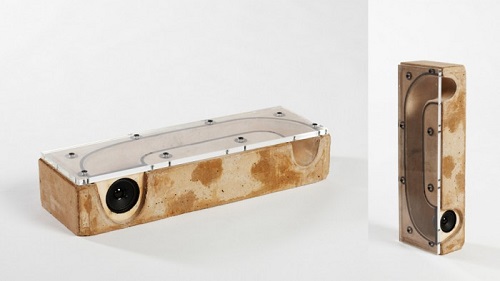
PPC Imaginarium Craig Tyndall and Martin Bolton Industrial Design The overall winners were two industrial designers, Martin Bolton and Craig Tyndall, who designed and built an audio speaker made from a combination of concrete, leather and acrylic. The two shared the grand prize of R100 000, and the winners in each category earned R50 000 each, with prizes of R15 000 being awarded to the runners-up.

But it’s not just about the money. Each category winner also has the opportunity to be mentored by an established artist in that field. Workshops and exhibition opportunities are also offered annually, as well as promotion of the artist through the media and online. PPC claims, through this project, to be “one of the biggest supporters of the Arts fraternity in our country”.

PPC has been in business for 123 years, and currently manufactures 8 million tons of cement products a year. Already operating in Botswana and Zambia, it is currently expanding into Algeria, DRC, Ethiopia, Mozambique, Rwanda and Zimbabwe.

The dedicated site for PPC Imaginarium, www.ppcimaginarium.co.za, is well-designed and stylish, with clear photographs and inspirational stories from the winners and some of the mentors.

PPC Imaginarium Mhlonishwa Chiliza SculpturePPC Imaginarium Bokang Lehabe Fashion WinnerPPC Imaginarium Chris van Rensburg Jewellery
The arts appeal to society’s higher self, to our sense of identity and value. The arts can tell stories that touch people throughout the ages. In every era, artists have been sponsored in different ways by those who understand why it’s important.

That’s the reason this week that, instead awarding “Ad of the Week” to an advert, I’m celebrating a campaign that has a positive influence in society while simultaneously improving the image of the brand in a way that is unexpected and innovative.

What better way to do this than with a place and a space that’s devoted to the imagination? An imaginarium that stimulates the best part of what it means to be alive, to think, to create and to be an artist.

I, for one, will never look at cement in quite the same way again!


Oresti PatriciosAd of the Week, published on MarkLives every Wednesday, is penned by Oresti Patricios (@orestaki), the CEO of Ornico, a Brand Intelligence® firm that focuses on media, reputation and brand research.


If you are involved in making advertising
that is smart, funny and/or engaging,
please let Oresti know about it at info@ornicogroup.co.za.


— MarkLives’ round-up of top ad and media industry news and opinion in your mailbox every Monday and Thursday. Sign up here!

Green Sky Thinking: Waste not, want not, with wonky food

by Colwyn Elder (@colwynelder) Asda, the UK’s second-largest retailer, recently began a campaign encouraging customers to buy “crooked” carrots, “knobbly” pears and “wonky” potatoes.

An attempt to reduce food waste, the “Beautiful on the Inside” range is sold in a dedicated fixture at a discounted price, and is based upon the research that 75% of shoppers would buy ‘wonky’ fruit and veg if they were cheaper than regular produce, according to the retailer.

Wonky veg. Source: your.asda.com
Source: your.asda.com

Prior to 2009, a controversial EU ban on fresh produce that failed to match standard shapes and sizes resulted in an estimated 20% to 40% of UK fruit and vegetables being routinely rejected before it reached the shops.

Yet, even post the ban, veg appeared to retain its perfect shape. The farmers blamed the supermarkets for not relaxing size and shape requirements, while supermarkets blamed consumer demand for unrealistically perfectly shaped produce.

Asda’s “beautiful on the inside”

Asda’s “beautiful on the inside” initiative attempts to redress this unrealistic expectation and educate customers that you shouldn’t judge a book by its cover.

The campaign has also featured in the first episode of Jamie Oliver’s new series, Jamie & Jimmy’s Friday Night Feast, whereby the celebrity chef and farmer Jimmy Doherty investigate the extent of food waste in the UK. Here the message comes direct from the source, with farmers telling their story of how they are unable to sell thousands of tonnes of fresh produce because it is deemed to be wonky or ugly.

[Please note that this YouTube video below is the full 45-odd minute episode of Jamie & Jimmy’s Friday Night Feast — ed-at-large.]

“If most Brits had half an idea of the amount going to waste,” says Oliver, “they’d be snapping up ugly veg by the trolley load. There’s no difference whatsoever in taste or nutritional value. This is perfectly good food that could and should be eaten by humans.”

Intermarche’s “Inglorious fruits and vegetables”

While it has received a lot of media coverage, this is not the first campaign of this nature. After the European Union declared 2014 to be the Year Against Food Waste, French retailer Intermarche’s cheeky “Inglorious fruits and vegetables” campaign went viral in March.

Intermarche – ‘Inglorious Fruits and Vegetables’ from Goodvertising on Vimeo.

The trial was such a success that the supermarket rolled out the initiative across its 1800 stores later in the year, with other French supermarket chains such as Auchan and Monoprix following suit.

Woolworths Australia’s “The Odd Bunch”

And it’s not only Europe that’s buying “wonky”. Down south in Australia, Jamie Oliver is also working with Woolworths, where The Odd Bunch campaign directly asks shoppers to choose “taste over waste” and “support our Aussie farmers”.


Pick n Pay’s “Imperfectly good”

Pick n Pay 2014 Imperfectly Good campaignAt a local level, Pick n Pay’s “Imperfectly good” campaign offered 40% off and generated much interest in the five stores where it trialed (and sold out!) in August last year.

What with figures from the UN Food and Agricultural Organisation showing that as much as 40% of fruit and vegetables go to waste worldwide, largely because they don’t meet cosmetic standards, all of these campaigns are a welcome wakeup call.

For retailers, finding the right balance between price and quality is an ongoing battle, but this idea enables them to offer lower prices on products where quality is ultimately about taste, not the girth, length or colour of an artificially created, perfectly streamlined carrot.


Colwyn Elder


Strategic consultant Colwyn Elder (@colwynelder) brings a global perspective to the issue of sustainability, having lived and worked in London, Tokyo, Amsterdam and Cape Town. She contributes the monthly “Green Sky Thinking” column on sustainability issues to MarkLives.


— MarkLives’ round-up of top ad and media industry news and opinion in your mailbox every Monday and Thursday. Sign up here!

Homegrown: Lessons from the streetside hair salon

by Lynne Gordon (@lynne_gordon) Classical marketing was built on touchpoint management, aiming for exceptional delivery of key moments of truth, be that at the shelf or in the usage occasion. In a new marketing landscape, as touchpoints fragment and competition proliferates, a new demand for integrated customer experiences emerges.

For marketers, this requires new skills; for organisations, it demands new ways of working. But for the neighbourhood salon owner, it’s business as usual — providing gritty lessons in the art of customer-experience management.

After Eight Beauty Salon, Johannesburg. Pic by Thabang Leshilo

The salon experience

After Eight Beauty Salon operates from a modest space on the streets behind Park Station, Johannesburg. As the name suggests, the salon is open late, designed to service busy millennials who arrive after work, and settle in for four hours with three hairdressers working to complete a head of braids. There’s no closing time here; salon hours are determined by the customers.

The hairdresser examines her customer’s hair with an expert eye. After sharing the story of a client, whose breaking, thinning hair was restored in just three weeks using T444z, she recommends the lady in front of her use it, too. It’s a minute 150g tub, for R400, but to the client with the problem, it seems a bargain. Without expensive advertising, smart branding or celebrity sheen here, recommendation rules.

Thuli will only have her hair done at Mangkosi’s Salon in Rosettenville, Johannesburg. Clustered in the store are a hair salon, nail bar and hair extension specialist alongside a small internet café and cellphone shop offering repairs, airtime and accessories. While she has her hair done, she has a Hunters Dry brought in, along with some food from the local chisanyama, which she shares with her stylist. In the background, a Nollywood movie plays, provoking lively debate on the latest drama going down.

This is the ultimate customer-experience economy, built upon a mastery of the complete consumer interaction, designed with the client at the centre. It’s the sum of small details that keep loyal customers returning to their hair salon, and it’s the story of the full experience that is passed on through word-of-mouth, bringing in new customers.

The journey to growth

It’s clear that good consumer journeys fuel brand growth. A focus upon the customer experience positions brands to derive benefits of differentiation, repeat purchase, premiumisation and reduced churn.

It’s hard, because brands are not running a single hair salon, and are faced with channel fragmentation, market clutter and long value chains. Brands that crack it — from Red Bull to Nike and Yuppiechef — will benefit disproportionately precisely because the bar is tough to meet.

So what do these brands stand to gain?

1. Great customer experiences offer a compelling path to differentiation in cluttered markets. The hair-salon owner understands that differentiating based on products and services alone is simply insufficient in a landscape where an estimated 40 000 informal salons proliferate the choices available for consumers.

Yet ask any black woman with a weave and she’ll tell you that she’ll drive miles to her favourite salon in the backstreets of Braamfontein, even when she lives and works in Sandton. Experiences count, differentiating brands which offer as much value in the interaction as they do with the product or service they provide.

Red Bull has built a media empire delivering an immersive brand experience centred on extreme sport, enabling it to face the onslaught of “me to” energy drinks with a clearly differentiated experience that’s hard to replicate.

2. Compelling customer experiences create new opportunities to cross-sell and up-sell consumers, growing revenues from selling more products to existing customers.

Just as with the R400 T444z sale, great customer experiences set a different bar for acceptable pricing, allowing Woolworths to command a premium in a highly competitive retail landscape, and taking me back to buy the next must-have kitchen gadget from Yuppiechef.

3. Great customer journeys are the fuel of brand stories and word-of-mouth.

Brand advocates are born out of experiences. Endorsement is fuelled by the sales assistant who goes the extra mile. My Vida cappuccino is Facebook-worthy not because of the flavour of the brew, but because of the barista’s leaf drawn in my foam. The holy grail of word-of-mouth in turn fuels new growth for brands that get the integrated experience right.

Successful hair salons get it right because a passionate owner understands her customer and invests in creating an irresistible customer experience.

Marketers connected to their consumers are making the leap, digging deep into the consumer journey and transforming their brands to create exciting new experiences in a new way of brand-building.

Credits: With thanks to Thuli Motaung (project director: qualitative insights) and Thabang Leshilo (project manager: brand-building) for their insights and photographs of marketing on the roadside.


Lynne Gordon


Lynne Gordon (@lynne_gordon) is the managing director at strategic marketing consultancy Added Value. She learned marketing on-the-job and is fascinated by the streets of South Africa, where small entrepreneurs — untrained as marketers — apply the art and science of branding to their businesses.

Her monthly MarkLives column, “Homegrown”, explores everyday businesses and the lessons corporate marketers can learn from the streets of Mzansi. Share your own observations, photos and examples of marketing from SA’s roadside with @lynne_gordon on Twitter.


— MarkLives’ round-up of top ad and media industry news and opinion in your mailbox every Monday and Thursday. Sign up here!

The Ad Exec: A projected future — Esquire trends for 2060

by Tom Fels (@thomasfels) Last month I paid tribute to two Esquire magazines, published exactly 47 years apart, contrasting both the advertising and editorial content.

Esquire, September 1970While a lot has certainly changed over the past five decades — what with technological advancements, social transformation and changing roles for men both at home and in the workplace — there is also much that has stayed the same. Gents still quaff expensive whiskies, aspire to wear a Rolex and generally take an interest in the same forms of progression.

More long term

However, the time spent producing that article did get me thinking about something a more long term. At this time of year, we’re accustomed to trend projections for the year ahead, but what if we were to take our Esquire lessons from the past 50-odd years and apply a lens on the next 50?

Acknowledging that the pace of change is increasing exponentially, it’s taken some drastic thinking to cue these advertising and subject matter trends for the year 2060:

  1. Format

Esquire will no longer be in print and will exist only as a digital and interactive audiovisual resource, accessed mostly by phone and smart projection technology. Content will be tailored to an individual based on preselected interests and hence no two interfaces are likely to be the same.

The linear navigation of the current content will exist as a vertical interface, enabling users to navigate to various points of interest within an article to access deeper levels of information.

All articles will be enhanced with meet-the-maker and behind-the-scenes footage.

  1. Frequency

Monthly magazines will have ceased to exist. Rolling content will be published as it becomes available. Some content will be produced ‘live’ and interacting users will be able to have the resulting article personalised to their interest.

Thousands of international writers, photographers, thinkers and artists will collaborate on individual topics to offer the speed and frequency demanded by the publisher and readers.

  1. Subscription

A pay-for-content model will charge readers in-app. For those using Google Glass and other near-view projectors, a retina scanner will charge per word read. Other publishers will have gone the pay-per-click route of today’s digital media houses. The art of storytelling will need to be more persuasive than ever.

  1. Advertisers

Already over the past 50 years, we’ve seen alcohol advertising diminish at a multiple of 15 times. Liquor ads will have been banned decades before 2060. While fashion houses and luxury brands will continue as paid-contributors, technology companies will dominate in the quantity and quality of communication.

Rolex will continue to feature and achieve a landmark century of advertising to the Esquire audience.

  1. Ad forms:

‘Advertising’, particularly the static variety, will be out of vogue and would have been replaced with brand-curated content. The majority of such content would already be housed in brand-owned communities, and the paid use of other supporting channels would be aimed at drawing new users to these communities.

The Esquire outlook

Branded media channels will be fragmenting fast and innovating even faster in 2060. Those that hold cult status will garner a loyal following, while a more transitory audience will migrate from brand communities to media channels, looking for curated experiences (not ‘reads’) and upholding a standard set of expectations no matter their destination.

The paradigm of accelerating change implies that there is more room for success — and failure — than ever before. If one facet of advertising can change 15-fold over the past 50 years, I imagine others could change at a multiple of four or five times that in the next 50.

The real challenge for Esquire and other media owners is in moving first, moving fast and, ultimately, risking it all to book their spot in the crosshairs of future popular culture.


Tom FelsWith a decade of local and international experience in leading brand consulting, design, shopper marketing and integrated advertising roles, Tom Fels (@thomasfels) has gained a deeply relevant understanding of the dynamics of agencies. His skills are put to work daily as group managing director of Publicis Machine. He contributes the monthly “The Ad Exec” column to MarkLives.

— MarkLives’ round-up of top ad and media industry news and opinion in your mailbox every three Monday and Thursday. Sign up here!

Online CPD Courses Psychology Online CPD Courses Marketing analytics software Marketing analytics software for small business Business management software Business accounting software Gearbox repair company Makeup artist