South African team behind the Mars One film


mars one

by Herman Manson (@marklives) Mars One, project to establish a human colony on Mars, which will be funded through merchandise, sponsorships and possibly a reality TV show, has launched a global online campaign to find potential ‘astronauts’ willing to join the production/project. Video applications are lodged by the public along with an application fee. The public will be involved in voting for their favourite prospective ‘astronauts’ reports New Scientist.

The short film (see below) calling for formal applications, which has just been released, was produced by South African ‘high-concept’ creative agency Now&Partners who are also early investors in the project.

“The search for life on Mars begins on Earth,” the film made up of animated stills from previous NASA space missions, tells viewers. Beautifully produced and scripted it obviously tries to re-engage the human fascination with space and inter-planetary exploration.

“This online application will be the first of the four rounds that together make the Mars One selection procedure,” according to the Mars One site. “Round One will run for over five months and end on 31st August 2013. Applicants selected at the end of this round will include the first crew that will land on Mars in 2023. Mars One selection committees will hone the search for the first crew in three subsequent rounds and further training.”

While the project is attracting lots of media attention, often sceptical, in the last year Mars One had already received 10,000 messages from prospective applicants from over 100 countries.

MarkLives caught up with Writer & Director James Yeats Smith and Daniel Siegler, Managing Director of Now&Partners, to talk about the project.

Q: Pretty cool ad. Tell us about the concept?

James Yeats Smith (JYS): The approach we took in creating the piece is conveyed beautifully by Antoine de Saint-Exupery, “If you want to build a ship, don’t gather people together to collect wood and don’t assign them tasks and work, but rather, teach them to long for the endless immensity of the sea.”

We wanted to create something emotionally rousing, something that would make the viewer feel united in mankind’s endeavour for greatness. To do this, we focussed on the ideology of space exploration, rather than the technical specifications of the mission.That being said, it was still important to contextualize the Mars mission by revisiting some of mankind’s past accomplishments as a means to ground the viewer’s belief in something real and tangible, before presenting the notion of a manned Mars mission.

Q: The film consists mostly of animated still images from the early NASA Gemini and Mercury missions. Fill us in on the production process.

Daniel Siegler (DS): The initial idea was to take a snapshot of a moment and expand it over time, exploring the idea of ‘making time’ if you will. We did a few screen tests initially and saw that it could be quite beautiful. Anwar Mcwhite, a single 2D Animator, who essentially created the entire animation of the film, did an unbelievable job.

JYS:It was challenging to find images and scenes that we all haven’t seen a milion times already, so we had to dig deep into the NASA archives to find photographs that excited us. Eventually, we found an amazing repository of high resolution Hasselblad scans of photographs taken by NASA astronauts and decided that we’d rather painstakingly animate and recreate those scenes than use recorded footage of rockets and spacewalks.

Q: Mars One seems silly but the ad was actually quite inspiring. We’ve forgotten to see a future beyond Earth as a crisp or one big terror target. That’s part of the intention here right?

JYS:The intention was definitely to stimulate a global debate about becoming an inter-planetary space faring species and depict a hopeful scenario that departs from the glum, oppressive representation we’ve become accustomed to in films and documentaries. I think, the only thing stopping us from realising this scenario is our belief that it’s possible.

Q: Having had a look at the Mars One website, and looking at the video applications coming in to be part of the mission to Mars, I noticed the applications are coming mostly from guys. How will you broaden this project’s appeal?

JYS:Thus far,human space flight has certainly favored men and there is real intent to make it more represenative of earth’s population, across all genders and races. As a result, we made the decision to feature a woman in the film seeing as we opted for male narration, so in the context of the film, we tried to strike an even balance between the two. Hopefully, women will find the project enticing enough to apply.

Q: Tell me more about the agency behind the ad.

DS:Now&Partners was founded in 2009 in Cape Town as an independent high-concept bureau dedicated to innovation in communication and the relationship between a truly exciting idea and its appropriate execution. We work between South Africa, Holland, Germany and the UK, depending on the project, and focus our thinking on products and ideas that are inspired by novel experiences and stories –giving us the reason for being, and working on projects like Mars One.

Q: And you guys are an early investor in Mars One – how did you find out about the project and why did you decide to invest time in it?

DS:James had been speaking with Mars One for a few months when he approached me with the project. I was immediately fascinated with the mission and idea, there was a level of disbelief which drew us both in I think – is this possible? We were fascinated with exploring space travel in terms of communication, story and concept and that was what really convinced us that we needed to do this.

Now&Partners invested in Mars One because it’s an audaciousand exciting endeavour and we’re very interested in the possibilites of the commercial space industry. We felt that if we could do a good job of getting people excited about going to Mars, we could get a return on our investment.

Q: Ethically, do you think it’s right to try and convince people to pay anywhere from US$5 – 75 to apply to be part of this mission?

JYS:Ultimately, a privately funded mission of this scale costs a lot of money. Considering that Mars One is blazing the trail by democratizing space travel, at least as far as allowing members of the international public to apply, a nominal application fee seems quite reasonable and separates the serious candidates from the charlatans or jokers.

Q: If not to Mars, where to from here?

JYS: All signs seem to indicate that space toursim will grow rapidly over the next decade, and the more it grows the more accesable it’ll become to the public. There is a lot of motivation to monetize human space flight when one considers companies like Virgin Galactic, with it’s orbital space flights, Golden Spike’s privatized lunar expeditions and the Russian company Orbital Technologies who aim to construct a space hotel in earth orbit, which is reminiscent of Elysium’s plot. So, it seems like ideas we’ve seen in science fiction are at the point where they are becoming reality.

Film credits:

Writer & Director: James Yeats Smith
Assistant Director: Frank van Rooijen
Executive Producer: Daniel Siegler
Animation: Anwar Mcwhite
Score: Markus Wormstorm
Additional Photography: Kope | Figgins
Narrator: John Rye
– Industry news you’ll make time for. Sign up for our free newsletter!

Shelf Life: Diesel design wins

Louise Marsland’s (@Louise_Marsland) pick of new product, packaging and design launches.

Diesel design wins, sweet saga continues and calling young creatives.

Diesel design wins

Diesel

L’Oreal has announced that Viktor & Rolf and Diesel have received an unprecedented three awards at the Fragrance Foundation France’s FiFi Awards in Paris.The Awards, which celebrate their 20th anniversary this year, are judged by the public and industry experts from Fragrance Foundation France. The prizes that Diesel and Viktor & Rolf collected were as follows: the People’s Prize for Diesel Only the Brave Tattoo; Best Selective Men’s Fragrance for Viktor&Rolf Spicebomb; Bottle Design Award, also for Viktor&Rolf Spicebomb.

Real women test new product

L Oreal laser renew

L’Oreal Paris has launched its new anti-aging skincare range in South Africa, the new Revitalift Laser Renew. It promises visible results in four weeks, and claims to re-plump, re-firm and refine skin, leaving it smoother and younger-looking.

Explains Alexia Baretta, L’Oreal Paris product manager: “Revitalift Laser Renew contains the naturally-derived sugar, Pro-Xylane, which has been proven in a six-month study to reduce the appearance of wrinkles, boost skin density and improve the skin’s natural elasticity and bounce. It also contains exfoliating lipohydroxy acid and moisturising hyaluronic acid. The result is visibly firmer, younger-looking skin.”

The launch also features a first for the brand – using real women in the campaign for this new product. As part of the campaign, 20 ordinary South African women between the ages of 35 and 50 were recruited to test the Revitalift Laser Renew range over a four week period. After the four week trial, L’Oréal Paris selected 10 of the women to represent the Revitalift Laser Renew brand and further share their Revitalift stories with South African women through various PR activations. “This is an innovative campaign in that it makes use of real women and shares their real experiences,” says Baretta.

*Declaration: this columnist took part in the product trial in 2012 prior to this column launching and is featured in the campaign.

Calling young creatives

Young creatives only have today to take advantage of a special offer from law firm Adams & Adams, for a free IP consultation in celebration of World Intellectual Property Day on Friday. The focus of WIPD this year, is on ‘Creativity: The Next Generation’ and its focus is also to promote the awareness of IP protection and enhance awareness of IP rights.

Bookings for the free IP consultation for young creatives on Friday, must be made by today, Thursday 25 April, by calling: 012 432 6000.

Sweet saga

huletts

In the first Shelf Life column for MarkLives.com, we gave the Huletts Equisweet sweetner dispenser a fail for not working. According to the latest packs on shelf, it is new and improved.

But it still doesn’t work properly, sticking and breaking apart with hardly any provocation. Still a fail guys!

Louise Marsland– Shelf Life by Louise Marsland is a weekly column on MarkLives. Tweet new product, packaging and design launches to @louise_marsland or email her at louise.marsland at gmail.com.

– Want to sponsor Shelf Life? Contact us here.

Louise Marsland has written about the FMCG, media, marketing and advertising industry for 18 years of her 25 year media career as a former Editor of magazines AdVantage, Marketing Mix and Progressive Retailing; as well as websites Bizcommunity.com and FMCGFiles. She currently edits the weekly Wednesday Media & Marketing Page for The New Age newspaper; and is the co-founder and Publishing Editor of SA’s newly launched industry trendwatching portal, TREND. at www.trendlives.info, in partnership with MarkLives.com.

– Industry profiles you’ll make time for. Sign up for our free newsletter!

Ad Contrarian: Mobile Everything Everywhere

by  Bob Hoffman (@adcontrarian), San Francisco Bay There is nothing dumber than a magazine with a vision. And there’s no kind of magazine with a vision dumber than a trade magazine with a vision. And there’s no kind of trade magazine dumber than an advertising trade magazine.

So today we are going to discuss an article that wins the triple crown of dumbness — an article with a vision of the future, from a trade magazine, in the advertising field.

The article is called: “MasterCard’s Vision for a Cashless, Cardless, World” and it appeared in Ad Age a while ago.

Like all these pieces it takes the flavor of the week, in this case “mobile,” applies no perspective, and elevates it to the status of earth-shaker. The guy who is peddling this nonsense escapes from the article unchallenged, and we are left with the impression that sometime in the near future we will be living in a “cashless, cardless world.”

Perhaps you are old enough to remember the 1980s when we anointed the “paperless society.” That was a real winner. In 2012 the U.S. Postal Service alone handled 160 billion pieces of mail.

Then in the 1990’s the visionary geniuses announced disintermediation — brick and mortar retailing was dead. All our retail transactions would be done online, directly with the manufacturer. Just one problem. According to the latest U.S. Dep’t of Commerce report, about 95% of all retail spending is still done in stores.

The newest breed of hysterical futurists are the mobile maniacs. You can’t swing a dead QR code without hitting a dozen articles about how “mobile” is going to “change everything.”

A headline on c/net’s website recently screamed that “Shopping via mobile devices increased 81 percent in 2012.” Ohmygod, 81%!

Let’s see exactly what this means.

Mobile devices accounted for 11% of all online purchases last year. And online purchases accounted for 5.2% of all retail sales.  So mobile purchases accounted for a whopping .57% of retail sales — not even 1%. If that represents an 81% increase from the previous year, then it rose from .32% to .57%. Stop the freakin’ presses!

(I have edited out a paragraph here which is offensive in light of the horrible events that occurred in Boston after this was posted.)

So now mobile devices are going to make money and credit cards disappear and we’re going to have a “cashless, cardless world.”

Yeah, when monkeys fly out of my butt.

– The Ad Contrarian is Bob Hoffman, ceo of Hoffman/Lewis advertising in San Francisco and St. Louis. Hoffman is the author of The Ad Contrarian and 101 Contrarian Ideas About Advertising. Reprinted from his blog The Ad Contrarian.

– Industry profiles you’ll make time for. Sign up for our free newsletter!

TopTV gets go-ahead for three porn channels

The Independent Communications Authority of South Africa (ICASA) has approved an application by On Digital Media (operating as TopTV) to broadcast three adult content channels. They are Playboy TV, Desire TV and Private Spice. The broadcast of adult content will be limited to between 20h00 and 05h00.Viewers will also need a double pin to access the channels.

“The Authority upholds the view that there is no law of general application prohibiting the production and distribution of adult content in the Republic. Only the production and distribution of child pornography is expressly prohibited by law,” said ICASA in a statement.

TopTV is currently in business rescue.

Also see: TopTV – determined to not bottom out

Ad of the week with Oresti Patricios: Underdog love story meets So You Think You Can Dance

MarkLives Ad of the Week with Oresti Patricios – Underdog love story meets So You Think You Can Dance

For many years now, Wimpy has opted for brand oriented campaigns that are highly visual with a strong feel-good factor. In these campaigns the burger people aren’t selling the bun, the patty or the sizzle, they’re selling a brand positioning that’s all about fun.

Way back in 1981 Wimpy had an absurd alien in an equally absurd UFO, coming to Earth to get a burger, only to have his UFO towed for illegal parking. Then there was that ‘free mug’ promotion that had a mug collector showing off his collection, only to have the boom microphone get stuck in the overhead fan, wreaking absolute havoc and destroying the whole collection, candid camera style. And who can forget “I love it when you talk foreign” – the spot that promoted Wimpy’s barista-style coffees? That particular TV ad achieved a massive word-of-mouth factor – at the time everyone was ‘talking foreign’ and mouthing the words: ‘Cremachino, café mocha, and macchiato.

[pullquote]Who can forget “I love it when you talk foreign” – the spot that promoted Wimpy’s barista-style coffees? That particular TV ad achieved a massive word-of-mouth factor – at the time everyone was ‘talking foreign’ and mouthing the words: ‘Cremachino, café mocha, and macchiato.’[/pullquote]

Wimpy has a long history in South Africa. The first store was opened in 1967 in Durban, and over the years it became SA’s de facto burger joint, and a part of our national fabric. In those early days one could buy a burger, chips and coke for a mere 60c. Bought from the American mother company in the late 70s by Bakers, it was later sold to Pleasure Foods, who in turn sold the chain to Famous Brands. In 2007 Famous Brands would go on to buy the struggling UK chain of Wimpy restaurants as well.

Since then, extensive rebranding has taken place to unify the SA and UK brands. The bold red-and-white logo is complemented in the UK by ‘Mr Wimpy’ – a big-headed character in what looks like a beefeater outfit, with a red skirt, floppy red hat and medals. Somehow I don’t think we’ll be seeing him here, but then again, I don’t think Wimpy needs a mascot because its local ads are such a hit.

For Wimpy, the advertising aesthetic has normally been to feature very ‘normal’, working class characters, always with a humorous twist – but never in a mocking way. It’s a formula that has enhanced the brand and promoted Wimpy as a place where fun happens.

Draftfcb’s latest spot is a case in point: it features a slightly offbeat young guy, who is filling up at an Engen. He spots the girl of his dreams wimpydrinking a milkshake in the Wimpy, so he cranks up the volume on his car stereo and does a wacky dance to “Got my Mind Set on You”, which is a remake of the old George Harrison song.

The girl notices him, and because his dance is so crazy, she looks quite alarmed. He catches her eye and he thinks he’s clinched the deal. But when he looks again, she’s gone! He’s about to leave when he sees her return to her seat… with a second straw. There is a cute connection moment, and the payoff line is ‘Enjoy the moment.’

The execution is simple but elegantly done, and the commercial movie was directed by Egg Films’ Kevin Fitzgerald, and shot by Alard de Smidt. The styling is very much like a typical romantic comedy: all soft-focus, light and airy. The branding is very subtle, and in the background – although there is no doubt this is a Wimpy at an Engen, it’s not shoved in your face.

The ‘Engen Wimpy Love Song’ spot is not so much about overt humour, but rather about eliciting a ‘feel-good’ response. The protagonists are older teenagers or in their very early twenties, so perhaps it’s also aimed at that demographic, suggesting that maybe Wimpy is a good place for meeting people, or a place where ‘life happens’.

[pullquote]We were looking for the feel-good, underdog-comes-right feeling, the one you get when the star falls in love with the ordinary bloke in the romantic comedy and gives us all hope[/pullquote]

Director Kevin Fitzgerald explains: “We were looking for the feel-good, underdog-comes-right feeling, the one you get when the star falls in love with the ordinary bloke in the romantic comedy and gives us all hope. The key element was the balance between the humour of the dance and the delicate moment when she finds herself charmed by his goofiness; balancing the two so that the dance never becomes too slapstick and the romantic moment never becomes too schmaltzy. The danger was that we placed too much emphasis on the humour of the dance and ignored the fact that this is first and foremost a love story, a zero-to-hero story.”

The actors are very well cast – just the right balance of boy-next-door and dream-girl. “It was important that he didn’t feel like a great dancer.” explains Kevin. “I wanted him to look like a complete amateur doing some moves he saw on So You Think You Can Dance, but there needed to be a spontaneity and sense of abandon to him that transcends his lack of skill.”

Let me know what you think.

Ad of the Week archive

Ad of the Week is published on MarkLives every Wednesday. See past selections here.
Oresti Patricios is the CEO of brand and reputation analysis company Ornico.

– Industry profiles you’ll make time for. Sign up for our free newsletter!

Interpublic Group Q1 operating losses grow

Interpublic Group, owners of agency networks including McCann, Draftfcb and Lowe + Partners, has announced a first quarter operating loss of $42.4 million, compared to a loss of $39.4 million a year ago. The Q1 2013 total net loss was $59.2 million compared to $45.9 million a year ago.

The information was contained in its First Quarter 2013 results released on Friday.

First quarter 2013 revenue was $1.54 billion, compared to $1.51 billion in the first quarter of 2012, with an organic revenue increase of 2.3% ipgcompared to the prior-year period. This was comprised of an organic revenue increase of 4.9% internationally and 0.5% in the U.S.

During the first quarter of 2013, salaries and related expenses were $1.13 billion, an increase of 2.5% compared to the same period in 2012. Staff cost ratio, which is total salaries and related expenses as a percentage of total revenue, was 73.4% in the first quarter of 2013 compared to 73.3% in the same period in 2012.

At March 31, 2013, cash, cash equivalents and marketable securities totalled $1.65 billion, compared to $2.59 billion at December 31, 2012 and $1.59 billion at March 31, 2012. Total debt was $2.23 billion at March 31, 2013, compared to $2.45 billion at December 31, 2012.

Omnicom (which owns BBDO, DDB and TBWA) has also released its Q1 2013 financials. Omnicom’s net income for the first quarter of 2013 increased to $205.1 million from $204.6 million in the first quarter of 2012.

Worldwide revenue increased 2.8% to $3,398.9 million from $3,307.3 million in the first quarter of 2012. US revenue for the first quarter of 2013 increased 4.2% to $1,791.6 million compared to $1,719.3 million in the first quarter of 2012. International revenue increased 1.2% to $1,607.3 million compared to $1,588.0 million in the first quarter of 2012.

Publicis Groupe’s consolidated revenue for the first quarter of 2013 was 1,563 million euro, up 7.6% from 1,452 million for the same period in 2012. The impact of exchange rates was a negative 19 million euro, i.e. 1.2% of revenue. It achieved organic growth of 1.3%. Its operations in Europe (excluding Russia and Turkey) saw a sharp decline (-6.5% after +3.6% in Q1 2012) while it experienced positive growth in North America (+4.4%) and in the BRIC+MISSAT countries (+5.5%). Digital activities also posted strong growth (+8.5%).

Publicis owns networks such as Saatchi & Saatchi, Leo Burnett and Publicis Worldwide.

The vast majority of operations in Europe recorded negative growth, including Germany (-4.8%), the UK (-6.1%), France (-11.3%), Spain (-13.1%) and Italy (-13.7%). Central Europe grew by 3.8%. China (+15.2%), India (+10.7%) and Russia (+5.7%) all grew.

Media Future: The coming to SA of the Big 4 flagship phones

Four major new phones are about to be released in South Africa. Arthur Goldstuck (@art2gee) highlights the key differentiators in the devices from Samsung, Sony, HTC and BlackBerry.

By the end of this month, South Africans will have the most dazzling choice of high-end flagship phones yet seen in this country. The launch of the Samsung Galaxy S4 on April 25 will be the most high-profile, but it won’t be the only game in town.

And there will be very few surprises. The phones in question have all been officially announced, and their features trumpeted at length.

samsung Galaxy S3
Samsung Galaxy S3

The big new contendors, along with the S4, are the Sony Xperia Z, the HTC One and the BlackBerry Q10. Time spent with prototypes or release versions of each of these does not, unfortunately, translate into being spoilt for choice; rather, it raises the bar on the confusion factor.

While the following brief overview may help resolve some of the confusion, anyone in the market for a new phone must choose what works on a personal level rather than what anonymous advisors are pushing.

The phone that will be pushed hardest is the Samsung Galaxy S4, thanks to Samsung’s global advertising budget now exceeding that of Coca-Cola. That shouldn’t be taken as an indication of the hype exceeding the reality, though. The S4 is all that.

As outlined previously in this column, it has a dazzling screen, measuring 5” across, and using a Full HD Super AMOLED display with a pixel density of 441 pixels per inch (ppi).

It is 7.9 mm thick and weighs only 130g, but packs in a 1.9GHz quad-core processor, Li-Ion 2600 mAh battery, 13 megapixel rear camera and 2 megapixel front camera. A barometer, temperature and humidity gauge turns the phone into a personal weather station.

Gesture control comes into its ownon the S4. Air View allows files to be opened simply by hovering a stylus above them, and Smart Scroll allows the screen to be browsed using only the eyes and a tilting movement.

The closest contendor to the S4 is the Sony Xperia Z, but there isn’t much to choose between them. The Z is also 7.9mm thin with a 5” screen, 1920 x 1080 screen resolution and 441 ppi display. A 13 megapixel camera uses HDR (High dynamic range) imaging for combining a series of images with different exposures into single photos.

A 1.5GHz chip and 2330 mAh battery rounds out the hardware specs that help it keep up with the S4. It doesn’t have the gimmicky weather features of the S4, but it does have a secret weapon: Sony’s Walkman legacy.  While we are unlikely to see a new version of the world’s first portable music player, the Walkman lives on as an app on the phone, rich with features that were undreamed of in the days of the Walkman cassette player.

The fundamental difference between the two phones is the feel in the hand. The Z is sharp and angular, while the S4 is curved and rounded.

That is the one element that sets the HTC One apart. It has “only” a 4.8” screen. But it is ingeniously designed with receding curves that result in it feeling a lot smaller in the hand than a mere 0.2” screen size difference would suggest. It is easier to operate with one hand, and this is probably the key feature that won over American critics, typically an iPhone-fawning audience, who have fallen head-over-heels in love with the device.

However, it competes on most other specs, with 468 ppi display, 1.7GHz processor and 2300 mAh battery. It has an edge when it comes to sound, with dual frontal speaker using Beats Audio.

Is that enough to compete? Only if it gets its act together on the marketing front, where it has been badly let down when previous phones also matched up to the best.

Rounding out the new Big 4, the BlackBerry Q10 has the advantage of arriving in the wake of the BlackBerry Z10. It adds a QWERTY keyboard alternative to the BlackBerry 10 operating system (hence Q10), and will hold immense appeal to existing BlackBerry users who are hesitant to make the switch to full touch-screen.

For this audience – and it is a substantial one in South Africa – the phone will be a revelation. Along with the Z10, it spells the end of hanging phones and hard reboots – the need for battery removal – that plagues the older versions. Its integration with BlackBerry World and smooth apps management also enhances the traditional experience.

It allows for separation of a home and work profile, meaning it meets companies’ network security needs while allowing for a personal experience away from the office.

In other words, this phone is less about the specs than about an ecosystem that makes sense to its users.

That’s one feature hardware specs alone can’t deliver.

* Arthur Goldstuck heads up World Wide Worx (www.worldwideworx.com) and is editor-in-chief of Gadget. He is a Consulting Editor to MarkLives and our media tech columnist. Follow him on Twitter on @art2gee. Reprinted from Gadget.

Industry news you will make time for. Subscribe here. It’s free!

Analysis of 2012 Amps readership figures: what lurks beneath for SA newspapers?

grubstreet

by Gill Moodie (@GrubstreetSA) The ABC circulation figures tell us that South African newspaper sales with the exception of the vernacular press are in a sustained decline but the Amps readership numbers – the full-year 2012 Amps were released last week – say that most newspaper titles have maintained their readership.

What gives here?

As we puzzle over the numbers, we know that newspapers have been hammered in developed markets – particularly in the US – and as online and cellphone usage spreads and deepens in SA, we all wonder if the downward move of print circulation will accelerate to match the trends overseas.

On the other hand, there is also the view that because we are an emerging market, print still has legs in this country – particularly in the vernacular press led by the fantastic success story of the isiZulu-language Isolezwe.

What actually is the state of the health of our newspapers?

I suspect that the truth lies somewhere in between the ABC and Amps pictures but, first, let’s look at the main trends in the recently released 2012 Amps figures from the South African Audience Research Foundation.

Courtesy of Saarf's 2012 Amps presentation.

Courtesy of Saarf’s 2012 Amps presentation.

Click here for the full 2012 presentation

The Sunday Times was the big mover. Its readership fell from 10.7% in 2011 to 9.8% in 2012 of the total amount of people surveyed – amounting to more than 3.4-million readers in 2012. This drop was in metropolitan areas, chiefly in Gauteng and among female and white readers.
The Sunday Times’ drop accounts for 80% of the decrease in readership for the weeklies but it still boasts the second-biggest readership of SA’s papers.

The paper that has the biggest readership in the country is that other industry titan, the Daily Sun. Its 2012 readership – 5.5-million – was unchanged from 2011.

Isolezwe_20130416.jpgWhen it comes to Isolezwe – which fascinates us all because it suggests the future growth of SA’s newspapers lies in vernacular products – 2012 is the first time that we have the readership of all three editions (the daily, Saturday and the Sunday) because it provides for the first full year for the Saturday edition, which was launched in August 2011.

Altogether, the three editions have 1.5-million readers but, says Saarf, it does look like the Saturday edition is stealing from the Sunday edition. The daily’s readership was slightly up on 2011 (from 2.6% to 2.7% of people surveyed) while the Sunday was slightly down (from 2.5% to 1.9%).
Overall, most newspaper titles have maintained their readership but weeklies are trending downwards.

When you take newspapers and magazines together, while online and mobile reading is growing, it is still low. Those people reading online and mobile are still reading traditionally and so paper remains the dominant platform.

What a different picture to that of ABCs, which is generally bleak and suggests readers are bailing from most newspapers – though where exactly they are going to is unclear.

What clouds our assessment of ABC v Amps is the fact that there is debate around how many people are reading a single copy of a paper (many say the Amps estimates are too high). On the other hand, we also know that in times of economic hardship, more people – especially in low LSM-groups – do share a single copy so this is consistent with what we see in the Daily Sun – where circulation is in decline and its readership is stable.

Minette Ferreira, the GM of Media24’s English titles (that includes the Daily Sun) as well as Beeld and Rapport told Grubstreet: “We are delighted to see the stability in the Daily Sun readership figures. While our circulation woes are continuing and the current economic conditions are not working in our favour, it’s clear that our reach into the mass market remains unrivalled. The Daily Sun reader is still fiercely loyal and continues to engage with the people’s paper daily and in their millions.

“For me, it’s essential that these readership numbers are used when evaluating a product, looking at circulation figures in isolation does not tell the full story. Readership and market penetration consideration is crucial to fully understand the role a title plays in the lives of their readers.”

Meanwhile, over at Isolezwe – where circulation figures have been on the up for some time – Brian Porter, the joint GM of Independent Newspapers in KwaZulu-Natal, said: “This ‘cannibalisation’ theory (from the Sunday to Saturday) comes as a bit of a surprise to us because all three editions have had very strong sales in the past year. So from a copy-sales point-of-view, we certainly haven’t seen buyers replacing one title with another.

“It is a concern from an advertiser perspective because we know how important these (Amps) figures are for planners making decisions based on reach. Isolezwe ngeSonto (the Sunday edition) has built up a nice advertiser base over the past five years. We get a lot of support from local advertisers who base their budget on what happens at the tills and there’s been no drop-off there.

“We also need to understand what these numbers represent. It’s an estimation – using the best possible methodology – of how many people read a copy within the publication period. All the isiZulu publications have a large rural component so we know that quite large readership fluctuations are not necessarily statistically significant. In rural KZN, we have to accept that 768 respondents represent a market of 3 477 000, making for sizeable standard deviations and therefore readership ranges.”

Times Media Group MD Mike Robertson did not respond to requests for comment on the Sunday Times’ Amps figures.

While some say that comparing and bringing together Amps and ABC figures is a game with numbers that can be shaped to suit any publisher’s purpose, I think we can discern some big trends here:

  • That buying newspapers is certainly in decline;
  • But that the attitudes to reading traditionally (on paper) have not shifted as dramatically as in other more developed markets. South Africans are still largely happy to get their news on paper!
  • If this is true – and, as Amps says, those people reading online and mobile are still reading traditionally – we have to question the supposition that South Africans are buying fewer newspapers because they are getting their news digitally?
  • Which leads us to two really scary questions: a). Are South Africans perhaps abandoning buying newspapers because the content is irrelevant and uninteresting to them rather than preferring to get it digitally?; and b). Are those that are abandoning buying newspapers perhaps not replacing this with a digital platform? Perhaps their appetite for local news is less.

These are questions to drill into for another column and certainly for deeper reader research.

– SA’s leading media commentator, Gill Moodie, offers intelligence on media – old and new. Reprinted from her site Grubstreet.

Sign up for our free newsletter!

Mixed reviews for online launch of news brand eNCA

enca

by Herman Manson (@marklives) eNCA, the South African based satellite news channel, recently launched a beta version of their website promising “an immersive experience for users”.

eNCA should be a much bigger news brand in the South African media market than it is. Its reach is limited to subscribers to MultiChoice’s DStv platform (and more recently the SKY digital satellite platform in the United Kingdom) although it also syndicates news content to free-to-air channel e.tv. The rebranding from eNews to eNCA in late 2012 means the brand is also still new to consumers.

While it dominates satellite news and its viewership figures is nothing to sneeze at, as a news brand it can and should be much stronger. A multi-channel approach is required to build any media brand today, and with revenue under pressure, the stakes for this business could not be higher.

Remgro, which owns a substantial stake in the eNCA holding company, Sabido, said in its unaudited results for the six months ended 31 December 2012 that advertising sales on e.tv and eNCA were “under pressure during the period under review but programming and operating costs remained stable.”

To address this, Remgro announced in a SENS statement that “the focus of the group for the forthcoming months is the ongoing development of a multi-channel strategy to enhance its competitiveness across a multiplicity of platforms and provide opportunities for new revenue streams. This includes the launch of e.tv Online and eNCA Online in the first half of 2013.”

There is obviously a lot at stake for the larger eNCA brand in pulling off the successful launch of eNCA.com

But reviews thus far have been mixed, at best. “Creating a new online home for eNews Channel Africa could have presented the news brand with a great opportunity to differentiate itself from the public broadcaster, but unfortunately an outdated look and cluttered execution just makes it look like more of the same,” says journalist and media commentator Mandy de Waal. “Fonts aside, the SABC and ENCA news sites are much of a muchness.”

cnn sized
CNN site – big headlines for a major story

“It’s a pity because given the travails at the public broadcaster, there’s much that ENCA could be doing to set itself apart from the SABC, and to carry favour with television viewers and people online looking for a news alternative,” says de Waal. Dishing up content through banner ads, as eNCA.com does for its weather section, is a pretty old fashioned way of dishing up content notes de Waal.

“The site’s very bitty and all over the show, the fonts used are small and there’s no real news hierarchy, so there’s nothing that really draws ones attention. The social media integration is also quite clunky and takes up a lot of unnecessary space. Personally it is not a site I’d spend a lot of time on, unless I was researching a story,” de Waal concluded.

Gill Moodie, the editor of media industry news site Grubstreet, quite likes the ‘busy-ness’ of the site, which she says flies against current  news-portal design trends, “but I think it suits the 24/7busy feel of a TV broadcaster.”

cnn live sized
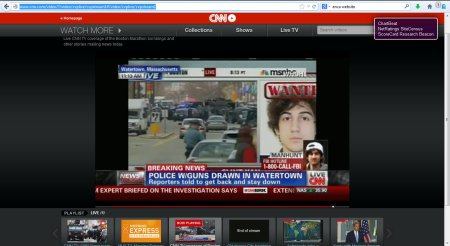
CNN live streaming its Boston coverage

Moodie really appreciated the weather maps, which to be honest, is pretty impressive, and possibly the strongest feature on the site.  The maps, integrated Twitter feed from presenter Derek Van Dam and latest video forecasts all seem pretty slick. I do think not fully integrating the weather report video offering on the sections landing page is a mistake (you have to go look for it). In fact, at a time when natural disasters like floods and super storms often dominate the news, it’s unfortunate that ‘weather’ still sits in a silo outside the newsroom proper. CNN especially had been doing tremendous work on making their weather forecasters part and parcel of their coverage of natural disasters.

As I’m writing this story, eNCA is reporting on floods in Soweto, with a screen grab from Google maps to illustrate. But why a screen grab? Its strength lies in video, yet no video was filed with this story. Why not use Van Dam to zoom in and out of affected areas using Google Maps and explain to the residents of Soweto which parts of the city is worst affected and to be avoided. Useful, different and sure to generate interest on social media – for now three opportunities missed.

The big news last week was the Boston marathon bombings and subsequent manhunt. All the TV news brands were pushing huge resources into the story and interest was global. For most of Friday, during which the US government effectively closed down one of its major cities, eNCA.com had nary video footage in sight, and wire copy so dull it would put you to sleep mid-lockdown.

Of course, TV news brands operate at a distinct disadvantage to newspaper news brands here. Newspapers news brands are spending their money on investigative journalism, one of the few media differentiators still available to them, and in-depth reporting. I don’t really expect strong copy from eNCA.com – but I do expect news. As it breaks.

TV news is all go, go, go. And they’ve got video, a medium gaining tremendous traction online the world over. Just use it.

skynews sized
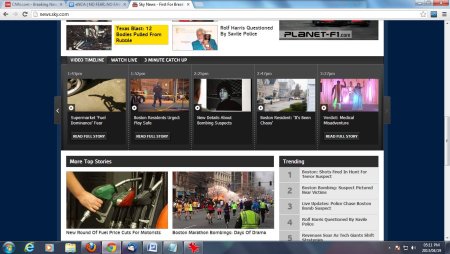
Sky News ran a video time line on the events in Boston

The site misses a couple of other beats. The blue background is awful and it screams Sky News (which, to its credit, ran a very smart video timeline of the Boston lock down). The monster eNCA logo of Africa takes up much too much space on TV screens, and online it contributes to making the site feel clunky.

If you are going to run house ads, don’t run them for tech.report on the day Boston is put under siege. Make it about Boston under siege – it’s the obvious news story visitors will be looking for (even the state broadcaster’s website got that one right). Video is the primary differentiator for eNCA.com – why does it sit at the bottom of the site? CNN was live streaming its Boston coverage!

Business news gets no break on the eNCA front page. Its flagship shows, like The Justice Factor and 3rd Degree, gets pages that feels like listings rather than something that engages. Same for the news teams. Like senior anchor Andrew Barnes? I promise you you won’t find any insight on the man at eNCA.com. You won’t even find his Twitter feed, which makes the sites’ trumpeting of its social media integration fall flat.

The site also doesn’t tap the opportunity represented by citizen journalism, unlike CNN and its iReport service, which de Waal notes could make eNCA vulnerable to challenge as TV becomes more convergent, and ‘news everywhere’ eats into their market.

eNCA.com doesn’t feel slick, just busy, and ideally it should be both. It needs to up its video content and give it greater prominence. Really big stories don’t seem to be properly highlighted – no big headlines – no sense of drama accompanying breaking news. For a site that is light on text it feels text-heavy. Profiles for presenters and shows aren’t being built out. I’ll happily visit eNCA for its weather page, but as its stands, not much else.

At the moment I don’t see what differentiates for the site from rivals – although I see lots of potential. Here’s hoping to team gets it right by the time the site moves out of Beta. eNCA should be a default news brand in South Africa and other markets on the continent and eNCA.com will play a critical role in achieving this (or failing miserably).

– Industry news you’ll make time for. Sign up for our free newsletter!

Design Annotator: ‘Fire in our hearts that will lead us home’

uno de waalDesign Annotator with Uno de Waal is a  new column featuring the top design work from South Africa’s biggest online creative showcase, Between 10 and 5, curated by Publisher Uno de Waal @Unodewaal. 

This week we’re looking at some incredible video pieces released (and a TV ad). I’m a big fan of behind the scenes/process related content, and the video by Ogilvy is definitely a hit. When it comes to illustration, I thought we’d be a bit light and only feature one piece this week, done by RADIO for an international Seaworld center. Love their work!

Cape Town Fish Market Kids Menu by Lowe Cape Town

ctfm_babysitter3_aotw-620x438

ctfm_babysitter4_aotw-620x438

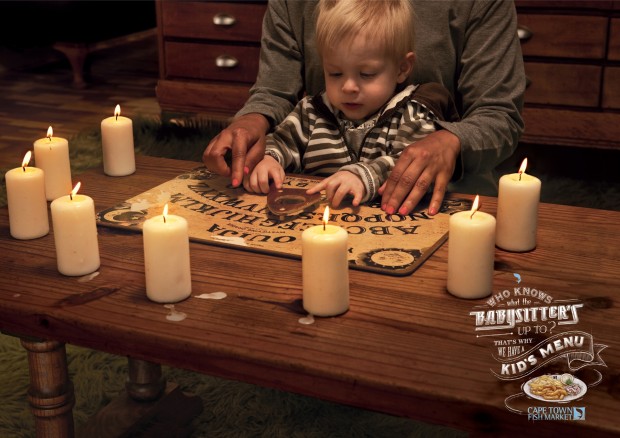
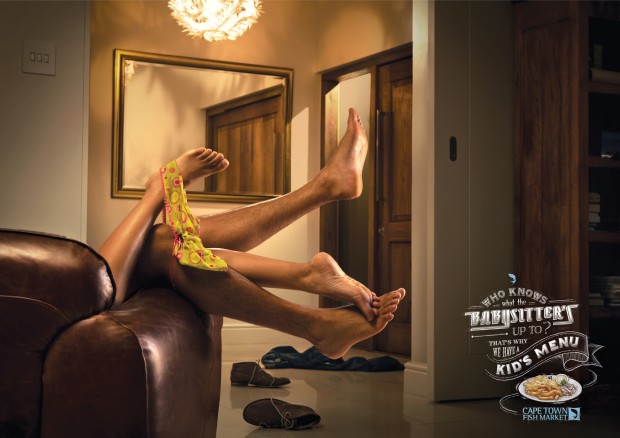
Lowe Cape Town plays on parents’ paranoia in this 6 ad print campaign for Cape Town Fish Market’s kids menu. The ads feature some pretty unsavoury scenarios with the world’s worst babysitter and suggest bringing the kids with to Cape Town Fish Market instead. The really great type treatment and illustration is by David Maclennan.

Fort Rixon creates video for Zimbabwe Independence Day

April 18 was Independence Day in Zimbabwe so Fort Rixon, a Zimbabwean illustrator living and working in Cape Town, made this short film to salute his country of birth. In it, he paints the message “Fire of the Heart, Leads me Home” onto the remains of an abandoned car.

He says, “We painted this car a while back, early in the morning. It is a gift for all Zimbabweans both at home or abroad as a reminder of the thing that keeps us moving positively into our future. Anyone from Zim would have had to travel long distances to do great things, and aspires to do even greater things. So here’s to a bright and beautiful people in a beautiful land – The Fire In Our Hearts that will lead us home.”

Radio for Seaworld in Orlando

Radio Agency for Sea world

Top quality, local creative studio Radio, started by Byron Meiring and Gert Schoeman in 2011, specialises in design, iconography and incredible illustration for brands and publications the world over. They recently added to their impressive client list with these maps made for the theme park SeaWorld Orlando.

Ogilvy and Mather – a brief history

This film was recently put together to tell the story of ‘the little yellow ad agency’, Rightford Searle-Tripp & Makin, which opened in Cape Town in 1976 and went on to become (the big red agency) Ogilvy & Mather South Africa.

Beacon All Sorts

The long-established payoff line, ‘The original play food’, inspired the new TVC by TBWA\Hunt\Lascaris for Beacon Allsorts. The ad is part of a relaunch for the brand after a five year break from television advertising.

Joint Executive Creative Director, Matthew Brink, says, “The relaunch revisits a proposition that has struck a chord with generations of consumers. You don’t mess with great originals. They retain their impact down the years and provide all the inspiration you’ll ever need.

10and5logosmall1


– Uno de Waal is a social strategist and the publisher of creative showcase 10and5.com.

– Industry profiles you’ll make time for. Sign up for our free newsletter!

Online CPD Courses Psychology Online CPD Courses Marketing analytics software Marketing analytics software for small business Business management software Business accounting software Gearbox repair company Makeup artist