ABC Analysis Q4 2012: Content marketers see mixed ABC results for custom print titles

The ABC still talks about custom magazines, magazines published on behalf of brands or organisations, even as the companies producing these magazines now prefer to talk about content marketing, and refer to themselves as content marketers rather than publishers.

For the ABC period October 2012 to December 2012 (ABC Q4 2012), the custom magazine category saw a significant decline as the total number of magazines circulated (per issue) falling to 12,704,431 from 13,416,345. This was primarily because two of the cellular giants pulled the plug on their custom titles. Vodacom discontinued Vodacom Now! in print (circ 866,090) – it continues to be published online – as did Cell C with its namesake title (circ 126,446). Clicks sheared nearly 200 000 copies from its club magazine. Dish Commercial (circ 160,424) also closed.

The biggest circulating custom magazines for Q4 2012 were:

  1. DSTV Premium & Skottel (formerly Dish Premium) (M) 1,607,527 (up from 1,390,045 in Q4 – New Media *corrected March 14
  2. DSTV Compact (formerly Dish Compact) (M) 1,258,629 (up from 1,088,982) – New Media *corrected March 14
  3. Foschini Retail Group Club Magazine (M) 1,016,178 (up from 1,051,369) – Highbury Safika Media
  4. Discovery (3xA) 987,557 (down from  1,061,217) – John Brown Publishing
  5. Jet Club (10xA) 863,676 (down from 953,224) – The Publishing Partnership
  6. Edgars Club (M) 835,474 (down from 846,584) – John Brown Publishing
  7. Click Club Card (AltM) 501,094 (down significantly from 706,136) – The Publishing Partnership
  8. Woolworths W (3xA) 447,380 – New Media
  9. Lewis Stores Club Magazine (AltM) 433,679 (down from 486,435) – New Highway Publishing
  10. JD Group Club Magazines A (M) 352,619 (down from 369,576) – Quantum Publishers
  11. RCS Lifestyle (Q)350,000 (up from 343,500) – The Publishing Partnership

Wild (Q) from Tip Publishing for Wild Card programme fell significantly to 57,407 from 72,145. Reality (Q), published by Ramsay Media for Sanlam, grew significantly to 177,279 from 110,000. Foschini Balanced Life (M) upped its circulation to 58,049 from 25,295. The ABC certificate for Club X (M) shows it grew to 227,754 from 131,170 – except it didn’t. A follow up notice revised it back down to 151 836 (hmmm Highbury Safika Media). Ackermans Club (New Media) grew to 96,712 from 68,503.

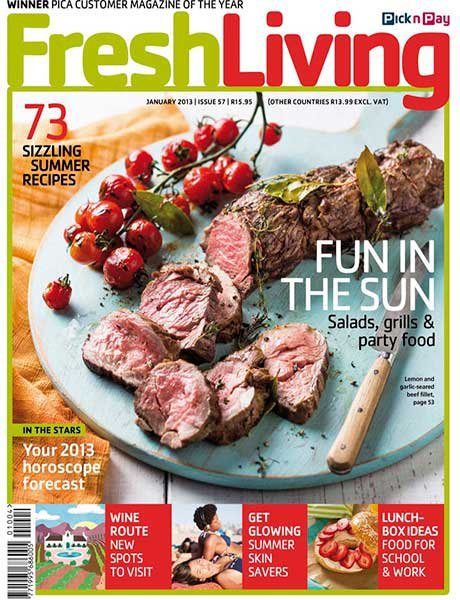
Highest single copy sales* – so over the counter sales basically – was achieved by Fresh Living (John Brown Publishing for PicknPay) selling 56,416 copies of its total 71,760 circulation. TASTE (New Media for Woolworths) sold 24,764 copies from its total circulation of 28,538. Single copy sales across all titles totalled 99,720 out of the 12,704,431 magazines circulated.

fresh living

Individual paid for subscriptions stood at 1,977,177 (some retailers claim to ‘charge’ loyalty/account members to receive their magazines). So the Foschini Retail Group Club Magazine claims 1,003,932 individuals paid 50% of the R17.95 ‘retail’ price to receive its magazine (single copy sales – nil).

Of the 12,704,431 magazines put into circulation, 10,504,122 were sent out free of charge, 2,200,309 is claimed to have been paid for (99,720 of those over the counter).

*Excludes diaries

Industry news you will make time for. Subscribe here. It’s free!

The real cost of SA’s most expensive website

by Arthur Goldstuck (@art2gee)  More was spent on the planning of the Free State government web site than most South African corporates have ever spent on the full development and implementation of their web sites.

The tender was awarded by the Free State Province on 24 February 2012 for the “Redesign/Relaunch of a comprehensive and integrated freestatewebsite” to the “Cherry Ikamva-Jugganaut Joint Venture”. It includes four phases prior to implementation, followed by implementation, maintenance and “content generation and management”.

The tender award document, supplied yesterday to Radio 702 by the Office of the Director General of the Free State Provincial Government, makes for startling reading.

Phase one, for “planning, conceptualization, research & information development”, allocates the following funds for financial year 2011/12:

“R350 000 per site for departments and Metro;
R300 000 per site for larger Local Municipalities;
R200 000 per site for Entities and District Municipalities;
R150 000 per site for other Local Municipalities”.

The Free State Provincial Government comprises 11 departments, including the Office of the Premier. Along with the Metro, the first line item therefore comprises 12 sites, for a total cost of R4 200 000.

The Free State province comprises 19 local municipalities, of which 6 could be described as “larger” (those that include the larger Free State towns, namely Kroonstad, Welkom Sasolburg, Parys, Harrismith and Bethlehem). The second line item, based on this outline, comes to R1 800 000.

The province includes four “District Municipalities”, which are in effect umbrella bodies for the 19 local municipalities. The Entities refer to statutory bodies, of which there are four: Free State Tourism Authority, Free State Gambling and Liquor Board, Free State Development Corporation and Centlec, the local electricity authority in Bloemfontein. Based on these municipalities and entities, the third line item amounts to R1 600 000.

A total of  13 “other Local Municipalities” are not included in the second line item, making for a cost, in the fourth line item, of  R1 950 000.

The total cost, then, of planning the Free State government website was R9 550 000.

Phase Two, for “Design”, also allocated to the 2011/12 financial year, included the same line items, with the same costing. In other words, the Design of the site/s cost exactly as much as the planning: a total of R9 550 000.

The allocation for Phase Three, the “Development and Creation” of the site/s, was R1 100 000.

Phase Four, for “Testing”, was open-ended, specifying “R900 per hour x 10 persons”. Assuming, very conservatively, that three 8-hour days were allocated for testing, this would have amounted to a relatively humble R216 000. No ceiling was placed on this amount, however, and it could be ten times as high.

Phase Five, for “Implementation”, which appeared to be something other than design, development, creation and testing, was given a budget of R413 600.

The total for the first five phases is R20 829 600, simply to get the site/s up and running.

Phase Six A, for Maintenance, and Six B, for “Content Generation and Management”, is a fascinating mix of hidden and unstated cost. Maintenance is costed at “R900 per hour x 2 persons”. It can safely be assumed that maintenance was allocated to budget as an ongoing function, i.e. 40-hours per week x 2 persons, amounting to R72 000 per week. Assuming the financial year ended in June, as it usually does for provinces, and a modest 12 weeks of maintenance was provided, the total would be R864 000.

Phase Six B, “Content Generation and Management” allows for “R75 000 per month per site x three months” in financial year 2011/12. The total number of sites, derived from the breakdown of Phase one, is no less than 39. For one month, the cost is R2 925 000. For the last three months of financial year 2011/12, the total cost was R8 775 000.

Assuming the project started in time for three months of content generation and management to be provided in the 2011/12 financial year, the total paid out in the four months after the tender was awarded would have been R30 468 600.

For financial year 2012, two phases are provided namely:

“Phase: Maintenance, including review and update of design: R900 per hours;
“Phase: Content Services, Generation and Management: R68 253 per month per site.”

Based on four weeks of maintenance per month, and assuming one person responsible, the cost of maintenance is R144 000 per month, or R1 728 000 per year. This assumes that it is not a per-site cost.

Content services, generation and management, on the other hand, is a per site service which, for 39 sites, amounts to  R2 661 867 per month, or R31 942 404 for the 2012/13 financial year.

The total cost of the web site for 2012/13: R33 670 404.

The allocation for 2013/2014 is exactly the same as for 2012/13: R33 670 404.

This puts the total cost of the site over less than three years at R97 809 408.

This, in turn, gives the Free State Government website (http://www.freestateonline.fs.gov.za) the distinction of being the most expensive website ever built (or not built) in South Africa. The previous website to hold that dubious honour, a South African Airways site aimed at foreign visitors, cost R90-million in a venture that was eventually aborted in 2001.

By way of comparison, the website of the South African Presidency (http://www.thepresidency.gov.za/), which is somewhat more complex than that of the Free State provincial Government, was built and maintained by Absol Internet Business Solutions (which hosts the Gadget website and content management system) at a total cost of about R250 000 over the past four years.

* Arthur Goldstuck heads up World Wide Worx (www.worldwideworx.com) and is editor-in-chief of Gadget. He is a Consulting Editor to MarkLives and our media tech columnist. Follow him on Twitter on @art2gee. Reprinted from Gadget.

Industry news you will make time for. Subscribe here. It’s free!

Playboy ‘No means no’ cover still irks some

MarkLives.com runs a regular slot featuring the best local and international magazine covers every week. We recognise well thought out, powerful and interesting (and hopefully all three in one) magazine covers and celebrate the mix of pragmatism, creativity and personal taste that created each of them. By media blogger MediaSlut.

INTERNATIONAL

Green Source, January / February 2013

Green Source

The blue/ice cover is very striking and of course very relevant for illustrating “The Climate Change Factor.” They took it up a level and actually got a real ice sculpture made to create the cover. And here’s how:

Successful Farming, February 2013

Successful welding

Who would have thought that farming magazine can take ‘welding’ to the this level on a magazine cover. One of those covers that probably won’t be seen (or appreciated) by many, but that deserves an award in my book.

Up, March 2013

UP

I love it that in-flight magazines are actually kicking Consumer magazines ass when it comes to creativity. This one is an in-flight magazine for an airline in Portugal.

LOCAL

AdVantage, March 2013

Advantage

A very rough drawing, but anyone would be able to recognize the reference to probably the most iconic BMW ad ever produced in South Africa. It’s simple, but says a lot about what you can expect in the March 2013 issue of AdVantage. Nice 0ne John Hunt.

Playboy South Africa, March 2013

Playboy 3 March 2013

PLAYBOY South Africa has decided to publish another unconventional cover. But this time with a much stronger message that they not only highlight on the cover, but in the magazine as well. The magazine wanted to show its support for the campaign against the sexual abuse of women. But the cover still has its fair share of critics, who object to the cover image  for ‘continuing to perpetuate stereotypes and strip the dignity from women’, as reported on IOL.

For more see Mediaslut.

– The (for now anonymous) blogger behind MediaSlut knows way too much for his own good about media in South Africa. Magazines in particular. His mission is to show when South African magazines might fail, but most importantly, succeed. If you’re looking for a library about South African magazines and news, your one-stop pitstop is MediaSlut. #MagazinesForTheWin

– Find a cover we should know about? Tweet us @marklives and @mediaslut
Sign up for our free newsletter!

EXCLUSIVE: FoxP2 Johannesburg open for business

by Herman Manson (@marklives) FoxP2 has officially opened its new Johannesburg agency head-quartered in the Design Quarter in Fourways. It will be an independent shop lead creatively by Grant Jacobsen while FoxP2 Group MD Charl Thom will manage the business side.

A Johannesburg agency has been on the cards for some time says Thom, who adds that it was important for the FoxP2 group to manage its growth Grant Jacobseneffectively and to wait for the right partner to team up with before it entered the market with a new agency.

Jacobsen left DDB South Africa at the end of last year. He had served as Executive Creative Director on campaigns for FNB, McDonald’s and Honda amongst others. Before that he was ECD at Draftfcb Johannesburg where he worked on Vodacom (including ‘Dictator – We’ve been having it‘), Lexus, FNB and Eskom.

Shareholding in the agency is split between Jacobsen, Thom and FoxP2 co-founders Justin Gomes and Andrew Whitehouse (currently with The Bull-White House in NY).

Thom says the agency officially opened its doors Feb 1 but that the group had held off on an announcement until it felt the office was running smoothly. The new agency is already talking to potential clients.

FoxP2 Johannesburg is also joined by Lynda Fiebiger as Business Unit Director (Previously Business Unit Director on Chicken Licken, Mercedes-Benz, Nedbank for Net#work BBDO) and strategist Des Jones (Previously Strategy Director on FNB, Nestle, SABMiller, Santam, Brandhouse, Liberty and Coca Cola for Grid/TBWA). It will initially draw on FoxP2 in Cape Town for operational support.

According to Thom FoxP2 had already decided to launch a Johannesburg agency when King James announced the launch of King James II, its partnership with Rob Mclennan and Graeme Jenner,  into the Johannesburg market.

Joe Public meanwhile is working on setting up a new agency in Cape Town  that will be formally launched in June 2013.

FoxP2 Johannesburg will operate as an independent shop and is registered as a separate company but sharing values and a culture with the Cape Town agency. Its launch removes geography as an obstacle to winning new business for the FoxP2 Group says Thom.

– Industry news you’ll make time for. Sign up for our free newsletter!

foxp2 johannesburg

Shelf Life: Design Indaba special edition

Louise Marsland’s (@Louise_Marsland) pick of new product, packaging and design launches.

It’s all about Design Indaba this week and what we learnt about beautiful things, product design and innovation.

The Most Beautiful Object in SA

The Most Beautiful Object in South Africa 2013, showcased every year at Design Indaba is a subjective competition, with objects nominated by a select group of design editors and pop culture commentators and voted for by the public. This year the entrants included a surfboard, two dresses, an umbrella, the City Press newspaper, a bicycle, a pedestrian visibility vest and necklaces.

The winning design was Gavin Rajah’s Pebble Dress, with a unique Ostrich leather foiling technique which has reportedly caught the attention of international fashion houses, including Chanel.

Most Beautiful Object in South Africa 2013

What also caught our eye, were the desk and the breadboard for their innovative designs. The Mechanical Bureau by Joe Paine was inspired by farm machinery. The Slice Cutting Board is by Jonathan Fundudis of Snapp Design has also been nominated by the German Design Council for an award.

The Slice cutting board

Mechanical Bureau

Misbehave. Often

Paula Scher Maps 2

Pentagraph partner and graphic designer, Paula Scher gave one of the most engaging and visually appealing presentations at Design Indaba this year. Scher has developed identity and branding systems, promotional materials, environmental graphics, packaging and publications for a wide range of clients.Her work has been exhibited all over the world. She is famous for her maps. This is the advice she had for designers: “What creativity really is, is this small, defiant act of misbehaving. It comes from generally being in situations where you are uncomfortable with something, looking for something, trapped, confined, or just carrying on.” She urges designers to misbehave in design and do things out of love and for fun and because you want to do something good.

Form follows meaning

Tube-Toys_Car_Oscar-Diaz

Product designer, Oscar Diaz was a delight with his innovative designs, including an ink-based calendar which makes use of the timed pace of the ink spreading on paper to indicate time. His work is not defined by a style, but rather from questioning objects, while considering their context and embedded cultural associations. He understands that kids usually prefer the packaging to their toys, when they are young, so he created a range of eco kids toys, his Tube Toys, assembled from the packaging, such as trains, tractors and fire trucks. Genius.

Ink Calender 2

Most innovative at Design Indaba

Stratflex furniture

Wintec Innovation won the 2013 Design Indaba Expo Innovation Award and R50 000 prize for their Stratflex furniture. The flat pack range is made from plywood and combined with Salinga timber frames with natural finish. Said expo manager, Kelly Berman: “It’s truly innovative, affordable, uses mostly local raw material and creates employment.”

For more on Design Indaba 2013 at MarkLives.com:

Our special Design Indaba 2013 section

On Design Indaba 2013 from TREND.at www.trendlives.info:

http://www.trendlives.info/2013/03/06/god-war-and-design-at-design-indaba/
http://www.trendlives.info/2013/03/01/john-hegartys-advertising-magic/
http://www.trendlives.info/2013/02/28/di2013-ben-terretts-design-principles/

Louise Marsland– Shelf Life by Louise Marsland is a weekly column on MarkLives. Tweet new product, packaging and design launches to @louise_marsland or email her at louise.marsland at gmail.com.

– Want to sponsor Shelf Life? Contact us here.

Louise Marsland has written about the FMCG, media, marketing and advertising industry for 18 years of her 25 year media career as a former Editor of magazines AdVantage, Marketing Mix and Progressive Retailing; as well as websites Bizcommunity.com and FMCGFiles. She currently edits the weekly Wednesday Media & Marketing Page for The New Age newspaper; and is the co-founder and Publishing Editor of SA’s newly launched industry trendwatching portal, TREND. at www.trendlives.info, in partnership with MarkLives.com.

– Industry profiles you’ll make time for. Sign up for our free newsletter!

Our current obsession with “engagement” is misguided


by  Bob Hoffman (@adcontrarian), San Francisco Bay Back in high school there were people who were “heavy users” of sex. Remember them?

They often had one characteristic in common — they were promiscuous. They didn’t just have lots of sex with one person. As we used to say, they “got around.”

The world of commerce is like that, too. Heavy users in a category tend to be promiscuous. They tend to try lots of different brands in the category. They get around.

Someone who is a heavy user in the fast food category might go to McDonald’s 4 out of 10 times; Subway 2.5 in 10; Wendy’s 1.5 in 10; Taco Bell 1 in 10…etc.

People in advertising and marketing often wrongly equate usage and loyalty. They think that heavy users in a category tend to be brand loyal. And that heavy users of a brand are brand loyal. The truth can be quite the opposite.

In the above example, the heavy fast food user might also be a heavy user of McDonald’s. He may go to McDonald’s 4 times a week. But he is not brand loyal. In fact, 6 out of 10 times he patronizes a competitor.

This is true in many categories. Heavy users of sneakers (like yours truly) will tend to have Nikes, Adidas, and Reeboks in their closets. Heavy users of wine are very avid brand jumpers. Heavy travelers visit a lot of different locations. 72% of Pepsi drinkers also drink Coke.

Meanwhile, light users can be very brand loyal. My parents didn’t eat out much, but when they did, they always went to the same places.

Of course, this does not mean there are no heavy category users who are highly brand loyal. But in general, the idea that heavy users in a category and heavy users of a brand are more loyal than light users is not just mistaken, it is dangerous.

It’s dangerous for two reasons. First, because it fosters the infantile fantasy that people care deeply about brands and want to have “relationships” with them.

Second, it has large implications for advertising strategy. Success of a brand is not singularly related to high degrees of brand loyalty. Let me repeat that. Success of a brand is not singularly related to high degrees of brand loyalty. In fact, the most important success factor for mainstream consumer brands is not how many loyal customers you have, but how many customers you have.

Which is why the current obsession with “engagement” is so misguided. The idea that your success is dependent upon your customers becoming deeply emotionally attached to your brand is a delusion. Consumers are promiscuous. Most successful brands have a customer profile that is a mile wide and an inch deep. They’re just not that into you.

As Martin Weigel says… “Your consumers are just someone else’s consumers who occasionally buy you.”

That is also why the current mania for spending enormous amounts of time, money, and energy getting your “fans” to “engage” with you is such a silly preoccupation. Having your customers “like” you may be nice, but having your competitors‘ customers try you is what builds your business.

Wanna grow your brand? You don’t need more engagement. You need more customers.

– The Ad Contrarian is Bob Hoffman, ceo of Hoffman/Lewis advertising in San Francisco and St. Louis. Hoffman is the author of The Ad Contrarian and 101 Contrarian Ideas About Advertising. Reprinted from his blog The Ad Contrarian.

– Industry profiles you’ll make time for. Sign up for our free newsletter!

Design Indaba 2013: God, war and the future at Design Indaba

by Louise Marsland’s (@Louise_Marsland) I’ve been attending Design Indaba conferences for eight years and while the speakers and the disciplines differ every year, there are always a couple of speakers that completely blow you away, either in their wonderful delivery, content or total inspiration.

The one thing I always take away with me is hope for the future. For my children, for our industry, for our planet and our very humanity.

The speakers at Design Indaba are carefully chosen to challenge conventional thinking, to push boundaries, to inspire.

I always tell people going for their first Indaba not to judge too quickly, to listen to speakers in fields that are not their own, to keep an open mind, not to make too many meetings at or outside the Indaba, but to immerse themselves in the experience. It will change the way you think about your own business and industry.

These are my best Design Indaba moments of 2013, the speakers who challenged me and inspired me…

We need to be prepared to hack reality

Dutch artist, innovator, interaction designer, Daan Roosegaarde, was my persopnal choice for best speaker at Design Indaba 2013. He received a standing ovation after his presentation of his sustainable, futuristic and fun solutions, like the touring colourful club dancefloor that produces energy when people dance on it; his Dune lighting system which interacts visually and with sound with passersby, transforming dark community spaces into tactile, interactive destinations. His glow in the dark paint for highways, which recharges during the day to light up the highways at night; or makes snowflakes appear when the temperature drops to warn motorists of slippery conditions, is being trialled with a roads agency.

Thinking about the interactivity that technology allows and sustainability, should be part of the default setting for designers, he says.

“For me it’s about techno poetry, rethinking life… We should create more types of co-creations. Reality is beautiful, amazing, but we should be ready to go out there and hack it, to use our imagination to make things.”

(See the MarkLives interview with Roosegaarde here)

daan roosegaarde

Steal when it’s appropriate & Good design is timeless

Graphic designer and founding partner of Push Pin Studios in New York, Seymour Chwast (81)  is the antithesis of conventional design. His presentation at Design Indaba 2013, entitled ‘God. War. Sex’ on his career to date, dealt with hell, a favourite subject of his. Hell is a high rise building, for those of you who didn’t know, and the penthouse is reserve for email spammers, which, according to Chwast’s word, are the worst sinners. He only steals ideas when it’s appropriate: “I have integrity.”

Chwast draws every day. He can’t help himself. From hell to God, to erotic shoes, he draws everything. His favourite tool is a pilot pencil, he doesn’t have “the nervous system for watercolours”.

Seymour Chwast

The artist has to decide who to serve

Within the complexity of our environment, how can I be an instrument to collectively reimagine our daily environment? This is the question that artist and interaction designer Jeanne van Heeswijk,  from The Netherlands, considered in trying to decide how to use her skills as an artist to improve communities. She embeds herself in communities, from Rotterdam to Liverpool, for years at a time, working with them to save their culture, improve their neighbourhoods and empower communities to design their own futures, not wait for them to be foist on them by local authority urban planning schemes which rarely take embedded culture into account, particularly in underprivileged areas.

“Communities need to start co-producing their own futures,. Most of my work is unravelling the invisible legislation, codes of government and social institutions which slowly prepare areas for their predictive futures.”

She calls it “radicalising the local” by empowering communities to become their own antidote.

Design shouldn’t be afraid to tackle big messy problems

Can design save the world? This is the question that Canadian design strategist Michael Grigoriev asked during the Pecha Kucha session. He undertook to make sense of all the trends, statements and methodologies advocating meaningful change and make sense of the information. The idea is that collectively, we are far more intelligent – based on our diversity and shared knowledge – than any single expert.

Grigoriev asks how we could aggregate that intelligence and create conditions and the right environment to tackle problems. He found that people have to care about something in order to participate and the tools of engagement have to be ones that people are comfortable using. “With our collective intelligence we make tons of new content… we can only tackle our biggest problems of our time, collectively. Design should not be afraid to tackle big messy problems. Designers need to start engaging with problems and tackling those problems and creating meaningful change. There are no more excuses. People are already sharing, we now only need to push it through to meaningful change.”

Creativity isn’t an occupation, it’s a pre-occupation

Keynote speaker, Sir John Hegarty, creative director and founder of Bartle Bogle Hegarty (BBH) advertising in the UK, says: “Creativity isn’t about predictability – it has to surprise and challenge, it has to be daring and yet motivating. Creativity is a manic construction of absurd, unlikely irreverent thoughts and feelings that somehow, when put together, change the way we see things. That’s why it’s magic.”

As society constantly changes and as brands and products constantly innovate, it becomes the responsibility of the creative person to capture the essence of that change and the opportunity it offers, he explains.

And on ideas: “The greatest spur to creating ideas is confidence, specifically the confidence in your ability to make magic. That’s the one truth a creative organisation must hold on to.”

Misbehave. Often.

What is creativity, but a small, defiant act of misbehaving, Pentagram partner and graphic designer, New York, Paula Scher, told the assembled delegates. We misbehave, Scher says, when we find ourselves in situations we are uncomfortable with, or are trapped, confined, or searching for something, or just carrying on. She keeps looking for ways to misbehave in design, to challenge the conventional and sidestep protocol. She is renowned for her map designs.

Paula Scher Maps 2

& Fake it (sometimes)

Sometimes you get up and you aren’t talented that day. Fake it, says Scher! “Repetition can be a creativity killer. One needs to try look at things differently, challenge yourself. “It is hard to rebel against yourself, it is hard to recognise your own stupidity.”

Do the hard work to make it simple & Build for inclusion

“Making something look simple is easy; making something simple to use is much harder, especially when the underlying systems are complex, but that is what we should be doing, says Ben Terrett, head of design at the UK Government’s Digital Services, Cabinet Office. “With great power comes great responsibility – very often people have no choice but to use our services. If we don’t work hard to make them simple and usable, we’re abusing that power and wasting people’s time.”

His core responsibility is merging and redesigning over 2000 UK government websites into one: Gov.UK.

Accessible design is good design, says Terrett. “We should build a product that is as inclusive, legible and readable as possible. If we have to sacrifice elegance, so be it. We should be afraid of the obvious, we shouldn’t try to reinvent web design conventions and should set out our expectations clearly.”

Synthetic biology – the design discipline of the future?

London-based artist, designer and writer, Daisy Ginsberg raised more questions than she provided answers in her provocative talk on synthetic biology [Video] and how disruptive it should be in not only solving problems, but making better products and using it in an ethical way to solve the world’s problems, like food shortages, materials and fuel. She has discovered that it can be “deliciously ambiguous” as a science when designers and scientists work together to reimagine new ways of creating things.

“The impact of synthetic biology may well be scientific and economic. But we think it will also be social, cultural and political.” She is convinced we are still asking the wrong questions in this field. “By asking the right questions, we will have problems to solve that are better. Science shouldn’t be separated from the humanities. I’m trying to open up this space for lots of other designers to experiment… I’m challenging the fundamentals of science.”

Daisy Ginsberg

– Louise Marsland is the Publishing Editor of TREND and a Contributing Editor to MarkLives.

See more Design Indaba 2013 stories here

MarkLives is an official Media Supporter of Design Indaba 2013. Sign up for our free newsletter!
The Switch: Try marriage vows

by Alistair Mokoena (@AlistairMokoena) The client-agency relationship is often referred to as a marriage. Even though this feels like a colloquial use of the term, it is not a misnomer. In fact, there are many elements of the client–agency relationship that bear similarity to a marriage.

The Oxford dictionary defines a marriage as ‘the formal union of a man and a woman, typically as recognized by law, by which they become alistair makoenahusband and wife’ [Oxford needs an update – ed.].

With marriage comes a set of vows which are undertakings that the parties make to each other. Some of these vows include a promise to respect, cherish and love each other, to provide for each other, to protect each other, to stay faithful to each other, to support each other’s goals, to support each other through difficulties and lastly to submit to each other.

If you compare a marriage to a client-agency relationship, you will notice that there are similarities between the two.

The client-agency contract makes provision for the supply of advertising services in return for a set fee or commission. It also states the duration of the contract and stipulates grounds for terminating the contract. What is often absent from this contract are rules of engagement or rules that govern how the parties relate to one another.

Let’s apply marriage vows to the client–agency relationship to see if they would be of any value.

A vow to respect each other is the cornerstone of all relationships. Without respect, relationships become servile and abusive. The best client–agency relationships are partnerships that are based on mutual respect (just as submission in a marriage has to be mutual).

Some agencies tend to treat clients like ‘mini gods’ thereby turning a partnership into a servant-master relationship. On the other hand, some clients tend to breathe fear into their agencies, treating them with disdain and disrespect. Needless to say such a relationship is doomed to fail.

The next vow is about loving and cherishing each other. Perhaps love is too strong a word in the context of client–agency relationships but it is important for the two parties to like each other and enjoy working with each other. I’ve seen instances where there is no love lost between the two and the relationship is merely transactional.

It doesn’t matter how hard you try, you will never create magic if the two parties don’t like each other. That’s why we have pre-pitch chemistry sessions between agencies and clients. Client–agency relationships that are purely based on money have more effervescence than substance.

Providing for one another and protecting each other go hand in hand. As much as agencies will say they do what they do for love, they also have bills to pay. It is important that they are fairly remunerated for what they do and appropriately incentivised to excel.

Clients on the other hand don’t have infinite budgets. The expectation therefore is that agencies will be sensitive to this by managing costs and realising efficiencies where possible.

Agencies have a duty to protect clients from unscrupulous and greedy suppliers. Clients have a reciprocal duty to protect agencies from undue and counter-productive meddling as well as indecision on the client side. The creative process is delicate and its immune system is not strong enough to withstand ‘too many cooks’.

Fidelity is an important aspect to the client–agency relationship. Some clients think ‘a bit of competition to keep agencies on their toes’ is an incentive to perform, the opposite is true. Agencies produce much better work when they work within a secure relationship of trust.

I’ve come across both clients and agencies who are guilty of infidelity. Sometimes clients, out of frustration with perceived excessive costs and lack of speed and agility of a large agency, turn to a small one-man-band agency down the road that can do the job much quicker and cheaper. This is clearly in breach of their contract but often the large agency is reluctant to invoke the contract lest they piss off the client and risk losing the account. I’ve also heard of agencies secretly pitching on conflicting business simply because the prospect comes with a larger fee and a nicer client to work with.

The last vow that comes to mind is a promise to support each other through difficult times – read ‘for richer or for poorer, in sickness and in health’. Every business goes through troughs and peaks. The world went through a massive economic recession a few years ago and a recent double dip recession.

We’ve seen consumers cut back on discretionary spend and clients advertising budgets come under pressure as a result. The question is how have agencies and clients responded to this exogenous shock to their ecosystem?

Are we seeing more efficiencies as a result? Have agencies dropped their fees, margin or commission in response? Have clients become more single-minded and put more money behind fewer objectives?

When agencies lose big accounts and are forced to retrench staff can they approach their other clients for help? I’m not suggesting the bottom line is not important, I’m merely challenging us to see the bigger picture.

In conclusion, great partnerships are what we should all strive for and work towards. People come to work to grow, do great work, create wealth and have fun. Nobody grows if they operate in a fearful, abusive environment where mistakes are not tolerated, debates are stifled and risk is not entertained. A dull, transactional relationship is neither fun nor sustainable. It doesn’t lead to great work and certainly doesn’t win awards.

So next time you enter into a client – agency contract make sure it starts with the words ‘I (name), take you (name) to be my partner …”

Alistair Mokoena (@AlistairMokoena) is a Unilever-trained Chartered Marketer with lots of blue-chip marketing experience. He’s currently MD of Draftfcb Joburg. Mokoena contributes the monthly “The Switch” column to MarkLives.com.

Industry news you will make time for. Subscribe here. It’s free!

Ad of the week with Oresti Patricios – A ‘lekker’ local campaign with wings

MarkLives Ad of the Week with Oresti Patricios – A ‘lekker’ local campaign with wings

kulula

Kulula continues its tradition of cheeky, humorous and thoroughly South African commercials, this time with a print ad that introduces the livery on the airline’s new fleet of Boeing 737-800s (and takes an indirect swipe at the national carrier).

The full colour print ad, launched on Sunday 03 March 2013 in the Sunday Times, shows a new Boeing , with livery proudly displaying the South African flag on the tail, and the bold new slogan “The Most South African Airways” on the side. Kulula has been careful not to mimic the font or the exact tail design of SAA planes, thus avoiding any potential legal trademark issues.

Known for their irreverent, comedic approach to marketing and getting their customers to chortle at the airline’s whacky in-flight announcements and edgy viral marketing, kulula.com succeeds in resonating with locals by being as South African as braaivleis, Shosholoza and vuvuzelas. The latest ad (which uses ‘South Africanisms’ like ‘super-stoked’ and ‘awesome’) which introduces the airline’s new slogan underscores Kulula’s patriotic brand positioning.

“We thought long and hard about a slogan that truly represents who we are as an airline and communicates our passion for South African travel, and this was the most fitting. We are proud of it and are sure it will be well received by our fans,” said Nadine Damen, Marketing Manager of kulula.com.

I’m not so sure it will be that well received by SAA, who are currently facing a High Court challenge from Comair (kulula.com’s parent company), against a proposed R5bn ‘bail out’ by the government. But then the green airline with the great sense of humour are not shy of controversy.

In 2010, kulula.com raised the ire of Fifa during the world’s biggest soccer extravaganza with an ambush campaign that positioned the airline as the “Unofficial Carrier of the You-Know-What”. Kulula were forced withdraw these hilarious ads due to Fifa’s tight control and ‘ownership’ of the 2010 World Cup brand and everything that went with it. No problem for Kulula, they just changed the ads and their agency (King James) came up with an even funnier ad offering free flights to anyone (legally) named Sepp Blatter. The campaign got massive coverage in the media and on social networks, and locals loved the rebellious nature of the ads.

This time round kulula.com has again embraced social media to drive brand loyalty. The latest ad follows on thematically from kulula.com’s January Facebook campaign, “The Most South African Flight Ever,” which packed a cross-section of unique South Africans, all nominated by Facebook fans, into a flight from Lanseria to … Lanseria.

The joyride included entertainment from Jack Parrow and gumboot dancers, a choir singing the anthem on take-off, and goodie bags containing famous SA brands like Zambuk and Ouma rusks. As a PR exercise, it seems to have worked really well, judging by the buzz it created on Facebook and Twitter, and the positive feedback it generated, even from those who didn’t make it onto the passenger list. The campaign got loads of publicity with pictures and write ups of the ‘historically’ local flight in the news media.

It’s a good tack to take. Although our government is mired in corruption and inefficiency, we South Africans are a patriotic bunch, especially when it comes to our lifestyle. And we support the underdog; so the David of kulula.com standing up to the SAA giant, especially when it helps us travel for less – well, we’re all for it.

Humour in advertising is tricky. You risk some people not ‘getting’ the joke or finding it offensive – either way it can undermine your credibility. Taking hundreds of people in a metal tube 30,000 feet into the air and delivering them safely to their destination might not be a laughing matter, but kulula.com seems to have always struck the right balance between levity and trustworthiness.

With help from their friends at King James, Kulula consistently delivers a service that offers real value while it builds a brand that South Africans really love.

Ad of the Week is published on MarkLives every Wednesday. See past selections here.
Oresti Patricios is the CEO of brand and reputation analysis company Ornico.

– Industry profiles you’ll make time for. Sign up for our free newsletter!

Fast-to-change SA consumer mags are thriving


grubstreet

by Gill Moodie (@GrubstreetSA) Why is it that consumer magazines  consistently outperform our newspapers in circulation figures these days?

Not that it’s plain-sailing for the magazine industry, as we saw in last week’s release of the fourth-quarter Audit Bureau of Circulations of SA (ABC) figures for 2012.

Just like newspapers, many magazine titles are suffering sales decline but it’s not across the board – there are more than a handful that are bucking the trend and some that are doing very well.

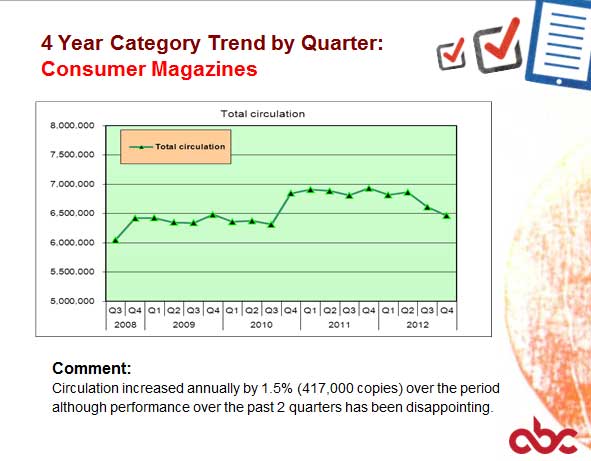
Take a look at these three graphs showing how consumer magazines have done over the past four years compared with daily and weekend newspapers. There is a slump  in consumer magazines in the last half of 2012 but it is very different from the consistent downwards trend suffered by newspapers over the past four years.

Courtesy of ABC presentation of Q4 2012 figures

Courtesy of ABC presentation of Q4 2012 figures

Courtesy of ABC Q4 2012 presentation

Courtesy of ABC Q4 2012 presentation

Courtesy of ABC Q4 2012 presentation (see link to full document at bottom of story)

Courtesy of ABC Q4 2012 presentation (see link to full document at bottom of story)

Is it a case, one wonders, in these straightened economic times of consumers taking money they might have spent on a newspaper and buying their favourite magazine every month instead?

This might well be the case in the lower LSM groups – where, for example,  female Afrikaans readers are not buying the Son newspaper but opting for Kuier magazine.

In the high LSM groups, I think newspapers and magazines are totally different purchasing decisions.

And while magazines have the advantage of being more niche – and more engaged with their audience because of this – they have also been quicker to change with the times than newspapers.

Most of SA’s magazines leapt into online and social networks, eventing and email newsletters with great enthusiasm long before newspapers did. They started talking about “brands” and “audience” – rather than “titles” and “readers” –  and delivering content on many platforms while looking for diversified income streams before newspapers.

While the big newspaper houses were held back by traditional cost structures and also by big corporates’ natural tendency to protect traditional income streams, there was flexibility in the magazine industry coming from the smaller, more nimble independent firms such as  Associated Media and RamsayMedia.

As they experimented, they learned more about building brand loyalty among the fickle media consumers of today and these  are the brands that we see thriving today.

So which magazines are doing well? Have a look the top performers in Q4 2012:


Courtesy of ABC Q4 2012 presentation

Courtesy of ABC Q4 2012 presentation

The very niche and small-circulation Expatriate SA and HQ Pony  are not particularly interesting but, once again, we have Media24’s fortnightly Kuier magazine  – launched in 2009 and which is very strong on human-interest stories – top of the pops.

This magazine is a phenomenon and it has been amazing to see how it has grabbed hold of a substantial gap in the market: that of Afrikaans-speaking coloured women.

When the third-quarter ABC figures for 2012 came out, I spoke to Kuier editor Kay Karriem about the secret of her mag’s  success and she told me it filled two important gaps in the Afrikaans market: for coloured women and for a mid-market product (for LSM 6-8).

She said her team was very conscious of the fact – especially given the current economic climate – that the magazine differentiated itself from others by offering real value for money. “Our focus is on extreme customer care… While we inform and educate and do all of those things, our main priority is to engage. You should be able to identify with what goes on in the magazine… so that we reflect the readers’ reality but we also want them to be comfortable.”

Karriem told me then that she believed that there was more room to grow precisely because of the country’s tough economic conditions and because Kuier is constantly examining its value proposition. And, looking at the Q4 2012 figures, she was right.

While I’m not sure of the backstory of Caxton’s Living and Loving parenting magazine at this stage, it is worth noting that Associated Media’s mags were generally up while RamsayMedia’s – previously the star of the show with Popular Mechanics (this time down to 43 863 from 50 585) – were generally down.

Both firms went through top-level change in the last part of last year – with Associated getting a new group publishing director in Adrian Pickstock  and Ramsay losing its well regarded MD, Stuart Lowe. I guess change sits well with some and less so with others.

Of Associated’s titles that put on circulation, we have:

Cosmopolitan went up from 81 406 total circulation in Q4 2011 to 86 885 in Q4 2012;

Good Housekeeping increased from 59 814 to 70 932 (but bear in mind there is a deliberate strategy of sampling quite a lot of copies because the brand is still new in SA);

Marie Claire rose from 37 439  to 41 137; and

House and Leisure went from 38 338  to 44 630 year-on-year.

Clearly Kuier, Living and Loving and  the Associated titles are doing something right – as are the following titles (bearing in mind these are total circulation figures so you do have to scrutinise incentivised sales, free and back copies):

Caxton’s Bona: up from 95 261 in 2011 to 97 190 in 2012;
Reader’s Digest SA: up from 35 833 to 40 269 (the mag was also up in the third quarter of 2012 compared with the corresponding period a year earlier);
Gisele Wertheim Aymés’ Longevity: up from 20 582 to 22 339;
Times Media Group’s  Elle Decoration: up from 22 130 to 23 630;
Times Media’s Elle: up from 38 891 to 43 820;
Caxton’s SA Garden and Home: up from 34 935 to 37 824;
Media24’s Fairlady: up from 48 789 to 57 522 (a notable turn-around here: the magazine’s Q3 2012 circ was 53 436 compared with 56 986 in Q3 2011);
Media24’s Ideas: up from 88 452 to 91 905; and
Caxton’s Woman and Home: up from 59 860 to 60 187.

Find more ABC analysis here

– SA’s leading media commentator, Gill Moodie, offers intelligence on media – old and new. Reprinted from her site Grubstreet.

Sign up for our free newsletter!

Online CPD Courses Psychology Online CPD Courses Marketing analytics software Marketing analytics software for small business Business management software Business accounting software Gearbox repair company Makeup artist