Africa Style: Social context and your brand

by Masingita Mazibuko Given the prevailing megatrends (megatrends take years and even decades to evolve, and tend to manifest in a number of microtrends, that is, emerging and niche behavioural changes, over the years) of Tech Life and Social Cohesion, the increasingly important role of Tech Life in enabling social cohesion is becoming clearer.

For example, if we look at brands as corporate citizens (that is, they operate within a broader social context), their role is to meet the needs or Masingita Mazibukowants of their intended target while still allowing their target market to inform them. The paradigm that is social networking – enabled by technological advances – has created such a situation.  Therefore the social context is more important than ever if a brand is to remain relevant.

I am guessing that First National Bank’s ‘You can Help’ campaign is seeking to give young South Africans a platform to voice their views was centred on this premise.

There was considerable debate around this campaign but, if we consider it in the context of the trends such as ‘good citizenship’ and ‘crowd voice’, it seems there is a desire for brands to be a conduit for informing, providing access and engagement.

As marketers, the mandate is to create growth and positively impact the bottom-line of the businesses that employ us.  I surmise that the fundamentals still ring true – real insight into one’s target consumer and their world regardless.

So brands perhaps need to ensure social drives are intrinsically linked to their core proposition whilst bringing them closer to their consumers.

Within South Africa there are brands taking the baton and driving this agenda:

Eskom 49m (with the aim to get 49 million South Africans to embrace energy savings) and the Alert! campaign actively seek to manage energy consumption in South Africa (albeit being driven by its poor pro-active management issues which are well-reported in our daily papers).

Woolworths does a great job of informing greener approaches, for example encouraging recycling or re-use of packaging thereby not targeting only green consumers but informing and encouraging others to play their role.

And the likes of Coca-Cola have embarked on a drive to empower 5-million women by 2020 through social upliftment, education and skills transfer. Importantly, this is not just a CSR campaign initiative but something that engages driving dialogue and engagement with the brand.

In the societal context where there is a desperate need for information and social transformation, one cannot help but think the role of brands is broader that conveying its intrinsic proposition. It is often said ‘Make the brand the hero’, but perhaps as social networking becomes endemic, a brand needs to create the right platform and let consumers make it the hero.

So what is the role of the brand? I would say it is to affect those who it is targeting and at times that may mean informing, opening their worlds, warming their hearts or building a sense of possibility so that they choose to engage with the brand.

What is clear, is that it is not about the brand on its own but about a brand that is jointly owned by its targets to ensure sharing of information.  The challenge is opening oneself to hearing what consumers have to say.

Masingita Mazibuko is an Associate Director at brand development and marketing insight consultancy Added Value. For more insights, visit www.added-value.com/source/. Mazibuko is a regular columnist for MarkLives.

Sign up for our free newsletter!

TEDActive 2013: Mankind’s Greatest Invention Coming To A Species Near You

tedactive 2013

by James Yeats Smith, filed from TEDActive 2013, Palm Springs. Thursday, 28 February. The day started with serious speed and intent. There was an Intel Mobile short film to finish; a dozen prolific speakers vying for attention; two-dozen emails clamouring at my screen and the final TEDActive throw down with Reggie Watts to get down to. Between all of this, I did manage to squeeze in two sessions and the speakers did not disappoint.

A session called ‘Indelicate Conversation’ lived up to its description with a darkly humorous talk by Dutch ornithologist, Kees Moeliker. Kees had the crowd in stitches as he described the phenomenon of homosexual necrophilia of the mallard, a piece of research that won him the Ig Nobel prize, an award that honours improbable research that first makes people laugh and then makes people think. While describing this rare occurrence in the animal world he whipped out the stuffed duck in question and began to pass it around the audience. He brought down the house later in his talk when he explained how the prize he’d won made him the unofficial expert in deviant sexual behaviour amongst animals and started receiving images from the public; a moose copulating with a bronze statue of a bison, a toad mounting a dead gold fish and a few others I should probably not describe. He became the first TED speaker in history to close with the big question, “Can I have my dead duck back please?” Read more about Moeliker’s left-field research on his blog.

And then came the stand out talk that definitely identified itself as a contender for the biggest idea of the conference.

Founder of the internet, Vint Cerf took the stage alongside MIT physicist, Neill Gershenfeld; cognitive psychologist, Diana Reiss and musician, Peter Gabriel for what was rumoured to be this year’s biggest announcement.

Reiss got the presentation off to a good start by pointing out that our Darwinian view of evolutionary processes have been largely committed to measuring physical changes in appearance and that biologists have been much more reticent at acknowledging intellectual evolution and consciousness. After explaining the behavioural work she’s been doing with dolphins over the last decade, she pointed out something that occurred to me moments before, dolphins too learn through self-organization – which was the contention of the impressive TEDPrize winner, Prof Sugata Mitra on how to reinvent the way we learn as humans. Ok, I was listening.

Gershenfeld stepped up and patched in Orangutans from Borneo, three bottlenose dolphins and an elephant from Thailand for a live video conference and began to elaborate on how these animals have started showing early signs of inter species communication via iPads. Right, now they had my full attention.

Gabriel took over to talk about inter-species jam sessions and showed a film of a chimp laying down piano riffs with him in his studio. He demonstrated how music was not only a means of communication that served as common denominator amongst culturally diverse humans, but potentially, also between species. Intrigued and somewhat sceptical, I continued to listen intently, not yet sure of where this was all going.

Finally, the internet Godfather, Vint Cerf slowly got up from his chair ambled over to his laptop and asked, “If the internet is one of man’s greatest inventions, how de we integrate the rest of the bio mass into it?” After posing the question he announced the imminent launch of the Inter-Species-Internet and my brain began to melt.

Cerf pointed out that we’re already in the process of establishing the inter planetary internet between Earth and Mars and that, wait for it… what we learn from the Inter Species Internet on Earth may teach us how to engage extra terrestrials one day.

If this didn’t come from the man who created what has become the most indispensable tool of our time, I would’ve struggled to take this seriously. But then I took a moment and remembered two things, firstly 2013 was the year TED saw the first non-human, ‘Gander the Dog’ officially enrolled as a conference attendee and secondly, that all truth passes through three stages: Firstly, it is ridiculed, secondly, it is violently opposed and lastly it is accepted as self-evident.

The Inter-Species-Internet is far from tangible at this stage, but isn’t it exciting to think that 30 years ago the internet endured the same ridicule and disbelief, and look how self evident that has become.

What ever our conclusions may be about ideas like this, they challenge us; they force us to come to terms with our own preconceptions of what’s possible, realistic, and even fathomable. If for nothing else I admire and support Cerf’s vision entirely on the basis that ‘An idea that is not dangerous, is not worthy of being called an idea at all’ -Oscar Wilde

Aint that the truth. JYS.

James Yeats Smith

– More stories for TEDActive 2013

– James Yeats Smith is an award winning Creative Director and writer focused on the convergence of marketing, entertainment and technology. He is based between New York, Cape Town & Johannesburg.

– Industry news you’ll make time for. Sign up for our free newsletter!

tedactive 2013

Building metrics to ensure effectiveness in ad campaigns

A MarkLives column by Odette van der Haar (@odette_roper), CEO, Association for Communication and Advertising What does effective mean? In the business of advertising and communications, we define it as ‘delivering a measurable business result.’ With the squeeze on budgets and the general malaise in the economy, the ability to prove effectiveness of any communications campaign has become more critical than ever.

The APEX awards have long been established as the standard by which effectiveness can be judged. However, the principles that govern APEXOdette van der Haar are not applicable only to award entries – there is in fact a leading agency that runs a mini-APEX process for every single campaign that it executes because effectiveness is paramount and ingrained in the culture and business practise of the agency.  This discipline intended to ensure that campaigns are not only creative and deliver brand resonance but that they also deliver business results in a tangible and measurable manner that is meaningful to the client.  The success of the agency is a testament to exactly this.

It is important for marketers to understand the interplay between creativity and effectiveness, allowing the agency to deliver holistic creative solutions whilst also working with the agency to build-in the kind of metrics that will allow for the effectiveness of the campaign to be measured.

Generally, campaigns fall one of three categories: Launch – for products or services that are new, or have no significant history of advertising, Change – for new campaigns from previously advertised brands, which resulted in significant short term effects on sales or behaviour and Sustain – for campaigns that benefited a business by maintaining or strengthening a brand over a longer period.

In terms of the actual metrics engaged to measure creative effectiveness, there could be a number of possibilities – one could look at an improvement in elements such as awareness, market share, brand equity, imagery or simply exceeding a sales target. To measure communications campaigns, measurement criteria or metrics need to be clearly defined.  For example, in the Launch category, metrics could include examining the precise timing of the campaign and its effect on the rate of sales.

For example, measuring sales directly after the launch of the campaign or designing a campaign for a specific purpose i.e. to direct the product towards a very particular target market and measuring the number of units sold.  Another benchmark to consider is whether a new product has been helped by a communications campaign to ensure a pattern of repeat purchase however, it must be noted that launch campaigns are particularly difficult to assess for effectiveness as market share starts from a zero base.

For assistance with metrics for Change and Sustain campaigns, more information is available on the APEX section of the ACA website.

What is important at the end of the day, is to put in place metrics and to have the metrics agreed upon by both the client and the agency as these are an indispensable tool for justification and measurement of the contribution to business success and return on investment generated by on the part of marketers and their agencies.

Truly effective work is work that delights consumers through its ability to connect hearts and minds, while being respected by clients because it delivers tangible results. We’ve always maintained that the business of advertising and communications is as much as science as it is an art because creativity and effectiveness work hand in hand.

– Odette van der Haar (nee Roper) is the CEO of the Association for Communication and Advertising (ACA) which is the recognised industry body of the advertising and communications profession in South Africa.

Design Indaba 2013: Daan Roosegaarde – hacking technology to personalise our environments


daan roosegaarde

By Herman Manson (@marklives) Design Indaba 2013 Well before Daan Roosegaarde (@SRoosegaarde) ever set foot in this country South Africans were already lining up to see if there might be opportunities to collaborate with the Dutch born artist and innovator.

Roosegaarde is known for exploring the relationships between technology, architecture and people, as with his Smart Highway project, which aims to create interactive and sustainable roads as part of our future landscapes.

Vehicles generating light through wind technology, dynamic lanes, using photoluminescent paint (that charges with sunlight) to create glow in the dark traffic lanes without the need for street lighting, induction priority lanes that charges electric cars as they drive. Roosegaarde wants roads to be more interactive and poetic as they form an essential aspect of our physical environment but has seen little innovation in the past century.

First footage of Smart Highway featured on Dutch Television from Daan Roosegaarde on Vimeo.

Roosegaarde is visiting South Africa as a speaker at the annual Design Indaba conference taking place Feb 27 – March 1.  He refers to himself as an entrepreneurial artist. He was trained as an artist, has a Masters in Architecture and a keen interest in technology. To ensure what he imagines becomes tangible Roosegaarde says he always knew he needed to work as part of a network of people. He merges his creative and business agendas to ensure his inventions don’t stay projects forever bound to drawing boards.

It’s important for Roosegaarde to “work in the now” rather than to wait to be “discovered” by “some old museum director” in the future. “I’m a hippie with a business plan,” he jokes.

Even though his work has been exhibited in major museums and galleries, including the Tate Modern and the Victoria and Albert Museum in London, he prefers placing installations in public spaces. Interactive design work explores the relationship between technology, emotion and expression like ‘Dune’ (an interactive landscape of light alongside the Maas River in Rotterdam), or his fashion experiment – ‘Intimacy’ (high-tech fashion which become transparent based on personal interactions). Sustainability for Roosegaarde is not about ‘retro do less’ but about participation and activation like with his experimental sustainable dance floor.

Dune by Roosegaarde – interactive landscape at the Maas river, Rotterdam (de Esch). from Daan Roosegaarde on Vimeo.

Intimacy White – Interactive fashion by Daan Roosegaarde from Daan Roosegaarde on Vimeo.

According to Roosegaarde our public spaces, commercialised as they are, have become disconnected from people. He describes us as a society living in a state of schizophrenia as a result. We would rather share our emotions in virtual spaces like Facebook than in our physical worlds that are becoming increasingly generic.

This disconnect between our virtual/digital world and our physical world fascinates Roosegaarde who finds his inspiration in exploring what would happen if our involved virtual world could really meet our physical world. Would it reconnect people and their built environment?

Innovation is not just about new technology but also about generating new stories about what our lives could look like (the real role of an artist, according to Roosegaarde). Public spaces should, like a Facebook page, encourage social interactions. Real life engagement and communication between people, Roosegaarde believes, could address many of the social ills we currently experience.

Roosegaarde is also fascinated by the idea that people can hack technology to personalise their environments. Wheels are extensions of our legs and glasses are extensions of our eyes, we are constantly making things to make our environments more understandable. It helps us experience our world in an intrinsic way. Roosegaarde wants to know why he can’t for example wear a plaster on his body telling him what vitamins his body requires – we can use technology to liberate and inform ourselves about our health and energy, things like that. As big systems fail us (hello government and service delivery) people will need to become more autonomous, using technology as a tool to achieve this.

The role of a designer is to update the world around them, to hack it, to create new tools that make the world more understandable.

In terms of his South African trip Roosegaarde says he is keen to learn from the country and the continent. Lots of sunshine and its possibility in terms of implementing his sustainable infrastructure projects excite him. That said Roosegaarde is careful to say he doesn’t want to be just another European designer pitching up to show work that is meaningless in an African context.

Roosegaarde is a firm believes in the copy-more economy. The ‘old economy’ is based on a copy-paste model where you take something, put a margin on it and resell it. Nobody adds any value. This is not a sustainable economic model, says Roosegaarde. With copy-more you learn, improve and upgrade. You do this consistently, doing it slightly differently every time. It encourages innovation and collaboration and adds value to products and projects. It’s a principle that would speak to many African innovators and artists and our sense of Ubuntu.

See more Design Indaba 2013 stories here

MarkLives is an official Media Supporter of Design Indaba 2013. Sign up for our free newsletter!

Design Indaba 2013: Ben Terrett – Designing better government


Ben Terrett

By Herman Manson (@marklives) Design Indaba 2013 Public design projects have been getting a bad name of late and Ben Terrett, Head of Design at the GDS – The British government’s Government Digital Service (@gdsteam), wants to reverse the trend with GDS.

Terrett and his team had been tasked to make tangible his governments’ intention to transform its approach to digital delivery of public services from what government needs to what its citizens need.

By focussing on user (i.e. ‘we the people’) experience to cut red tape and speed up service delivery Terrett and the GDS is radically altering governments’ usual approach to its citizenry. Who knew government was about us rather than the political class! Terrett emphasises that the projects’ success rests on determining – and meeting – user needs. His team spends a lot of time thinking about how to make transacting with government easier and more convenient.

The first task of GDS was to launch a one-stop website at gov.uk that will eventually replace the hundreds of smaller government department sites. It means you don’t need to know what part of government handles a specific issue – you will find the information you require in a single digital space. Launched in October 2012 the site has already seen its 100 millionth user.

The new gov.uk site focuses on easy access to information, presented in a way that is relevant, easy to find and easy to digest. Transparency is important here – design can be used as much to hide as to highlight information (think small print).

The gov.uk site also strips away nonsense. It should only contain the kind information government should be telling you says Terrett – the rest you should find elsewhere. So on previous government sites citizens were informed on ‘how to identify [sea] waves’ and what to do when they get cold (‘put on a pull-over’). Information irrelevant to government’s core function is being done away with. It certainly makes government seem less controlling and domineering.

Next the site will be rolling out transactional capacity – things like obtaining power of attorney, which also presented interesting design issues for the team (it involves several people, and strips one of a lot of legal authority). Terrett purposely slowed down the online process – he doesn’t feel this is something that should be rushed. Still it will take only 20 minutes online.

Even though authority for designing all the UK governments’ digital communications have been centralised under GDS pushback hasn’t been an issue. GDS establishes guidelines and then build capacity within departments.

The GDS has published what it calls its core design principles but these could also serve as a manifesto to rethink how government approaches and processes service delivery.

1. Start with needs (user needs not government needs)
2. Do less (do what only government can do)
3. Design with data (shape the system to fit what people naturally choose to do rather than bending them to a system we’ve invented)
4. Do the hard work to make it simple
5. Iterate. Then iterate again. (test to make sure it works)
6. Build for inclusion (accessible design is good design)
7. Understand context (understand the technological and practical circumstances in which our services are used)
8. Build digital services, not websites (“Our service doesn’t begin and end at our website. It might start with a search engine and end at the post office.”)
9. Be consistent, not uniform
10. Make things open: it makes things better

Already city and national governments are visiting GDS in the hope to take home some of its design best practice. GDS isn’t fixated on the web either – mobile is already playing an important role – and Terrett says you never know what platform will be arriving next. In the meantime they are building a system people would want to use and are streamlining processes along the way.

See more Design Indaba 2013 stories here

MarkLives is an official Media Supporter of Design Indaba 2013. Sign up for our free newsletter!

“Man. Superman. Gunman.” Oscar Pistorius through the lens of TIME magazine

MarkLives.com runs a regular slot featuring the best local and international magazine covers every week. We recognise well thought out, powerful and interesting (and hopefully all three in one) magazine covers and celebrate the mix of pragmatism, creativity and personal taste that created each of them. By media blogger MediaSlut.

INTERNATIONAL

TIME, 11 March 2013

TIME

“Man. Superman. Gunman.” Chilling words. Super cover. Can’t wait for my issue to arrive in the post!

Time Out (London), 18 February 2013

Time Out London

The previous Time Out London cover was really ‘naughty’ (and also featured as one of our favourite covers last week), and this week they’ve used the same look and feel and created and little funny (and genius) graphic portraying “Drugs in London”. Seems like the creative team is really having a lot of fun these days…

The Economist, 25 February 2013

The_Economist_2013-02-23_www.storemags.com

Striking, but sad and true, cover/text graphic illustrating “the death of Syria”.

Texas Monthly, March 2013

Texas Monthly

This image of Lance Armstrong makes him seem vulnerable. It’s a winning image, and great use of cover lines. You can read the full article here.

Populous, Issue 8

Populas

Baseball. I don’t know anything about this sport, but I really like the creative use of ‘while chalk’ in the masthead, that fits into what’s happening elsewhere on the cover.

– The (for now anonymous) blogger behind MediaSlut knows way too much for his own good about media in South Africa. Magazines in particular. His mission is to show when South African magazines might fail, but most importantly, succeed. If you’re looking for a library about South African magazines and news, your one-stop pitstop is MediaSlut. #MagazinesForTheWin

– Find a cover we should know about? Tweet us @marklives and @mediaslut
Sign up for our free newsletter!

ABC Analysis Q4 2012: Oops! Newspapers just did it again

Yup print newspaper proprietors generally did a decent impression of Britney Spears’ career path judging by the current (continuing downward) trajectory of newspaper print circulation.

The ABC has released circulation statistics for the period October 2012 – December 2012 (ABC Q4 2012). Here are a couple of numbers that stood out in terms of newspaper circulations.

Note: We compare the current figures with the same figures for this time last year and not with the previous quarter.

For magazine circulation figures click here

Daily newspapers

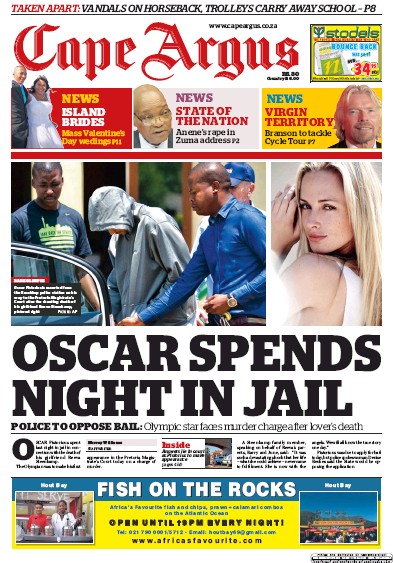
Beeld falls to 66,132 from 73,486. Cape Argus falls to 32,337 from 44,159 and the Cape Times falls to 34,627 from 42,849. Tabloid Daily Sun is down to 322,324 from 380,683 (336,319 in Q3 2012). Pretoria News – down to 17,576 from 21,721. Son falls to 96,598 from 105,775 and the Cape-Argus_20130215Sowetan is down to 100,349 from 117,862. The Star – 102,244 down from 128,683.

Isolezwe is up slightly to 106,858 from 103,467.

MarkLives Big Daily Newspaper List*

1. Daily Sun 322,324
2. The Times** 146,956
3. Isolezwe 106,858
4. The Star 102,244
5. Sowetan 100,349
6. Son 96,598
7. Beeld 66,132
8. The Citizen 64,627
9. Die Burger (Wes Kaap) 50,674
10. Business Day 35,149

** ABC considers The Times a hydrid (paid-for and free to subscribers of The Sunday Times) newspaper.
* South African titles only. Must have cover price. Excludes Free papers.

Weekly & Weekend papers

Amongst the weekend papers Beeld (Saturday edition) fell to 63,962 from 70,311 and Die Burger to 76,805 from 79,363. The Saturday Star plunged to 75,089 from 94,439. Weekend Argus – down to 60,383 from 70,134

Sunday papers also faced circulation decline. City Press fell to 126,400 from 149,265. Rapport fell to 213,460 from 218,053 and The Sunday Times fell to 449,799 from 462,895. Tabloid Sunday Sun fell to 184,417 from 213,041 and Sunday World fell to 130,656 from 146,149.

Ilanga Langesonto declined to 64,344 from 79,521 but Isolezwe ngoMgqibelo climbed to 73,448 from 58,851 and Isolezwe ngeSonto climbed to 87,175 from 80,050.

In terms of the weekly newspapers Ilanga fell to 118,584 from 129,452 and the Mail & Guardian declined slightly to 48,999 from 50,474. Soccer Laduma breaks the trend going up to 311,774 from 300,488 (but its down from  360,668 in Q3 2012).

MarkLives Big Weekend Newspaper List*

1. Sunday Times 449,799
2. Rapport 213,460
3. Sunday Sun 184,417
4. Sunday World 130,656
5. City Press 126,400
6. Isolezwe ngeSonto 87,175
7. Saturday Star 75,089
8. Sunday Tribune 71,675
9. Isolezwe ngoMgqibelo 73,448 +1
10. Die Burger (Wes Kaap) 64,826 New

MarkLives Biggest Circulation per issue Newspaper List*

1. Sunday Times 449,799
2. Daily Sun 322,324 +1
3. Soccer Laduma 311,774 -1
4. Rapport 213,460
5. Sunday Sun 184,417
6. The Times** 146,956 +1
7. Sunday World 130,656 -1
8. City Press 126,400
9. Isolezwe 106,858
10. The Star 102,244

11. Sowetan 100,349

* South African titles only. Must have cover price. Excludes Free papers.

Media news you’ll make time for. Sign up for our free newsletter!
For more analysis see  ABC figures for Q4 2012 show the massive challenges facing Survé at the Indie by Gill Moodie

TEDActive 2013: Don’t Ask for Permission. Ask for Forgiveness.

tedxthurs

by James Yeats Smith, filed from TEDActive 2013, Palm Springs. Wednesday, 27 February. The ingenuity, bravery and resilience of today’s speakers were a rare sight to behold. Each of the four sessions; Disrupt, Dream, Create & Sustain brought the crowd to its feet at least once and out of the four, three featured talks by fellow South Africans.

Surprisingly it wasn’t my personal deity, Elon Musk, CEO of SpaceX, Tesla Motors and Solar City that spurred the crowd response I had anticipated (despite being compared to Steve Jobs by TED Curator, Chris Anderson). Nor was it the ungainly presentation by Lesley Perkes that lacked cohesion and left everyone feeling awkward and confused, but came instead from a much more unlikely and unexpected source, Allan Savory. Delivering his talk with tremendous eloquence and clarity, the conservationist received a lengthy standing ovation for his noble fight against desertification of the world’s grasslands. Admittedly, it didn’t seem like the kind of topic that would get the crowd juiced and elicit such an overwhelming surge of support, but that’s exactly what makes this conference so unique.

Staying in the vein of the unexpected, Sergey Brin, co-founder of Google, made a surprise appearance to demonstrate Google’s latest innovation, Google Glass, a product that displays information in a smart phone like format, freeing up your hands and enabling you to navigate your digital interactions via an optical display. Asked by Chris Anderson at the end of his talk if this product shouldn’t perhaps have come from Apple, there was a pregnant pause before Sergey sarcastically rebutted, “Well thanks Chris. I appreciate your confidence in Google’s technology…” an eerie silence rang out across the theater, something I actually found rather refreshing.

The most profound and certainly the most iconoclastic of all the speakers was futurist, Stewart Brand. Brand intends to re-create, or “de-extinct” certain animals that have disappeared from the planet by using cutting edge biotechnology developed by his wife, Ryan Phelan and George Church from the company, DNA Direct. By harvesting ancient DNA from extinct animals they’ll be able to sequence the genomes of species and resurrect them by implanting germ plasma into animals from the same genus. The result? Brand and his team have performed the first ‘de-extinction’ in history by successfully breeding the departed Pyrenean ibex in Northern Spain. Granted, resurrecting the woolly mammoth using ancient DNA my sound like mad science, but Brand’s Revive & Restore project has an entirely rational goal: to learn what causes extinctions so we can protect currently endangered species, preserve genetic and biological diversity, repair depleted ecosystems and essentially, undo the harm that humans have caused in the past.

After the talk I picked up ‘Regenesis’ from the TEDBookstore by a member of Brand’s team, George Church, which outlines how synthetic biology will reinvent nature and ourselves. Church is widely considered one of the most brilliant scientists in the world and if the opening sentence, “What follows is the greatest story ever” is anything to go by, I would strongly recommend getting your hands on a copy.

Do we want extinct species back? Well, tune into the live stream from the National Geographic Headquarters in Washington for the TEDxDeExtinction debate on 15 March to see a myriad of perspectives on what is surely one of the most exciting and frightening technological advancements in human history.

After breaking for lunch with the co-founder of Groupon and an engineer from Tesla Motors, I returned to the theater and surrendered myself to notion that I don’t need to work harder, I need to work smarter. It sounds simple, but we’re so conditioned to feel that long hours are directly related to productivity that it may take quite a bit of practice and recalibrating to truly understand what this really means.

The next speaker however seemed to have understood this at birth. After losing a family friend to pancreatic cancer, fifteen year old, Jack Andraka has been hailed as the Edison of our time. Jack decided that the diagnostic systems currently at our avail were simply not effective enough at early cancer detection, so he decided to improve it. Carbon nanotubes, a biology lecture on antibodies and a flash of insight led Jack to design a cheaper, more sensitive cancer detector. Andraka’s invention has shown over 90% accuracy in early detection of cancer markers, costs a mere $3 and earned him the 2012 Intel Science Fair grand prize, and the most violent applause I have ever had the privilege of participating in. Mind bending.

I could go on, but time to run and meet my new Intel buddies for more chatter about mobile futures, which after today’s fantastic showing is not at all intimidating.

Don’t sweat the technique. JYS.

James Yeats Smith

– For more stories for TEDActive 2013 be sure to check back tomorrow

– James Yeats Smith is an award winning Creative Director and writer focused on the convergence of marketing, entertainment and technology. He is based between New York, Cape Town & Johannesburg.

– Industry news you’ll make time for. Sign up for our free newsletter!

Online CPD Courses Psychology Online CPD Courses Marketing analytics software Marketing analytics software for small business Business management software Business accounting software Gearbox repair company Makeup artist