Africa Style: To put out to pitch, or not?

by Masingita Mazibuko Contrary to how firm and solid it feels beneath our feet, the earth is in a fluid state and influenced by numerous forces that bring about change. I recall memorising during high school science classes a number of the principles that influence that change, such as opposites attract when it comes to ions and cations.

In any case, this is not an attempt to recall my science from yesteryear (a futile task, I suspect, and one I shall put off until my daughter requires me to dust off those cranial cobwebs). The inference is rather to highlight that tension can give rise to vastly different results when it is amplified or reduced.

Masingita MazibukoEvolved into a debate

Six months ago, when I told a colleague-cum-BTL-agency-owner about my move from an agency to a client organisation, the conversation naturally evolved into a debate concerning how to tackle any new work that needed to be done; that is, to put it out to pitch, or not.

The common perspective is that marketers are at times guilty of calling willy-nilly for pitches. The rationale, or perceived rationale, is that they do so to hedge their bets, perhaps largely out of fear of putting all their eggs in one strategic and creative basket.

Personally, I think this perception is exaggerated and exacerbated by the anxiety of a team in the pitch situation. Not only is there time pressure, but it is going head-to-head with other agencies and obviously has to consider that the work it puts out might not crack the brief immediately.

Consider the alternative

My colleague, however, highlighted the downsides of the pitch process, forcing me to consider the alternative.

A pitch is akin to a first date, during which you present yourself in your finest, and are at your most witty, in a bid to ensure the relationship moves forward.

In the marketing world, this means that the agency or consultancy’s best resource is often deployed to ensure it ‘wins the business’, to the detriment of existing clients. So, a marketing community that constantly demands its service providers pitch in a sense destabilises the industry. Hmmm…

Another school of thought holds that healthy competition (the pitch) can act as a stimulus and thereby fuel creativity.

Clear caveat

“Mohammed Ali had Joe Frazier; Bill Gates had Steve Jobs,” states Christian Jarret* in The Surprising Benefits of a Creative Rivalry. In this piece, he highlights the benefits of healthy rivalry when it comes to igniting creativity. There is, of course, a clear caveat: “It depends on how one handles the competition at hand.”

Key principles mentioned include “one should not avoid healthy rivalry”, “one must not obsess over one’s rival” and “one should also seek to prove naysayers wrong”.

When I consider this perspective, I immediately think of the music industry’s Grammy Awards, the film community’s Academy Awards (Oscars) and Emmy Awards, and the South African ad industry’s The Loerie Awards. In all of these, and others as well as on the sports fields, the overall objective is to ensure advancement of the respective fields.

No one right answer

So, there’s no one right answer to the question, “Should I call for a pitch or not?”

On the one hand, you cannot underestimate the importance of deeper engagement between client and agency, and many a brand has been built as result of enduring relationships. On the other, creative rivalry does play a role in fuelling creativity.

Ultimately though, regardless, the aim is to ensure that whatever emerges serves to build your brand in addressing the needs and desires of your target.

For the right reasons

Wait a minute — that last line reads as if I am sitting on the fence. Let me put it another way: going to pitch is always the right answer when the marketer can honestly admit that he or she is seeking a pitch for the right reasons, eg there’s a fundamental shift in his or her communication strategy that requires different expertise (from TV to digital, say).

But taking on a new marketing partner is not a painless process — it will take time for that partner to build the brand-knowledge that resides with the encumbent agency.

All relationships go through ups and downs, and it is by tackling the troughs head on that they can be strengthened.

Forge ahead

I firmly believe that simply seeking a new idea is not a good reason to go out to pitch. Unless the marketer is 100% certain there are other, insurmountable reasons, I would suggest he or she forge ahead with the existing relationship and seek ways to stimulate higher levels of creativity.

Masingita Mazibuko, marketing director at Unilever, contributes the monthly “Africa Style” column to MarkLives.com. The views expressed within this column are entirely her own.


*Jarret Christian. The Surprising Benefits of a Creative Rivalry. www.99u.com

— MarkLives’ round-up of top ad and media industry news and opinion in your mailbox every three work days. Sign up here!

Smart Africa TV: Every1Mobile CEO on SmartSex and mobile community

by Russell Southwood (@BalancingActAfr) In this interview, Algy Williams, CEO of Every1Mobile, talks about:

  • its most used social community, SmartSex, which covers sexual health and relationships;
  • the other nine communities it runs which cover — among other things — soccer, education, jobs, entertainment and creative writing;
  • the mobile platforms these communities are available on; and
  • the balance of originated and user-generated content.

Smart MonkeyRussell Southwood is the founder of Balancing Act and the web TV channel Smart Monkey TV, and has been an analyst in telecoms, internet and broadcast in Africa for the last 14 years. Smart Monkey TV aims to capture the energy at the crossroads between African culture and technology. MarkLives is syndicating content from Smart Monkey TV on a weekly basis for the column “Smart Africa TV”.

— MarkLives’ round-up of top ad and media industry news and opinion in your mailbox every three work days. Sign up here!

Uber — not a taxi as you know it

by Herman Manson (@marklives) Uber, a mobile app that connects passengers with private drivers licensed to carry passengers, has recently set up in Johannesburg, Cape Town and Durban in its first foray into African markets. [SPECIAL OFFER FOR MARKLIVES READERS!]

Uber mobile appQuality public transport

Quality public transport remains underserved in the South African market, although cities are starting to wake up to the negative impact this has upon their tourist image and how their citizens interact with their city.

Uber, which vets the private drivers it collaborates with, allows passengers to request a ride via their mobile phones through an app that allows passengers to see what the driver looks like, what type of car will pick them up and the licence plate of the vehicle they requested.

You also get the price upfront, and payment happens through your credit card, details of which are held by Uber once you register to use the service. It’s cashless and convenient, will speak to safety-conscious South Africans, and you can opt to split your fare with friends (they must opt in).

Passengers can also track the vehicle’s progress to your pickup point.

Team of three

When Uber sets up in a new city, it usually starts with a team of three, explains Lindsey Elkin, community manager at Uber Cape Town. That would be a community manager, an operations and logistics manager who signs up new drivers, and a general manager.

Teams expand as the business does. In some markets, Uber is already struggling to find enough drivers — in a bid to alleviate the problem, it recently announced discounted financing or leasing for vehicles made by Toyota and General Motors in some of its high-growth markets.

In SA, the service currently only offers Uber Black (mid-range vehicles). Other services, including UberX (a lower-cost service using everyday cars), Taxi (taxis leased to drivers), SUV and Lux (luxury cars) will come online as demand determines and once the basic Black service is well-established.

Both drivers and passengers can rate one another (so, if you are an abusive passenger, other drivers can avoid you and, if the driver service is lacking, other passengers will be forewarned).

Minimum fares

A minimum fare of R50 is charged in Cape Town. There is a base fare of R15 plus R1.10 a minute + R11 a kilometre. A cancellation fee of R45 is charged if passengers cancel a booked service. Fares are set by Uber.

In Joburg, the minimum fare is R85 and the base fare R60, and in Durban the minimum fare is R35 and the base fare R17 [it really does show where the money is — ed].

Although numbers are not available for either the number of drivers Uber employs or the number of locals who have signed up for the service, Elkin says growth is rapid. New drivers and passengers are found through word of mouth, social media and trade partnerships with event organisers and restaurants.

SA is a springboard into the rest of the continent; Uber is already advertising positions in Nairobi.


MarkLives readers will receive R150 in credit if they sign up here
as first-time users for the Uber service.


— MarkLives’ round-up of top ad and media industry news and opinion in your mailbox every three work days. Sign up here!

MagLove: Chef Luke Dale-Roberts makes some waves

by MediaSlut (@MediaSlut) My choice of the best international and local magazine covers in MagLove this week:

  • Dear.
  • Oxford American
  • ELLE Singapore (Special Collector’s Edition: The Birthday Issue)
  • The Look Book
  • ELLE LUXE Italy
  • Eat Out
  • DESTINY

Find a cover we should know about? Tweet us at @Marklives and @MediaSlut.
Want to view all the covers at a glance? See our MagLove Pinboard!


INTERNATIONAL

Dear., Issue #3

Dear., Issue #3

Dear. is a Korean magazine, based in Seoul, which focuses on the “fashion production industry and small trader and enterprises in Korea” which “listen to the voices of the people who have quietly but diligently worked for the Korean fashion industry” when they visit these factories.

Doesn’t sound very appealing to many, I know; it almost sounds like a gossip and Union magazine mixed together, but for factory workers.

But with this cover treatment, I think it looks great and very interesting, and a lot of B2B titles can really learn from Dear.! Its previous covers are just as creative and smart…

Oxford American, November 2013

Oxford American, November 2013

Oxford American, a quarterly literary magazine featuring “the best in Southern writing while documenting the complexity and vitality of the American South”, has gone old-school with a great execution in celebration of its “Southern Music Issue”.

Some cool detail went into this cover and its design elements.

ELLE Singapore, December 2013

ELLE Singapore, December 2013 (Special Collector's Edition: The Birthday Issue)

The Singapore edition of ELLE seems to be celebrating it 20th anniversary, but not like ELLE Denmark, which celebrated its birthday by placing model Louise P. on five different covers…

ELLE Singapore has gone the ‘fun’ route by breaking the mould through not placing any model on its cover but instead using what seems like little Minion-inspired fashion characters.

I’m not familiar with this market at all, but my gut is telling me that this leap might be a bit too big from its normal covers. Hopefully, its normal readers will recognise the brand, and not think it’s a teenage magazine… But it’s bold and fun, and I like it.

The Look Book, Issue #2

The Look Book, Issue #2

My holiday is officially 10 work-days away, so I’m constantly daydreaming and “wishing I were there already”.

This cover from The Look Book speaks directly to me, for a number of reasons: the typography, humour, visual appeal, and the dream factor.

Less really is more on most covers, and I sometimes wish some of our South African titles would catch on…

ELLE LUXE (Italy), December 2013

ELLE LUXE (Italy), December 2013

Another ELLE cover that is breaking the mould and not placing a personality (dressed in high fashion) on the cover.

I’m not sure who the designer of the drawing is, but I like the simple drawing, typography, and end result of the cover.

LOCAL

Eat Out, 2014

Eat Out, 2014

If you’re familiar with the annual Eat Out Magazine (I call it my Restaurant Bible), you would know that it’s had a wide range of different types of covers over the past few years (you can view them all here), ranging from profile shots (2011) to a collage with items you use to eat/drink (2012) to golden leeks made to look like a trophy (2013).

But the best out of all of them, and the latest 2014 issue, is the cover with Chef Luke Dale-Roberts with a fish draped on his shoulder, and water splashes!

This striking image and cover coincides with a new look to the magazine and website (to launch next week), and with the “Bold New Look” campaign that is currently being aired. The extended TV ad is a must-watch!

DESTINY, December 2013

DESTINY, 12 December 2013

As a Christmas present to its readers, it seems as if DESTINY magazine has given them the best and most beautiful possible cover, with the stunning Lira!

It’s not just the amazing photography, where she looks ultra-hot and ultra-sexy; it’s also the little pink splash-over colour which adds to the success of this cover.

Lira talks about her “multi-million-Rand business” but I think she actually looks a multi-million-Rands on this DESTINY cover…


MediaSlutMagLove by @MediaSlut is a regular slot featuring the best local and international magazine covers every week, recognising well thought-out, powerful and interesting (and hopefully all three-in-one) covers and celebrating the mix of pragmatism, creativity and personal taste that created each of them. The (for now anonymous) blogger behind MediaSlut knows way too much for his own good about media in South Africa, magazines in particular. His mission is to show when SA magazines fail but, most importantly, also when they succeed. If you’re looking for a library about SA magazines and news, this is your one-stop pitstop.


Find a cover we should know about? Tweet us at @Marklives and @MediaSlut.
Want to view all the covers at a glance? See our MagLove Pinboard!


Media Future: Wi-Fi rides in to save mobile

by  Arthur Goldstuck (@art2gee)  The next big thing in mobile data growth is good old Wi-Fi, but in a new guise called “Wi-Fi offload.”

If someone mentions Wi-Fi offload, and you think it’s an offer to download half the Internet free of charge, you’re not a mobile network operator.

wi fiDizzying pace

For operators, it’s a lifeline to future growth. As data traffic grows at a dizzying pace across Africa — Vodacom announced recently that its data revenue outside South Africa grew by 100% in the past year — it’s becoming increasingly difficult for networks to cope with the traffic. The result is deteriorating voice quality — hello, hello, can you hear me now? — and frustratingly slow data speeds.

But Wi-Fi offers a solution. As Wi-Fi networks expand throughout Africa’s cities, they represent an opportunity to relieve the strain from the traditional 2G and 3G networks, and certainly from the 4G networks of the future.

The answer is Wi-Fi offload, which involves operators moving mobile traffic from their traditional networks onto Wi-Fi networks.

Key challenges: capacity and coverage

“The key challenges for mobile networks are capacity and coverage, says Kian Ellens, Cisco Systems’ business development manager for mobility solutions across the Middle East and Africa.

“The difficulty is that, whereas most coverage is outdoors, most consumption is indoors, hence the focus on small cells and now on Wi-Fi offload. The underlying challenge is that it must be carrier class Wi-Fi — good enough for a mobile network to provide quality voice.

“A lot of work is happening around how do we deliver carrier class experience, as well as on authentication mechanisms to make the hand-over seamless. Already, in some markets we are seeing reduction in churn because subscribers can switch to their home Wi-Fi connection.”

Land-grab under way

Ellens believes a land-grab is under way in South Africa to provide carrier class Wi-Fi. Evidence is provided by the massive roll-out of hotspots under way by Telkom Mobile and a partnership revealed recently between WirelessG and Vodacom to grow the Always On network to more than 6 000 hotspots in the next five years. Telkom Mobile intends to match this number, while the Western Cape government has announced an initiative to bring free Wi-Fi access to low-income areas.

The result of all these projects is that, by 2019, Wi-Fi will be pervasive in public areas across South Africa. Thanks to newly standardised technologies, it will then be possible to switch signals between mobile networks and Wi-Fi networks.

A new Wi-Fi standard developed by the global Wi-Fi Alliance (WFA), called Passpoint, also known as Hotspot 2.0, is designed for both signal switching and more flexible content delivery and authentication procedures.

Mobile-style roaming

“This will bring mobile-style roaming to Wi-Fi,” says Ellen. “The network will know who your preferred provider is, and it has the ability to advertise services to you. We’ve got the ability to do this today.”

An enthusiastic backer of Hotspot 2.0, Ruckus Wireless sees it as an opportunity for hotspot owners to monetise their public access Wi-Fi networks by entering into roaming arrangements with mobile operators — providing even further incentives across industries.

“In time, the consumer won’t know or care what access they’re using, cellular or Wi-Fi, because it will all be automatic,” says Michael Fletcher, sales director for Ruckus Wireless sub-Saharan Africa. “They will get a bill at the end of every month that covers all access.”

The flexibility and overall cost-effectiveness of Wi-Fi, he says, underline its potential to meet the demand for broadband access in Africa.

Arthur Goldstuck heads up World Wide Worx (www.worldwideworx.com) and is editor-in-chief of Gadget. He is a consulting editor to MarkLives and our media tech columnist. Follow him on Twitter on @art2gee.

This article has been republished from Gadget.

Shelf Life: Window shopping by touch

Louise Marsland (@Louise_Marsland)’s pick of new product, packaging and design launches this week:

  • iGlass is a new product that turns shop windows into touchscreens;
  • More luxury festive season gifts for your favourite clients (and media);
  • Sweet window branding for Marc Jacobs’ new launch; and
  • A report back on KFC’s Hope campaign.

Window shopping

iGlass
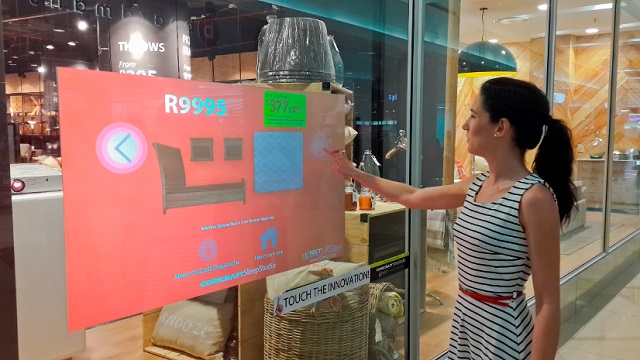
Shop windows have just become interactive touchscreens too, with the launch of iGlass in South Africa by NXT\ digital company.

iGlass creates interactive sales displays, turning a standard storefront window into a touchscreen where consumers can buy products, get quotes, browse catalogues or brochures, and view and be alerted to product information.

This innovative retail technology is targeted at retailers and landlords of properties with high foot-traffic rates who want to draw more passing trade, but are facing traditional constraints in the retail space. These include limited shopping hours, limited floor space for displays, and increased rental space costs.

The value to retailers includes being able to promote their businesses at events and trade shows, in shop fronts, or as part of ‘lobby displays’.

The window-display technology works with adhesive rear projection film. Images, video and dynamic media content are projected onto the storefront window — or mobile display, turning it into a TV screen. Music and sound effects are also possible add-ons.

It can be tailor-made to specific retailer needs, catering for different glass or surface dimensions. The projectors can accommodate small surfaces to large buildings.

Because of the unique gestures available on iGlass, it can also be used to play games designed by the retailer, to take part in competitions and to share company information socially on multiple platforms, including social media.

iGlass comes with a reporting solution and is a measurable technology.

NXT\’s Wayne Levine says, because iGlass is first and foremost a visual medium, retailers it has presented it to have quickly understood its potential to capture consumers’ attention. “It’s a solution with unlimited creative potential that really captures the imagination of everyone who sees it.”

See iGlass in action: www.facebook.com/NXTDigitalInnovation.

Singing the blues

JW Blue Label Travellers Trunk special
Now here’s an exclusive festive-season gifting idea that’s luxury personified: Johnnie Walker Blue Label has partnered with iconic designer Alfred Dunhill to create a limited edition collection, aptly promoting the rarity and flavor of Johnnie Walker Blue Label.

The result is a collection of exclusive gifts inspired by the pioneering spirit of John Walker and Alfred Dunhill. The Limited Edition Giftpack features a 750ml designed bottle with its interior evoking the contours of a map, bringing the two iconic brands’ shared journey to life. The bottle’s exterior seamlessly marries the Johnnie Walker Blue Label signature-blue colour packaging with Dunhill’s signature ‘Chassis’ design and gunmetal finish made famous in its leather goods.

The Limited Edition Giftpack is available for purchase from Makro and Norman Goodfellows stores nationwide and the recommended retail price is R2199 per giftpack.

Additionally, the collection includes a Travel Retail Exclusive Giftpack; and a Limited Edition Travellers’ Trunk, valued at R80 000. Only 500 bespoke pieces of the Limited Edition Travellers’ Trunk have been produced globally.

Exclusive much?

Honey, honey

Marc Jacobs window promo
Honey is a new fragrance brand from international fashion and fragrance house, Marc Jacobs. Primedia Unlimited’s Fashion Media business, which specialises in in-store advertising and window displays, was commissioned to launch Honey, aimed at women.

“The brand is utilising a multitude of our media platforms inside Edgars and Red Square stores including vibrant window displays for a period of two weeks,” says Fashion Media CEO Sean Reed.

“By advertising on prominent window displays, customers who are in the market for a new fragrance are firstly made aware of the product and, secondly, are enticed to enter the store to try it out.”

Honey by Marc Jacobs is described as being ‘sunny, delicious and floral’, with the freshness of green pear and a bright splash of fruity punch and juicy mandarin.

Hope for the hungry

KFC Add Hope store branding
Here’s an update on KFC’s Add Hope campaign: it has raised R210 million in five years to feed hungry children, after a total of R3.7 million was raised by KFC customers during this October, World Hunger Month. This amount is part of the annual total of R23 million donated by KFC customers.

KFC franchisees also contribute to Add Hope, with this year’s contribution totaling R23 million, which will be added to the customer donations, reaching a cumulative total of R46 million for 2013.

Through the Add Hope initiative, KFC seeks to use the role of its brand in SA to make a real and meaningful difference to hunger relief in the country, using its store network of over 700 stores to raise funds every day of the year to help feed hungry children.

The 2013 KFC Add Hope campaign, which began on 1 October and ended on 9 November, saw the KFC brand give up its iconic Colonel logo at 104 of its stores and replaced it with the smiling faces of children who represent those who benefit from Add Hope funding throughout the year.

Customers ‘Add Hope’ to their KFC bills through a R2 donation.


Louise MarslandShelf Life by Louise Marsland is a weekly column on MarkLives. Tweet new product, packaging and design launches to @louise_marsland or email her at louise.marsland at gmail.com. Want to sponsor Shelf Life? Contact us here.

Louise has written about the FMCG, media, marketing and advertising industry for 18 years of her 25-year media career as a former editor of magazines AdVantage, Marketing Mix and Progressive Retailing, as well as websites Bizcommunity.com and FMCGFiles. She currently edits the weekly Wednesday Media & Marketing Page for The New Age newspaper; and is the co-founder and publishing editor of South Africa’s industry trendwatching portal, TREND. at www.trendlives.info, in partnership with MarkLives.com.

Tech Law: Free is the death of the open web

by Paul Jacobson (@pauljacobson) Our insistence on having access to free services such as Facebook or Twitter both heralds the death of the open web and, at the same time, has given rise to most of the online privacy-related controversies in recent years.

Paul JacobsonHave to make money

The problem with free services is that they have to make money in some way or another and the way that they generally do this is through advertising, which leverages our personal information in order to give some kind of value to their advertisers.

We agree to this when we sign up for these services. The extent of our agreement is documented in privacy policies which few people read and truly consider.

What this means is that we are essentially trading information about ourselves for access to these services which, admittedly, we do see value in, otherwise we wouldn’t use them quite so much.

Often takes a back seat

What happens in the meantime is that these free services find themselves having to extract more and more value from us, using our personal information through tailoring their infrastructure to take more advantage of our preferences, relationships and data. What this means for consumers is that the respect for consumer privacy often takes a back seat to extracting more value from advertising revenue.

Public pressure on these free services, typically reputational harm, is what keeps them relatively honest and often attracts regulatory oversight in the interests of preserving consumers’ rights and protecting their privacy.

Despite this, most of the privacy controversies on the social web emerge from the intersection of a need to establish a sustainable and profitable revenue model while, at the same time, maintaining some degree of respect for consumers’ privacy rights in order to secure users’ trust in these services.

Particularly vocal

Google has been particularly vocal about the importance it places on users’ trust as an incentive to “do no evil”.

An emerging trend is that social services are becoming more closed and are limiting interoperability with other services. The idea is to ensure that users spend more and more of their time in investing more and more of themselves in these services to maximise value.

A consequence of this is markedly less emphasis on open standards supporting an open, interoperable web and that, on the whole, is enormously detrimental to this idea of an open web, where people can engage with each other across multiple platforms and services.

Happening again

One area where we are seeing this happening again is in the instant messaging or chat space, which has seen a resurgence of interest, likely because this is where younger users seem to be heading as the platform for their preferred social experience.

Facebook and Google have developed mobile messaging services (Messenger and Hangouts, respectively), partly to compete with enormously popular mobile-based messaging services such as  WhatsApp and, more recently, WeChat. Unfortunately, these services are largely neither compatible nor interoperable with each other.

What is happening with these chat/messaging services echoes what happened originally with email services in the distant prehistory of the internet. Back then, if you were using one email provider, you typically couldn’t send an email to a user using another email provider because each email service ran on proprietary and incompatible platforms.

Enormously enhanced

This eventually changed with the adoption of open standards facilitating the distribution of email across different service providers and enormously enhanced the value of the email as a primary communication method upon which we all rely today.

Despite open messaging protocols such as XMPP (formerly Jabber), which enable providers to create interoperable messaging products, the current generation of messaging services are following defunct proprietary models that once crippled email.

Even Google, which baked XMPP into its Google Talk service, has abandoned XMPP in favour of its proprietary Hangouts service that has replaced Google Talk as Google’s primary chat service.

Facebook’s Messenger, at one point, supported XMPP (and may still do so) but Facebook’s emphasis (as with Google, Apple, WhatsApp, WeChat and others) is to entice users to switch to its platform as their primary chat service.

Sticky service

Chat is a pretty sticky service and, if a brand can entice users to switch, its overall service use would likely increase considerably, enhancing its value to advertisers and causing users to pay an even higher price for these “free” services.

In the meantime, hopes for an open web, based on interoperable standards and protocols, are fading. Our hopes now lie with companies such as Mozilla and to an extent, ironically, with Google (still an advocate for an open web) and their desire to move beyond closed platforms to continue building an interoperable web capable of generating meaningful revenue to support free services.

Paul Jacobson (@pauljacobson) is the founder and director of Web•Tech•Law. He contributes the regular “Tech Law” column focusing on issues in the digital marketing space to MarkLives.com. CC BY-SA 2.5

Green Sky Thinking: What brands can learn from street art

by Colwyn Elder (@colwynelder) From the cave paintings of our ancestors to current social commentary, street art has evolved over many years to become a multifaceted, democratic and often rich form of visual expression.

More recently, we’ve witnessed yet another evolution, from outdoor urban environment to the somewhat cleaner walls of art galleries, where artworks are now being sold for serious amounts of money.

Banksy: I don't believe in global warmingMaturing form

This move indoors shows a maturing form of urban art. It also lends artists a new level of credibility, ensuring their message is listened to more closely by more people.

The well-known-though-never-been-seen popular Banksy tops the list of the street-art genre, with his Keep It Spotless piece (essentially a defaced Damien Hirst painting) having sold in 2008 at a Sotheby’s Auction for US$1 870 000. He has been exhibiting on the streets of New York City during October 2013 with a series of new work that is part of his “Better Out than In” residency.

Banksy is probably the most famous street artist in the world and uses his credibility, talent, elusive mystique and marketing to bring attention to important environmental issues.

I remember when all this was treesGreat media placement

Whether a generic comment on rising water levels and deforestation, or a more specific corporate jibe such as the ‘kiddie dolphin ride‘ response to the BP oil spill, his commentary is clever and carefully positioned, bringing a contextual relevance that forces passers-by to pay attention.

In the communications industry, we call this great media placement.

Reverse graffiti is also clever placement of message and is well-used in the environmental sustainability space by artists and brands alike. As an evolution of the simple “wash me” message written with a fingertip on a dirty vehicle, reverse or clean graffiti is created by removing dirt or dust from a grimy surface.

Reverse graffiti: green works“Professor of dirt”

Paul Curtis, pioneer of the reverse graffiti movement (and who goes by the street name “Moose”) says: “I make pictures by cleaning… I am a professor of dirt.”

Using a variety of tools, from a simple shoe-brush through to a high-pressure water stream, Moose aims to “beautify our urban environments by taking advantage of the negative spaces that can be created by cutting through their grimy coats”.

As with traditional graffiti, reverse graffiti is used commercially as a form of out-of-home advertising. In fact, whole agencies have been built off the back of the idea such as Green Graffiti in Europe and Curb Media, which operates out of the UK, Brazil and Mexico.

Forms of “natural” media

In addition to doing clean graffiti messaging for clients such as P&G and Vodafone, Curb Media also offers other forms of “natural” media, including a living floral billboard for Banrock wine to communicate its support for British wildflowers, “mossages” (messages grown in moss) for NPower’s Climate Cops campaign, pop-up gardens in otherwise rundown areas of London for Febreze, a sand sculpted car for Renault’s Captur launch, Sky Tweets for Paddy Power and an amazing bacterial billboard for Warner Bros’ launch of the film Contagion.

In this latter activation, two giant petri dishes were placed in a disused Toronto store window, allowing bacteria to spawn into the Contagion title over 10 days, generating over US$3 000 000 of earned media across North America and 500 000 YouTube views in 72 hours.

This blurring of context and content, media and message, makes for an exciting and constantly evolving media landscape, with numerous opportunities for sustainability-oriented messaging.

Communication in context

Call it what you will: guerilla marketing, brand activation, online content creation or PR stunt, Banksy shows us that to avoid gimmicks and borrowed interest, the success of communication in context lies is the strength of the idea. A good story well told.

Y&R strategy director Colwyn Elder (@colwynelder) has 17 years of experience in strategic planning, together with specific credentials in sustainability communications, social marketing, corporate social responsibility and cause-related marketing. She contributes the monthly “Green Sky Thinking” column on sustainability issues to MarkLives.

Ad of the Week: Airbrushed into nothingness

by Oresti Patricios (@orestaki) Press freedom is one of the cornerstones of democracy. Since Edmund Burke coined the term “The Fourth Estate” in 1787, the press has been considered a watchdog for the public interest, against government, clergy, business or any other force overstepping its legal or moral bounds.

The press as a protector of public interest been something of an issue in South Africa in recent months, what with our president calling for “patriotic reporting“ in September and the controversial “Secrecy Bill” having been passed by Parliament in April. Not to mention the perfect example of the “Streisand effect” that resulted from government’s ‘ban’ on publishing pictures of Nkandla last week.

M&G Freedom is Knowing - Mandela in Prison
Mandela in Prison. Source: 10and5.com.

Oppositional stance

The Mail & Guardian weekly newspaper is well known for its oppositional stance in SA politics, and once again has made its position clear with its latest print campaign, “Freedom is Knowing”, prepared by TBWA\Hunt\Lascaris Johannesburg.

The ads show iconic scenes from historic press photographs — but with a difference: the subjects have been airbrushed out of the images.

So there is Mandela’s Robben Island cell — but without the world’s revered leader. There is Princess Diana’s car crash scene in the Paris tunnel — but without the wreck. There is the picture of the New York Twin Towers where a man jumped to his death — but there is nobody to be seen.

M&G Freedom is Knowing - Twin Towers Jumper
Twin Towers Jumper. Source: 10and5.com.

The slogan is simple: “Freedom of Press. The difference between knowing what happened here, and not knowing at all. Mail & Guardian.”

The executive creative directors are Adam Livesey and Matthew Brink, the creative director is Justin Wright, and the copywriter for this campaign is Natalie Rose. All that careful airbrushing and retouching was done by Rob Frew.

Sharp-eyed critics

Sharp-eyed critics and art buffs have already pointed out that the concept is not entirely original. In 2009, photographer and artist Pavel Maria Smejkal used this concept in his collection called “Fatescapes”, wherein he took scenes from war and removed the people and the machinery of war.

M&G Freedom is Knowing - Napalm Girl
Napalm Girl. Source: 10and5.com.

Smejkal explained his approach thus: “I use images that have become our cultural heritage, constitute the memory of nations, serve as symbols or tools of propaganda, and exemplify a specific approach to photography as a document of the historical moment. […] Aware that their authenticity is not unquestionable, I return to these key images after they have been reinterpreted numerous times from various perspectives, and by manipulating their content I explore their purpose, function, and future.”

The artist’s picture of Tiananmen Square, for example, is poignant: instead of a man standing in front of a tank, there is just the empty street; but it is nonetheless hauntingly familiar and iconic. Perhaps the Chinese government would have preferred this ‘truth’ to what the world saw on that day.

M&G Freedom is Knowing - Diana Tunnel
Diana Tunnel. Source: 10and5.com.

No doubt many despotic leaders would gladly remove embarrassing blots from their history, and varnish over the cracks.

What is truly original?

Should the creators of this ad campaign have acknowledged Smejkal’s influence? Perhaps, but then again, what is truly original? And when it comes to this campaign, context is everything.

There is only one scenario that is common to both the original artist’s and this M&G campaign. It is that of the street in Vietnam where, in 1972, a girl was filmed running from her village, her clothes having been burnt off by napalm.

And, while Smejkal’s works tend to look at the landscapes from war scenes, the M&G campaign focuses on more recent events that are probably more relevant to South Africans.

I think that, even though the basic premise is the same, the message is quite different — particularly when viewed in the context of the South African ethos.

Airbrushed into nothingness

Imagine a country where we didn’t have access to information, and both local and international events were airbrushed into nothingness. The result is imagery that is as evocative as it is haunting.

My only criticism would be that there could have been more ‘local content’ which is a hot talking point, such as— for instance — Jacob Zuma and Nkandla.

Of course, even democratic governments and ethical corporations hire spin-doctors to handle bad fallout when things go wrong, or to promote ideas that are anticipated to meet popular resistance. That said, as citizens we have to be discerning, even sceptical, about what we read.

Although we will always trust the media that agree with us, there is of necessity a mistrustful relationship between the populace and the press. For the real sceptics there are sites such as Snopes and Factcheck, and in SA we have the newly created Africa Check that investigates claims and spin made closer to home.

Given that the Weekly Mail (in its time) and Mail & Guardian (its successor) campaigned for an end to apartheid, and has subsequently been fearless in uncovering scams and scandals, from the arms deal to Nkandla, it’s fitting that the weekly investigative newspaper should attach its brand to the concept of media freedom.

As relevant now as ever

This campaign, with its simple, clear slogan and arresting photographic imagery, brings home a message that is as relevant now as it has ever been in the SA context.

Media freedom must be preserved in SA and, when it comes to protecting the public interest, there is no organisation better placed to do it than the likes of the Mail & Guardian.

Oresti PatriciosAd of the Week, published on MarkLives every Wednesday, is penned by Oresti Patricios (@orestaki), the CEO of Ornico, a Brand Intelligence® firm that focuses on media, reputation and brand research. If you are involved in making advertising that is smart, funny and/or engaging, please let Oresti know about it at info@ornicogroup.co.za.

Online CPD Courses Psychology Online CPD Courses Marketing analytics software Marketing analytics software for small business Business management software Business accounting software Gearbox repair company Makeup artist