‘Disgusting’ sums up Indy Newspapers today

by Herman Manson (@marklives) Nobody really thought this month could get any worse for the South African media industry. But Independent Newspapers has upped the ante and the South African National Editors’ Forum is on the warpath.

Recap

  • There was The Huffington Post South Africa posting a video clip in which Winnie Madikizela-Mandela was taken to suggest that South African journalists Anton Harber and Thandeka Gqubule where apartheid agents. No context or right of reply were offered and HuffPost’s mea culpa couldn’t put the genie back in the bottle.
  • Then the tone-deaf Sunday Times headlined “Blonde Ambition” as a description of a female politician’s amibitions.
  • The Mail & Guardian ran three different iterations of its story on the death of Ramon Leon (father of former Democratic Alliance leader, Tony Leon), revising the original not once but twice. What started on Monday with “Hanging judge dies” ended on Thursday with “Ramon Leon, Tony Leon’s father, has died” and “Tribute: A brave, ‘activist’  judge“.

https://twitter.com/LaurieAClaase/status/986936278682947586

  • Independent Newspapers-owned Business Report ran two versions of same story by a “staff reporter” (with an editor’s note and opinion inserted into original ‘news’ story) — no note to readers explaining changes, either.
  • Finally, Business Day ran a tone deaf editorial which couldn’t decide on whether it’s mounting a defense of ex-Imperial CEO, Mark Lamberti, or of employees victimised by corporate execs.

Independent Newspapers today

But Independent Newspapers has upped the ante by running the same story, minus any byline, across most of its titles today, Friday, 20 April 2018, in which it claims to have uncovered “dirty tricks campaign similar to those employed by Stratcom during the apartheid era to demonise Struggle activists like Winnie Madikizela- Mandela – but in this instance, the campaign was aimed at Independent Media and its executive chairman, Dr Iqbal Survé.”

As per the IOL version, the writers — whom one would presume to have been the senior editors and executive management of the group since no journalists are credited — smears journalists from Tiso Blackstar, Daily Maverick, and Amabhungane: Ann Crotty, Sam Sole and Tim Cohen are all specifically mentioned.

Survé recently failed to list Sagarmatha Technologies, a group which would ultimately have included Independent Newspapers.

Mail & Guardian: Sagarmatha and other fairy tales

In a statement issued today, the South African National Editors’ Forum (SANEF) notes it “is deeply concerned and disgusted by the labelling of certain prominent South African journalists and editors as ‘Stratcom’ agents in a front-page article published by all major Independent Media-owned newspapers on Friday. This is the second time in as many weeks that prominent journalists have been called ‘Stratcom’ agents without any proof being provided by those making the accusations. At issue this time is the unsuccessful listing of Sagarmatha Technologies on the JSE by the owners of Independent Media.

“The orchestrated way in which all the group’s newspapers published this defamatory piece today shows something else at play, which purpose cannot be to serve the public,” SANEF notes. “SANEF will urgently engage our members at Independent Media to convey our deep concern about this unfair episode and gain a better understanding of the issues at play that are seemingly not serving journalism.”

An audio statement recorded by the SANEF chairperson, Mahlatse Mahlase, on the labelling of certain prominent South African journalists and editors as “Stratcom” agents in a front-page article published by all major Independent Media-owned newspapers on Friday, 20 April 2018. Supplied by SANEF.


Full SANEF statement

The South African National Editors’ Forum (SANEF) is deeply concerned and disgusted by the labelling of certain prominent South African journalists and editors as “Stratcom” agents in a front-page article published by all major Independent Media-owned newspapers on Friday.This is the second time in as many weeks that prominent journalists have been called “Stratcom” agents without any proof being provided by those making the accusations.At issue this time is the unsuccessful listing of Sagarmatha Technologies on the JSE by the owners of Independent Media.

The faces and names of South African journalists who have reported critically on this transaction are published alongside those of Vic McPherson and other masterminds of the apartheid state’s Stratcom operation whose main aim was to sow division and spread lies in the anti-apartheid movement.This led to the death of many activists and the manipulation of facts to suit the agenda of the oppressor.

SANEF believes to equate this unlawful and corrupt institution with the work of critical journalists, playing their watchdog role in investigating private sector irregularities, is not only defamatory, but disgusting.This is a sad day for South African journalism. The Independent Media group has been a critical part of the media landscape for decades. Some of the finest journalism to come out of this country has been produced by journalists working on titles like The Star, Cape Times and The Mercury.

The orchestrated way in which all the group’s newspapers published this defamatory piece today shows something else at play, which purpose cannot be to serve the public. SANEF will urgently engage our members at Independent Media to convey our deep concern about this unfair episode and gain a better understanding of the issues at play that are seemingly not serving journalism.

SANEF will further write to the Public Investment Corporation, a main shareholder in Independent Media (to the tune of R1 billion in equity stakes, loans and converted debt), to urgently express our deep concerns about the lapse of journalistic principles and standards at this important voice in the media landscape.

The PIC invests money on behalf of government employees in projects to grow and strengthen democracy. We believe that labelling bona fide journalists “Stratcom” agents for investigating a private sector transaction fundamentally undermines this purpose.

SANEF stands in solidarity with editors and journalists within the Independent Group who value editorial independence but are seemingly powerless to stop these stories.

 Social media reaction

https://twitter.com/marklives/status/987227650220548096


Herman Manson 2017Herman Manson (@marklives) is the founder and editor of MarkLives.com.

— One subscription form, three newsletters: sign up now for the MarkLives newsletter, including Ramify headlines; The Interlocker, our new monthly comms-focused mailer; and Brands & Branding, launching soon!

Buckland exits Creative Spark, M&C Saatchi Group

by Herman Manson (@marklives) Matthew Buckland has exited Creative Spark, the digital agency he launched, and taken its news and media division, Burn Media, with him. Buckland also leaves his role of chief executive: digital at M&C Saatchi Group in South Africa but will continue to consult for Creative Spark on some of its key clients.

Creative Spark is a digital agency with approximately 70 staff in Cape Town and Johannesburg; clients include Danone, Medscheme, Kimberly-Clark, Gautrain and EOH. Burn Media includes memeburn.com, ventureburn.com, gearburn.com and motorburn.com. The M&C Saatchi group acquired Creative Spark in 2015.

Tanja Lategan, the former CEO of Primedia Online, was appointed managing director of Creative Spark in late 2017, when Buckland took on the group role at M&C Saatchi.

“Matthew has always been hugely passionate about the Burn Media business which he founded a number of years ago, so I was not surprised by his decision to focus more fully on this,” said Mike Abel, chief executive and founder of the M&C Saatchi Abel Group, in a media statement. “Bringing in Tanja as managing director last year has allowed him to completely let go of running Creative Spark, and to reimmerse himself in his innovative media company. I have little doubt that both Creative Spark and Burn Media will continue on their trajectories of success, by offering their clients outstanding work, thinking, and service.”


Herman Manson 2017Herman Manson (@marklives) is the founder and editor of MarkLives.com.

— One subscription form, three newsletters: sign up now for the MarkLives newsletter, including Ramify headlines; The Interlocker, our new monthly comms-focused mailer; and Brands & Branding, launching soon!

Cover Stories: Thoughtfulness in design (20 Apr 2018)

Shane de Lange (@shanenilfunct)’s weekly analysis of media design — both past and present, print and online — from South Africa and around the world:

  • Spotlight on Africa/print: Contemporary And provides a platform for African artists, curators, and writers to speak on a global stage.
  • Online: Pattern Brutalist is an illustrated education in historic brutalist architectural structures from the late 20th century
  • Iconic: Slash contributed to our definition of Punk today, and the invention of independent, avant-garde publications as culturally relevant discursive devices
  • International/print: The Guardian Review delves into the universe of renowned physicist, Carlo Rovelli, providing an illustrated adventure in time travel
  • International/print: Volkskrant curates a selection of 10 iconic contemporary from around the world to create an eclectic series of covers

Find a cover we should know about? Tweet us at @Marklives and @shanenilfunct.
Pinterest icon Want to view all the covers at a glance? See our Pinterest board!


Spotlight on Africa and the diaspora

Heart-Love-Polygon-Geometric-Flat-Design-Icon-Illustration by lekkyjustdoit courtesy of FreeDigitalPhotos  Contemporary And (C&) (Germany), February 2018

Contemporary And, issue 8, February 2018

Contemporary And (C&) is an online art magazine with occasional print editions initiated by Germany’s Institute for Foreign Cultural Relations (Institut für Auslandsbeziehungen). Embracing a variety of differing perspectives within the context of African art and discourse, C& is a cultural publication that showcases cutting-edge, contemporary art from Africa and the diaspora. Based in Berlin, the magazine is internationalist in its approach and remotely delivers diverse, critical perspectives about and from contemporary African cultural voices.

Spanning a global network of creatives, C& provides a platform for African artists, curators, and writers to speak on a global stage, allowing for the creation of new artistic connections and cultural cross-pollination. The eighth issue of the printed magazine is themed “conditions”, with a still from a performance titled “It’s Not a Thing” from Portland-based, avant-garde, African-American dancer, Keyon Gaskin.


Print

Heart-Love-Polygon-Geometric-Flat-Design-Icon-Illustration by lekkyjustdoit courtesy of FreeDigitalPhotos  Volkskrant Magazine (Netherlands), April 2018

Volkskrant, April 2018 collage of four
L-R: Covers by Richard Turley; Jaap Biemans & Anna Kiosse, Paul Faasen, and Rodrigo Sanchez.

In celebration of the ADCN Awards, Volkskrant magazine had 10 different covers designed for its latest issue. Themed “creativity” and art directed by Jaap Biemans, a selection of iconic creatives from around the world was assembled to each contribute a cover design, including: Mirko Borsche, Anthony Burrill & Ewoudt Boonstra, Wim Crouwel, David Carson, Richard Turley, Paul Faassen, George Lois, Rodrgo Sanchez, Kessels & Kramer, and Jaap Biemans & Anna Kiosse.

Some favorites among this collection of covers include Sanchez and Faassen, who respectively tackle the importance of making mistakes during the creative process, signified by crumpled paper. Also eye-catching is Jaap Biemans & Anna Kiosse, who are frank about good design being about kicking ass, not kissing ass, and Richard Turley doesn’t mince words about the delusions of grandeur and self-proclaimed genius that many creatives tend to have, immersing himself “in the head, body — and indeed creative process — of a renowned designer”.


Heart-Love-Polygon-Geometric-Flat-Design-Icon-Illustration by lekkyjustdoit courtesy of FreeDigitalPhotos  The Guardian Review (UK), issue #230, 2018

The Guardian Review, issue 12, 14 April 2018

Art-directed by Bruno Haward and themed “Adventures in Time Travel”, last Saturday’s cover of The Guardian’s Review magazine delved into the universe of renowned physicist, Carlo Rovelli. Referencing the author’s most recent book, The Order of Time, and illustrated by Serbian illustrator, Bratislav Milenkovic, the cover visualises a few complex concepts in an incredibly accessible and aesthetically pleasing way. Dabbling with anything from quantum theory to Einstein, Milenkovic’s artwork communicates an immersive illustrated story in textbook fashion. Beautifully composed, colorful and animated, textured, this is illustration at the edge of the universe, piercing through time and space — not to mention, world-class visual communication.


Online

 Heart-Love-Polygon-Geometric-Flat-Design-Icon-Illustration by lekkyjustdoit courtesy of FreeDigitalPhotos  Pattern Brutalist (Russia), issue 1, January 2017

Pattern Brutalist, issue 1, January 2017

Popularised during the 1950s and extending into the ’70s, brutalist architecture became one of a variety of representative styles for post-World War II, late-modernist design of the built environment. Concrete and pattern formed the core of the style, referencing one of Le Corbusier’s preferred material, béton brut (French for raw or exposed concrete). Brutalism came into vogue, particularly in Europe, after Reyner Banham, a British architectural critic, published his book “The New Brutalism” in 1966.

A personal project of Russian illustrator, Sergey Lisovsky, Pattern Brutalist draws inspiration from brutalism and poetically visualises seminal architectural structures in a stylised, almost romanticised, illustrated style. The site incorporates a horizontal navigation, encompassing four historic structures, including Apartment Building VDNKH (Moscow), Robotron Bildungszentrum (Dresden), Genex Tower (Serbia), and Aviators House (Moscow). Rarely has an education in historic architectural structures from the late 20th century been so delightfully tasteful.


Iconic

Heart-Love-Polygon-Geometric-Flat-Design-Icon-Illustration by lekkyjustdoit courtesy of FreeDigitalPhotos  Slash (US), 1977–1980

Slash Magazine, vol 2, issue 7, August 1979

Slash was a large-format, Los Angeles-based, punk fanzine that published 29 issues between 1977 and 1980. Emulating the format of a tabloid, the zine essentially promoted the Los Angeles punk scene. It frequently placed local underground bands such as The Screamers and The Skulls on the cover, effectively documenting punk in America and bringing attention to the scene in the city.

Slash opened its punk audience to other musical genres, and had an offshoot record label called Slash Records, which became an important proponent of the punk movement during the late ’70s. Slash closed its doors in 1980 — aggressively short-lived and true to the anarchic life and death of the original movement. Essentially, by 1980, punk was dead, and the remaining hubris of the movement had evolved into other musical forms such as post-punk and hardcore. Slash had accomplished as much as it could have, given the nature of punk, which was bound to destroy itself.

A favorite cover is Vol. 2 issue 7 from August 1979, which has an illustration of an archetypal punk illustrated by Gary Panter, titled “Jimbo”. Panter’s illustration canon speaks to the vernacular of the underground comix era, comprising publications that were almost always small press, self-published, independent, proto-punk comic experiments. His work was in honour of punk’s dying moments. Alongside this, there was the introduction of new avant-garde comics and likeminded independent publications during the early ’80s, such as Art Spiegelman and Françoise Mouly’s RAW. As a result, the historic contribution that punk zines such as Slash made cannot be ignored.

References


Shane de LangeShane de Lange (@shanenilfunct) is a designer, writer, and educator currently based in Cape Town, South Africa, working in the fields of communication design and digital media. He works from Gilgamesh, a small design studio, and is a senior lecturer in graphic design at Vega School in Cape Town. Connect on Pinterest and Instagram.

Cover Stories, formerly MagLove, is a regular slot deconstructing media cover design, both past and present.

— One subscription form, three newsletters: sign up now for the MarkLives newsletter, including Ramify headlines; The Interlocker, our new monthly comms-focused mailer; and Brands & Branding, launching soon!

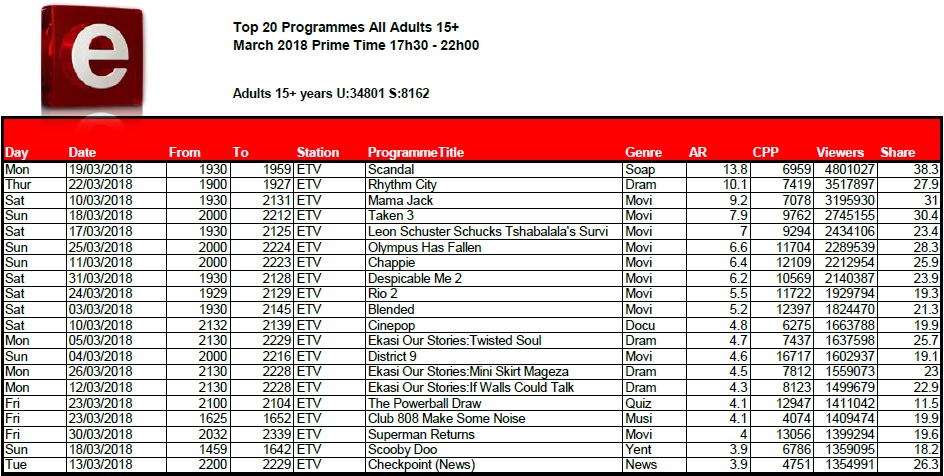
SA TV Ratings: e.tv — primetime top 20 for Mar 2018

by MarkLives (@marklives) The hottest primetime shows on e.tv in South Africa revealed: TV ratings for March 2018.

e.tv March 2018

BRCSA TV Ratings March 2018 primetime etv
Click to enlarge and view clearly.

Source: BRCSA March 2018

In 2016, the Broadcast Research Council of South Africa (BRCSA) changed its policy about giving away TAMS and now only monthly reports, highlighting the top 20 or 30 primetime shows on several popular channels, are available.


Broadcast Research Council of South AfricaThe Broadcast Research Council of South Africa (the BRC) is a non-profit, industry body that was incorporated in 2015 to cater to the audience research needs of the radio and television industry in South Africa.

— One subscription form, three newsletters: sign up now for the MarkLives newsletter, including Ramify headlines; The Interlocker, our new monthly comms-focused mailer; and Brands & Branding, launching soon!

Decoding the Business Day Lamberti editorial (we tried)

by Herman Manson (@marklives) It continues to be a terrible week for South Africa’s media. Having kicked sub-editors and fact-checkers to the kerb, the South African news media are pushing out badly constructed and error-filled copy which fans the flames of social media and leads to a perception that SA journalists lack credibility (and yes, some do).

Business Day editorial

The latest to cause outrage is Business Day, which has just run an editorial headlined “EDITORIAL: Don’t fire the messenger.” The extract reads: “It is a pity. Lamberti has displayed outstanding patriotism and commitment.”

Business Day: EDITORIAL: Don’t fire the messenger
Politicsweb: Adile Chowan vs Mark Lamberti & Co.: The High Court judgment

Having read (only) the headline and the excerpt, it’s reasonable to assume the takeout for most readers would be that Business Day is saying:

  • Mark Lamberti is a patriot
  • His departure as CEO of Imperial was unfortunate
  • His message may have been uncomfortable, but he didn’t deserve what came his way.

Lamberti recently resigned his leadership positions at Eskom, Business Leadership South Africa and finally, yesterday (Wednesday 18 April 2018), Imperial after a court ruled against him and Imperial in a race and gender-discrimination case brought against him by Adila Chowan after she had filed, according to the court’s judgement, an internal grievance “of racial discrimination and unfair treatment against Mr Lamberti”.

Following Chowan’s raising her grievance of racial discrimination and unfair treatment by Lamberti and Janse van Rensburg, a law firm was appointed to conduct the grievance investigation. A report on the investigation, which neither contained any findings nor recommendations, was presented to a meeting of Imperial’s non-executive directors, who sided with Lamberti. Chowan was then subjected to a disciplinary hearing, suspended, and ultimately dismissed in 2015.

Yes and no

Does our takeout from the Business Day headline and extract correlate with the editorial? Yes and no.

Business Day argues that Lamberti offers a much-needed executive skill set in corporate SA and that, for many years, he contributed to the success of a company that employs thousands of South Africans. “Lamberti, of all the top CEOs in the country, has displayed outstanding patriotism and commitment to the country.”

But it’s not completely clear cut. The editorial further argues, if in a rather convoluted way, that Lamberti showed arrogance and poor judgment. Writes the paper: “But if firing Chowan for making such a complaint (an internal inquiry found her complaint to be without foundation) was the only problem, we could charge Lamberti and those at Imperial who were also party to the decision (they were apparently advised to do this by lawyers!) with arrogance and poor judgment.”

It also acknowledges that “Lamberti was accused of racism, his accuser was fired and now the label of racist is stuck fast to his name. He will pay a very heavy price for the errors made in this debacle.” In the same breath, it seems to backtrack by arguing that “[i]n Lamberti’s case, the comments he made in which he referred to Chowan at some point as ‘an affirmative action’ employee were not in themselves racist.”

Confused

If you’re feeling terribly confused, we’re with you. The editorial dithers on whether the comments made by Lamberti are racist or not.

It continues down this route when it makes a vague argument about Lamberti’s “notionally racist statement” in writing “[s]o although Lamberti was not found to have been overtly racist — indeed his notionally racist statement was that the company would relish an affirmative action employee — Chowan was found, with justification, to have genuinely been discriminated against.”

As per the court record, Lamerti had referred to Chowan as “a female, employment equity, technically competent, they would like to keep her but if she wants to go she must go, others have left this management and done better outside the company, and that she required three to four years to develop her leadership skills.”

Business Day also suggests that the court finding and Lamberti’s resignation suggest no disgruntled employees may be fired in South Africa (a bit dramatic, especially for the newspaper): “In what workplace and under what set of circumstances would it be acceptable to fire an employee for making a complaint against the boss? In 2018, the answers to that must certainly be: not in any workplace and never.”

‘Good old days’

It nearly feels as if the paper is lamenting the ‘good old days’: “Now due to both the law and social norms, CEOs like everyone else are compelled to behave fairly and to respect all employees, no matter how big or small in the operation that person might be.”

In its conclusion, the editorial states: “The smallest remark or gesture, whether intentionally racist or just insensitive and tone deaf to the mood of one’s colleagues, can go nuclear in the age of e-mail, social media and instant messaging, which can at times resemble a kind of mass hysteria. The best way to deal with it is to recognise the mistake immediately and apologise. The stupidest way to deal with it is to fire the messenger, even if that is the advice of your legal team.”

While some has taken this to refer to Lamberti, and his departure from Imperial, it seems instead to be referencing Chowan, as she was the only person to be fired in this saga; Lamberti quit. The argument, it would seem, is don’t fire employees you’ve messed up with, Mr Executive. Just apologise.

In conclusion, the headline and extract, coupled with a photo of Lamberti when shared on social media, suggests a defense of Lamberti’s actions, and of taking a stance in opposition to his departure from Imperial. As this analysis have shown, this is partly true, and that the paper seems to be suggesting that Lamberti was a good leader with high-value skills, and that his retirement is a loss for our country. But the messenger referred to in the headline seems to be Chowan, and not Lamberti, so the editorial is arguably a call for SA business executives to take notice of what employees are trying to say about their organisational culture, not to get rid of them.

Core message

Unfortunately, the core message, as per the headline and conclusion, has been heavily diluted by the paper’s indecision on whether it’s mounting a defense of Lamberti, or of employees victimised by corporate execs.

It’s important to note that an editorial essentially expresses an editor’s point of view (or opinion). I, for one, subscribe to Business Day’s right to publish controversial and diverse views and opinions.

Social media reaction

https://twitter.com/5942017jojo/status/986852877527408640

https://twitter.com/MashotoPhala/status/986846242494926848

https://twitter.com/GoodHair99/status/986834934076727297


Herman Manson 2017Herman Manson (@marklives) is the founder and editor of MarkLives.com.

— One subscription form, three newsletters: sign up now for the MarkLives newsletter, including Ramify headlines; The Interlocker, our new monthly comms-focused mailer; and Brands & Branding, launching soon!

Young, Gifted & Killing It: Thithi Nteta

by Veli Ngubane (@TheNduna) Training in information design. Doctors as parents. Part of the launch team of Vuzu. A sneaker addiction. These are just some of the soundbytes from our interview with Thithi Nteta (@teeteenteta), now sitting on exco at FCB Joburg. Read more about her views on the global challenge around gender diversity and her approach to leadership.

Thithi NtetaVeli Ngubane: Tell us more about yourself: where did you grow up and what did you want to be when you were growing up?
Thithi Nthetha: I grew up and went to school and university in Pretoria, where I studied Information design at Tuks. I am the oldest of four children, my siblings are my best friends and my parents are both doctors. When I was growing up, I wanted to be a variety of things. After watching “Free Willy,” I wanted to be a marine biologist; after Denzel Washington won an Oscar for “Training Day”, I wanted to be an actress. At some point, I wanted to be a fashion designer and used to spend my school holidays sketching dresses and outfits.

VN: Please explain what you actually do and how an average day looks for you?
TN: My title is integrated executive business director for the Absa/Barclays account at FCB Joburg. I am responsible for running the business, which really covers a variety of things like making sure that the account is performing financially, that the client is as happy as a client can be, [and] that the people who work on this piece of business feel validated, cared for and enjoy coming to work. I do spend a lot of time on our people, because the people make the work… they create the magic.

VN: What is your philosophy in life that influences your work?
TN: Leadership is not a rank, or a position. Leadership is a decision; it is a choice to look after your people.

VN: What lessons have you learnt from your experience in the industry that have led to your success?

TN: When I was 25 years old, I was working at a small broadcast production agency as a producer working on the launch of Vuzu. As a result of the agency’s size, the role not only required me to be the project lead on the channel launch but other tasks outside my job description. I wrote scripts, held mics on set, did wardrobe where necessary etc, but the rolling up your sleeves and getting things done wasn’t the most-important lesson I learnt there. Being so young, I had several people who were older than me reporting to me and this was something I struggled with. The best advice I got at that time was from my executive producer, who basically told me that. given the kind of person I am, that I would more than likely find myself in leadership roles and have people who are older and perhaps who have been doing a certain thing longer than me reporting to me, and that I had to get over my complex around the age thing and keep it moving.

VN: What are your views on why the industry is slow to transform?
TN: I studied information design at the University of Pretoria and, in all four years of my degree, I was the only black person in that Fine Arts and Design building. When I got to fourth year, I sat on the panel interviewing potential candidates and I remember us debating a young black girl’s application because we weren’t sure she’d be able to afford to complete the course, even though she was incredibly talented. While the course I studied wasn’t as expensive as the Vegas and Open Windows of the world, it was, overall, an expensive course to do: from the markers you need to buy to the MacBook you need to get with the software. Even with my privileged background, I had to work as a waitress to be able to cover some of those costs. So, really, I think it starts at the source. Why are the schools so expensive? Why do they only really allow for a certain kind of person to be able to study there?

In addition to the above, we need to stop saying that there aren’t enough black creatives and accepting that response when HR and talent recruitment people come back with that answer. We need to create spaces that make black staff feel “safe”, “seen” and supported. Spaces where their frustrations, when expressed, are addressed.

Last, but definitely not least, the retention of black staff needs to become a priority. A purposeful priority, with SMART objectives in place that hold various people accountable for this priority. Something as simple as recognising a junior or mid-level staff member with potential and investing time and money into that individual’s growth plan could go a long way. Imagine a world where it was the KPI of a senior white person in a role to identify a black staff member reporting to them directly and work with them to their next promotion. The success of that manager would be closely linked to the success of their direct report. There would be no room for “they are not good enough” because that would reflect directly on you as their manager.

VN: Why do you think the ad industry is failing to grow female talent to top positions in agencies?
TN: I think the world in general is failing at creating spaces where female talent can grow into top positions, because we don’t take gender diversity seriously. Most organisations talk about it, but there is no strategy or commitment from senior or executive leadership on this, even though research shows that companies with a greater share of women on their boards of directors and executive committees tend to perform better financially. In addition to this, the ideas around what people consider to be good, or rather necessary, leadership skills needs to change. There is still a significant amount of unlearning that needs to happen with regards to what qualifies as leadership.

VN: How do you perceive yourself as a woman leader in the creative industry?
TN: I am of the servant-leader school of thought. I am about inclusive leadership that makes people feel valued, heard and seen. I learnt very early on in my career that you get the best out of people when they want to work for and with you.

VN: What advice can you give to people wanting to get into the business?
TN: You need to be an all-rounder. Most of what you do is problem-solving, and time is expensive.

VN: What do you like most about your job? What is most challenging?
TN: I like being at the agency, being part of the creative process and part of people’s growth. The most-challenging part of the job is keeping great work sold in.

TN: What is your favourite ad campaign, past and present, and why?
VN: I can’t really think of any ad or ad campaign I am into right now, but a piece of moving content that I will always consider to be quite dope is the SABC 1 Ya Mampela ad [that I] pinned on my Twitter account. I just remember being quite moved by the ad and, even today, when I watch it, it is a piece of content that makes one feel something.

VN: What has been a highlight in your career?
TN: I have been really blessed to have a career of highlights; I mean, by the time I was 26, I had helped launch a TV channel. But, in general, if I have wanted something, I have managed to work for it. I wanted to work for a fashion magazine at some point, and managed to get a job working as a fashion assistant at Cosmo. I worked at Nike Sportswear’s PR agency during the 2010 FIFA World Cup as the PR manager on the account, and was the field marketing manager at Red Bull South Africa at some point. But I suppose if I was to call out one thing, I’d have to say that running my small boutique agency for three years and securing retainers with Nike Sportswear and G-Star RAW was a highlight. That period taught me a lot about doing the right things with your time, problem-solving and making decisions.

VN: What are the key trends to look out for in 2018 from an ad industry business perspective?
TN: Automation is going to continue to threaten the industry. Increased move to digital channels is going to continue to threaten the above-the-line production value. With the collapse of AMPS, we don’t actually know whether people are consuming content on TV on their phones. Which means we are all making calls on media and channel that are not backed up by data. The “black mirror”, aka our cellphone screens, is really where it’s at.

VN: What’s next for you in your career?
TN: Right now, I am really happy at FCB Joburg, doing what I am doing. Running an account of this size, with as much autonomy as I have, allows me to exercise my entrepreneurial spirit and really lead the way I want to lead. I am fortunate enough to be a black woman on exco because I have a say on how we do things, and I can actually contribute to the change.

VN: Tell us something about yourself not generally known.
TN: I am not really that good at self-promotion and I own a lot of sneakers. It’s embarrassing.


Veli NgubaneVeli Ngubane (@TheNduna) entered the world of advertising with a passion after completing his BSocSci (law, politics and economics) at UCT and a post-graduate marketing diploma at Red & Yellow, where he’s currently advisory board chairman. He also sits on the IAB’s Transformation & Education Council, is a DMA board member and has judged the Loeries, Apex and AdFocus awards. He is CCO and founding partner of the largest black-owned and -managed full-service agencies in the country, AVATAR. He is also co-founder of M&N Brands, which is building an African network of agencies to rival the global giants. In his monthly column “Young, Gifted & Killing It”, he profiles award-winning, kick-ass black creative talent in South Africa.

— One subscription form, three newsletters: sign up now for the MarkLives newsletter, including Ramify headlines; The Interlocker, our new monthly comms-focused mailer; and Brands & Branding, launching soon!

Adnalysis: Running a business is a marathon — so, too, is brand-building

by Bogosi Motshegwa (@Thinkerneur) Have you ever thought about why the process of operating a corporate or business is referred to as “running a business”? It’s because it’s a marathon, “a long-lasting or difficult task or activity” (emphasis added). I’ve never run a marathon, nor have I run a business yet, but working within organisations that are trying to run their business and build their brands has given me insight into the parallels between them.

I doubt there’s ever anybody who goes into business to go out of it, not even Kodak or, most recently, Toys-R-Us in the US. Even businesses that fail dismally, while the thought of possible failure is there, don’t have the intention. And, indeed, running a business or trying to build a brand is a difficult task or activity (while brand-building is a single function of running a business, I use them interchangeably in this context as I believe that, without a strong brand, there won’t be a sustainable business to run — if you build your brand, you ultimately building a business).

Purpose

The purpose of the original marathon was to deliver a message. If you think about it, brand marketing is exactly that: delivering a key message which seeks to convey your brand’s value proposition or that thing that you have that none of your competitors have. At least, I hope you have something different or unique to offer or provide.

Please complete this sentence by leaving your answer in the Comments section below: “Give that man a…”

I’ve no doubt that you were able to complete the sentence without flinching or even thinking too much about it. That, ladies and gentlemen, is the power of delivering a key message consistently over a considerable amount of time — the operative words being “over a considerable amount of time.”

What do businesses and marathons have in common?

They both require patience. I’m sometimes stunned by marketers’ or clients’ expectations for a single campaign to deliver on their long-term goals. Impossible. That’s like saying that a particular 20km distance will decide on a runner’s fate to win or complete a race. Technically that may be true, but it’s not just that distance; it’s all things added together that culminate into a result, whether desirable or not.

It’s not what you do only in a given instance but everything you decide to do or not.

Building a brand or running a business sometimes feels like a futile exercise, just like how marathon runners sometimes question their sanity when on the road, their legs pounding on the tar, and it seems as if they’re going nowhere slowly. You put in the effort but there seems to be little or no result.

Building a brand becomes difficult, competitors literally running past you as if you’re standing still. It’s competitive, it’s aggressive and it’s painful.

The beauty of building or running a business

Unless you’re a startup and literally the only person doing the work, more often businesses have more than one person, and so it is never an individual’s task to run alone. You have people around you. Take a break if you personally need to.

When building your brand, your job is to deliver that special thing about your brand consistently. The thing about business or brand-building as a marathon is that there’s no finish line — it’s a long-term game. How you decide to run will determine your longevity and whether you stay in the race or not.

How you need to think about your brand/business

  • Never bank on any single campaign to solve of your business’ or brand’s problems; it’s everything you do.
  • Keep on trying new things. Always think about what you can do differently, without being schizophrenic. A perfect example is Nando’s. It keeps doing new things that feel/sound/look familiar, like only it can do. Why? Because it’s cemented its brand’s identity. It’s not trying to do a lot of different things or say too many things; all it does is speak its purpose in different ways.
  • Do more things. Yes, budgets or a lack thereof are a thing but you need to do more as a brand. Start thinking differently about media channels or options. Everybody wants to do TV, but how affordable is it? Yes, it’s huge and still commands the majority of people’s attention but, with it being so fragmented, especially pay-TV, shouldn’t you start thinking differently about where you place your eggs?
  • In everything you do, ensure that you keep true to your brand’s identity.
  • Campaigns are big but they’re not the end of the brand (unless you do something distasteful or stupid). Everything should count and should add value.
  • Don’t give in too quickly on a campaign: give it time and be patient.

Winning

The key to winning is not just consistency but consistency of simplicity —be consistent keep your message simple and easy to understand.


Bogosi MotshegwaBogosi Motshegwa (@Thinkerneur) truly believes that advertising can really change the world. Every single day he tries to prove this. He shares his thoughts on the industry and sometimes has unconventional views. Bogosi is the co-founder of Melanoid Éclat (for finding black entrepreneurs), a committee member of AMASA, an Advisory Council member and guest speaker at Vega, and also does speaker management at TEDxJohannesburg. He is currently a strategic planner at Net#work BBDO. He contributes the monthly column, “Adnalysis”, which analyses adland from a strategist’s point of view, to MarkLives.com.

— One subscription form, three newsletters: sign up now for the MarkLives newsletter, including Ramify headlines; The Interlocker, our new monthly comms-focused mailer; and Brands & Branding, launching soon!

South African media tarnishing own reputation

by Herman Manson (@marklives) The reputation of South Africa’s media establishment (and anti-establishment) has been taking a beating of late. We collate some of the public reaction on the retractions, misogyny and what appears to be personal vendettas. It’s been a shameful couple of weeks.

The Huffington Post South Africa (JV with Media24)

https://twitter.com/verashni/status/985563865336467456

https://twitter.com/Kutshomna/status/984880163744862208

Sunday Times (Tiso Blackstar Group)

The Sunday Times thought a “Blonde Ambition” would make a swell description of a female politician’s amibitions.

https://twitter.com/Natasha9Mazzone/status/985461481138479104

https://twitter.com/FazlinFransman/status/985548690738819072

Mail & Guardian

The Mail & Guardian ran three different iterations of its story on the death of Ramon Leon (father of former Democratic Alliance leader, Tony Leon), revising the original not once but twice.

https://twitter.com/LaurieAClaase/status/986168547322843136

https://twitter.com/mailandguardian/status/985906995839623169

https://twitter.com/XondoZ12/status/986148724693983233

https://twitter.com/Zeeni_Panini/status/986120324809764865

Further reading

M&G pulls ‘hanging judge’ claim against Ramon Leon

“Publication forced to apologise after making false claims against highly-regarded jurist following his death.”

Business Report (Independent Newspapers)

What is going on at Business Report? Two versions of same story by “staff reporter” (but see editor’s note and opinion inserted into original ‘news’ story). No note to readers explaining changes either.

Updated story

Story with changes

Further reading

amaBhungane Analysis: Iqbal Survé’s mythical beast

“The full extent of the destruction at Independent Media since the Public Investment Corporation placed the company at the disposal of Iqbal Survé has been laid bare – ironically via Surve’s outrageous attempt to use other peoples money to plug the R2,3-billion hole in his media balance sheet.”

Independent Media response to amaBhungane/Daily Maverick

“The most important point we would like to make here is that we, as Independent Media and Sagarmatha Technologies Limited, have nothing to hide. We have been consistently transparent. What worries most of our media competitors – our main detractors – is that we have identified the future of media and have constructed a Multi-Sided-Platform (MSP) that will make traditional media houses obsolete. They are fighting for their existence.”

Independent Media sets the record straight on JSE listing

“In the weeks leading up to the listing, certain opposition media companies embarked on a disinformation campaign against Independent Media in an attempt to scupper the listing. Snippets of information, contained in the 212-page PLS, were extracted and represented as an “exposé”, in an attempt to mislead the public and create a picture of wrongdoing and to cast suspicion on some of the people and companies involved in Sagarmatha Technologies.”

https://twitter.com/Mngxitama/status/985433568418717696


Herman Manson 2017Herman Manson (@marklives) is the founder and editor of MarkLives.com.

— One subscription form, three newsletters: sign up now for the MarkLives newsletter, including Ramify headlines; The Interlocker, our new monthly comms-focused mailer; and Brands & Branding, launching soon!

By Invitation Only: Lead generation in the age of PoPi

by Gareth Mountain. Lead generation is constantly evolving and, with the Protection of Personal Information (PoPI) Act set for implementation, big changes are around the corner. So, what to expect for the industry?

As in 2017, the lead-generation industry is continuing to prove itself as a highly successful marketing method, especially for the right products. Lead generation provides clients not only with a solid return on investment but also improved growth during difficult times. That said, it needs to be done correctly, and not many companies spend enough time on honing campaigns.

SMS

Looking at the lead generation locally, SMS marketing still dominates and remains a key channel to reach the mass market in South Africa. The volume behind SMS campaigns makes this a predictable option, offering not only a massive reach but also the ability to geo-target campaigns or segment it according to demographics.

Email

It is in the email space where most of the action is, where lead-generation software is improving significantly. Importantly, there is software that now measures ROI in real time, while machine learning is also making an appearance here, with, for example, algorithms improving data segmentation. This will play a big part in lowering marketing costs for companies, alongside the ability to automatically manage delivery failures. The latter tracks incorrect email addresses and excludes them on future campaigns so that companies don’t get charged when sending them.

New email products are continuing to emerge, designed to gather more leads and, at the same time, drive down acquisition costs. Two worth mentioning are Read2Lead, and Click2Call. Read2Lead provides a soft-call from a call centre agent after a customer clicks on a specific article in an email campaign, eg “Short term insurance during the holiday season”. Those who hate completing webforms online to get someone from the company to phone them should take note of Click2Call. A link in the marketing email simply directs the interested party to a “Thank you” page, with a call-centre agent having received the instructions to initiate a call.

Call centres

The one to watch, especially with PoPI looming, is call-centre marketing, or outbound as it is also called. Set to flourish, the segment employs a significant amount of people locally, and this is perhaps one of the reasons why PoPI seems to be more lenient when it comes to outbound calls, compared to electronic marketing methods.

On the one hand, companies are allowed one outbound call to a person, through which they must require opt-in to allow further calls. On the other hand, electronic channels such as SMS and email will require explicit opt-in from the get-go from those being marketed to, and this is set to impact lead generation in a number of ways.

The significant impact of PoPI

First, the cost of marketing using an outside company’s data assets (mailing lists) will escalate. Therefore — and this can’t be emphasised enough — companies should start working on opt-in from their clients straight away. An opt-in database will be crucial for any business looking to stay in the game and should be seen as an extremely valuable asset. Start monetising this as a priority and invest in your own channels as soon as possible.

Secondly, since SMS and email marketing will be most affected by PoPI, we may expect innovation in lead generation outside of these channels. This means revisiting a call-centre strategy, making sure your website indexes well on Google, coming up with innovative social media strategies, and looking at pay-per-click models of advertising.

Working together is key

While the onus will rest on companies doing the marketing to comply with PoPI, and not those providing the lead generation channels to do so, there is no reason that these two parties shouldn’t work together. Lead-generation companies must help clients to not only understand PoPI and the implications of the act but also to innovate and help build intellectual property in their lead channels.

When it comes to PoPI, being both proactive and innovative will be key. There are going to be companies that will be made an example of and slapped with hefty fines to deter those that think that PoPI will be an act without teeth. Make sure your company is not one of them.


Gareth MountainGareth Mountain is head of sales at Olico, a PoPI-compliant lending and innovation company that is an online and mobile marketing partner.

“Motive” is a by-invitation-only column on MarkLives.com. Contributors are picked by the editors but generally don’t form part of our regular columnist lineup, unless the topic is off-column.

— One subscription form, three newsletters: sign up now for the MarkLives newsletter, including Ramify headlines; The Interlocker, our new monthly comms-focused mailer; and Brands & Branding, launching soon!

Shelf Life: Comedy kings crash the insurance industry

Cheryl Hunter (shelflife at marklives.com)’s weekly pick of all things new — ads, product, packaging, design, insight, food, décor and more!

  • King Price captures consumers with comedy
  • Burger King’s Whopper guide dog
  • Ballo expands into apparel

A-tractor humour

King Price Insurance has once again put its light-hearted brand tonality and messaging at the forefront for the first TVC in a new brand campaign to raise awareness in the cluttered insurance industry.

https://youtu.be/W2zLQS-ZKqk

In an industry not traditionally known for its sense of humour, the new ad (about a farmer getting sexy with his tractor) is essentially about something being lost in translation, which is something that happens all too often in South Africa. This is one of the reasons, says Natalie Bisset, King Price general manager of marketing, that King Price goes to such lengths to write its policy wording in easy to understand, everyday language, rather than complicated legalese: “Our clients understand exactly what they’re paying for. King Price is big on humour — it’s the way we take the ‘eina’ out of insurance. And, if we can encourage South Africans to own that they’re flawsome, we’ll do that, too. Because we totally own that, while we’re awesome, fixing our flaws is always top of our to-do list.”

Strategically, this is the first ad in a brand campaign conceptualised in-house, and the series isn’t focused on the insurance offering. Freckle, the creative baby of writer/actor/film-maker duo Bennie Fourie and Bouwer Bosch, was responsible for the concept and production. The brief was open-ended: “Push brand. Be funny. Embrace cultural diversity. Disrupt the clutter. Emphasise that we make sense when others don’t. That was pretty much it.”

“What makes the ad so funny,” says Fourie, “is that we stripped away all the gimmicks and focused on capturing the human element. It’s a simple story. Our main character, Callie, doesn’t even know he’s funny. That’s where the comedy happens.”

In terms of raising brand-awareness, and distinguishing the King Price brand in a cluttered insurance market, the ad has been viewed more than 326 000 times on YouTube and reportedly went viral all over the world on WhatsApp in less than 24 hours. Bisset says that this level of online uptake enables massive re-marketing opportunities, which is where targeted product-specific messaging will come into play: “Having a holistic plan in place is critical. Advertising is just one part of any successful strategic marketing campaign, and must translate back into sales. We’re still very much the ‘new kid on the block’ and we don’t have massive marketing budgets to throw around, so everything we do translates back to our ‘lean-and-mean’ family value. Minimum spend for maximum impact.”

Brendan Barnes, of punk rock band Crash Car Burn-fame, did the cinematography for the ad, and Peach van Plezten created the music.

kingprice.co.za • Facebook • Twitter • Instagram
creativefreckle.com • Facebook • Twitter


The best nose in town

The second-largest fast food hamburger chain in the world, Burger King, has always had an open-door policy when it comes to certified guide dogs. To show how important this is to the brand, some time was taken to teach Flynn, a guide dog, how to sniff out a Whopper anywhere in the world and make a visually impaired Whopper fan’s wish come true.

https://youtu.be/0xW6lqI-BlQ

Nathan, 29 years old and visually impaired, loves flame-grilled burgers from Burger King. His faithful companion, Flynn, never leaves his side, so to enjoy flame-grilled burgers whenever Nathan desires, he came up with a great idea: combining the obvious. Nathan asked Burger King about the possibility of training Flynn to recognise the special scent of flame-grilled burgers and Flynn started his special training for his new position as a “Whopper Dog”, leading his owner to the closest Burger King restaurant on command. The story that follows, beautifully captured by German ad agency, Grabarz & Partners, takes the viewer on a two-week journey to witness Flynn’s progress and ultimate success at finding a Whopper in Paris, France.

Ezelna Jones, marketing executive for Burger King SA, says, “This film proves that our flame-grilled burgers are not only superior when it comes to taste but also when it comes to the delicious aroma.”

burgerking.co.za • Facebook • Twitter • Instagram
grabarzundpartner.de • Facebook • Twitter • Instagram


More bling from Ballo

Cape Town-based, wooden sunglasses brand, Ballo, is making waves as the success of its unique sunglasses has resulted in an expansion of its range into the apparel market, using hemp as the material of choice.

Ballo apparel collageAlistair Barnes, owner and founder of Ballo, came up with an idea to design and create a pair of sunglasses that are unique and completely sustainable. The first material used was a pair of the designer’s old jeans and since then. ShweShwe fabric and cork offcuts, old advertising billboards and hemp canvas offcuts have been used. Sticking to local heritage, the Ballo range comes in different shapes and sizes, with locally inspired prints showing off the brand’s African design.

According to Barnes, sustainability and durability are core principles of the brand and are being carried through to the range of apparel currently being developed: “This is possible because China has been fine-tuning its hemp production for thousands of years and [has] managed to perfect a process that has almost no impact on the environment.”

Men’s t-shirts, shorts, caps, bum-bags and totes are all coming soon.

ballo.co.za • Facebook • Twitter • Instagram


Cheryl HunterShelf Life is MarkLives.com’s weekly column covering all things new. Notify us of yours at shelflife at marklives dot com. Want to sponsor Shelf Life? Contact us here.

Cheryl Hunter (@cherylhunter) has written for the South African media, marketing and advertising industries for more than 15 years. A former editor of M&M in Independent Newspapers and contributor to Bizcommunity, AdFocus, AdReview and the Ad Annual, she has also produced for various television networks and currently consults on communication strategy and media liaison.

— One subscription form, three newsletters: sign up now for the MarkLives newsletter, including Ramify headlines; The Interlocker, our new monthly comms-focused mailer; and Brands & Branding, launching soon!

Online CPD Courses Psychology Online CPD Courses Marketing analytics software Marketing analytics software for small business Business management software Business accounting software Gearbox repair company Makeup artist