Ad of the week with Oresti Patricios – when the product becomes the artwork

MarkLives Ad of the Week with Oresti Patricios – when the product becomes the artwork

chappies one

chappies 2

This week’s Ad of the Week is once again about a campaign that moves outside of the mainstream, and engages with the community, using art and social media.

For anyone growing up in SA in the past six decades, there are several brands that have come to symbolise our very ‘South African-ness’ and which are as much a part of our fabric as braaivleis, Soweto, ‘koeksusters’ or Mandela.  To get a sense of what I mean, think of Springbok Radio, Marmite, Sunlight, Mrs Ball’s, Marie biscuits… and of course Chappies bubblegum.

When I was young, there was only one flavour of Chappies, and that was the juicy gum that was a sort of fruity pink. And yes, I mean pink as a flavour. You got four for a cent, and they came in a wrapper with an inspired gimmick – one that has endured for generations.

The attention grabber that the Chapelatcompany came up with from the start – in case you’re from a foreign country, or lived under the dictates of cruel and inhuman parents who didn’t allow you to buy bubblegum – was called ‘Did You Know?’ Inspired by the Springbok Radio show, ‘Three Wise Men’,Chappies’ defining device was the interesting and little-known facts that were printed on the inside of the distinctive bright yellow, blue and red striped wrapper. If you’ve ever unwrapped Chappies and pondered over the factoids contained on the wrapper you’ll know exactly what I’m on about.

The product has evolved a little over the decades, with new flavours like grape and watermelon having been introduced of late. But at its heart the product is still the same square of soft gum, and it’s still to be found in just about any café in SA. In fact, as many as 7 million Chappies are sold every day in this country.

Chappies’ market-share may be unassailable. No cheap foreign product is going to replace it, because it’s what we as South Africans know and trust. But the challenge nonetheless is to keep the brand fresh, relevant and associated with fun. So what Brand Manager Georgina Harpur and Ogilvy Cape Town came up with, was a simple, two-phased approach to drive interest in the brand and get people talking and participating in the Chappies’ brand.

In its first phase, the campaign started with a call to action using a MXit/Facebook competition that asked fans for new “Did You Know?” facts for Chappies’ wrappers. The response was almost overwhelming: over 50,000 submissions were received, all of which had to be appraised and fact-checked. All 170 of those who were selected won prizes – a year’s supply of their favourite bubble gum, and a framed copy of their ‘Did You Know’ on a Chappies’ wrapper.

OK, so a Facebook/MXit competition isn’t in and of itself a unique idea, although the execution was slick, and targeted at exactly the right demographic. But the factoid competition engaged the fans in the next phase, which was very much a street-level affair.

Phase 2 was the creation of “Edible Street Art” based on six of the “Did You Know” facts that Chappies received. Using the different coloured Chappies bubblegums (in their wrappers) as “tiles”, six mosaic designs were installed in Woodstock, Cape Town Station, Khayelitsha, Maboneng Precinct, Parkhurst and Greenside.

The largest artwork took 15 hours to set up, and only 15 minutes to disassemble, with the help of the public – which included just about any kid within a 5km radius!

What makes this campaign interesting, I believe, is the way in which the brand is integrated into the campaign. The product becomes the artwork, and the public is appropriately engaged in both sourcing the factoids which are a pivotal brand device, and then watch as these ‘Did You Knows’ came to life in public artwork.

There’s something inherently youthful about the Chappies brand, despite the fact that it has been around since the 1940’s. So what’s exciting about this campaign is how it embraces new mediums and out the box thinking to promote a message that’s both fun and creative. The end result: a fresh face for an old favourite, entrenching it as a truly South African brand. But what’s truly cool about the campaign was that it was about paying tribute to the people who buy and support the brand – as everyone who chomped on the artwork, after it was disassembled, can attest to.

Ad of the Week is published on MarkLives every Wednesday. See past selections here.
Oresti Patricios is the CEO of brand and reputation analysis company Ornico.

– Industry profiles you’ll make time for. Sign up for our free newsletter!

Let’s talk sustainability: ‘Enough. For All. Forever.’

by Colwyn Elder (@colwynelder) Sustainability is one of those big, hairy, honking subjects that everyone is talking about but no-one really wants to talk about, because let’s face it – we’re all guilty! Especially if you work in advertising, in other words: you’re a cog in the wheel of the over-consumption-machine without which we wouldn’t be having this uncomfortable conversation in the first place.

But even if you don’t work in advertising, keep reading, because if you drove your car in to work this morning (especially if you drove in your colwyn elder4×4 all by yourself), you’re guilty. And if you rode your bike into work, and then followed up with a long, hot shower, you’re also guilty. By and large we are all living, to a lesser or greater extent, an unsustainable lifestyle.

And there it is. The elephant in the room that nobody wants to talk about.

So let’s talk about it.

We live in a world where an increasing number of people will compete for finite resources. This requires a fundamental and significant shift in how we live.

I recently attended the Sustain Our Africa Conference in Cape Town, which succinctly summed up the notion of sustainability in a single pithy definition: ‘Enough. For All. Forever.’ It’s successful because it manages to wrap up sustainability’s triple bottom line of ‘People, Planet, Profit’, in an engaging and motivating way. It’s positive, inclusive and sounds like a future we’d all like to be part of, far cry from the ‘end is nigh’ commentary we’ve heard in the past. To achieve the significant level of change required, it’s important for people to see themselves as part of the solution rather than the problem.

And similarly, if we view business as a part of the solution – not the problem – we can begin to see the role of business in a future that has ‘enough, for all, forever’.

Last year I worked on a sustainability project for one of the UK’s leading banks and interviewed stakeholders across the breadth of the organisation. Interestingly all senior partners were in agreement that sustainability has ‘become part of the must-have’s of corporate culture’ and there’s ‘not a boardroom in the FTSE100 where this isn’t important to them’, yet they struggled to agree on what this meant for them as business. Answers ranged from the ‘cost of doing business to the world’ to ‘being here as a bank tomorrow’ and ‘innovating and evolving so that we can be relevant to our customers.’

Almost all of them spoke about baking it in, not bolting it on. In order to achieve this – and make business a part of the solution – we need to stop seeing CSR as a separate function. Applying good corporate citizenship across the business may work to minimize impact or even redress negative impact, but this simply brings us back to a zero base. Instead we should attempt to find new ways of doing business and create shared value – for customers, for commerce, for our world.

Unilever has a big ambition to double the size of the company whilst reducing their overall impact on the environment. At the same time it recognises that the majority of their footprint comes not from the manufacture of their products (29% comes from raw materials and manufacture), but rather in consumer usage of these products (68%).

In other words to reduce their impact, it is imperative to change consumer behaviour. Developing a more concentrated washing liquid means less packaging, which in turn means fewer trucks on the road. But most importantly Unilever’s customers can feel good about by using less to achieve the same level of efficacy.

Creating shared value is about finding the intersection between your business and society’s needs and challenges, creating economic value in a way that also creates value for society.

An example of business using innovation to create social value is Vodafone’s M-Pesa mobile banking service. Whilst 80% of Kenyan adults don’t have a bank account, they do have a mobile phone. M-Pesa offers a fast, safe and easy way to send and receive money, enabling customers to deposit, withdraw and transfer money – something they were previously unable to do – by means of their mobile phone.

As another of my research stakeholder’s said: ‘sustainability is an opportunity to surprise customers in a positive way by caring about something that s/he cares about’. If business thinks of itself in this way, as a creator of shared value, not just shareholder value, and as a contributor to society as a whole, then we can start to shape a shared future our customers will actually want to talk about.

Y&R strategy director Colwyn Elder (@colwynelder) has 17 years of experience in strategic planning, together with specific credentials in sustainability communications, social marketing, corporate social responsibility and cause-related marketing. She contributes the monthly “Green Sky Thinking” column on sustainability issues to MarkLives.

Sign up for our free newsletter!

Joe Public heads to Cape Town

by Herman Manson (@marklives) Joe Public is working on setting up a new agency in Cape Town. Gareth Leck, MD at Joe Public Advertising, says the new agency will be formally launched in June 2013. It is being set up for Joe Public by Leon Jacobs, until recently the joe publicExecutive Creative Director at Saatchi & Saatchi in Geneva and before that Regional Creative Director at Saatchi & Saatchi in Hong Kong.

Jacobs has a long history in South African advertising having previously worked at  Saatchi & Saatchi in Cape Town, TBWA\Hunt\Lascaris and at Giant Films.

Jacobs is currently in the process of setting out the positioning of the new agency, defining its structure and finding key people to help set up the new agency. Its name is also still in development.

Leck says the group is building an agency in Cape Town, not just an office, and that he believes it will become a significant business in its own right.

The new agency will play a key role in digitising the entire Joe Public Group, says Leck.

“Joe Public is faced with a rare opportunity here,” says Jacobs. “We have a blank canvas to engineer a new model from the ground up, pushed forward by the amazing momentum of the Joe Public brand. I am confident that we are going to bring something to the market that will be very competitive.”

– Industry news you’ll make time for. Sign up for our free newsletter!

Who is Dr Iqbal Survé – future owner of Independent Newspapers?

grubstreet

by Gill Moodie (@GrubstreetSA) Who is Dr Iqbal Survé, the man who is about to become South Africa’s  newest media proprietor if the sale of Independent Newspapers  goes through?

Yesterday it was announced that the Irish owners of Independent Newspapers had agreed to sell their  South African division  to Sekunjalo Independent Media Consortium led by Survé for R2-billion.

The deal, said a story in Business Report,  is still subject to the final agreement being signed by both parties, shareholder approval by the Irish owners and approval by the Competition Commission.

Oscar Pistorius front pages
Independent Newspapers’ flagship title.

Independent Newspaper is the biggest collection of English newspaper in the country and includes The Star, Cape Times, Cape Argus, The Mercury, Daily News, Pretoria News as well as publishing phenomenon, the isiZulu Isolezwe.

This is not Survé’s only venture into media ownership and Grubstreet revealed last week that his company, Sekunjalo, was backing a new medium-wave radio station for Cape Town,  Magic AM.

The station is also backed by Cape Media, the B2B company  that publishes Leadership magazine, and is being guided through the licence application process by broadcasting veteran Tony Sanderson. The station is yet to have its licence approved by the regulator, Icasa.

Grubstreet was not able to get an interview with Survé last week or this morning but  this extensive Leadership profile of him from July  last year tells us that  he  grew up in a poor family in Cape Town and studied medicine at the University of Cape Town.

In the apartheid years, he went on to become known as the “struggle doctor” as he was close to the Robben Island prisoners  who were receiving treatment at Groote Schuur Hospital.

Having attracted the attention of the apartheid authorities because of this, he studied sports medicine so that he would not have to work in the hospital system and later he went on to to work with Bafana Bafana and the Indian cricket team.

His close association with the top ANC leaders as a doctor and adviser continued into the 1990s and beyond.

“He has accompanied presidents Nelson Mandela, Thabo Mbeki, Kgalema Motlanthe and Jacob Zuma on state visits as a captain of industry,” said Leadership, “and participates in many prestigious presidential, ministerial and public institutions and advisory boards.”

Survé and other partners started Sekunjalo in the late 1990s and it was listed on the JSE in 1999. Controversy was to follow and as Leadership writes:

From its inception, Sekunjalo only purchased controlling stakes in companies, hoping to empower black workers. In 1999, it had purchased a 11% stake in LeisureNet, a white-owned and -run South African company that operated health clubs globally and was seeking a BEE partner. As a result of an over-ambitious international expansion and two CEOs who were charged in 2000, the company went under in one of the biggest corporate scandals in South African history – resulting in Sekunjalo, as a passive investor, losing R160-million along with major investors such as Investec, Coronation, Sanlam and others. In one day, Sekunjalo’s stock dropped 44%.

Dr Survé, already a very public figure in South Africa, had to decide what to do, particularly what to tell his loyal employees who had invested so much in Sekunjalo’s mission. “It was the most difficult year of my life so far,” he admits. “At times, I wondered whether I shouldn’t simply return to the medical profession. I saw very little of my family. I worked nearly 20 hours a day that year.

“Many observers thought we wouldn’t make it. Companies of more or less the same size as ours had collapsed in similar circumstances, but we succeeded in surviving.”

And survive it has; in fact, Sekunjalo has mastered the saying: ‘What does not kill you makes you stronger.’ At the Inaugural Annual Meeting of the New Champions held in Dalian, China in 2007, Sekunjalo was identified as one of the 125 Founding Members of the Community of Global Growth Companies.

This has allowed Dr Survé to pursue other ventures – with his family, his philanthropic ventures, the numerous other boards on which he sits, and wonderful initiatives such as the Clinton Global Initiative and the WEF.

According to the July Leadership article, Sekunjalo has more than 130 investments, primarily in Africa – chiefly in oil and energy, mineral resources, defence, telecommunications and power, and is the shareholding partner to Siemens AG, Nokia Siemens Networks, British Telecom and Saab AB in their African businesses.

He has a reputation as a philanthropist internationally and the Survé Family Foundation has supported 168 projects throughout the world.

Sekunjalo was at the centre of a controversy last year about questionable tender processes involved in an R800-million contract for maintaining eight state-owned research and patrol vessels.

The government announced an inquiry into the matter. However, in April last year it emerged that the ship-maintenance tender inquiry was to become a  general commission of inquiry into the overall effectiveness of the fisheries department while the Public Protector said it would investigate the matter.

Sekunjalo also holds a major stake in Premier Fishing that has long-term fishing rights in south coast and west coast lobster, pelagic  and squid stocks.

– SA’s leading media commentator, Gill Moodie, offers intelligence on media – old and new. Reprinted from her site Grubstreet.

Sign up for our free newsletter!


Win free tickets to Jozi multi-channel publishing conference

Winners announced. Competition closed!

Congratulations to our winners: Ayanda Moholi, Larry Khumalo and Leani le Roux

A conference in multi-channel publishing is taking place on February 21 at the FNB Auditorium in Johannesburg. WoodWing´s Next Wave Tour will feature a number of publishing specialists including Ryk Benade, Head of Digital Magazine Production Media24 Markets and Alistair Fairweather, General Manager Digital Operations Mail & Guardian.

Roger Risdal, Senior Business Development Manager Digital Publishing Team at Adobe, will update the visitors about the current status and iTunesArtwork@2xthe future of Adobe´s Digital Publishing Suite.

The conference is sponsored by WoodWing, developer of multi-channel and digital asset management software, so obviously the talks will be friendly to that business.

A conference ticket, including lunch and drinks, is available for R1250. The registration form is available at www.woodwing.com/en/events/nextwave-south-africa.

MarkLives is offering three sets of double tickets to interested readers who will be in Johannesburg on Feb 21.

To win a set of tickets simply drop us a line via our contact form with your email address and phone number. We will select three random names on Tuesday the 19th and inform winners directly.

Finding ROI in content marketing

by Herman Manson (@marklives) Eve Williams (@everewilliams) is Managing Director of UK based content agency Cedar (@cedarcontent). The agency also has offices in Shanghai, Cape Town and Johannesburg. Cedar is especially well known for publishing High eve williamsLife for British Airways, Real Food for Tesco (the UK’s largest food title) and Do Not Disturb for Best Western.

Last year Williams was selected to the Media Week 30 Under 30 – an accolade that recognises ‘the next generation of talent in the industry.’ She was the only winner from the content marketing industry.

Williams will be speaking at Content 2013, the content marketing conference taking place on the 25th and 26th February 2013 at the Fugard Theatre in Cape Town, on content marketing in the retail space, dissecting how international brands are using content marketing.

How has content marketing evolved over the past five years?

Eve Williams: It’s still early days in the evolution of content [marketing]. The big bang which created the content marketing universe probably only happened five years ago [contract publishing of course is much older – Ed]. I expect a social media meteor collided with an array of digital electrons, print protons and mobile neutrons. (Please bear with me on the cosmological metaphor – I’m in content marketing rather than astrophysics for a reason.)

In those five formative years though, there have probably been 5 key reasons why content has been able to evolve and prosper, rather than just fade into the marketing black hole (I’ll leave the extended metaphor here I think):

  1. Advances in technology have opened up new ways for brands to curate content, and even more ways for audiences to access it. The explosion of tablet devices and wifi in our worlds has meant that information is only ever one click away, and if you are the brand who can provide that more quickly or simply than anyone else, you’ve got a significant head start.
  2. Traditional marketing strategies using above the line activity was no longer cutting it for consumers. They wanted something more from the brand, and a reason to remain loyal. Content offered the perfect opportunity to tell the brand’s story. Simultaneously brands have recognised the enormous opportunity open to them if they can nurture their owned media portfolios.
  3. Consumers are now simply more responsive to content. There’s a different attitude to free and branded content because consumers are seeing more quality examples of it. This has had a definite snowball effect meaning that consumers are more readily turning away from traditional paid for and newsstand content. This means the doors have been opened for other brands to enter the space.
  4. Social media has also enabled brands to create dialogues with consumers like never before. As long as it’s an interesting conversation, consumers will engage.
  5. And importantly marketers have found a way to make content useful and relevant to their audience. Branded content is no longer about simply selling the brand, it’s now about providing relevant services and advice to the consumer.

And we’ve only just entered the enlightenment. So here’s to a long and prosperous evolution in the content marketing universe.

When deciding which channels are appropriate for the content of each of your clients what do you look to base your selection on?

Williams: You always have to start by putting the audience first. What kind of content is going to be most useful to them – videos, articles, blogs? What kind of channels do they use – mobile, web, magazines, tablets, social media? And where do they want to access the content – at home, work, on the go? Once you understand this you can align it to the objectives of the brand. That enables you to create a plan tailored to the consumers specifically. If you have a very broad target audience you may need to broaden out the channel mix.

When you’ve established which channels you’ll be using, you need to consider how they’ll be joining up. An effective content strategy relies on a very complimentary approach to each of the channels. How are they driving traffic to each other? How are they providing extra information? And most importantly how they are enabling you to track audience behaviour and therefore judge effectiveness? The best kind of content strategy shouldn’t have a channel mix that  is set in stone. It should be fine-tuned over time to ensure that all the channels are being leveraged most effectively.

How big a part of your business comes from print and how do you see these percentages shift over the short, medium and content 2013long term?

Williams: The shape of our business has evolved considerably over the last few years. We see billings associated with a broader range of channels and the skills base of our staff has evolved similarly. Clients are increasingly experimenting with digital channels and we have certainly seen growth in the last few years. However the growth in digital certainly isn’t indirectly proportional to any decline in print. There is still a significant commitment to print. While we can still prove that print drives a strong ROI, the brands we work with will continue to invest in. There is understandably an appetite to explore the varying successes of digital channels as consumers become more responsive to content on web, mobile and tablet. If we look at our client portfolios though, the key trend is in having very channel neutral content programmes. We now see more clients integrating content across multiple platforms rather than any serious migration from one to another.

Tablet mags – flash in the pan or are they only getting started?

Williams: When a new technology or means of communication comes on to the scene, there’s often a tendency to consider what it will replace. However it’s good to remember that the TV didn’t replace the cinema, the magazine didn’t make newspapers redundant, and internet on mobile phones didn’t signal the end of the desktop computer. And there’s no reason to think that the emergence of tablets are going to do the same.

In short consumers are able to consume more. Particularly when that ‘more’ makes their life easier, simpler, and fundamentally makes information more accessible. Tablets give consumers a new way of accessing, consolidating and saving the content they most want. Plus it can give them new experiences from the content including interactive links, video, and a social dialogue so they can see what their friends and other consumers have enjoyed. There are frequent reports about the increase in double and triple screening behaviour; this only goes to support the fact that consumers can just deal with more content.

Nothing suggests that the growing popularity of tablets will supplant an interest in media like magazines. As is stands tablet and print still present very different user experiences; the first much practical and the latter more emotional. People talk about the ‘sit up’ nature of digital content like laptops and tablets, and the ‘sit back’ nature of magazines allowing consumers to relax with the content. The portability of the tablet blurs the lines slightly. But it will only be when the toddlers of today grow up, who have known tablets all their lives, that we’ll know whether these emotional connotations will persist.

In addition to these more philosophical questions about the role of tablets in our lives, there are certain practical reasons why it’s difficult to see them as flash in the pan. For brands, tablets offer the opportunity to significantly extend the reach of the content distributed. For advertisers, it’s even possible to start targeting their ads to the relevant audiences reading the tablet mags. And for consumers, it’s possible to personalise the kind of content they want to receive.

However it’s just as easy for brands and content providers to not make the most of these opportunities, which tablets uniquely present. And therefore neglect the potential they offer to advertisers, brands and consumers. So the moral of the story, again, is to tailor the content to the channel and make it as useful and relevant to the consumer as possible.

Augmented Reality still feels seems a bit gimmicky. How do you see it evolve down the line?

Williams: Augmented reality is considered by many as the content marketer’s new toy. For some it’s just a novelty adding another level experience, but without necessarily any real benefit for the audience. For some though, it presents a genuinely unique opportunity to join up the standard analog experience of print to the interactive experience of digital all with just the mobile phone in their pocket.

If used right, it’ll instantly transform readers into customers by allowing them to buy products off the pages; it’ll turn novices into experts by giving them videos of the skills based content; and it’ll turn promiscuous shoppers into loyalists by giving them a reason to return to the brand. If it’s done wrong though, and the augment reality offers little more than an extra animation on the page, readers might even become critics, let down by a disappointing experience delivered by the brand.

Content is expensive – how do you manage content costs while maintaining quality?

Williams: I prefer to think that content is valuable rather than expensive! With the right measurement mechanics in place, it’s now possible to show that content can have a great ROI. We help our clients to become effective and profitable media owners. This is a new way of thinking for many clients, but once they appreciate the size of the opportunity, they realise they can open up a whole new world of potential for their business. For some brands, it’s possible to make the content pay for itself through advertising funding. It’s often a very focused target audience with great measurement mechanics in place, which is exactly what advertisers are desperate for. However for some the expenditure on content can be justified simply by the incremental sales it returns.

Whatever way you slice it though, you have to maintain the quality of the content. If you let this drop, you’ll also lose its potential to deliver profit and start to fund itself. It’s a false economy to scrimp on the quality of content. After all, what will you be saying about the quality of your brand, product, or service, if you can’t even communicate about your brand assets in a quality way.

– Industry news you’ll make time for. Sign up for our free newsletter!

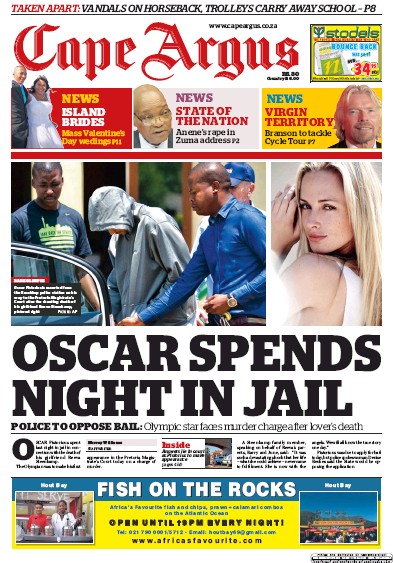
Newspaper front pages dominated by Pistorius arrest

grubstreet

by Gill Moodie (@GrubstreetSA) It’s the same splash today – the sensational Oscar Pistorius shooting – so it’s really interesting to see which South African newspapers came up trumps in the design and headline department in our daily round-up of front pages.

I’d say that Die Burger and Beeld come up tops in design.

Nice balance on Beeld’s front page and that pic of Reeva Steenkamp is not one I’ve seen before But I love the way Die Burger has played the hooded and bowed Oscar so prominently… inviting us in to wonder what is going on in this man’s mind. Wonderful and intriguing.

Everyone else is OK but nothing special although The Herald went absolutely the right route for their readers by focusing on Steenkamp, who comes from Port Elizabeth and whose parents live there. I fancy they could have done a bit more with the design, considering the local angle.

Then in terms of headlines, I really like Volksblad’s “Wat het gebeur?”, Beeld’s “Dood agter deur” and Die Burger’s “Vier skote later…”

All very simple and very bold… and they tell the story and they touch a nerve.

I can’t stand the twee-ness going on in the English papers: “Deadly Valentine” at both The Star and The Mercury is so predictable – as is the Daily Dispatch’s “Bloody Valentine”. The Times’ “Oscar’s darkest day” is not much better.

Darkest day? D’ya think? Honestly, mense! Have you totally run out of ideas?

Oscar Pistorius front pages Oscar Pistorius front pages

Oscar Pistorius front pages Oscar Pistorius front pages

Oscar Pistorius front pages Oscar Pistorius front pages

The-Mercury_20130215 Oscar Pistorius front pages

Oscar Pistorius front pages Oscar Pistorius front pages

Oscar Pistorius front pages Oscar Pistorius front pages

– SA’s leading media commentator, Gill Moodie, offers intelligence on media – old and new. Reprinted from her site Grubstreet.

Sign up for our free newsletter

Nike, Oscar Pistorius and weaponry – more ads deemed inappropriate

Nike has issued the following statement to the media on its commercial endorsement of Oscar Pistorius. Pistorius was arrested following the shooting death of his girlfriend Reeva Steenkamp early Thursday morning.

“Nike extends its deepest sympathy and condolences to all families concerned following this tragic incident. As it is a police matter, Nike will not comment further at this time.”

Commentators are already questioning the appropriateness of ad collateral produced for Nike including its ‘Nike – My body is my weapon’ campaign that featured Pistorius.

“Pistorius’ website pulled the ad [I am the bullet in the chamber – see below] because of its obvious bad taste given the situation,” wrote Jay Busbee on Yahoo Sports. “Question: is it in bad taste regardless of the new revelations? Is weaponry and violence too serious of a metaphor to employ so casually in marketing?”

oscar pistorius

See also:
Oscar Pistorius sponsors awaiting results of police investigation
M-Net pulls Oscar Pistorius ‘Oscar’ campaign from screens

– Exclusive media & marketing news you’ll make time for. Sign up for our free newsletter!

Magazine covers we love (this week)

MarkLives.com runs a regular slot featuring the best local and international magazine covers every week. We recognise well thought out, powerful and interesting (and hopefully all three in one) magazine covers and celebrate the mix of pragmatism, creativity and personal taste that created each of them. By media blogger MediaSlut.

INTERNATIONAL

Washingtonian, March 2013

Washingtonian

The annual Vanity Fair Young Hollywood covers are always over the top and extremely well styled and shot. I would compare this Washingtonian cover to that of Vanity Fair Young Hollywood – but of course in celebration of “Great Bars”. This shot is old-school, just perfect, and worth some recognition.

.AB, February 2013

ab

Finances can be boring. But this Accounting and Business  title is putting “The end of Cash” into perspective. Quite literally. And it’s using paper-art to help illustrate it. Art seems to be the new magazine cover.

B, January / February 2013

b2

B magazine is all about “Brand. Balance”. It seems like they try to capture the essence of a well-known brand with each issue, and portray it beautifully not only on the cover, but also inside on its pages (look at some of the beautiful spreads here). The covers are beautiful, striking and unique.

LOCAL

DESTINY MAN, March / April 2013

Destinty Man 2 March April 2013

Covers without a dash of colour generally don’t sell that well (research shows). But DESTINY MAN has created a beautiful and striking and extremely strong cover for their March / April 2013 issue. I think it’s bold.

– The (for now anonymous) blogger behind MediaSlut knows way too much for his own good about media in South Africa. Magazines in particular. His mission is to show when South African magazines might fail, but most importantly, succeed. If you’re looking for a library about South African magazines and news, your one-stop pitstop is MediaSlut. #MagazinesForTheWin

– Find a cover we should know about? Tweet us @marklives and @mediaslut
Sign up for our free newsletter!

Oscar Pistorius sponsors awaiting results of police investigation


oscar pistorius

BT, a sponsor of South African Paralympic athlete Oscar Pistorius, will wait for the results of the South African police investigation before it comments further on its endorsement of the athlete, who is currently being investigated for the shooting death of his girlfriend Reeva Steenkamp on Thursday morning.

“BT is shocked by this terrible, tragic news. We await the outcome of the South African police investigation, and until we know the outcome we would not be in a position to comment any further,” a statement by the company read.

Meanwhile the Mirror in the UK has published an image it says was removed from the official Oscar Pistorius website (the image was also published on 2Oceansvibe).  Featuring the Nike swoosh the screen grab shows images of Pistorius in motion and the line “I am the bullet in the chamber.”

The Mirror reports a Nike spokesperson as saying the company will not make a decision ons its relationship with Pistorius until it hears from wither Pistorius or his agent.

Oakley, Thierry Mugler and Ossur all also has commercial relationships with Pistorius.

– Exclusive media & marketing news you’ll make time for. Sign up for our free newsletter!

Online CPD Courses Psychology Online CPD Courses Marketing analytics software Marketing analytics software for small business Business management software Business accounting software Gearbox repair company Makeup artist