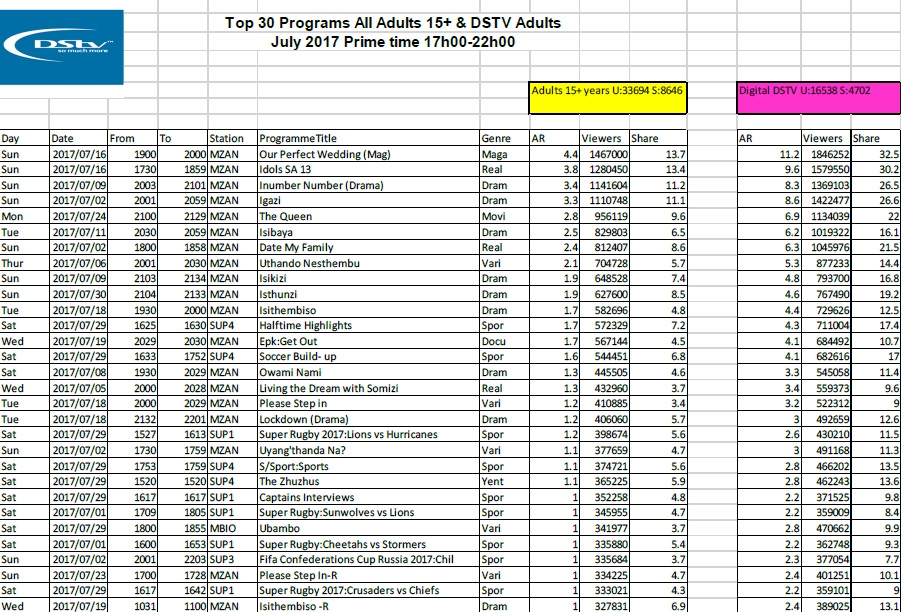
by MarkLives (@marklives) The hottest primetime television shows on DStv in South Africa revealed: TV ratings for July 2017.
In 2016, the Broadcast Research Council of South Africa (BRCSA) changed its policy about giving away TAMS and now only monthly reports, highlighting the top 20 or 30 primetime shows on several popular channels, are available.
The Broadcast Research Council of South Africa (the BRC) is a non-profit, industry body that was incorporated in 2015 to cater to the audience research needs of the radio and television industry in South Africa.
— Sign up now for the MarkLives email newsletter every Monday and Thursday, now including headlines from the Ramify.biz company newsroom service!
by Charlie Mathews (@CharlesLeeZA) Today, Friday, 18 August 2017, the infamous Bell Pottinger will be brought before the UK Public Relations and Communications Association (PRCA) disciplinary committee to address allegations that the spin company “ran a secret campaign to stir up racial tension in South Africa” for the Guptas and Duduzane Zuma, son of South African president Jacob Zuma.
Charles Lee Mathews (@CharlesLeeZA) is the founder of TheWriters.co.za, a boutique strategy and content shop that helps brands better connect — and engage with — the people who matter most. When not writing, or thinking about human behaviour, Charlie creates The Marketing Mice exclusively for MarkLives.
— Sign up now for the MarkLives email newsletter every Monday and Thursday, now including headlines from the Ramify.biz company newsroom service!
by Johanna McDowell (@jomcdowell) A panel of procurement experts from the private and public sector was recently invited to comment on a number of issues facing marketers and agencies generally, and then specifically, in 2017. The rationale for focusing more on procurement comes from the findings in the SCOPEN agencyScope 2017 study that very few agencies are making direct contact with procurement in either the private of public sectors.
This is a major opportunity for agencies to explore; hence the importance of finding out directly from procurement heads.
1. Public sector outlook
Leading procurement experts in the public sector commented that there will be a bigger focus on pools of companies and agencies to fulfil government tenders. In general, tenders will be far more focused on compliance than ever before.
US$9.5tn spent worldwide by governments
R500bn spent on marketing by South Africa government institutions
The public sector is expected to be very active this year.
Procurement in government doesn’t have to be restricted to tenders only. Agencies are urged to be in contact with procurement, regardless of any tender activity. It’s better for government procurement to engage with agencies when there is no tender, as otherwise it could be seen as risky.
Innovative ideas are always welcome.
2. Private sector outlook
Money will continue to be spent on marketing but it will be very focused on driving sales.
Procurement will always focus on working and non-working capital; keep the ratio at 80:20 and all will be well. Agency fees (non-working capital) which exceed 20% of the budget will be trimmed.
3. BEE
This is increasingly important in both private and public sectors.
4. Role of procurement in negotiations
In the public sector, procurement and marketing have an equal role and, in most cases, marketing can’t meet with agencies unless procurement is present. Procurement looks for sustainability of supply, compliance, underquoting and overpricing. All of these are key issues when signing up an agency.
In addition, procurement will look to ‘match’ the size of an agency with the size of a tender — too small and delivery will be a problem; too large and pricing might not be competitive.
Procurement will also benchmark prices
5. What happens when an agency goes over budget? What does procurement do?
Expenditure has to be approved via purchase orders.
Governance on budgets is getting tighter — underspending is as serious as overspending. Controls are essential.
Slight variances may be allowed.
6. And if budgets are cut?
Procurement will help marketing and the agencies revisit the deliverables of a contract and make suitable adjustments.
~~~
And the last word — agencies were encouraged to NOT bypass procurement departments.
by Martin MacGregor (@MartMacG) I recently went to a procurement workshop; I’ve an innate interest in trying to understand how things work and so it felt completely logical to spend time unpacking the unsexy side of marketing. It was a surprisingly enlightening experience and I walked away much better-educated on why procurement departments are necessary in our world. But it also highlighted the virtuous circle of most advertising conversations these days.
In summary, there are normally three arguments put forward:
Without a big idea, brands are spewing out nothing more than bland landfill.
If the advertising doesn’t result in sales, what’s the point?
Success is when the lowest-possible cost is achieved.
Yes, I have sat in meetings where creative, marketing and procurement have all passionately argued their corner with no compromise. The result is usually that one side “wins” and consumers either see a bloated TV ad, a brand cheapening discount ad or they don’t see the ad at all.
All correct
In a world, where we are constantly looking for black-and-white solutions, the answer here is grey — wonderfully grey. That’s because they are all correct and every campaign should have those three arguments as primary objectives.
Brands need investment and the currency of brand equity is big ideas that stick. Any brand that is not investing in itself will fail. The proof is everywhere.
If the big idea can’t translate into converting the consumer at point of sale, then it’s not very big at all. Consumers may now be reached in so many different ways and big ideas need thousands of iterations to work — and there is no justification for some of those not actually closing the deal..
Getting enough brand and audience behaviour data is no longer the issue — it’s what you do with it that counts. If used correctly, it should mean being able to pinpoint the right consumer at the right time or place. This highly valuable consumer should be reached at the lowest-possible cost — but that negotiation is much easier when wastage has been eliminated.
Very simple
It’s very simple: big ideas, that actually sell, reaching a relevant consumer, relatively cheaply.
My Twitter feed is full of non-negotiable opinions. Maybe it’s the age of Trump but it feels as if everyone’s become a bit blinkered in their outlook. Let’s remember that, sometimes, there’s nothing wrong with some grey.
Martin MacGregor (@MartMacG) is managing director of Connect, an M&C Saatchi Company, with offices in Johannesburg and Cape Town. Martin has spent 18 years in the industry, and has previously worked at Ogilvy and was MD of MEC Nota Bene in Cape Town. He contributes the monthly “Media Redefined” column, in which he challenges norms in the media space, to MarkLives.com.
— Sign up now for the MarkLives email newsletter every Monday and Thursday, now including headlines from the Ramify.biz company newsroom service!
by Mark Tungate (@MarkTungate) Travelling should be about new people and places, rather than stress and hassle. With this in mind, Buenos Aires startup, Bluesmart, is creating “smart luggage”. These connected cases may make at least part of your journey less painful.
Revolutionise luggage
“Until recently, the last big innovation in luggage was when they stuck wheels on it,” observes Ale Sarra. And he should know, as he’s head of industrial design at Bluesmart, the Argentinian startup that has set out to revolutionise luggage.
As its name suggests, the company is all about “smart luggage”: connected bags that tell you how much they weigh and where they are, among other things. [At the time of writing, only a compact carry-on was available, but Series 2 is now available on preorder at Indiegogo. — ed-at-large]
“This began three years ago as a conversation between myself and two friends who travelled a lot for work,” says Alejo Verlini, co-founder of Bluesmart, who ran his own design agency at the time. “We all agreed that travel was a wonderful thing — because it opened your mind to different cultures — but that the journey itself was often a hassle.”
Stories about lost luggage
They all had stories, he said, about lost luggage. “We realised that, while there were many products that were using new technology to meet the higher expectations of consumers, there had been no real innovation in luggage.”
Straight away, they began exchanging ideas about a high-tech suitcase that could signal its location anywhere in the world, link to the airline to provide updated flight details and even send alerts about gate changes. “There were a million possibilities but, in the end, we decided to concentrate on a few realistic pain points: lost or stolen luggage, paying for overweight luggage, and devices with dead batteries.”
Having raised some capital from friends and family, they went to China to find out how they could bring their idea to life. “We realised that the luggage supply chain was very old-fashioned; the guys who make bags and wheels and handles don’t speak the same language as the guys who make phones and tablets. So our first challenge was to bring the worlds of luggage and electronics closer together.”
Carry-on model
They also tore apart “about 250 bags” to find out how they were made and what customers liked about them. Finally, they produced ten working units, choosing a carry-on model because it was the most-iconic product among their target market of “super-frequent travellers”. The model and a related video became the basis of a crowd-funding campaign that generated preorders worth US$2m in 20 days.
“That’s when we said to ourselves, ‘This has become a reality now.’” So they set up shop in Hong Kong and went into production, shipping the preordered units nine months later. As of May 2017, they’d shipped more than 40 000 units all over the world.
The Bluesmart suitcase links to an app that enables the user to track it via GPS and check its weight. It automatically locks if you walk too far away. And, when you walk back again, you can use it to charge your devices as you’re waiting at the gate. The case is approved by all the major airline associations, and compliant with FAA, DOT and TSA, so while it attracted a few strange questions in the early days, it’s now a more-familiar sight on x-ray conveyor belts.
Tech meets luxe
Design-wise, the sleek case deliberately makes a statement. “It’s a conversation starter,” says Verlini. “Our customers love other telling people about it, because what they’re actually saying is, ‘I’m a modern traveller — so I’m investing in the future of travel.’”
In other words, the case is a self-branding device, like a luxury fashion item. No surprise, then, that it’s available at high-end stores such as Saks in New York and Selfridges in London. It also won the Red Dot Design Award “Best of the Best” category in 2016. Style-wise, it can compete with most of its non-connected counterparts.
https://youtu.be/abo_5bPxuWY
“We wanted a product that expressed the technology without looking like R2D2,” Verlini explains. “So we were very careful to mix polycarbonate with fabric. The fabric adds a sense of style, and the pouch at the front enabled us to show just how easy it is to remove your laptop, which is vital for our customers.”
Standout effect
The handle’s blue bars create a standout effect to get that conversation started. The blue wheels are the final flourish. “Every traveller loves wheels; they are an icon of movement. So we decided to make our wheels special. They literally elevate the product.”
The company does everything in-house, from design and manufacturing to marketing, which relies largely on word-of-mouth. “The community is always helping us,” says Verlini. “Because of the app, we have a direct relationship with our users. We can reach out to them anywhere in the world, anytime, and ask them very specific questions. That’s the strongest source of knowledge we have.”
Social influencers and mainstream journalists have been quick to pick up on the product. “It’s because they can approach it from lots of angles: technology, design, travel, fashion — there are stories to tell and content to create.” Sports stars such as runner Usain Bolt and skateboarder Tony Hawk have enthusiastically adopted the product, with no prompting from the company. Hawk even posted a jokey film of himself chasing a Bluesmart suitcase on his skateboard. At the end of the clip, when allowed only one carry-on item, he chucks his board aside.
Bluesmart owners tend to be male — 70% of them, to be exact — but the company is working on ways of attracting more female customers. “In terms of the colours and the lines, our cases are quite masculine. Unfortunately, this is still something very common with technology-oriented products. But now that we’ve created this new category — smart luggage — we can create different interpretations of that.”
The company’s ultimate vision is that “everything you carry with you should be connected”. He adds with a smile: “Once you know that, you can imagine how far we could go.”
Mark Tungate (@MarkTungate) is the editorial director of the Epica Awards (@EpicaAwards), the only global creative prize judged by the specialist press. A British journalist based in Paris, Tungate is also the author of seven books about branding and advertising, including Adland: A Global History of Advertising and, most recently, The Escape Industry, a journey through the business of travel. Over his 30-year career, he has has written for leading newspapers and magazines in the UK, France and the US.
In this series of articles called Design Plus, Epica highlights creativity in the design field.
— Sign up now for the MarkLives email newsletter every Monday and Thursday, now including headlines from the Ramify.biz company newsroom service!
by Mark Eardley. Answer the headline question correctly and you’ll know who influences and makes the business-buying decisions that generate your sales and margins. Knowledge is power.
You’ll know which audiences to engage. You’ll have an opportunity to discover their motivations for supporting a decision to select or reject your offering. You’ll know what you need to say to each of them and how to say it. That’s powerful.
Acquiring it is the first of marketing’s two key contributions to an organisation: providing knowledge on how and why buying decisions are influenced and made. The second key contribution is to ensure the organisation aligns its products and services accordingly.
Know your customer: who, exactly, is the ‘customer’ in B2B?
Outsiders
It’s possible that the most-powerful influence on a B2B buying decision comes from outside the buyer’s organisation.
Here’s a list of five types of outsiders who might feature in a B2B buying decision:
Trusted advisors: Professional advisors — ranging from management consultants to architects — may have enormous influence as specifiers of products and services recommended to clients. Such advisors are hired to act as the voice of authority and clients tend to heed the advice their paying for.
Industry analysts: Although perhaps less directly influential, the opinions of industry and product analysts (eg Gartner, Forrester and Ovum in the ICT sector) may be a significant consideration in B2B buying decisions.
Sector peers: Another particularly powerful source of external influence on buying decisions comes from peers within the purchasers’ industry. Peer-to-peer influence may be hugely compelling when it’s based on positive experiences of your offering. It’s a heavy-weight endorsement when an existing user testifies that you can and will deliver the results you promise. It’s also a potent warning sign if they say you can’t…
Industry media: Respected commentators in the media across a whole range of B2B sectors (as well as the general media) may be an important voice in the conversations leading to a buying decision.
Value added resellers (VARs): B2B products are often a small component of a multifaceted, overall product or service purchased by the end-user. If that’s the case with whatever you are providing, then VARs may be the most powerful influencer of all.
So, there’s a set of five potentially deal-swinging influencers that operate outside of an end-user’s organisation. And when you look inside an end-user, the list of decision-influencers just keeps on growing.
Insiders
Within end-users, anyone who’s affected by your offering is probably going to have a fair bit to say about the pros and cons of buying from you.
Using the simple criteria of who is affected by buying from you, it’s really easy to list these insiders across functions such as finance, business analysis, HR, strategy, IT, production, operations, R&D, sales, customer support, marketing, SHEQ and project management.
Typical B2B sphere of influence
Throughout the sphere, marketing must harness unanimous support for the buying decision. Credit: Mark Eardley.
Working with the sphere: the right message for the right people
Having compiled your list of influencers across the sphere, the next step is to define how your offering will produce positive, concrete results specifically for each of them. That requires delivering evidence (known as ‘content’ in marketing-speak) which proves how their particularly responsibilities will be fulfilled and how the success of their organisation will be advanced by buying from you instead of your competitors.
This is straightforward stuff. It’s a simple process of matching benefits to beneficiaries: who gains from the results you deliver and how do they gain?
After listening: act on what the ‘customer’ says
“You listen to the customer. Then you change what you do in response to the lessons learned from listening. There, I just summarised about 85% of the marketing concept. Simple.” —Mark Ritson, Marketing Week
Of course, the simple things you see are all complicated.
The first complication for B2B organisations is that they might not know their sphere’s composition. That means it’s impossible to listen to influencers and discover what they think. If that’s the case, it’ll be a rare coincidence if the organisation secures buying decisions by saying exactly the right things to exactly the right people.
The second complication is that B2B marketers often lack the corporate authority to change what their organisation does and how it does it. That’s hardly surprising. Why should anything change if the perspectives of every element in the sphere can’t be qualified and quantified?
Justifying change
Analysing these perspectives is critical because they will always — yes, always — be based on B2B’s five buying motivators: quality, price, service, time and how well you understand and solve challenges facing your market.
In comparison with the competition, if everyone in the sphere thinks your price is high, your quality low, your service unreliable, your lead-times long and sector knowledge patchy, then it’s time for change. And the people within your organisation responsible for each of those five issues need compelling information as to why change is necessary.
As a marketer, you may change such negativity by providing relevant, credible evidence that justifies a more-positive, -favourable perception throughout the sphere. Evidence that will build sales-creating trust. However, if such perception-altering evidence cannot be provided — because it doesn’t exist — then your offering needs to change so that it is aligned with your sphere’s buying motivators.
Mark Eardley advises B2B companies on how to govern their marketing to attract and retain profitable customers; several of his clients have grown to become market leaders. He is the author, together with Charlie Stewart, of Business-to-Business Marketing: A Step-by-Step Guide (Penguin Random House), which offers practical, actionable advice on how to make marketing make money. Mark contributes the monthly “Back2Basics” column, covering how B2B companies and their agencies should manage their marketing, to MarkLives.com.
— Sign up now for the MarkLives email newsletter every Monday and Thursday, now including headlines from the Ramify.biz company newsroom service!
by Oresti Patricios (@orestaki)Citadel Wealth Management’s new TVC, by Bain & Bunkell and director Dean Blumberg of Bouffant*, is a sobering message that reminds us about the important things in life.
I’ve always believed that success in life is not dependent on mere financial success but getting the balance between work, family, play and self-development right. We often hear the adage that nobody on their deathbed says they wish they had spent more time at work — there is more to life than just building a career and accumulating wealth. This is the underlying message of Bain & Bunkell’s latest cinematic ad for Citadel Wealth Management, aimed at high-nett worth individuals. Typically you’d find this market in the upper echelons of the corporate world but they’re also entrepreneurs who’ve been successful in their ventures, and who want to preserve their wealth for the benefit of their descendants, or to leave a legacy that survives them.
The Citadel campaign is all about leaving something behind that is about more than just wealth and is a creative and meaningful reminder about all the important things in life. “Remarkable Life” takes place at a funeral. A eulogy is being delivered by a man who we assume was a business associate of the deceased. “Michael always gave the best stock tips,” he says. “Usually over an expensive lunch. And who can forget those classic sports cars?”
The camera tracks past a big picture of the deceased, and various members of the congregation until it comes to rest on a man whose face matches that of the picture: Michael.
He turns to the camera and says, “Well, that wasn’t much of a life. Let’s try it again.”
There is a movie projector skip-frame effect, and we’re back to the point we started, with the eulogy. “Michael’s international business often kept him away from his home.”
Michael addresses the camera once more: “I’ve got to do better.”
Again, there is a skip-frame effect, and we’re back to the eulogy: “Michael was always good with money.”
Now he’s starting to look quite disappointed and frustrated. This time he just gives the camera an eye-roll, and the skip-frame effect takes us back once more.
The eulogy has changed once more. “Mike’s bottom line,” the man says, “was his family.” This time the tone of voice has changed, and there is a sense of genuine sadness in his voice. “He always found time to take his son fishing, and his daughters to ballet,” he continues. The camera focuses on the family, as they share in the memory. The camera tracks back to where Michael was sitting previously, as the tender, heartfelt speech continues. But this time there is only a shaft of light where he was.
The screen fades to black, to be replaced with the text, “Don’t just use your money to make more money”. This is followed by the slogan, “Reach your remarkable”.
There are several versions of the ad. One changes the dialog of the eulogy to talk about Michael as a man who enjoyed adventure and lived life to the full. There are also shorter versions, and agency strategist, Simon Bunkell. informs us that there are actually four endings, to keep the story fresh, which we’ll see being rolled out over time.
The message seems a little counterintuitive — after all, investment firms such as Citadel are there primarily to help people grow their wealth, with the principle of “Don’t work for your money; let your money work for you.” But the deeper message comes through strongly, and this is where Citadel is being really smart: it embraces the idea that you can achieve a balance in life, and, most importantly, Citadel is there to help you achieve this.
The ad is beautifully shot, with cinematic production value. The stone chapel, with shafts of light streaming down from the high windows, the tasteful flower arrangements, the perfectly cast actors, the sedate camera movement, all combine to create an immersive movie-like experience that is entertaining and engaging.
If this doesn’t take top honours at local and international awards, then I’ll be very surprised.
Congratulations to Citadel and everyone involved with this superbly crafted piece of work. It sets a benchmark for investment advertising and signals a smart approach to what must be a very discerning market.
Credits
Agency: Bain & Bunkell
Chief creative officer: Jonathan Bain
Creative director: Sheldon Stewart
Copywriter: Billy Rivers
Strategist: Simon Bunkell
Agency producer: Caz Friedman
Account director: Vicky Moodley
Production company: Bouffant*
Director: Dean Blumberg
Producer: Channelle Critchfield
DOP: Tim Pike
Post-production company: Deliverance Post Production
Editor: Anthony Lee Martin
Sound mix: Produce Sound
Grade: Rushes (London)
*This was Blumberg’s swansong for Bouffant. He is now represented by Massif.
Ad of the Week, published on MarkLives every Wednesday, is penned by Oresti Patricios (@orestaki), the CEO of Ornico, a Brand Intelligence® firm that focuses on media, reputation and brand research. If you are involved in making advertising that is smart, funny and/or engaging, please let Oresti know about it at clientservice@ornicogroup.co.za.
— Sign up now for the MarkLives email newsletter every Monday and Thursday, now including headlines from the Ramify.biz company newsroom service!
by Robyn Campbell (@RobynPony) You can’t spend five minutes online without coming across a piece about sexual harassment or gender discrimination in the digital marketing or technology landscape.
Just the other week, Google made headlines when an internal memo distributed by one of its engineers went public. His opinion on gender equality included this landmine: “Distribution of preferences and abilities of men and women differ in part due to biological causes and that these differences may explain why we don’t see equal representation of women in tech and leadership.” He was promptly dismissed for “perpetuating gender stereotypes” and violating Google’s Code of Conduct, but the incident highlights a bigger gender-discrimination problem.
Between Uber, Kevin Richards from Saatchi & Saatchi and even Elon Musk’s Tesla, the stories are real and they are alarming.
Gender disparity
The advertising landscape in South Africa has only just started to make headway on transformation, with some agencies leading the charge in making significant change to the industry and country. But, with our day-to-day focus on achieving genuine transformation, the industry — digital advertising in particular — must remind itself to keep an eye on gender disparity.
Consider the following. This year, only 23% of the Bookmark judges were women. There are an alarmingly small number of female managing directors, and even fewer executive creative directors or creative directors —on LinkedIn, you’ll be lucky to find one woman listed on the first page when searching for digital creative directors.
Now consider the repercussions of the digital industry’s gender inequality on the relevance and effectiveness of the work it does for its clients.
Women provide unique insights and valuable perspectives that are indispensable when it comes to creating truly inclusive work. Collaboration is nothing without diverse viewpoints, and collaboration is a key component in the rise of digital. But, if there are no women…
Our industry has a problem
Our industry has a problem and we all, men and women, need to embrace the ideals of feminism to change the status quo.
Step one would be understanding that equality isn’t just achieved by providing exactly the same to male and female staff; it’s about tailoring our working environments to be personalised to individual needs, providing the foundation for women to be successful. It’s the opportunity to have a child without it affecting your career; the opportunity to be considered stoic instead of icy; the opportunity to be respected and heard at the boardroom table without being considered ‘bossy’.
We need to strive to be more conscious; we need to use our position in the industry to make a difference, to empower our women and girls. We need to address how we can affect change from ground zero. How are we hiring, how are we training, how are we identifying bias; are we paying fairly, what are we doing to move away from the established stereotypes?
And then, of course, the power we have working in advertising is to change perceptions with our work.
#SeeHer
As Marc Pritchard from P&G said about that brand’s #SeeHer campaign: “With advertising, we can make gender equality normal. It’s all about your cognitive processing. We’re focused on a mission to make sure advertising accurately reflects women and girls.”
It was gratifying to see gender equality being put firmly centre stage at last year’s Loerie Awards. Then incoming chairperson, Suhana Gordhan (creative director, FCB Joburg) spoke about the huge challenges she had to overcome to succeed in her industry, as well as those she still faces daily. I am hopeful she has been keeping the conversation alive and positioning the Loeries to be a positive change agent in our industry.
I also challenge you to consider what you are doing to make a change, at its simplest, to make this an industry you would want your daughters to work in.
Inspiration
As inspiration, I leave you with two quotes.
Prince Harry said: “We know that when women are empowered, they immeasurably improve the lives of everyone around them — their families, their communities and their country.”
Actress and activist, Emma Watson, said it differently: “If you stand for equality, then you’re a feminist. Sorry to tell you.”
Robyn Campbell (@RobynPony) is the managing director of Hellocomputer Cape Town, the digital arm of FCB Africa. During her eight-year tenure with the agency, she has facilitated work that uses a combination of smart strategy, unique creativity and forward-thinking technology.
“Motive” is a by-invitation-only column on MarkLives.com. Contributors are picked by the editors but generally don’t form part of our regular columnist lineup, unless the topic is off-column.
— Sign up now for the MarkLives email newsletter every Monday and Thursday, now including headlines from the Ramify.biz company newsroom service!
by Tom Fels (@thomasfels) I’m not one to lament the globalisation of our economy; it’s brought the world’s products directly to our doorstep, or increasingly, a mouse-click away. This is exciting in that it creates competition, improves the speed of innovation and, in the end, offers us more choice. I don’t think anyone would turn their back on that but we do need to be conscious of what we are losing and not just focus on what we are gaining, in the process.
A few decades ago, people did business with those they knew and trusted. Bankers understood your situation, aspirations and track record. Grocers sourced from farmers you knew, while your tailor had perhaps even made suits and dresses for your parents. There was, in that age, an enormous emphasis on the quality of personal relationships, where little touches that demonstrated a kindness seldom seen today ultimately instilled a sense of loyalty that would endure for a generation or more.
The marketing effect
Today, as the economy has gone beyond borders, so marketing has become more targeted as brand owners define ‘who their products are for’, rather than relying on geography or the self-selection of old. The online media universe, in particular, allows this targeting to become hyper-relevant, with a focus on serving the right messages, at the right times, to the ‘right’ audiences. Many would agree that a banner is not life-enriching but most would also admit to having finally given in to the remarketing efforts of an online retailer for a pair of shoes they’ve been browsing. No store visit necessary; no store (even) necessary.
However, while everyone looks to pursue greater efficiencies, better targeting and improved returns, they increasingly risk losing the benefit of history’s lesson in the value of personal relations.
Keeping it personal
I remember vividly the story shared by an inspirational ex-director at Louis Vuitton (now head of luxury and CRM at the Pernod Ricard Headquarters), Tareef Shawa, who has an almost-unbreakable bond with his crisp white Lanvin shirts. His first purchase was routine, with all the courtesy you’d expect from a luxury outfitter, but what happened thereafter was remarkable: a personal follow-up to find out how he was enjoying the garment and whether he had any further needs, and then, appropriately timed some months later, a courtesy call from the same store assistant to let him know that a new delivery of shirts had arrived, and that a few in his size had been set aside, should he wish to pick them up or have them delivered.
Even as a man who works at the height of the luxury sector, with both means and endless choice, he is a massive advocate of this level of personal courtesy. He’s not going to buy a classic white shirt from anywhere else.
What may we take from this?
In a digitised age, where transactions are becoming increasingly impersonal, purchase decisions have almost nothing to do with trusted relationships. A great loss, and a great opportunity for those who take the time to know their customers and their needs, rather than have to apply the same amount of effort to convert not just the first purchase but every purchase thereafter. What used to be held in memory is now being held in data. What used to be exchanged face-to-face may now be delivered via SMS, email or app notification — the channels may have changed but the sentiment remains the same.
The surprise of receiving an appropriate, thoughtful note builds brand preference just as much as enjoyment of the product. To tip it entirely over the edge, a real-world note, phone call or personal interaction is all it may take to break entirely through the clutter and convert a lifetime of repeat business.
Let us, therefore, not forget that, in the race for efficiency, there’s a silver bullet that is increasingly being ignored, and that is the simple and enduring value of care.
With a history of local and international experience in leading brand consulting, design, shopper marketing and integrated advertising roles, Tom Fels (@thomasfels) has gained a deeply relevant understanding of the marketing ecosystem. His skills are now put to work daily as chief executive of digital technology and performance-marketing business, Nurun (www.nurun.com). He contributes the monthly “Ad Exec” column to MarkLives.
— Sign up now for the MarkLives email newsletter every Monday and Thursday, now including headlines from the Ramify.biz company newsroom service!
Cheryl Hunter (shelflife at marklives.com)’s weekly pick of all things new — product, packaging, design, insight, food, décor and more!
MINISO to open 50 stores in SA
FCB Durban sees how salt runs with Cerebos
Cold-pressed juice from Sir Fruit
Gauteng first to get glimpse of MINISO
Japanese fashion and beauty retailer, MINISO, which operates more than 2000 stores in 50 countries, has officially launched in South Africa at Pretoria’s Menlyn Park Shopping Centre, with another 50 local stores in the pipeline.
Inspired by a philosophy of fast fashion coupled with simplicity, MINISO updates its product offering every seven days and had global sales of US$1.5bn in 2016. Says Phoebe Dongxiang, MINISO HR director, “The range focuses on making high-quality products that are accessible, encouraging the personalised intelligent purchase trend. Our aim is to design and manufacture excellent goods at honest prices, taking into account the earth’s resources and the environment to fully respect nature and the essence of the product. The personalised, smart-shopping experience is what consumers in 2017 crave and we have an exceptional offering with something for everyone.”
Just four years, old, MINISO, a member of the Saiman Holdings Group, was cofounded in 2013 by Japanese designer, Miyake Junya and Chinese entrepreneur, Ye Guofu in Tokyo, Japan. It has several categories that showcase enormous variety including consumer goods, health and beauty, jewelry and accessories, creative homeware, digital products, stationary and gifts and seasonal products, to name a few.
MINISO stores are opening first in Gauteng and are available at Maponya Mall in Soweto and Menlyn Park Shopping Centre in Pretoria. The next stores set to open are in Forest Hill in Kyalami and Norwood Mall in Johannesburg. The Durban and Cape Town store launches will take place in September 2017.
SA salt brand, Cerebos, is back on our TV screens after a 20-year hiatus with a new animated TVC created by FCB Durban.
The ad tells the story of a little girl who dreams of one day experiencing snow. Unfortunately, she lives in one of the warmest towns in South Africa, so that dream is destined to be just that until her grandparents intervene — with a little help from Cerebos.
Says FCB Durban creative director, Brandon Govender, “Cerebos is an iconic brand and having created their previous TV commercials, including the engaging ‘Masterpiece’, we gladly accepted the challenge to create something new and memorable. We wanted something out of the ordinary and decided it simply had to be animated. Tulips & Chimneys are the best in the business, and we’ve truly enjoyed working with them to bring the characters and story to life. It’s been a real labour of love for all involved, and we couldn’t be happier with the result.”
The free-flowing nature of Cerebos salt was the inspiration behind the “See How It Runs” line in the ad, which launched at the weekend on e.tv and SABC.
South Africa’s premium fruit juice, Sir Fruit, is taking its offering to the next level with a newly released cold pressed range.
Sir Fruit’s brand manager, Taryn van Zyl, says: “You will not find a tastier, more-delicious cold-pressed juice out there. They are free from added sugar, preservatives, artificial flavours, colours or stabilisers. This is the king of juicing methods, which means the vibrant new range harvests the maximum amount of goodness from the fields. Cold-pressed juices remain true to the brand, naturally, with product integrity being the no. 1 priority. Unpasteurised and never heated, it’s only the good stuff.”
After various purchases, mergers and acquisitions, the company is now a totally independent entity owned by three Baker brothers.
The new variants include apple, beetroot, raspberry, orange, carrot and ginger; carrot, apple, orange, granadilla and ginger; and apple, cucumber, spinach, kale and mint. The range retails for R21.95 per 300ml and is available nationally.
Shelf Life is MarkLives.com’s weekly column covering all things new. Notify us of yours at shelflife at marklives dot com. Want to sponsor Shelf Life? Contact us here.
Cheryl Hunter (@cherylhunter) has written for the South African media, marketing and advertising industries for more than 15 years. A former editor of M&M in Independent Newspapers and contributor to Bizcommunity, AdFocus, AdReview and the Ad Annual, she has also produced for various television networks and currently consults on communication strategy and media liaison.
— Sign up now for the MarkLives email newsletter every Monday and Thursday, now including headlines from the Ramify.biz company newsroom service!