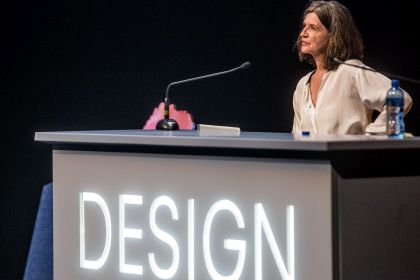
Rethinking nature in a changed world #designindaba

by Herman Manson (@marklives) Every year, Design Indaba brings together a group of the world’s top design grads to present their work to conference delegates. The work they present varies greatly, but are generally exciting and thought-provoking. Kathryn Fleming was one of the 2015 group of Pecha Kucha speakers.

Kathryn FlemingBilled as a “multidisciplinary designer exploring the intersections of science, art and technology”, Fleming explores a radical rethink of how we engage with nature in a natural world we have already reshaped radically.

The argument is that human intervention has reshaped the world, and trying to protect species, whose ecosystems we have destroyed, is setting us up for failure and the loss of more species. Instead, they should be allowed, even encouraged, to evolve and adapt to a new, changed environment. We become creators not only of the environment but of the creatures that inhabit it.

Completely out of the box

It’s completely out-of-the-box thinking some delegates might have wished on a sci-fi conference instead, but it’s one of those presentations that question design and its moral complexities — something designers often choose to gloss over. You sit squirming and afterwards apply some of those questions to the kind of product and industrial design Hella Jongerius riled against earlier in the day.

Fleming has reimagined what the new wild might look like. For instance, take her “Bleeding Flower” whose petals change colour “in sympathy to hormonal changes of women in close proximity”.

The Bleeding Flower

Kathryn Fleming: Bleeding FlowerKathryn Fleming: Bleeding Flower - ovulationThe Beaked Porcupine

Kathryn Fleming: The Beaked PorcupineKathryn Fleming: The Beaked Porcupine - field guideThe Superbivore

Kathryn Fleming: The SuperbivoreKathryn Fleming: The Superbivore - profileKathryn Fleming: The Superbivore - field guideFleming holds a bachelor’s degree from the Rhode Island School of Design, and a master’s degree in Design Interactions from the Royal College of Art.

— MarkLives.com is a proud Media Supporter of Design Indaba 2015. Get our round-up of top ad and media industry news and opinion in your mailbox every Monday and Thursday. Sign up here!

Hella Jongerius calls for new industrial design values #designindaba

by Herman Manson (@marklives) Hella Jongerius is railing against shit design — design driven purely by profit, design without conscience, design without awareness.

Hella JongeriusThe Dutch industrial and product designer is calling for these values to be integrated into industrial design once again because, she told delegates at the 20th annual Design Indaba conference, the earth needs help; those exploited through low-paying, outsourced jobs need help; consumers need help; and, yes, producers need help.

Help and improvement in the condition of all these stakeholders can be improved through a more holistic approach among industrial designers, and can be used once again to focus on quality and practical economics.

Jongerius argues that design should move away from objects as isolated items; instead it should interrogate their relationship with people.

Six steps

Jongerius offers six steps to assist industrial designers in achieving this goal:

  1. Design the materials. It allows designers to repurpose old material and explore the process of creation (and improvement) right from the start.
  2. Keep the design process hands-on. Literally. Jongerius believes in the value of crafting with one’s hands — touching and experiencing the material and designed object.
  3. Celebrate imperfection as perfection (may) kill(s) creativity.
  4. Make use of archives — explore past solutions and learn from them. This creates greater cultural awareness in a time obsessed only with the new.
  5. Have a signature (essentially a call to craftsmanship) that makes your work recognisable.
  6. Research, ask questions, find knowledge.

— MarkLives.com is a proud Media Supporter of Design Indaba 2015. Get our round-up of top ad and media industry news and opinion in your mailbox every Monday and Thursday. Sign up here!

Can an agency inspire a nation? #designindaba #makechange

by Herman Manson (@marklives) Can an ad agency really inspire a nation? The answer, surely, would be no? That was proved wrong by two creative directors dancing to Michael Jackson’s Black or White on the stage of Design Indaba 2015.

Xolisa Dyeshana and Pepe MaraisPepe Marais and Xolisa Dyeshana, chief creative officer and executive creative director, respectively, of advertising agency Joe Public, were making a point about how purpose drives change in ‘black and white’ (and how the death of spirit of the Mandela era is greatly exaggerated, after all) .

Marais and business partner Gareth Leck conceptualised their agency 16 years ago on a couch which still takes pride of place in Marais’ office. It’s a business made up of people and their stories, as Dyeshana puts it, and what inspiring stories they tell.

Having sold the business and see it lose its way, the duo bought back the agency in 2009, and set upon a path of rediscovering a purpose for their agency and careers. Finding meaning in the advertising biz seems like a steep challenge but, for Marais and Leck, it would centre on growth.

Not the self-serving kind but the selfless kind where growth serves the business and its people, clients and, says Marais, the country.

Joe Public has built a reputation for its emotive work for brands such as Tracker, Nike and, more recently, Dial Direct. In the process, its agency has achieved incredible client and revenue growth, and created work that has shifted the purpose of the organisations they work with.

For Tracker, it became less about retrieving stolen vehicles and more about serving those often caught up in the trauma of a highjacking. Sales doubled over the course of four years and in the process the agency created an ad that remains powerfully effective years after it was made.

For Nike, and South Africans, the agency decided to claim back the streets of Johannesburg, even if only for one evening, with its inspiring “Run Free, #RunJozi” campaign (which also involved a number of other agencies, including VWV and Trigger Isobar).

In a country that fought for its freedom, citizens had become prisoners as crime was keeping them off the streets. The campaign aimed to take back the streets on Human Rights Day, signing up 10 000 runners to reclaim the streets of Johannesburg at night, along with some 350 000 spectators.

Dial Direct has been repositioned from just another insurer to an insurer who values your time. Its emotive TV spot, about a kid helping at home to save his mother time so she can come to his school play, doubled sales in the first month it flighted.

Marais and Dyeshana are passionately South African — and with South African I mean what Mandela had in mind for us, rather than what the current political elite makes us out to be.

They believe we, as a nation, can apply the concept of growth — the selfless kind, again — to our dysfunctional education system and so inspire and grow the country. According to Marais, of the 27 000 schools in the country, 22 000 are dysfunctional. He and Dyeshana believes that, by improving education, the outlook for the country and its citizens automatically improve.

They have identified that English is taught only as a second language at 80% of SA’s schools, while math and science are both taught only in English — as a key problem that pupils face. Their One School at a Time Project English campaign sets out to raise money for English language tuition. The results have been impressive and dramatic, and used one average Grade 8 learner, named Lesego, to read a passage on radio station SAfm, every day for a week. The spot tracked her progress over five days with extra English tuition.

Whether its reasserting some control over our lives, as the Tracker ad offers, taking back the streets with Nike or improving the lives of our children through something as basic as extra English classes, the agency is inspiring a country — with the country actually even noticing.

It’s affirmative messaging speaks of hope, not failure, and it was wonderfully appropriate for the two creative, one black, one white, to dance together onto a stage, reminding South Africans that we are in this together.

— MarkLives.com is a proud Media Supporter of Design Indaba 2015. Get our round-up of top ad and media industry news and opinion in your mailbox every Monday and Thursday. Sign up here!

Shelf Life: The ABCD model of township outdoor media

Louise Marsland (@Louise_Marsland)’s weekly pick of recent product, packaging, design and food launches:

  • Wall media builds into Africa
  • Castle Lite brought to life by Moving Tactics
  • Salon Media straightens out ghd, and
  • Jupiter Cape Town and Design Indaba urge change

Another ‘brick’ in the wall

Township wall media specialists Keys Communications - example of wall advertisingTownship wall media specialists, Keys Communications, are heading into Africa with its model which pays locals for wall space to advertise brands on major arterials. The new headquarters will be in Zimbabwe.

Its model has a pivotal social responsibility component, providing members of poorer communities with revenue opportunities for the use of township walls as an advertising platform. Brands in turn, have the opportunity to improve the socio-economic conditions of township residents by providing them with an income.

“This is our ABCD model of township outdoor media, which we are now introducing into the rest of Africa,” explains Anisa Kale, owner of Keys Communications. “The ABCD [Assets Based Community Development] Model, which uses existing township resources of people, knowledge and structures, creates mutual benefits between the advertiser and target market to foster community affinity and loyalty to brands.”

“Zimbabwe and similar countries in Africa are an ideal environment for township wall media, where like South Africa, there is always an ever increasing consumer market.”

The agency to date has worked with brands such as Supersport, Nedbank, Wimpy, Department of Water Affairs, Strepsils, Coca Cola SA (Powerplay Energy Drink), Guinness Draught Beer, Eskom and so on.

Digital moves for Castle

Most activations for brands these days are starting to include innovative and impactful digital elements, such as the Castle Lite VIP event by Moving Tactics Digital Impact and RK Events over the 2014 festive season, which took brand interaction to a whole new level.

Moving Tactics Digital Impact is the most recent addition to the Moving Tactics stable. This division specialises in short-term, rental and campaign-based digital activation solutions and focuses upon concept development and implementation using touch, projection and holographic technology.

Castle Lite’s “The Republic of Extra Cold” VIP event on Stanley Island in Plettenberg Bay, at the end of 2014, saw the integration of digital elements into interactive challenge categories at the party which was sprinkled with local celebrities, DJs and performers.

The Castle Lite party involved many of the above digital tactics, including water projections to entertain the crowd; games; access control using guests’ own body temperature; video interaction; and so on.

Castle Lite’s The Republic of Extra Cold VIP event 1Castle Lite’s The Republic of Extra Cold VIP event 2
According to Andy Higginbotham, Moving Tactics Digital Impact creative director, it was important to keep the brand centre-stage and having partygoers use digital applications and touchscreen tech to interact with the brand did just that:

  • Access control: guests gained access to the event via the ‘Passport Control’ element by which they had to place their hands on a glass touchpad Android tablet. Once their fingerprints were scanned, a welcome message appeared and they officially gained access.
  • Vital statistics: to determine if they were ‘Extra Cold’ enough to join the party, guests were asked to place their fingers on an on-screen ‘button’ on Android tablets, for a brief period to have their temperature measured.
  • Catch a cold: the application encouraged guests to win points by catching simulated snowflakes in a Castle Lite beer bucket. The gaming mechanics involved a simple left and right swiping of the finger on a glass surface onto which imagery had been projected.
  • Resolve to be cold: two video booths were used to capture guests’ individual video recorded resolutions for 2015 via interactive touch screens.
  • Collect-a-case: guests tested their ability to stop scrolling at a specific time by having the scroller land on a case of Castle Lite. Points were scored for correct strikes and lost for misses.

The art of Salon Media

Primedia Unlimited’s Salon Media for ghdBespoke artwork has been created by Primedia Unlimited’s in-salon advertising business, Salon Media, to increase brand awareness of ghd products within selected hair salons in South Africa. Mirror stickers and decals in varying sizes have been used as the advertising platform of choice.

“The artwork differs from salon to salon to maximise the aesthetics and spaces each venue has to offer,” says Kylie Henry, internal sales manager at Salon Media. “The ghd-affiliated salons are each sporting updated creative and the feedback from customers has been extremely positive.

“Our salon owners and ghd worked hand in hand to customise artwork and get the best benefits out of each project.”

#MakeChange

Design Indaba 2015 #MAKECHANGE TVC screengrab - #makechangeDesign Indaba this year has called on people to promote change in the hope that simple actions will lead to creative solutions to daily problems in South African society. The campaign call to action, conceptualised by The Jupiter Drawing Room Cape Town, is #MakeChange.

The Design Indaba Conference takes place at the Cape Town International Convention Centre (CTICC), 25-27 February 2015.

For more on this campaign:


Shelf Life is a weekly column by Louise Marsland. Tweet new product, packaging and design launches to @louise_marsland Louise Marslandor email her at louise.marsland at gmail.com. Want to sponsor Shelf Life? Contact us here.

Louise has written about the FMCG, media, marketing and advertising industry for over 20 years as a former editor of magazines AdVantage, Marketing Mix and Progressive Retailing, as well as websites Bizcommunity.com and FMCGFiles. She also edited the weekly Wednesday Media & Marketing Page for The New Age newspaper. She is currently the publishing editor of industry trendwatching portal, TRENDAFRiCA, for consumer insight, research and trends in Africa; a regular industry columnist and speaker; a consultant on content strategy; and contributing editor to Fast Company South Africa magazine, which has just launched in South Africa.

— MarkLives.com is a proud Media Supporter of Design Indaba 2015. Get our round-up of top ad and media industry news and opinion in your mailbox every Monday and Thursday. Sign up here!

Ad of the Week: Looks good on paper #designindaba

by Oresti Patricios (@orestaki) “Make. Change.” is the mantra for Design Indaba Festival 2015, which has been taking Cape Town by storm since 20 February until 1 March 2015. This year, The Jupiter Drawing Room Cape Town has conceptualised the creative for the event with a campaign showcasing the use of paper that harnesses the brand’s core theme, #MAKECHANGE.

Twenty years on, the internationally well-respected Design Indaba has broadened its offering and is now a through-the-year, multidisciplinary celebration of creativity.

Design Indaba 2015 #MAKECHANGE TVC screengrab - #makechangeThe brightest talent

The annual festival includes the Design Indaba Expo, FilmFest, Music Circuit, multiple simulcast versions of the conference (which has attracted and showcased the brightest talent since its inception in 1995) in cities around South Africa, and other events. The website DesignIndaba.com attracts over half a million visitors each year, and there is also a Design Indaba Do Tank which tackles projects that showcase collaboration and creativity. This platform also hosts community initiatives, training workshops and manages design projects, many of which are funded by Design Indaba Trust, the non-profit arm of this operation.

#MAKECHANGE is a clever campaign which speaks to Design Indaba’s core message for 2015 — that it’s up to everyone to take matters into their own hands and influence change for the better. It’s all about creating a better future using thinking, creativity and, of course, design.


Paper has been used as a thematic material in the print, TV ads and more, with elements all having the appearance of having been handmade. So much can be done to or with paper and paper-based materials, and this versatility reflects the creative human spirit. Paper can also be sustainable, recyclable and lightweight, so easier on the environment.

The Jupiter Drawing Room Cape Town TVC for Design Indaba: “Make. Change.”

Taking an in-depth look at the TV commercial, Jupiter Cape Town has created a stop-frame animation ad in which the central character is a geeky (but trendy) young man (made of paper), who talks the viewer through the central concept of the event — effectively its manifesto. Throughout the ad, clever folding, tearing and wrapping animations are used to transition from one scene to the next.

“You’re not crazy for thinking you can change your world,” begins the paper man, sitting on a park bench. “There’s a lot to change.” As he says this, the page (which is his world) folds, and he pops up out of a hole in front of a factory.

Real interacts with paper

In combination with this stop-frame protagonist, lifelike hands interact with the paper environment. For example, a hand comes in to pull our hero out of the way as a cardboard factory rolls up and is replaced with a vegetable garden. As this happens, the voiceover continues: “Wrongs to rights, ‘brokens’ to fixed… Hey, even some ‘goods’ that can be made better.” We watch as the hand fixes a swing, then grabs some sunshine and puts it in a jar above a desk.

Design Indaba 2015 #MAKECHANGE TVC screengrab - makeBut it’s up to us, as the voice-over says: “A flash of inspiration could come from any one of us, igniting the urge to bend, build, mould, shape… to make.” Here the lifelike hands are bending and folding coloured paper in different ways to make the shape of the word “MAKE”. “Little by little,” the little paper man reassures us, “in time, things will be different. And, before we know it, we’ll have made a better place for all of us.”

The climax of the sequence portrays a happy polar bear and a happy penguin on an ice floe before it transitions back to the paper man on his bench. “You’re not crazy for thinking you can change your world. You’re crazy if you don’t try,” he says, before pulling a string that brings down the #MAKECHANGE hashtag, followed by the web address.

Meticulous attention to detail

If you look closely, the creators have paid meticulous attention to detail, and each frame, with its folds, crumples and torn edges, is a veritable work of paper art. The music, a peppy bit of jazz guitar, drives the animation. The colours used for all the items are bright — vibrantly so — and there is an overall sense of optimism; the ad convincingly conveys that actively participating in change brings hope.

Design Indaba 2015 #MAKECHANGE TVC screengrab - brightly lit roomThe copy manages to give a strong message without being patronising, yet is clear enough for a child to follow. The bright colours, funky music and fast-moving animation all serve to draw the viewer in, and should appeal to all but the most jaded of viewers.

As an ad, it’s deceptively simple, and the message serves to reinforce Design Indaba as an environmentally conscious, environmentally activist, brand. It’s an inspiring ad that should speak to the creative in all of us, and give us hope for a brighter, greener, more hands-on future.

Credits:
Animation director: Ruan Vermeulen (LMMC)
Animation and post production: Wicked Pixels

Jupiter team:
Executive creative director — design: Joanne Thomas
Creative director: Carla Kreuser
Copywriter: Kate Royce
Art director: Robert Prinsloo
Project managers: Alison Pegg and Vuyokazi Jonas
Retouching and DTP: Gareth Skibbe, Haydn Fairman and Ernestine Daniels:
Design intern: Sarah Gregg-MacDonald

See also:


Oresti PatriciosAd of the Week, published on MarkLives every Wednesday, is penned by Oresti Patricios (@orestaki), the CEO of Ornico, a Brand Intelligence® firm that focuses on media, reputation and brand research.


If you are involved in making advertising
that is smart, funny and/or engaging,
please let Oresti know about it at info@ornicogroup.co.za.


— MarkLives.com is a proud Media Supporter of Design Indaba 2015. Get our round-up of top ad and media industry news and opinion in your mailbox every Monday and Thursday. Sign up here!

Interview: Pepe Marais & Xolisa Dyeshana #designindaba

by Herman Manson (@marklives) We talk to Pepe Marais and Xolisa Dyeshana, chief creative officer and executive creative director, respectively, of advertising agency Joe Public, on how they started their advertising careers, their tools of the trade and what skill sets they think a modern creative director needs to create consistently effective work (even we were surprised).

Xolisa Dyeshana & Pepe Marais

MarkLives logoHow did you get into advertising?


Pepe Marais: I come from a very poor background. My one friend came from a wealthy home and his father was a civil engineer, so naturally I aspired to become a civil engineer.

During my last day of two years’ National Defence Force service — yes, I am that old — I was waiting at the airport in Rundu, Namibia, for a flight back to South Africa. One lonely guy was waiting with me.

We got chatting and it turned out he was a graphic designer who happened to have a book full of his designs with him.

I was hooked and a few weeks later I enrolled at the Ruth Prowse School of Art in Cape Town.

Xolisa Dyeshana: I’ve always been an artistic person, from the ritual my brothers and I had of drawing at home when it rained to choosing art as one of my main subjects at school. When I completed matric I was unsure about what I wanted to do. As much as I wanted to follow my artistic passion, I didn’t want to be poor doing it. It was around that time that I found out about advertising, which for me was the perfect solution as I could indulge in my passion, get paid for it and be able to see my work up in lights!

MarkLives logoCan you share some of the process and planning you undertake for each piece of work?


PM: I am in a phase of my career where I can finally focus on the one thing that matters most in my business life: Creativity.

In my mind there’s only one process that serves great ideas and that is to generate loads of them. This is an ongoing challenge as creative people fear looking bad, which means they hold themselves back from really great thinking.

So instead of focusing on planning and process, I focus on creating an environment where people feel safe to express themselves fully and where they are empowered to share their thoughts, no matter how crazy these thoughts may be. In fact, the crazier the better.

After all, to quote that one ad we are still striving to do, “the people who are crazy enough to think they can change the world, are the ones who do.”

XD: We are a strategically led agency, so for us any brief begins with strong direction from strategy. The next step is to find a strong insight. This can come from anywhere, creative, strat, account management, finance, you name it, just as long as it comes. That is why we place such emphasis on having a diverse agency, because in order to create insightful work, you need a diverse group of people who can give you those insights. After that, the job goes to the relevant creative team who then comes up with an idea based on the strategy and insight.

MarkLives logoWhat are the key skill sets you think a modern creative director needs to create consistently effective work?


PM: The modern creative director needs to be old school. Ideas first, scamps second. More heart, less head. Always seeking to serve others, rather than self.

XD: He/she needs to have their ear to the ground. They need to be observant. And they need to be willing to try things, even if they fail.

MarkLives logoWhat are the key tools of your trade — the equipment you prefer personally and use consistently?


PM: My mind — which is far more than just my brain. My little black book — it’s amazing what an old-school tool like this can do to your thinking. And then a dash of the iPad Mini — always good to stay in touch with the social platforms that feed my grey sponge.

XD: A good dictionary. A great sense of humour and a very thick skin.

MarkLives logoWhat is the key message you want delegates at Design Indaba to takeaway from your talk?


PM: That the road to success — whatever you may deem success to be — is paved with Purpose.

XD: Creativity is the not-so-secret ingredient that transforms logic into magic and allows us to find truly innovative solutions that can alter behaviour and even propel our country forward.

MarkLives logoBest advice you can give a youngster entering the trade?


PM: Find greater meaning to what you do. I found mine at the age of 38 and it dramatically altered my career. Imagine if you found yours at 18.

XD: You are entering one of the best industries in the world, but also one of the toughest. Be passionate, be hungry but, most of all, be hardworking. Listen more than you speak; don’t fall into the trap of arrogance; leave your ego at home. Keep your eye on the detail and don’t expect too much too quickly. When you don’t know something, ask. Practise. And most of all, have fun.

— MarkLives.com is a proud Media Supporter of Design Indaba 2015. Get our round-up of top ad and media industry news and opinion in your mailbox every Monday and Thursday. Sign up here!

#3D: WT# is omni-channel marketing?

by Prakash Patel (@prakashpatel_1) So, WT# is omni-channel marketing? Some sort of marketing religion?

In brief:

    • Traditional customer journey moments of truth (MOT) have eroded away and been replaced with Zero MOT (ZMOT)
    • Omni-channel is more than channels, integration, and consistent brand experiences, even if these elements are fundamental in marketing
    • Consumers won’t be silo-ed by brands’ strategic ecosystems
    • We forget about consumer experiences (not brand experience) in the larger context of how consumers shop today
    • Consumer journeys may start in one place and finish in another — update your strat accordingly

A trip down memory lane

Before I explain, let’s take a trip down memory lane…

In the early 2000s, while working at rmg:connect (part of JWT), our marketing efforts focused on understanding customers across three channels, namely ATL, BTL, and the relatively new channel, digital. Our core focus was around “offline”, “online” and, importantly, “CRM” (management of customers). That’s pretty much what our name stood for. “Relationship Marketing Group”. Apt, we thought.

When it came to ATL, however, the brand custodians were JWT (back then, no one dared cross the line). This led to a major choice. You were either ATL or BTL but, being the youthful optimists that we were, this didn’t prevent us talking about TTL and integration as a bunch of young optimistic strategists and analysts.

Our biggest challenge

However, our biggest challenge was strategising and executing customer experiences across all channels or, as it later became known, integrated marketing.

I’d like to think that we did a pretty good job for clients such as Mercedes Benz Europe, where we were one of the first agencies to have created an end-to-end integrated (yes, it has been around a while) CRM programme for both the OEM and dealers, guiding customers between channels based upon consumer preference, value, relevancy, and data-driven magic (as there was nothing like data insights to help us segment our base intelligently to maximise marketing budgets and return).

At the same time, we’d also like to think we coined the phrase “Consistent Brand Experience,” and delivered consistent integrated solutions to maximise customer experience and sales opportunities, regardless of the channel.

Getting to the point

What’s my point, you may be asking? Marketing today is a different kettle of fish, the likes of which couldn’t have been imagined by the most experienced of adland executives, what with the explosive growth of digital consumption and the seemingly daily proliferation of social media channels and platforms that has now reached the point of mass appeal).

Nowadays marketers are faced with more challenges and choices than ever before when considering how to reach their consumers and how to allocate their budgets. It’s no longer ATL or BTL, but TV, radio, billboard, or TV integrated with a digital element…

The new (and old) rule is still about integrated 1:1 marketing, which forces us to know and understand today’s holistic “customer experience”, and not just focus upon one or more channels.

Constantly back and forth

Today’s consumers are constantly back and forth, changing between channels and devices in an attempt to get the best deal. The best example is when consumers compare prices by scanning a barcode in-store and buy the product online with a discount code.

This type of experience is called the zero moment of truth (ZMOT), where the traditional customer journey moments of truth (MOTs) have eroded away and been replaced with the new model, which you can see here.

Traditional and the new model of marketing b2c - Designed by Fogg Traditional and the new model of marketing b2c - Designed by Fogg 2This is the omni-consumer. They can be everywhere, anywhere, using anything they have access to, and are no longer bound to a linear purchase funnel. Their cycle looks more like a bowl of spaghetti bolognese or a flight path.

According to CEO AG Lafley in the P&G 2013 Annual Report about MOT and ZMOT,

“We have to win at the first moment of truth, when the consumer chooses our product at the store shelf, and the second moment of truth, when the consumer uses the product at home and decides whether to buy it again. We also have to win at the ‘zero moment of truth’, when the consumer discovers information about our brands and products before they shop.”

Definitions

This brings me to omni-channel marketing, which is defined as a multi-channel approach to sales which seeks to provide the customer with a ‘seamless’ shopping experience, wherever they may be starting, whether it’s catalogue, shopping online, desktop, mobile device, tablet, telephone, or in your actual store. It’s also described as the evolution of multi-channel retailing, with a concentrated seamless approach on the consumer experience through all available shopping channels, ie online, offline, or in-store, etc.

Both definitions talk to the same thing: multi-channel. Why, then, do we need a new buzzword?

This is where the confusion comes in. If you research the words we’ve been talking about, you’ll find that “omni” is from the Latin, omnis, meaning “all”; “cross-channel” is from the Latin, crux, meaning to go “across”; and, finally, “multi-channel” is from the Latin, multus, meaning “multiple”.

Simply an evolution?

Is omni-channel therefore simply an evolution of the terms integrated, cross and multi?

To my mind, omni-channel is more than channels, integration, and consistent brand experiences, even if these elements are fundamental in marketing. It’s about understanding all experiences from our consumers’ perspective across all available channels.

New flight paths to purchase - Designed by FoggTherefore, brands who want to think omni-channel need to think holistically.

It’s not just about thinking of customers but about their entire experience, taking into account that consumers don’t stay in one eco-system but can jump and switch around. Their eco-system is defined by where they are, what they’re trying to achieve, what they need, and what they have access to. They won’t be ‘siloed’ by brands’ strategic ecosystems. Not even those of Apple.

Understand the now consumer

My perspective is that we should bring in the sum total of our learnings from decades ago until now, from just one or two channels to understanding our now consumers who are at the forefront of making changes and demand on marketers. These customers are now more informed, have wider access, more choices, greater variety of device and platform, and are able to go back and forth among many MOTs and ZMOTs.

I find that we forget about consumer experiences (not brand experience) in the larger context of how consumers shop today. It’s important to not only see channels, operational systems, transactional systems or media, or integrated channels at best. It’s imperative that we think OMNI from our consumers’ perspective and build our strategy that supports the new omni-consumer experience.

In doing so, we must take into account what they’re using, where their point of purchase or engagement is, what they’re doing, and the fact that their journey may start in one place and finish in another.

And that’s my 2c.


Prakash Patel, October 2014


Prakash Patel (@prakashpatel_1) is chief strategy officer at Fogg Experiential Design, a digital and experiential agency based in Johannesburg and Cape Town that believes in the power of creative ideas and the technical magic that brings them to life.

He has over 25 years of experience in advertising, digital and data planning, a passion for integrated marketing strategies, and believes that the holy grail of marketing has always been — and always will be — data. Prakash contributes the monthly “#3D” (Data-Driven & Digital) column to MarkLives.com, exploring how data-driven and digital marketing can add value to marketing communication.


— MarkLives’ round-up of top ad and media industry news and opinion in your mailbox every Monday and Thursday. Sign up here!

Design Indaba: Making #makechange #designindaba

Design Indaba 2015 is upon us and its ad agency, The Jupiter Drawing Room Cape Town, is once again responsible for its advertising and marketing campaign.

This year, the event is encouraging participants to ignite positive change through design. The campaign has taken a back-to-basics approach, encouraging Jupiter’s own creative department to spend less time behind their Macs and more time using their hands to create something that feels tangible. Using paper as a base, all the creative elements of the campaign have been crafted painstakingly by hand.

Design Indaba 2015 postcards of speakers
Design Indaba 2015: postcards of speakers

“If we wanted to inspire people to #MAKECHANGE, it needed to appear as simple as possible for them to do so,” says Joanne Thomas, executive creative director of design at Jupiter. “To do this, we chose paper as the base to bring our visuals to life and gave the campaign a very ‘hands on’ feel. We wanted people to almost imagine the illustrations being created on someone’s desk somewhere — which they were — by hand.”

We take a behind-the-scenes look at the Design Indaba 2015 creative campaign.

#MAKECHANGE rationale

Joanne Thomas: There’s a movement taking place at the moment. This desire to take matters into our own hands and help someone or change something for the better. To find our own creative solutions to the problems our society is faced with daily that ignite positive change in this world. Lasting change.

These acts of design ‘activism’ don’t necessarily cost a lot of money. They don’t always require a lot of planning or even huge amounts of energy. In a lot of cases the designer isn’t even a designer, and this is the message we want to share.

That you can use creativity to put a smile on someone’s face, to pretty up a street, uplift a community, or even better someone’s life.

Through this campaign we want to celebrate the people and organisations that are already doing this, and inspire and challenge those who aren’t, to get involved.

TV & print look & feel

JT: If we wanted to inspire people to #MAKECHANGE it needed to appear as simple as possible for them to do so. To do this we chose paper as the base to bring our visuals to life, and gave the campaign a very ‘hands on’ feel. We wanted people to almost imagine the illustrations being created on someone’s desk somewhere (which they were — by hand).

The illustrations for both print and TV needed to appear simple and charming, but considered, so if one looked a little closer, they would see the meticulous detail that went into creating them.

We kept the tone of the campaign casual with a bit of character so as to appeal to everybody, not just the design community.

Process

Design Indaba 2015 campaign 1

Design Indaba 2015 campaign 2

Design Indaba 2015 campaign 3

Design Indaba 2015 campaign 4

Design Indaba 2015 campaign 5

Design Indaba 2015 campaign 6

Design Indaba 2015 campaign: print process

DI Print Process 9

Design Indaba 2015 campaign: print process

Design Indaba 2015 campaign: print process

Design Indaba 2015 campaign

Design Indaba 2015 campaign: on the Mac

Design Indaba 2015 campaign: TV process

Results:

Design Indaba Sunday Times Bergie Single PageDesign Indaba Press LightDesign Indaba Cat PressDesign Indaba Press Raindrop

TV campaign:

Credits:
Animation director: Ruan Vermeulen (LMMC)
Animation and post production: Wicked Pixels

Jupiter team:
Executive creative director — design: Joanne Thomas
Creative director: Carla Kreuser
Copywriter: Kate Royce
Art director: Robert Prinsloo
Project managers: Alison Pegg and Vuyokazi Jonas
Retouching and DTP: Gareth Skibbe, Haydn Fairman and Ernestine Daniels:
Design intern: Sarah Gregg-MacDonald

See also:


— MarkLives.com is a proud Media Supporter of Design Indaba 2015. Get our round-up of top ad and media industry news and opinion in your mailbox every Monday and Thursday. Sign up here!

Jason Cumming new MD of M&C Saatchi Africa

by Herman Manson (@marklives) Jason Cumming is the new MD of M&C Saatchi Africa. Cumming left his previous position as MD of agency Leftfield, in which he was also a shareholder, late last year.

Cumming is the third MD at M&C Saatchi in as many years. Its first MD,  Rick de Kock, was head-hunted by Barclays to become its head of marketing and communications — Africa division. M&C Saatchi Africa ECD Ashley Bacon then took over the MD role as well, but has now stepped back; he retains his position as ECD.

Jason Cumming
Jason Cumming

Strategic plan

Cumming is in the process of drawing up a strategic plan for business and brand growth on the continent outside of SA. He says the agency will eventually be represented in East, West and Central Africa.

Cumming says he left Leftfield after that agency lost its major account — the FrieslandCampina dairy business for Nigeria — which it had held since 2008. The agency has since downscaled dramatically, and Cumming has sold his shareholding back to Leftfield founder, Jonathan Swanepoel.

Swanepoel has confirmed that he is repositioning the agency as a much smaller boutique offering. It retains GTBank as a client in Nigeria and will do strategic branding work for SA clients as well.

Biggest challenge

Cumming says his biggest challenge initially will be finding partner agencies in key markets and then deciding with what structure the network wants to roll out in those markets.

His focus will be on quality rather than quantity; expect two or three dots on the map rather than dozens, says Cumming, who is critical of the current vacuuming strategy employed by several rival networks. Nigeria will be his first stop, followed by Kenya. The agency is already active in Central Africa through client Heineken.

M&C Saatchi AfricaCurrently, Cumming has a team of eight but his agency taps into M&C Saatchi Abel’s Cape Town and Joburg resources. M&C Saatchi Africa is driven from the M&C Saatchi Abel office in Cape Town.

Generally welcomed

According to Cumming, the expansion of agency networks across the continent is generally welcomed in those markets who view them as global brands (rather than as SA brands).

Cumming is optimistic about growth on the continent but says agencies need to rethink how they enter these markets. Much of the continent skipped past desktop computing in favour of mobile technology — he says the continent can again leap-frog traditional agency models in favour of more flexible and innovative models.

— MarkLives’ round-up of top ad and media industry news and opinion in your mailbox every Monday and Thursday. Sign up here!

Publicis Machine wins BTL Barclays Africa Corporate and Investment Banking

Publicis Machine has won the below-the-line (BTL) communications  account for the Barclays Africa Corporate and Investment Banking business. This win follows a three-stage pitch process that began in November 2014 and culminated in a three-way strategic and creative pitch.

Publicis Machine“We were looking for an agency partner to help create a well-defined strategic framework in which our BTL communications could be expressed consistently whilst supporting our broader business objectives,” says Gina Yorke-Smith, head of marketing and corporate relations at Barclays Africa, in a statement to the media.

The agency is currently recruiting in Johannesburg to help service the account.

In 2014, MACHINE became Publicis Machine after it was acquired by Publicis Groupe and merged with its Publicis agency.

The agency employs 170 staff in Johannesburg and Cape Town. New business wins in 2014 also included  Auto & General, Jaguar/Land Rover and Peermont hotels, resulting in 42% revenue growth.

Publicis Machine was recently named the agency to watch in a poll of its peers on MarkLives.com.

— MarkLives’ round-up of top ad and media industry news and opinion in your mailbox every Monday and Thursday. Sign up here!


Online CPD Courses Psychology Online CPD Courses Marketing analytics software Marketing analytics software for small business Business management software Business accounting software Gearbox repair company Makeup artist