

by Angela Haarhoff (@ANGtheHOFF) The word “insight” has long been a buzz word in advertising and media. It still is. What has happened, though, is that it has become meaningless at times, fraught with subjective opinion, and bandied about without consideration of context and application, becoming one of those things that people expect as a deliverable and think exists across all forms of data and occasion. This, sadly, is not always the case.
Sometimes, there just isn’t an insight. Gasp! Let’s admit it. An Adex run may yield some key observations but not necessarily provide the golden egg of an insight a client is hoping for.
Has insight itself been overworked and is it in need of a rethink?
Global thought-leadership illustrates that the idea of insight is morphing more towards that of foresight, when it comes to adding real value. Insight alone is no longer enough. We want to know what is going to happen based upon an insight. There, once again, the insight has become the expected deliverable and the foresight is the true nugget.
What with research costs soaring and marketing budgets feeling the pinch, the ways in which we gather insights and develop foresight have become more challenging. At the same time, however, online and social media have opened up new doors through which to research and dipstick consumers and audiences.
Unscripted insight
So often, formal research is influenced by just that — the formality of it all. Respondents may say what they think you want them to hear or be swayed by group opinion. Thanks to the advent of online and interactive social media, traditional above-the-line media, as we know them, have had to up their game in starting and maintaining a two-way conversation with their audiences.
There is no place where people are more comfortable about sharing their true thoughts and opinions than on radio. Radio, in a manner of speaking, often acts as a voice for a community. Radio is an untapped and unscripted mine of insight as we listen to those two-way conversations which take place both on-air and across radio’s platform extensions. Isn’t it funny that, for a medium which we LISTEN to all the time, we don’t always really hear what is being said?
Sentiment
Just as ‘social listening’ tools monitor sentiment online, so too can radio provide us with pure qualitative options for gauging sentiment. By prompting discussions and feedback, researchers and marketers may gain a good sense of a topic, campaign or brand. Perhaps this is where the likes of CliffCentral are successful in that the (current) lack of censorship allows for people to discuss real issues and vent their real opinions without fear of being cut off? Take nothing away from large national, regional and community stations, however —listeners continue to engage and be engaged with the content they are hearing and seeing across all platforms.
All of this occurs in real-time, eradicating lengthy lead times. The dynamic nature of the ongoing and ever-changing content allows for currency and for true trend-watching. Just as Twitter Trends change from hour to hour, so too does the fluidity of radio.
Who will catch the nuggets?
It may seem like a full-time job for one to pick up on these insights, gauge sentiment and then analyse it — and, without a set objective, it may be.
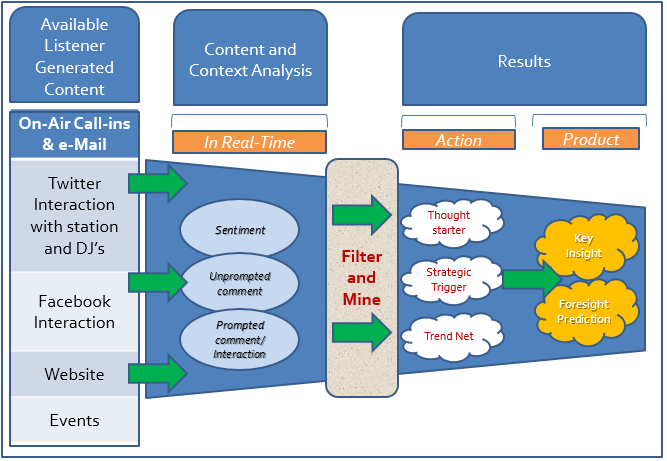
The nature of radio at the moment provides an available base for research and a market that is eager to interact, albeit often on its own terms. Cleverly designed research or campaigns, which act as a call to action for interaction itself, may yield some very meaty and useful qualitative food for thought.
As an example, a leading retail brand launched a key pneumonic element as part of a campaign. By engaging in competitions run on radio and listening to audience response, it was discovered that the concept took longer than expected to be adopted. After much analysis, it was established that, from a media and creative perspective, it can take 3–4 weeks for effective take-up time for elements such as catchphrases or pneumonics. It was also learnt that creating a peak period for engagement is key. A drip strategy does not promise impact or response. Having a key day, for example, which builds hype and excitement, shows better results.
Mining the listener and interaction content which occurs on air and across platforms holds much potential. Going forward, there may be an opportunity for us to gain more in-depth radio data, and this, coupled with a new mind set for researching and mining radio content itself, points to exciting things for the future of radio advertising.
 Angela Haarhoff (@ANGtheHOFF) is an analytics and insights strategist at MEC Notabene Johannesburg. A Psychology and AAA Brand Management graduate, her background includes diverse years spent in strategic planning, marketing services and public relations. Follow @mecnotabene for regular media updates.
“Motive” is a by-invitation-only column on MarkLives.com. Contributors are picked by the editors but generally don’t form part of our regular columnist lineup, unless the topic is off-column.
— MarkLives’ round-up of top ad and media industry news and opinion in your mailbox every Monday and Thursday. Sign up here!