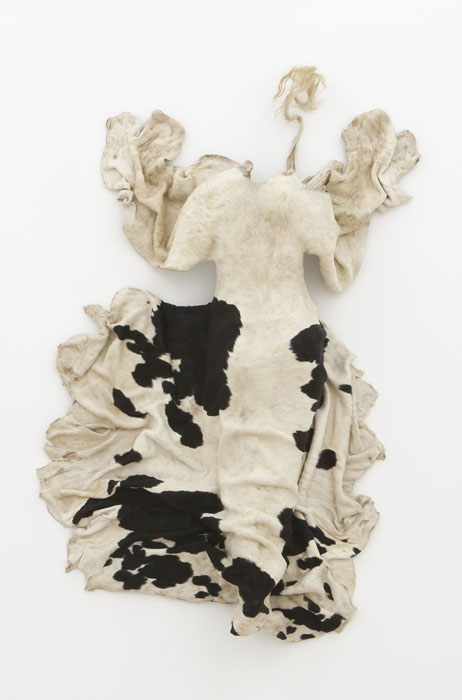
Nandipha Mntambo’s Ode to the Silence #designindaba

Nandipha Mntambo won the Standard Bank Young Artist Award for Visual Art in 2011 and is a speaker at Design Indaba 2014. She has had four solo shows at Stevenson in Cape Town (2007, 2009, 2012) and Johannesburg (2009); and held her first European solo exhibition at Andréhn-Schiptjenko, Stockholm, in 2013.

Devotion, 2013
Devotion, 2013
Lweti, 2013
Lweti, 2013
Enchantment, 2012
Enchantment, 2012
The Unspoken, 2012
The Unspoken, 2012
Ode to the Silence, 2012

Copyright: Nandipha Mntambo. Courtesy of Stevenson, Cape Town and Johannesburg.

— MarkLives is an official Media Supporter of Design Indaba 2014. Sign up for our free newsletter!

The many faces of Zanele Muholi — ‘Faces and Phases’ #designindaba

Zanele Muholi, a visual activist and photographer, is a speaker at the 2014 Design Indaba. In 2013 she won the Fine Prize for an emerging artist at the 2013 Carnegie International and the prestigious Prince Claus Award, presented in Amsterdam, as well as the Freedom of Expression Index Arts award. Her work focuses on black lesbians and transgendered persons. In 2012, she produced the documentary Difficult Love.

Charmain Carrol, Parktown, Johannesburg, 2013
Tumi Nkopane, KwaThema, Johannesburg, 2013
Maureen Velile Majola, Parktown, Johannesburg, 2013
Boitumelo Mimie Sepotokele, White City, Soweto, Johannesburg, 2013
Noluntu Makalima, Yeoville, Johannesburg, 2013
Lithakazi Nomngcongo, Vredehoek, Cape Town, 2012
Collen Mfazwe, August House, Johannesburg, 2012
Nana Nxumalo, Pietermaritzburg, KwaZulu Natal, 2012

Copyright: Zanele Muholi. Courtesy of Stevenson, Cape Town and Johannesburg.

— MarkLives is an official Media Supporter of Design Indaba 2014. Sign up for our free newsletter!

Athi-Patra Ruga: Not your average wallflower #designindaba

Athi-Patra Ruga (@AthiPatraRuga) was born in Umtata in 1984 and lives and works in both Johannesburg and Cape Town. Ruga was recently included in the Phaidon book Younger Than Jesus, a directory of over 500 of the world’s best artists under the age of 33. His works form part of private public and museum collections here and abroad, namely: Museion — Museum of Modern and Contemporary Art, Bolzano Italy; CAAC — Pigozzi Collection, The Wedge Collection, and the Iziko South African National Gallery. He is a speaker at Design Indaba 2014.

Uzuko. 2013 Wool, Thread and Artificial Flowers on Tapestry Canvas. 200 x 180 cm
UnoZuko. 2013 Wool, Thread and Artificial Flowers on Tapestry Canvas. 195 x 180 cm
Invitation…Presentation…Induction. 2013. Wool and Thread on Tapestry Canvas. 300 x 175 cm
Invitation…Presentation…Induction. 2013. Wool and Thread on Tapestry Canvas.
300 x 175 cm
The Night of the Long Knives I. 2013. Archival inkjet Print on Photorag Baryta<br />Edition of 5. 157 x 202 cm
The Night of the Long Knives I. 2013. Archival inkjet Print on Photorag Baryta
Edition of 5. 157 x 202 cm
Thud of a Snowflake. 2013. High-density foam, artificial flowers, Fiberglas, steel, polystyrene, fabric, rhinestones, automative paint, glue. Plinth: 370 x 245 x 8.5 cm Balloon figure: 160 x 140 x 255 cm Flower figure: 140 x 210 x 42 cm

Copyright: Athi-Patra Ruga. Courtesy of WHATIFTHEWORLD/, Cape Town.

— MarkLives is an official Media Supporter of Design Indaba 2014. Sign up for our free newsletter!

ABC Analysis Q4 2013: The biggest circulating newspapers in South Africa

by Herman Manson (@marklives) The Audit Bureau of Circulations of South Africa has released circulation statistics for the period October 2013 — December 2013 (ABC Q4 2013).

Most newspaper circulations are down slightly. As a category, daily newspapers saw an increase only because the ABC moved The Times into this category. If it hadn’t, the category would have shown a decline — as, in fact, The Times did.

Paid-for newspapers are down, although the circulation falls don’t seem to be severe in most cases. A couple of hundred copies here, a couple of thousand there, but they do add up. The tabloids really aren’t doing well — the economy is biting and belts are being tightened all round — especially in communities where the tabloids find their primary market. Son fell to 86,837 from 96,598, Daily Sun fell sharply to 297,614 from 322,324, Sunday Sun fell to 177,257 from 184,417 and Sunday World to 116,659 from 130,656.

Upside

On the upside, it’s good to see The Herald holding the line, and even increasing its circulation somewhat. Some of the vernacular titles continue to show positive growth (maybe this will also change when people can get their news for free on their mobiles in the language of their choice!). The Mail & Guardian grew nicely to 51,551 from 48,999.

Into the breach left by the crumbling paid-for circulation steps the freesheets, up to an impressive 6,738,314 copies from 6,137,501 in the corresponding previous reporting period, thanks mainly to new entrants into the market.

Note: we compare the current figures with the same figures for this time last year, and not with the previous quarter.

For magazine circulation figures, click here.

ABC member circulation totals:

Daily Newspapers: up to 1,600,667 from 1,534,519 for the previous corresponding period
Weekly papers: down to 632,934 from 666,129
Weekend papers: down to 2,100,272 2,274,906
Local papers: down to 421,344 from 436,192
‘Hybrid’ papers: down to 22,497 162,722
Free papers: up to 6,738,314 from 6,137,501

Daily papers

The Times has been moved from the Hybrid to the Daily category in the latest ABC results. This is the reason that the category shows blue (growth), even as most of the daily papers show a decline in circulation (red). MarkLives has always included The Times in our round-up for Dailies so it doesn’t affect our ranking below.

Among Gauteng-based dailies, Beeld falls to 64,874 from 66,132 and Sowetan to 99,236 from 100,349. The Citizen falls to 58,735 from 64,627 and The Star falls to 100,898 from 102,244. Pretoria News is down slightly to 17,243 from 17,576.

In the Eastern Cape, Die Burger falls to 10,018 from 10,795 and the Daily Dispatch falls to 25,521 from 26,339. The Herald grows slightly to 22,621 from 22,079.

In the Western Cape, Die Burger falls to 50,494 from 51,022. The Cape Argus falls to 30,204 from 32,337 while sister paper The Cape Times falls to 32,611 from 34,627. Son falls to 86,837 from 96,598. Free State daily Die Volksblad is down to 20,456 from 21,446.

In KZN Daily News falls to 28,881 from 30,743 and The Mercury is down slightly to 29,010 from 29,761. Isolezwe jumps to 107,119 from 106,858. The Witness falls to 17,549 from 18,804.

Business Day falls to 33,667 from 35,149. Daily Sun falls sharply to 297,614 from 322,324. The Times sits at 142,523 — down from 146,956.

MarkLives Big Daily Newspaper List*

  1. Daily Sun 297,614
  2. The Times 142,523
  3. Isolezwe 107,119
  4. The Star 100,898
  5. Sowetan 99,236
  6. Son 86,837
  7. Beeld 64,874
  8. Die Burger 60,512 (combined Eastern and Western Cape editions) +1
  9. The Citizen 58,735 -1
  10. Business Day 33,667 [new entry]

The Cape Times fell out of our Top 10.

Weekly & Weekend papers

City PressOn the weekly front, Ilanga falls to 95,994 from 118,584 but the Mail & Guardian grows to 51,551 from 48,999. Soccer Laduma  declines to 307,275 from 311,774.

In terms of the weekend papers, Beeld‘s Saturday edition falls to 58,411 from 63,962 and Die Burger (Eastern & Western Cape editions) declines to 75,853 from 76,805. The Citizen (Saturday) falls to 34,498 from 36,650. The Saturday Star falls to 73,487 from 75,089.

City Press falls to 124,418 from 126,400, Rapport falls to 187,288 from 213,460. The Sunday Times sees a steep decline to 411,186 from 449,799. The Sunday Independent declines to 33,966 from 35,263. Son op Sondag falls to 54,625 from 56,927 while Sondag has been discontinued. Sunday Sun falls to 177,257 from 184,417 and Sunday World to 116,659 from 130,656.

Ilanga Langesonto falls to 56,074 from 64,344. Isolezwe ngeSonto grows to 88,026 from 87,175 and Isolezwe ngoMgqibelo grows to 82,339 from 73,448. Sunday Tribune falls to 68,277 from 71,675. Weekend Argus is down to 55,121 from 60,383. The Post falls to 43,975 from 44,683.

MarkLives Biggest Circulation per issue Newspaper List*

  1. Sunday Times 411,186
  2. Soccer Laduma 307,275
  3. Daily Sun 297,614
  4. Rapport 187,288
  5. Sunday Sun 177,257
  6. The Times 142,523
  7. City Press 124,418
  8. Sunday World 116,659
  9. Isolezwe 107,119
  10. The Star 100,898

Sowetan 99,236
Ilanga 95,994

** ABC considers The Times a hybrid (paid-for and free to subscribers of The Sunday Times) newspaper.
* South African titles only. Must have cover price. Excludes free papers.

— MarkLives’ round-up of top ad and media industry news and opinion in your mailbox every three work days. Sign up here!

ABC Analysis Q4 2013: The biggest circulating consumer magazines in South Africa

by Herman Manson (@marklives) The Audit Bureau of Circulations of South Africa has released circulation statistics for the period October 2013 — December 2013 (ABC Q4 2013). Here are several consumer magazine ABC figures that popped out for us (see our newspaper ABC analysis here). We’ve also updated our list of the biggest circulating consumer magazines in SA!

Note: We compare the current figures with the same figures for this time last year and not with the previous quarter!

Overall, circulation has fallen to 5,912,001 from 6,463,916 in the previous corresponding reporting period (and from 6,050,593 in the previous quarter). Single copy sales stand at 3,974,366 and total paid (includes subscription figures) stand at 4,754,642. Paid-for digital copy sales stand at 76,823 (up from 69,581 in 2013 Q3).

Some insights:

  • Entrepreneur has the biggest paid-for circulation of any business magazine in the country.
  • Many titles in the entertainment, celeb category have seen a decline in circulation.
  • Men’s Health sees a significant drop to 50,507 from 61,663; FHM falls to 25,690 from 28,084; but niche players in the men’s market are doing well.
  • The sport & hobby category sees circulation fall to 398,734 from 478,795.
  • Following a spectacular crash in circulation, Cosmo makes a slight comeback from the previous quarter to climb to 74,242 from 63,386  (but it’s still down from 86,885 in the previous corresponding reporting period).
  • A bit of a bloodbath in the woman’s category — total circulation is down to 1,433,419 from 1,574,675. Good Housekeeping, Finesse and Ideas/Idees have all lost thousands of copies in circulation.
  • Something isn’t sitting well with the Woman & Home ABCs. We explain why.

Business press

Entrepreneur climbs to 22,323 from 17,280 in the previous corresponding reporting period. Noseweek grows to 17,776 from 17,588 and Succeed to 22,395 from 19,178. Forbes Africa sits steady at 17,336 (slightly down from 17,538) — its total paid circulation is 6,769.

Financial Mail, which was revamped late last year, holds steady at 23,140 (down from 23,595). Finweek collapses to 13,217 from 23,456 (and falls from 14,013 in 2013 Q3). Interestingly, in terms of single-copy retail sales, Finweek outperforms FM, selling 4,209 copies to FMs 3,563.

Biggest circulating business magazines in terms of paid-for (sales, bulk and subscriptions) circulation:

Entrepreneur 22,114
Financial Mail 21,055
Noseweek 17,776
Personal Finance 13,319
Succeed Magazine 12,605
Finweek 10,727
Your Business Magazine 9,033
Forbes Africa 6,769

Biggest circulating business magazines in terms of total circulation:

Financial Mail 23,140
Succeed Magazine 22,395
Entrepreneur 22,323
Noseweek 17,776
Forbes Africa 17,336
Personal Finance 13,334
Finweek 13,217

Entertainment, celeb news

heat magazine grows to 28,446 from 27,945. Drum climbs to 120,241 from 118,793, but Huisgenoot falls to 261,224 from 270,310, Huisgenootand YOU sees a slight decline to 153,055 from 155,125. Bona sees a steep decline to 81,504 from 97,190.

People falls to 81,782 from 85,978. TV Plus (Afrikaans) falls to 35,303 from 37,667 while its English language edition falls to 39,411 from 41,889. Taalgenoot falls to 67,300 from 68,330. Rolling Stone sits at 8,723 (single copy sales 1,625, 1,500 digital copies). The Red Bulletin falls to 38,476 from 64,250. Live magazine is up to 50,731 from 48,167.

Home & Gardening, Leisure

In the home category, Conde Nast House & Garden falls to 43,725 from 45,144 and House & Leisure falls to 40,320 from 44,630. Tuin/Home falls to 80,970 from 82,430. SA Garden and Home declines to 55,006 from 57,224. Easy DIY holds steady at 23,379 (slightly down from 23,414). Elle Decoration grows to 25,552 from 23,630 while Food and Home Entertaining falls from 30,332 to 32,672. SA Home Owner grows to 39,633 from 37,824. Sarie Kos grows to 52,503 from 50,496 and Visi to 13,349 from 12,531.

Men’s market. Niche does well.

Blaque Magazine releases its first ABC certificate with a circulation of 14,638. Braintainment grows to 13,412 from 12,525 as does Destiny Man — to 20,922 from 19,251. FHM falls to 25,690 from 28,084 while Men’s Health sees a significant drop to 50,507 from 61,663. GQ also declines to 25,690 from 28,084. Popular Mechanics reports a slight decline to 43,283 from 43,863. Stuff falls to 18,352 from 25,317 (the publisher notes that the title changed frequency — up from six issues a year to 10). PC Format falls to 12,957 from 13,813 while gaming rival NAG climbs to 21,529 from 18,750.

Amakhosi magazine falls sharply to 29,079 from 36,756. Compleat Golfer falls to 9,783 from 14,380 and Golf Digest to 11,331 from 12,577. Game & Hunt/Wild & Jag climbs to 13,720 from 11,181 while SA Hunter jumps to 40,985 from 38,616. Kick Off falls to 40,804 from 52,328. The sport & hobby category sees circulation fall to 398,734 from 478,795.

Hitting the road

CAR magazine falls to 75,904 from 81,114, TopGear falls to 26,205 from 29,187 and TopCar to 15,495 from 17,548. Speed & Sound falls to 37,085 from 40,932. Drive Out/WegRy declines to 30,269 from 31,584 but Leisure Wheels grows to 19,627 from 18,035.

On the travel side, Getaway falls to 41,791 from 45,347 and Weg/Go to 70,448 from 73,949. SA Country Life comes in at 33,776 (down from 33,840).

Cosmo up on previous quarter

Cosmopolitan falls to 74,242 from 86,885 (but is up from 63,386 in Q3 2013). Meanwhile, Finesse seems to be doing a Cosmo — collapsing to 56,146 from 72,661. Not that long ago, both magazines sported ABCs of over 100 000. Destiny grows to 31,224 from 27,822 and Elle to 45,942 from 43,820.

Fair Lady falls to 55,343 form 57,522 and Glamour to 69,737 from 71,096. Good Housekeeping joins Cosmo and Finesse by collapsing from 55,357 to 70,932.

Ideas/Idees falls to 75,970 from 91,905. And let’s not forget Real magazine, falling to 33,769 from 54,055.

Marie Claire falls to 33,837 from 41,137 and Grazia falls to 21,518 from 23,182. O sees a significant decline, to 31,053 from 37,459. Rooi Rose is down to 96,844 from 112,381 while arch-rival Sarie falls to 92,768 from 93,473. True Love falls to 56,604 from 68,146, Woman & Home to 89,195 from 100,310 and Women’s Health to 55,453 from 60,187.

Something isn’t sitting well with the Woman & Home ABCs. There seems to be a pattern of growth in one quarter, followed by collapse in the next:

  • Q4 2013 — collapse (89,195 from 100,310)
  • Q3 2013 — growth (to 106,036 from 86,153)
  • Q2 2013 — collapse (to 83,863 from 101,690)
  • Q1 2013 — growth (to 90,830 from 86,160).

WTF, people?

Kuier looks good at 109,481, up from 94,926, as does Move!, growing to 131,227 from 113,500.

Fitness Magazine grows to 22,972 from 17,624 while Longevity falls to 17,217 from 22,339. Intiem sits at 31,696 (up slightly from 31,128). Soul, Saltwater Girl and Seventeen have all been discontinued.

The MarkLives Big Magazine list*

* By total circulation. Must have a cover price. Annuals excluded.
Movement on the Big Magazine list compared to 2013 Q3 data.

  1. Huisgenoot 261,224 –
  2. YOU 153,055 –
  3. Move! 131,227 –
  4. Drum 120,241 –
  5. Kuier 109,481 +2
  6. Rooi Rose 96,844 +2
  7. Sarie 92,768 +2
  8. Woman & Home 89,195 -3
  9. People 81,782 [re-entry]
  10. Bona 81,504 -4

Tuis/Home (80,970) falls out of Top 10.

— MarkLives’ round-up of top ad and media industry news and opinion in your mailbox every three work days. Sign up here!

ABC Newspaper Round-up Q4 2013: Newspaper decline slows

Extracts from the ABC Q4 2013 presentation released today, Wednesday, 26 February 2014, show an upswing in total newspaper circulation trends:

  • The passing of former President Nelson Mandela had a pronounced impact on newspaper sales, according to the ABC. The Mail & Guardian, in particular, was up 22% on Q3.
  • On the Weekend Newspaper front, the decline is slowing. Isolezwe ngoMgqibelo, however, jumped 12% year-on-year and 4.5% on Q3.

[There does indeed seem to be an upswing in newspaper circulation but, upon closer inspection, it would seem to have less to do with the paid-for newspaper market, which continues to show a broad decline, and everything to do with a number of new entrants (23 in fact) in the freesheet space. While newspaper circulation decline might have been less severe because of the newsworthiness of the passing away of former President Mandela, newspaper circulation does not seem to have increased as a result. You can find our own analysis of the latest ABC newspaper results here.]

Graphs, analysis and data courtesy of the ABC.

Four Year Total Newspaper Circulation Trend by Quarter:

Four Year Total Newspaper Circulation Trend by Quarter

Total Newspapers increased by 246,000 copies, compared to the previous quarter.

Four Year Category Trend by Quarter:
Daily Newspapers

Four Year Category Trend by Quarter: Daily Newspapers

Circulation has declined annually by 4.2% since 2009, equivalent to 281,000 copies. However, Q4  increases by 149,000 copies, compared to Q3, mainly the result of The Times moving from Hybrid to Daily newspapers.

Four Year Trend Analysis by Language:
Daily Newspapers

Four Year Trend Analysis by Language: Daily Newspapers

English titles have declined by 4.1% annually (200, 000 copies) over the period. Afrikaans titles have declined by 6.2% annually (83,000 copies) over the period. Vernacular titles have increased by 3,000 copies over the period.

Titles Showing Largest Decline:
Daily Newspapers

No Publication Name TOTAL CIRCULATION Corresponding Previous Period Variance — Prior Year Previous Quarter Variance — Previous Quarter
1 Son (Daily)  86 837 96 598  -10,10%  86 598 0,28%
2 Citizen, The (Daily)  58 735 64 627  -9,12%  60 242 -2,50%
3 Daily Sun  297 614  322 324  -7,67%  291 132 2,23%
4 Witness, The 17 549  18 804  -6,67%  17 260 1,67%
5 Cape Argus  30 204  32 337 -6,60% 30777 -1,86%

Four Year Category Trend by Quarter:
Weekly Newspapers

Four Year Category Trend by Quarter: Weekly Newspapers

Weekly newspapers reflect an erratic performance. Q4, however, declined by 4% (23,000 copies), compared to Q3.

Four Year Category Trend by Quarter:
Weekend Newspapers

Four Year Category Trend by Quarter: Weekend Newspapers

Circulation has declined annually by 4.3% (407,000 copies) over the period. Q4, however, only declined by 1.7 % (31,000 copies), compared to Q3.

Four Year Trend Analysis by Language:
Weekend Newspapers

Four Year Trend Analysis by Language: Weekend Newspapers

English titles have declined annually by 4.7% (305,000 copies) over the period. Afrikaans titles have declined  annually by 7.4% (183,000 copies) over the period. Vernacular titles have grown annually by 13% (81,000 copies) over the period.

Four Year Category Trend by Quarter:
Local Newspapers

Four Year Category Trend by Quarter: Local Newspapers

Local Newspapers have declined by 3.2% (65,000 copies) over the period. Q4 reflected a similar circulation compared to Q3.

Four Year Category Trend by Quarter:
Free Newspapers

Four Year Category Trend by Quarter: Free Newspapers

Distribution has increased annually by 7.5% (1,615,000 copies) over the period, increasing by 4.6% (295.000 copies) in Q4, compared to Q3, mainly the result of new members.

Graphs, analysis and data courtesy of the ABC.

— MarkLives’ round-up of top ad and media industry news and opinion in your mailbox every three work days. Sign up here!

ABC Magazine Round-up Q4 2013: Not happy days for consumer mags

Extracts from the ABC Q4 2013 presentation released today, Wednesday, 26 February 2014, shows a difficult trading environment for magazine publishers. The magazine category has recorded a disappointing 8.5% decline.

Graphs, analysis and data courtesy of the ABC.

Four Year Magazine Circulation by Quarter

Four Year Magazine Circulation by Quarter

Total magazines decreased by 4.7% (951,000 copies) over the previous quarter. Consumer magazines decreased by 1.9% (138,000 copies) over the previous quarter.

Titles Showing Largest Growth
Consumer Magazines

No Publication Name TOTAL CIRCULATION Corresponding Previous Period Variance — Prior Year
1 Kuier Combo (Annual) 105 511  23 077 357,21%
2 SA Career Focus(Six monthly)  4 835  2 412 100,46%
3 Fitness His Edition (Six monthly)  11 693  8 214 42,35%
4 Fitness Magazine (Six monthly)  22 972  17 624 30,34%
5 Entrepreneur  22 323  17 280 29,18%

Four Year Category Trend by Quarter:
Consumer Magazines — Home

Four Year Category Trend by Quarter: Consumer Magazines — Home

Circulation has remained static over the period. Q4, however, decreased by 7.5% (58,000 copies), compared to Q3, mainly the result of some titles reporting on a biennial cycle.

Four Year Category Trend by Quarter:
Consumer Magazines — Woman’s General

Four Year Category Trend by Quarter: Consumer Magazines — Woman’s General

This category has fluctuated considerably. Circulation declined by 2.7% annually (185,000 copies) over the period, although Q4 increased slightly compared to Q3.

Four Year Category Trend by Quarter:
Consumer Magazines — Sport and Hobby

Circulation declined annually by 3% (59,000 copies) over the period. Q4, however, declined by 12% (52,000 copies) compared to Q3, mainly the result of discontinued titles.

Four Year Category Trend by Quarter:
Consumer Magazines — Travel

Circulation increased annually by 23% (252,000 copies) over the period, fluctuating considerably as a result of biennial reporting titles. Q4 increased by 47% (162,000 copies) compared to Q3, because of new members, changed reporting cycles, and biennial reporting titles.

Four Year Category Trend by Quarter:
Business-to-Business Magazines

Four Year Category Trend by Quarter: Business-to-Business Magazines

Circulation has increased annually by 0.7% (33,000 copies) over the period.

Four Year Category Trend by Quarter:
Custom Magazines

Four Year Category Trend by Quarter: Custom Magazines

Circulation increased annually by 1.8% (838,000 copies) over the period. However, Q4 decreased by 6.5% (811, 000 copies) compared to Q3, mainly the result of one large title not reporting.

Four Year Category Trend by Quarter:
Free Magazines

Four Year Category Trend by Quarter: Free Magazines

Circulation declined annually by 18% over the period. Q4 decreased by 4.8% (30,000 copies) compared to Q3.

Graphs, analysis and data courtesy of the ABC.

— MarkLives’ round-up of top ad and media industry news and opinion in your mailbox every three work days. Sign up here!

Ije Nwokorie on the death of brand myths #designindaba

by Russell Southwood (@BalancingActAfr) In this interview, Ije Nwokorie, managing director at Wolff Olins London and a speaker at the Design Indaba 2014, talks about how he came to run Wolff Olins London and what branding means for him, as well as:

  • the impact of the Internet on how people feel about brands,
  • reasons for the disconnect between surface messages and what the customer experiences,
  • the controversy over the London Olympics logo
  • and his work with Mercedes Benz.

Image source: Wolff Olins London

Smart MonkeyRussell Southwood is the founder of Balancing Act and the web TV channel Smart Monkey TV, and has been an analyst in telecoms, internet and broadcast in Africa for the last 14 years. Smart Monkey TV aims to capture the energy at the crossroads between African culture and technology. MarkLives is syndicating content from Smart Monkey TV on a weekly basis for the column “Smart Africa TV”.

— MarkLives is an official Media Supporter of Design Indaba 2014. Sign up for our free newsletter!

Design Annotator: Design Indaba, creative hustles and boers at the end of the world

by Uno de Waal (@Unodewaal) This week on Design Annotator we’ve rounded up:10and5logosmall1

  • the nominations for this year’s Design Indaba “Most Beautiful Object In South Africa”
  • studio visits with Cape Town and Joburg designers exhibiting at the Design Indaba Expo
  • a Google Hangout with Absa’s brand manager on its Design Indaba sponsorship
  • the inaugural GUILD Design Fair
  • “#CreativeHustles — Design Will Save the World?” events for young creatives
  • an interview with Richard Finn Gregory on his upcoming film ‘The Boers at the End of the World’, and
  • how to buy illustration prints from Take Me Home online!

DESIGN INDABA

Design Indaba 2014 | Most Beautiful Object in South Africa

Design Indaba 2014 — Most Beautiful Object in South Africa

The Most Beautiful Object in South Africa (MBOISA) competition is a regular feature at the Design Indaba Expo. Twelve cultural commentators are asked to nominate an object that they deem to be SA’s most beautiful and, in doing so, spark contemplation on what constitutes beauty.

This year, the nominations span fashion, jewellery, product design and film.

View all the MBOISA nominations, as well as who they were chosen by and why they were put forward. 

Prepping for Design Indaba Expo | Studio visits in Cape Town and Joburg

Design Indaba Studio Visits — Studio Number 19, Ceramic Factory, Henriette Botha

In the run-up to the Design Indaba Expo, we visited the studios and workshops of exhibiting designers for a behind-the-scenes look at what it takes to get ready.

In Cape Town, we visited Adriaan Kuiters, Pichulik, Jasper Eales Original, Oh Dear Megan, MarethColleen and Famke.

In Johannesburg, we paid a visit to Studio Number 19, Ceramic Factory and Henriette Botha.

A hangout with Absa brand manager Lauren Smith on the Design Indaba sponsorship

We had a Google Hangout with Absa brand manager, Lauren Smith, to learn more about Absa’s involvement with Design Indaba, and what its plans are in the creative world for 2014.

THINGS TO SEE AND DO

The Inaugural GUILD Design Fair

GUILD Design Fair — Daniella Mooney's Parquetry

GUILD, the inaugural Design Fair by Southern Guild, kicks off this week in Cape Town as part of World Design Capital 2014. Together in one, carefully curated space, the fair will bring handmade, limited-edition collectable design from Africa, the US, South America, Britain and Europe.

More about GUILD Design Fair and a sneak peak of the exhibiting designers.

#CreativeHustles for 2014 — Design Will Save the World?

CreativeHustles — Design Will Save the WorldThis year, Live Magazine SA and the British Council Connect ZA are hosting South Africa’s first #CreativeHustles — Design Will Save the World? events which will allow young South Africans, ages 18–30 years, access to a creative community where they can engage with and learn from industry professionals.

The first #CreativeHustles takes place on 26 February in Cape Town and on 3 March in Johannesburg.

Find out more about #CreativeHustles 2014 and the speaker line-up.

GOOD TO KNOW

The Boers at the End of the World: Filmmaker Richard Finn Gregory shares some insights on meeting this remote community

The Boers at the End of the World

Early last week, the teaser for a documentary entitled The Boers at the End of the World was released. Just three and a half minutes in length, this video — about a community of Afrikaner descendants eking out a rural life in a remote corner of Patagonia — has captured the attention of thousands of people and resparked questionings about what it is to be ‘South African’.

We spoke to filmmaker Richard Finn Gregory (who directed and produced the video) about this amazing project.

Take Me Home | Buy prints online!

Take Me Home by Between 10and5 | Buy Prints Online!

After our exciting first Take Me Home print sale at the beginning of February, we were asked if there were any prints still available and how to get hold of them. Well, good news! They’re for sale online, so hurry before they’re all gone!

View all available illustrations and see how to purchase prints online.

Uno de Waal


Design Annotator is a regular column on MarkLives featuring the top design work from South Africa’s biggest online creative showcase, Between 10 and 5, which is curated by publisher Uno de Waal (@Unodewaal).


— MarkLives’ round-up of top ad and media industry news and opinion in your mailbox every three work days. Sign up here!

TRENDAFRiCA: 10 MegaTrends for 2014

by JWT Intelligence (@JWTIntelligence) Trends don’t happen in isolation. They tend to intersect and work in tandem with each other. And many are extensions or outgrowths of trends, reveals JWT Intelligence in the TRENDAFRiCA 2014 Trends Annual.

In our forecast, we see consumers both welcoming and resisting technology’s growing omnipresence in their lives. For many, technology serves as a gateway to opportunity and an enabler of hyper-efficient lifestyles, but those who are most immersed are starting to question its effect on their lives and on their privacy.

This is a summary of the highlights of JWT’s 10 MegaTrends for 2014. More detail is available in the TRENDAFRiCA digizine, available for download free of charge.

1.       2014_Trends_Annual_Cover_Final-1IMMERSIVE EXPERIENCES

Entertainment, narratives and brand experiences will become more immersive and altogether more enveloping in a bid to capture consumers’ imagination and attention. Greater immersion means more active involvement, and the Millennials and Generation Z have grown up with tools and technologies that enable them to be active participants in entertainment and media. They’re accustomed to being at the centre of experiences rather than passive observers.The impact of this trend is being seen across all avenues of storytelling. From the arts to journalism; the design of brand experiences;and even the retail space are leveraging the opportunities that these experiences bring. For example, the future of cinema could well be the ‘Secret Cinema’ (which screens mystery movies in exotic locations around the UK).

2.       DO YOU SPEAK VISUAL?

We’re shifting to a visual vocabulary that relies on photos, video snippets and other imagery, largely supplanting the need for text. ‘Visual’ is a new lingo that needs to be mastered.Images are increasingly supplanting words, changing the way we communicate and how we see and understand the world. We are growing accustomed to consuming information that’s dominated by images – coming to favour‘show’ over ‘tell’. Across industries and disciplines, brand communicators will have to master how to express themselves visually and how to read and interpret images—and understand the nuances across cultures, generations, demographics and communications platforms.

3.       THE AGE OF IMPATIENCE

With the mainstreaming of the on-demand economy and our always-on culture, consumer expectations for speed and ease are rising exponentially. As businesses respond in kind, making the availability of their products and services more instant, impatience and impulsiveness will only continue to increase.Thanks in part to mobile-enabled lifestyles, faster connectivity, instant downloads, streaming services and our always-on culture, consumers are developing ever-increasing expectations for speed and efficiency. Impatience will come to define the generations growing up in a real-time, visually oriented world.Businesses are catering to the rising demand for instant gratification in various ways, offering same-day or even same-hour delivery services; providing full seasons of TV series for binge viewers; using mobile to make payments and shopping more effortless; creating dating apps that enable yes/no decisions at a glance.

4.       MOBILE AS A GATEWAY TO OPPORTUNITY

In emerging markets, the mobile device is coming to represent a gateway to opportunity – helping people change their lives by giving them access to financial systems, new business tools, better health care, better healthcare, education and more.In Africa, the fastest-growing smartphone market, smartphone penetration has the potential to jump from around 2-5% currently, to 30% by 2025, and up to 50% in leading countries on the continent, according to McKinsey. As many as 300 million new smartphones could be sold in Africa in the next decade. Mobile represents both a commercial opportunity and an opportunity to help consumers buildup businesses, improve their health, become more informed citizens and connect with people around the globe.

 5.       TELEPATHIC TECHNOLOGY

Thanks to the rise of brain-computer interfaces and emotion recognition technology, brands are getting more adept at understanding consumers’ minds and moods, and reacting in a very personalised way.As cutting-edge as they seem, brain-computer interfaces (BCIs) have existed for decades. But until recently, electroencephalography (EEG) readers were cumbersome devices. The past decade has given rise to pared-down, inexpensive versions of EEG headsets and affective computing technologies (computers that read emotions). These developments, along with the trend toward greater personalisation, are pushing Telepathic Technology into the commercial realm. Marketers are complementing traditional research methods with neuromarketing to uncover consumers’ non-conscious responses to packaging, advertising, entertainment content and so on. While still in its early days, the applications are far reaching:from mind-controlled cars to art exhibits that morph based on patrons’ brain-wave activity to headphones that play music suited to the listener’s mood.

 6.       THE END OF ANONYMITY

Thanks to an array of new technologies and a growing drive to collect personal data, it’s becoming nearly impossible to remain unobserved and untracked by corporations and governments. As anonymity becomes more elusive, expect pushback from consumers and a growing paranoia around technologies and services that affect privacy.Surveillance has become a recurring theme in the news – not only the revelations about government tactics but reports of how businesses are collecting data on consumers. In the near future, these and other up-and-coming technologies, like Google Glass and commercial drones, will further hinder anonymity.The ability to track and leverage data is becoming a key competitive advantage for brands, but navigating this landscape will require extreme sensitivity, a close reading of customer attitudes, adherence to emerging best practices and very finely calibrated use of the new services at companies’ disposal.

7. RAGING AGAINST THE MACHINE

As we move further into the digital age, we’re starting to both fear and resent technology, fretting about what’s been lost in our embrace of unprecedented change. We’ll put a higher value on all things that feel essentially human and seriously question (while not entirely resisting) technology’s siren call.With digital devices, ‘in the moment’ frequently becomes ‘recording the moment’ (if not ‘missing the moment entirely’). The higher-quality cameras in today’s mobile devices, coupled with the rise of image-based platforms like Instagram and Vine, seem to spur an urge to record anything remotely interesting. As a result, we’re experiencing life through our screens.Consumers will be searching for the best of both worlds, and brands can help them navigate the line between too immersed and too disconnected.

8. RE-MIXING TRADITION

With social norms quickly changing and a new anything-goes attitude, people are mashing up cherished traditions with decidedly new ideas, creating their own recipes for what feels right.Globalisation and digital technology are expanding people’s worldview, providing a myriad new ideas from which to draw inspiration. Meanwhile, many societies are becoming more progressive and inclusive, and everything from marriage to parenthood is open to reinterpretation as more people take non-traditional life paths.While traditions have always evolved, shifted with and reflected the times, today they’re mutating at an increasingly rapid pace, as with most everything in modern life. But precisely because life is moving so fast, traditions old and new may be more important than ever, something to hold on to as everything else changes. Brands will need to keep up with these shifts. Marketers have numerous opportunities to insert themselves into fluctuating traditions, guide consumers down new paths or help bring the best of the past into the future.

9. PROUDLY IMPERFECT

Imperfection and even outright ugliness – the quirky, the messy and the flawed – are taking on a new appeal in a world’s that’s become neatly polished and curated. Imperfection provides an unfiltered, all too human version of reality that reflects all the diversity that’s seen in everyday life.Today imperfection signals that something is handmade or more natural – which is ultimately more appealing for authenticity-seeking consumers, for whom perfection is becoming synonymous with synthetic or machine-made. Consumers increasingly prize authenticity, originality and individuality. Thus they’re embracing things that feel more human: this includes goods (like homemade-looking food), imagery (ugly selfies, unretouched images), models and actresses, even imperfect parenting.

10. MINDFUL LIVING

Consumers are developing a quasi-Zen desire to experience everything in a more present, conscious way. Once the domain of the spiritual set, mindful living is filtering into the mainstream, as more people feel drawn to the idea of shutting out distractions and focusing on the moment.Mindfulness means being completely present in the here and now, with no distractions. People are growing weary of the multiplying demands on their attention and overwhelmed by a bombardment of information. At the same time, they’re mixing and matching religious and spiritual practices. Part of this pushback and re-evaluation includes taking a more mindful approach to digital consumption, which is often the reason we’re not in the moment.

TRENDAFRiCA logoFor the full report with even more detail and examples, please go to TRENDAFRiCA (www.trendafrica.co.za), which provides consumer insight, research and trends in Africa. Louise Marsland is the publishing editor of this industry trendwatching portal.

— MarkLives’ round-up of top ad and media industry news and opinion in your mailbox every three work days. Sign up here!

Online CPD Courses Psychology Online CPD Courses Marketing analytics software Marketing analytics software for small business Business management software Business accounting software Gearbox repair company Makeup artist