

by Kyle Hauptfleisch (@Kylefrankwhite) The practice of marketing with content is nothing new; great examples can be found as far back as the 1800s. However, in the dynamic, and often hostile, environment of the web, the application of this discipline is still in its fledgling stages. There is a lot of confusion as to what content marketing is, and isn’t.
Definition
Content marketing may be defined as:
“a strategic marketing approach focused on creating and distributing valuable, relevant, and consistent content to attract and retain a clearly-defined audience — and, ultimately, to drive profitable customer action.” — The Content Marketing Institute
This definition is riddled with clues as to what makes well-executed content marketing so powerful and points to why brands are getting it so wrong, the most-notable point being a fundamental lack of strategic direction.
Only about a third of brands producing content have a documented strategy, meaning the vast majority doesn’t have any real objectives behind their content production. A strategy covers the basic questions — who, what, when, where, how — but none as important as why.
As a marketer, before you can figure out how to make your content strategy great, you have to have one, even if it’s bad. A bad strategy may at least be changed and improved upon. Once you have laid out the basic foundations, these seven points will help to give your brand an edge over your competition.
1. Add value
Most executives will tell you that the objective of any marketing initiative is increasing the bottom line — and they are right; let’s not fool ourselves. Content marketing is no different. It just does it in a way that adds value outside of, but related to, your business’s products and services.
Content marketing is about creating an audience of loyal brand advocates, and that requires building a relationship with your readers. Relationships are not built by pushing products, but rather by cultivating trust. Trust is created by adding value; find a way to help your customers.
Creating an editorial mission statement will help govern your objectives, and guide you to serving your audience better.
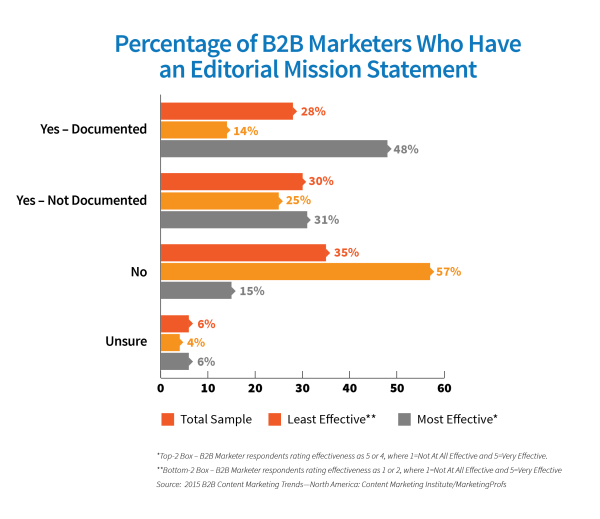
Your editorial mission statement needs to have:
- Who? The type of people that you are aiming to help
- What? The type of information with which to help those people.
- Why? What people will be able to do with that information once acquired
Think about the questions or challenges that your customers will experience within your given industry and offer solutions with your content. If your contribution isn’t adding value by solving a specific problem, then don’t bother writing it.
2. Measurability
How you determine success — and which metrics define it — is going to differ according to the objectives in your content strategy. Look at each objective independently and figure out which metric relates to it. This is going to assist you with determining if you are producing the right type of content.
One metric, however, should be standard: lead quality. According to The Content Marketing Institute, B2B marketers identify lead quality as more important than even sales.
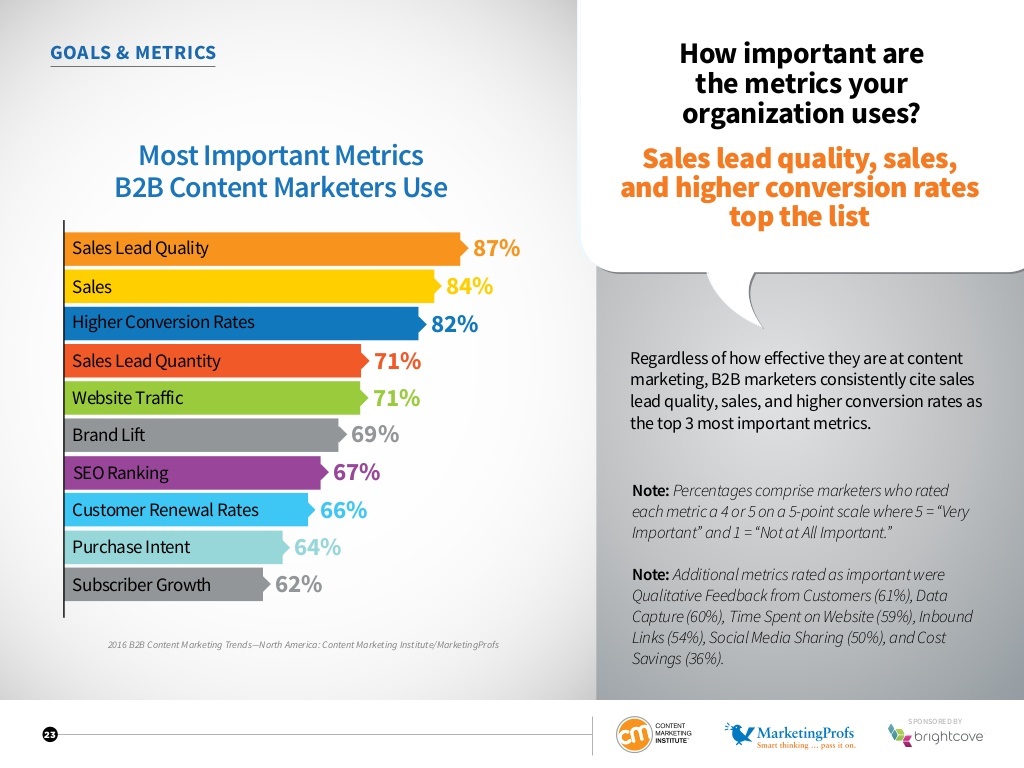
And it’s easy to see why. Your leads database is a phone book of direct lines to your customers.
Having Facebook or Twitter followers may be powerful and are important, especially for content distribution, but relying upon those platforms as a source of leads may be risky. Social media platforms are out of your control and are subject to change. Be careful of building upon rented land.
Determine which metrics are relevant to your business and its objectives, and whether these are currently being measured.
3. Targeting
Targeting to demographics alone is no longer enough. Your target audience should be defined by needs, not characteristics.
Targeting by those needs is the difficult part, and one of the major reasons an inbound strategy is so effective. If your business is creating content based upon solutions, it will attract anyone with those problems, regardless of demographic. You won’t miss out upon someone simply because you think that they are too ‘thirty’ to care.
This may be done by establishing detailed user personae and addressing their specific pain points and distinctive goals. Craft messaging that is directed to these segments of your audience.
4. Consistency
Growing an audience requires painstakingly consistent effort. Media owners are well aware of this, ensuring to publish as regularly as possible. Readers will only come back to your platform if you give them a reason to. And returning visitors are important — they are the community.
Keeping up with industry trends is going to keep your business relevant and will make your blog a popular destination.
Think about ramping up publishing frequency as soon as you have a robust strategy. When it comes to publishing, more is more.
5. Patience
A brand needs to build a loyal audience before it may monetise it and is unlikely to do that in under nine months. This may be accelerated with intelligent distribution strategies but it’s the long-term play — effort compounds over time.

You should come to terms with this and manage the expectations of the stakeholders involved. Trying to excavate value before it has been provided is a sure way for your content platform to lose credibility and, with it, its readers.
Content marketing is a marathon. It is not going to generate millions of leads overnight but it will over time.
6. Distribution
Creating content is one thing; getting people to consume it is another.
“If I create great content, people will come, right?”
Wrong.
You need to ensure that you have a distribution strategy in place. By using all the channels at your disposal and finding ways to repurpose existing content for other media, you may accelerate the amount of time it will take to yield results and grow your reach.
Native advertising is also a natural way to get your content in front of a relevant audience. By keeping your content neutral — that is, about your industry, not your business — you may even stand to make some money off distribution. Syndication agreements, with publications that need highly relevant content in the industries that they cover, are not at all uncommon.
Think about additional ways to get eyes upon your content. A good rule of thumb for effort is 30% creation and 70% distribution.
7. Budget
You get out what you put in.
This is true of most marketing initiatives but, with content marketing, you are likely to get out so much more when investing in the right places. The B2B marketers who are getting the most out of their content strategies are the ones who are putting budget toward quality over quantity.

It is therefore important to shell out more for good writers, crafting a solid strategy and giving your content mileage through effective distribution tactics, rather than artificially inflating reach by putting all your spend toward paid-media strategies.
Think about why you spend upon marketing in the first place. It’s finding a relevant audience to communicate with. Why borrow an audience when you can invest in building your own?
Conclusion
The advertising that initially colonised digital media has become oppressive and obtuse, both in its contents and placement, and is more a hindrance than a benefit for anyone brave enough to browse without an ad blocker. Engagement with these traditional forms of digital advertising are rare, if even noticed at all. Marketers are constantly trying to get the attention of consumers, and those consumers are constantly searching for something worth their attention.
Which is why content marketing is trending.
Google Trends: “Content Marketing” interest over time
In an environment where so few brands have a robust strategy, why not give yours an edge?
References
- Content Marketing Institute: The One Brief Statement That Will Refine Your Content Marketing
- Business 2 Community: Is Content Marketing Worth The Investment?
 Kyle Hauptfleisch (@Kylefrankwhite) is currently the CMO of Barbarossa Media, a content-first digital agency based in Cape Town. He has over a decade of management experience in various sectors, has helped grow numerous award-winning websites, sat on the IAB’s Publishing Council of South Africa and has assisted the IAB in creating industry guidelines for native advertising. He loves digital and is optimistic about its future, despite current challenges.
“Motive” is a by-invitation-only column on MarkLives.com. Contributors are picked by the editors but generally don’t form part of our regular columnist lineup, unless the topic is off-column.
— Sign up now for the MarkLives email newsletter every Monday and Thursday, now including headlines from the Ramify.biz company newsroom service!