

by Mandy de Waal (@mandyldewaal) If you’re chowing down on some nyama choma (barbecued meat) in Kenya and you’re offered a beer, the chances are that it will be a Tusker. The oldest beer brand in that market, Tusker remains East Africa’s best-loved beer because of product excellence and the smart marketing that backs this brand.

Source of national pride
Brewed by East Africa Breweries in product variants called Tusker Lager, Tusker Lite, Tusker Malt Lager and Tusker Keg (a draught), what makes this brand a source of national pride?
Since its very beginnings, Tusker has been all about quality. The very first beers made by the founders of the company, Charles and George Hurst, in 1922, were brewed in large copper pots and bottled by hand. Sadly, Charles Hurst was killed a year later, after being stormed by a bull elephant. The brand was named Tusker (a colloquial term for an elephant) in his memory.
This beer is made using the same fine ingredients it always has — with equatorial barley that is harvested from Mount Kenya’s base and spring water from the Aberdare mountain range. Superbrands, which has a write-up on Tusker, says that this is what gives the beer brand its “unique, exquisite and authentic taste — crisp and refreshing, perfectly suited for hot African weather”. Consistency is a big deal for Tusker, which is probably the reason that it has won the International Monde Selection — beer’s international seal of approval — five times.
“Favourite among younger age groups”
“Due to its rich Kenyan/East African heritage, the brand has tended to appeal to ‘mature’ East African men and a large percentage of the brand’s sales volumes come from the older age group. The brand, however, is still a favourite among younger age groups and continues to be a key recruiter into the beer category,” the write-up by Superbrands states.
Because Tusker appealed more to older men, a couple of years ago East Africa Breweries (the current owners of Tusker) came up with a brilliant strategy to reinvigorate the brand and to broaden its appeal.
Tusker has always used national pride as a key theme in its campaigns, because this is the beer’s perceptual pivot. Just take a look at Tusk’s slogan — ‘bia yangu, nchi yangu’ — a Swahili phrase which means: “My beer. My country.”
Strong media presence
Tusker has a strong media presence in East Africa, and is actively involved in sporting events, sponsorships and even has financial interests in a soccer club called the Tusker FC. But the brand wanted a special vehicle for communicating directly with a younger market.
Charles Muchene, the chairman of East Africa Breweries, describes the campaign in the company’s 2014 financial results, issued late last year. “Our iconic flagship brand in Kenya has unveiled some of the most brilliant consumer engagement initiatives over the last year. In December 2013, the Tusker brand announced a new TV reality show under the ‘Twende Kazi’ thematic that brought together 50 contestants for 50 days and showcased the true resilient East African spirit,” he states.
Accenture picks up on this in a case study on the brand. “While younger consumers initially perceived its Tusker Lager beer as old-fashioned, EABL [East Africa Breweries Limited] turned this perception around to the point that it became the biggest brand in East Africa.”
“Limited marketing budget”
“The company had a limited marketing budget, and knew that the impact of traditional TV- or radio based advertising would be limited,” the case study continues.

EAB took a relative but calculated risk. It focused its spend on a high-impact platform, with a single offering it knew would resonate with younger consumers. The result was an integrated campaign focused on a mega-television-event called “Tusker Project Fame” —a talent-scouting reality show much like X-Factor or Idols. But Tusker Project Fame is all about pitting talent from Kenya’s regions against each other.
“To overcome limited access to TVs, EABL sponsored ‘viewing bars’ where the show was screened in conjunction with promotions on EABL drinks,” writes Accenture. “It also held contests to boost audience engagement. EABL provided training and branded material to retailers to ensure that the brand was delivered successfully to target consumers. It also leveraged mobile and internet technology: the company generated more than 1 million SMS votes and web traffic of approximately 70,000 hits per week.”
The slogan for this promotional drive? “Refresh your roots.”
Innovative promotional-marketing pioneer
Tusker has always pioneered innovative promotional marketing. According to Superbrands: “[t]he brand is a trailblazer in the area of creative promotional activities, which include:
- Mavuno Kenya nzima (harvest throughout Kenya)
- Nderemo ya mabingwa (roar of the champions)
- Fungua fanaka (open success)
- Bambua tafrija (reveal celebrations)
“These promotions have rewarded over 250,000 consumers with more than KSh 300 million in cash, and helped transform the lives of many consumers.”
Tusker’s brand value has grown greatly as a result of its innovative promotions and marketing. “In November 2013 the brand was named the seventh most-admired and -valued brand in Africa in a survey carried out by TMS and Brand Finance Plc,” writes Muchene in his chairman’s report.

561%
“According to the survey which began three years ago, our endeared TUSKER Lager has gained in brand value by 561% becoming one of Africa’s leading local beers.”
In 2013 Tusker Lager’s brand value was pegged at US$222bn. A year later in 2014, the brand value had risen again, this time by 18% to US$263bn.
In 2013, Tusker was the tenth most admired African brand on the continent. In 2014, the beer brand had climbed all the way up the rankings and was placed second. It was beaten only by MTN, which took top position as the most-admired African brand.
Then vs now
Now let’s talk about the elephant in the room. In the ’90s, South African Breweries (then without Miller) tried to conquer the Kenyan beer market with a price war. Back then, Tusker was owned by Kenyan Breweries, which sent SAB packing with its tails between the legs because of Tusker’s very clever positioning which, of course, focused on Kenyan pride. Two decades later, things are different.
In February this year, Nairobi’s The Star reported on EAB’s “slow sales” for its flagship brand during the first half of its financial year. “Tusker which has over the years enjoyed a strong market presence performed lower than expected, with sales growth at four per cent slower than last year, the company said yesterday,” reported The Star. The actual value of the total Tusker sales for the period wasn’t disclosed.
“Tusker performance was flat. We are struggling in that segment,” says Joe Muganda of EAB. “The economy is tough and things are tough for people,” Muganda adds.
A beast of a challenge
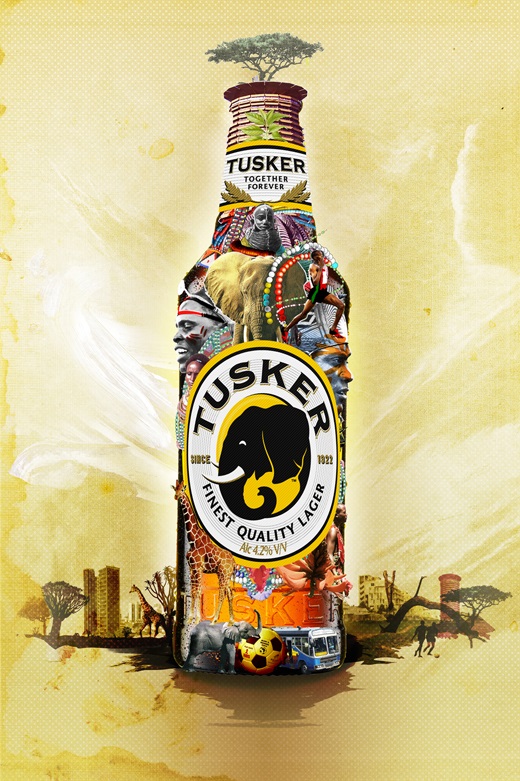
SABMiller is well back in EAB’s territory and, while Tusker has turned some tight corners in the past, the elephant of a brand faces a beast of a challenge — financial relevance. The new brew in Kenya is a SABMiller beer, made from sorghum, which is nimbly priced. It’s SABMiller’s first salvo in taking on illegal brewers.
The big question for Tusker now is: how do you maintain your brand integrity and broaden your market during tough times? We’ll have to wait and see how well Tusker answers this question.
Read more:
- Tusker sales remain flat as Guinness boosts EABL in The Star (Kenya)
- Brewing a better beer for Africa in Fortune
- SABMiller brews strategy to crack Kenya market in Business Daily Africa

Mandy de Waal is a writer based in Cape Town, South Africa. Follow her on Twitter at @mandyldewaal or at MandyLdeWaal [@] gmail.com.
— MarkLives’ round-up of top ad and media industry news and opinion in your mailbox every Monday and Thursday. Sign up here!
I am writing a WW2 memoir. Tuskers beer in cans are mentioned in my notes. Can you please tell me if Tuskers was being canned in1941 and, if so, what shape the cans were.
Many thanks.