

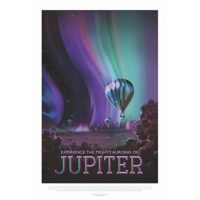
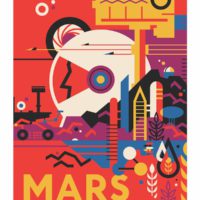
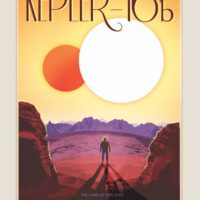
by Mark Tungate (@MarkTungate) Space, as everybody knows, is the final frontier. And it may be one that you and I can explore, if the space tourism business gets off the ground — and we win the lottery. This month’s column was inspired by the discovery of some of the more beautiful posters I’ve seen of late. They were created by NASA’s Jet Propulsion Laboratory (JPL), of all people, and posit faraway planets as potential tourist destinations.
Apparently JPL has its own in-house creative team, called The Studio, headed by David Delgado. Find out more about the posters here.
The posters were enthusiastically picked up and shared by space bloggers and mainstream media.

The race for space
The posters depict a fantasy, of course, but the race to open outer space to tourism is a reality. In February 2016, Richard Branson unveiled his latest Virgin Galactic spacecraft, getting back into the space business after the tragic crash of his previous craft in a test flight in 2014.
And Branson isn’t the only one in the space game. As you may know, Elon Musk — of Tesla fame — has his own project, called SpaceX, while Amazon founder, Jeff Bezos, is behind Blue Origin. Both companies are concentrating upon reusable rockets that will make taking cargo (and eventually passengers) into space far cheaper.
Musk experienced his own setback recently when an explosion at the SpaceX launch site in Florida destroyed not only one of his rockets, but also its payload — an Israeli-owned communication satellite [that was going to be used by Facebook to provide internet connectivity — ed-at-large]. Nobody was hurt in the incident.
All the companies involved will no doubt fix their glitches, bringing affordable space travel closer to a reality. But a handful of people have already become space tourists, thanks to an unlikely partnership between a private US concern and Russia’s space programme.
Fashioning the future
In 2001, a Virginia-based company called Space Adventures brokered a deal with the Russians that enabled Dennis Tito — an engineer — to blast off in a Soyuz spacecraft and visit the International Space Station. The trip cost him US$20m. Since then, Space Adventures has taken eight people on the same trip, as well as organising hundreds of zero gravity flights for wealthy tourists.
Design-wise, neither the spacecraft nor the suits used by early space tourists are much to look at. Richard Branson’s SpaceShipTwo craft has a bit more dash to it, however. In addition, the craft is stationed at a building in the Mojave desert called The Gateway to Space, designed by the UK architectural firm, Foster & Partners.
And then there are the suits. In January, Virgin Galactic announced that fashion brand Y-3 — a collaboration between Japanese designer, Yohji Yamamoto, and Adidas — would be designing “a full range of garments” for its spaceflight operations. Not just flight suits, but outfits for ground staff too.
https://www.youtube.com/watch?v=yGi1qz1zWrw
So, while taking a trip to Jupiter is still off-limits to mere mortals, if you’ve got the cash to pay for a ticket, you could experience outer space — and look chic while doing it.
 Mark Tungate (@MarkTungate) is the editorial director of the Epica Awards (@EpicaAwards), the only global creative prize judged by the specialist press. In this series of articles called Design Plus, Epica highlights creativity in the design field.
— Sign up now for the MarkLives email newsletter every Monday and Thursday, now including headlines from the Ramify.biz company newsroom service!