

by DK Badenhorst (@BrandCultureSA) Social justice causes are like brands in many ways. They have character, they stand for something and they would often be better off if we changed our behaviour.
I suspect this has not always been the case and, from what I can gather, Edward Bernays was the first man to connect the dots between selling product (or increasing the bottom line) and ideology. More can be found about this in his “Torches of Freedom” campaign.
Today, however, it is not a matter of ‘do you think we need brand character?’ but rather a battle for creating the most authentic, culturally relevant brand character — to be someone that people can identify with — to stand for something that people want to stand for. This is the holy grail of both social justice movements and brands, but the two approach the matter from two different angles.
Brands often pursue the consequence of culture. That is to say, brands look into culture and find out what can be done to marry a better world with a better bottom line. Brands have to pursue something that actually makes the world better. People are too smart not to. The world is too connected and advertising is too expensive to try pull the wool over someone’s eyes.
But brands are relatively free to find a cause. The problem with brands usually boils down to profitability. If they are not viable as business entities, they can pack their bags. This is without a doubt why brands employ armies of artists, business people and social science experts to craft campaigns that land the right message just so, just in the right place, with just the right accent, with just the right volume.
It’s not by accident that Nike’s Possibilities ad used the cheeky Bradley Cooper to narrate an ad that makes you wonder ‘why not’. Why don’t you shrug doubt off and just try? Just do it? Not with a maniacal Leonidas-like scream (as it easily could have been) but just with cheek and defiance. The Possibilities commercial itself probably reveals a small part of Nike’s bigger business strategy to not lose business to the ever-evolving world of informal sports. Sure, tie it all back to formal sports heroes (it is sponsoring these guys after all) but don’t forget that, at a grassroots level, sport is simply about pushing yourself.
Social justice movements fall short here. They have a different approach in that they know what they stand for. They know what change they want in the world. They just lack the product and the profit incentive which, in turn, means they lack the communications team to turn their desires into messages that can drive behaviour change.
What do I mean by all of this? Let’s take an example and compare a social justice movement to the Nike commercial. It will be a brutal comparison as it will be neither complete, nor fair — I am using the best that the brand world has to offer — but it will illustrate the point and hopefully help craft the messages of social justice movements.
Recently I visited the restaurant called “Bacon on Bree” in Cape Town. Now, let’s be clear here — it’s bacon, not macon, not vegan bacon. It turns the death of animals into profit; at some point pigs lose out. Opposite the road from this venue I ran into the scene pictured below.
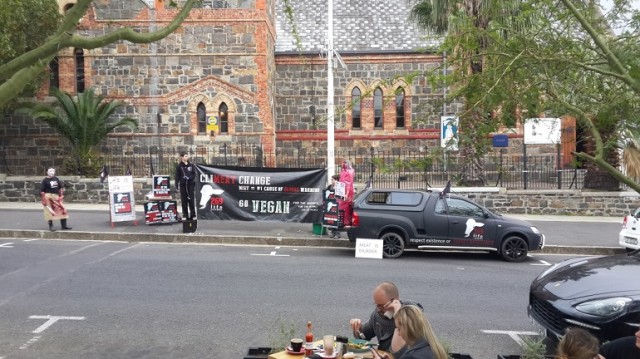 I took this picture before I turned into the restaurant. I was not offended by 269 Life’s judgement, but rather because of how the message had no effect on my decision-making process. I later discovered that the activists’ message motivated some of the people inside the restaurant to order extra bacon or to buy some to take home. This is a failed message on the part of our ‘social justice warriors’. If pigs employed these people as their ad agency, they should promptly fire them; they are doing more harm than good.
The vegan message has been around for a very long time and it holds merit. The facts are, more often than not, in favour of the vegans and, from what I can gather, commercial farming is potentially unsustainable and likely aiding climate change. It’s a message worth spreading, and, if it’s worth doing, it’s worth doing well.
Now, let’s step back and see where they went wrong. Why is this message not landing well?
They dramatise the problem
I’m not a huge fan of fear-mongering. People disengage when confronted with fear. I recall an old HIV/AIDS campaign in South Africa where they had people on billboards looking out over the traffic in a somewhat self-reflecting pose. I can’t recall the caption entirely but it was short and punchy — to the effect of ‘I know, do you?’ Their expressions didn’t leave me burning with curiosity. Whatever it was that they knew, it looked like they’d prefer not to and so did I.
This was a mild version of what I saw outside the restaurant. Here we had a group of people (not coincidentally) using the party colours of Hitler’s Nazi party to tell us how inhumane we are, how we are destroying the planet and how what we are doing is actually bad for us. I’ve met one member of this particular brand of social justice during an on-street interview and, after a short 30 minutes, he took my details and proceeded to send me videos of pigs being tortured to death (because I mentioned bacon) and a video of a small mammal being skinned alive (because my car had leather seats).
I still love bacon for breakfast and I still think leather seats are great. This is not to say that I in principle supported the torture of animals — I simply disengaged and, like a zombie, carried on living life.
People change incrementally. They change no more than what will leave them within arm’s reach of their comfort zone. Like cats exploring new territory, they always want to scurry back inside, within seconds, if dogs bark or a flock of pigeons land on the roof. Force them further and they run back and hide.
Not only does fear mongering not achieve your goal, it also scares people, making it more difficult for the next message to change behaviour and, in some cases, reinforces negative behaviour.
They are preaching to the choir
Here I wish to highlight the importance of understanding people. I’m not arguing that you should commission full-scale ethnographic and cultural study for every change you want to make. Just acknowledge that everyone is not like you. It seems like an idiotic thing to say but consider the following.
In one of his shows, Loyiso Gola points out his surprise when, in Nigeria, he was offered a full chicken for breakfast. Like most South Africans, he assumed breakfast is a bit lighter. Very seldom is chicken considered part of a traditional breakfast and never is it imagined that the full bird will appear on the menu. It’s what Žižek once referred to as an “unknown known”. Something that we know but we are totally unaware of. Most of us know a full chicken does not belong on a breakfast menu but, until now, you probably didn’t know that you knew this. That, to an extent, is ideology. The rules we follow without knowing that we follow them.
It’s perfectly normal and admirable to sit on cultural rails and live your life in your local cultural context. I would even argue that it is what we ought to do. But, if you are trying to convince people to change their behaviour, it is important to understand both your and their unknown knowns.
Our social justice warriors in Bree Street have neglected to take this into account. Their belief that ‘meat is murder’ and that ‘all life is equal’ falls on deaf ears; it’s just not true for anyone in the store. The animal rights activists obviously feel strongly about the message. This is why they have decided to join the group and this is obviously why they are sacrificing a perfectly fine Saturday morning holding up a banner outside the restaurant.
They are trying to hold the patrons of the store morally accountable for taking part in what they call a genocide, but this message does not land because the people inside simply do not share their beliefs — they say “no, it isn’t” as they order some extra bacon with their sandwiches.
To find common ground and shared understanding, you would have to trace a route much farther back, perhaps even to argue the meaning of life, what it means to be a sentient being and why a human life is the same as an animal life. This message must then be understood in the context of a country with widely held monotheistic religious beliefs, including that God himself made animals for human consumption. ‘If the creator of the universe said it’s for my sandwich, who are you to tell me it isn’t?’
The dishonest appropriation of social support
My last point — and the one that probably gets to me most — is the dishonest use of the social support society allocates to causes.
First, let me take one step back. I visited the group’s website to see what it was all about. On its website, there was blatant looting of Holocaust language. The payoff line “remembering to never forget” is clearly taken from the cultural fallout of the Holocaust. In addition to that, members brand their arms in the way that the Third Reich branded Jews: with a tattoo on the wrist. The jury is not out on whether or not human life is equal to animal life, but here an organization has decided to equate a slaughterhouse to a concentration camp, meat eaters to the Nazi Party, and the meat industry to the Holocaust.
I won’t delve too much into why global society has decided to take such a strong stance against genocide — I hope that is obvious and clear to you (at least an unknown known, if you would) — but we can start from the point that if you manage to find genocide in the making and can convincingly persuade society that it is happening, you’ll in theory find all the support you need.
269life.com is trying to equate genocide (the Holocaust in particular) to meat eating. It’s a cheap trick that aims on cashing out on society’s stance against genocide. You cannot make a convincing argument so you try to hitch a free ride with something that is an overwhelmingly strong argument. It’s saying, ‘Yes, the Holocaust was bad; now if you look at my cause you can see that we’re not that different.’ It’s insulting to both victims and to anyone who believes that genocide is wrong. 269life.com still has all its work ahead of it in convincing us why animals are like people; it has opted out of the argument, instead just claiming it, and in the worst way.
Why do we care?
Like all brands, social justice warriors have something to say, and 99.9% of the time it’s worth listening to. While I’m a huge supporter of the meat industry, I do believe that animal-rights activists have something valid to say. They have a cultural shift worth making, but it’s not going to happen by bullying one “Bacon on Bree” customer at a time into submission. It’s not scalable and it doesn’t work.
On that day I saw two old ladies (the most sympathetic demographic) pointing and laughing at the movement as they ate their bacon sandwiches. . One gentleman told me he’d ordered extra bacon and some to take home, and we heard that the store was particularly busy on that day. It would seem the activists were doing more harm than good. They were just highlighting lines in the sand, labelling people and inciting them to indulge entrenched behaviour. You cannot make a vegan out of a meat eater by telling him he’s a murderer for it. Much like you can’t make Nike fans by calling adidas stupid, Coke fans by calling Pepsi dumb or Stormers fans by calling the Bulls a bad team. People just don’t work that way.
And, while we argue identity politics, a potentially better world is slipping through our fingers. A message about healthier eating, more-sustainable food production and better treatment of animals gets trampled under the feet of people rushing to score a point for either team-us or against team-them.
Who did it right?
The gay rights movement has been a fantastic one. In many ways, the battle is won. Tiffany’s and Axe are now featuring same-sex couples, same-sex marriage is considered normal in many places and SE Cupp was begging the American right to accept gay couples. I imagine that, as with feminism, a lot of work will still has to be done in a world where openness to the issue is always at various levels (some African countries still send you to prison for being gay, let alone for gay marriage).
But the battle was not one that demonised one party and held another up as poor victims. It was a simple message: ‘All people are the same so le’ts treat all people the same.’ It didn’t try to convince people of something new; it just made a convincing argument that cantilevered ‘equality’ into a new space. Are all people equal? Yes. Are gay people considered people? Yes. Then gay people should be equal. Yes.
I’m sure there was a lot of name-calling, that there were groups of gay people who looked with hate towards straight people. I’m sure it mirrored other movements where a group of people are demonised and vilified not for what they do but for who they are. But the vanguard of the movement was always one that everyone could buy into.
The commercial called Nobody’s Memories is a brilliant piece of communication that illustrates this point so well. It makes same-sex marriage the same. It taps into something everyone believes in: beautiful memories. If you are against gay marriage, you are taking these cherished memories away from so many people for reasons you can’t really explain. It talks not to same-sex couples but to all people.
When your client is a brand, you measure your success against brand equity, profit and so forth. Profit is the lifeblood of businesses and, if you cannot in some way (whether it’s through awareness, brand equity or sales) tie your communication back to profit, you have to revisit the drawing board. But if your client is someone without a voice (animals, children etc) or an injustice (inequality or rights violation), your measure of success becomes a better world. Are those facing the inequality or those that are voiceless better off for your message? If I were an animal, would I want 269 Life saying those things to a group of people who wants to eat me?
I often use the term “emotionally responsible” when it comes to messaging. We need to be emotionally responsible when we talk to people. We cannot just say what we feel; we must respect how we will make people feel. Our hyper-connected world has pushed a wide variety of people together.
The challenge is no longer simply visibility and being heard — it’s about putting yourself in the shoes of other people, seeing yourself through their eyes and then trying to figure out how the thing that you are selling (whether it’s soft drinks or social justice) can make their life a bit better in a way that they would want.
Updated at 5.24pm on 21 August 2015. A previous version of this column referred to Bacon on Bree as a specialist butchery, when it is a restaurant. We regret the error.

DK Badenhorst (@BrandCultureSA) is lead strategist at Cape Town ad agency, FoxP2 wno brings cultural context and long-term trend insights to brand communication through cultural insight and semiotics. He contributes the monthly “Brand Culture” column, exploring the value and meaning interaction between brands and society, to MarkLives.com.
— MarkLives’ round-up of top ad and media industry news and opinion in your mailbox every Monday and Thursday. Sign up here!
I found your article very interesting and enlightening. Thank you. I know this is entirely not the point but please may I just say for the record that Bacon On Bree is a restaurant, not a butchery and we only use pasture-reared pigs and NEVER support commercial farming.