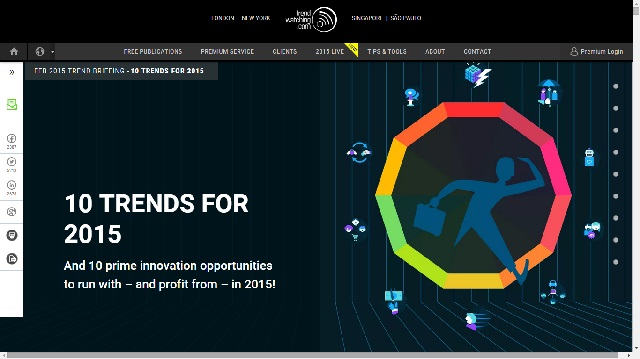

by Colwyn Elder (@colwynelder) Reading Trendwatching’s 10 trends shaping consumerism in 2015, it seems ‘sharing is caring’ and being human is ‘being on trend’.
A collision of the Sharing Economy and the Internet of Things has created a whole new world of asset sharing, dubbed as The Internet of Sharing Things by Trendwatching. Examples here include:
- Audi Unite, which launched in Sweden at the end of last year and enables customers to share a car in a private network of up to five people. The location and availability of the car are viewed via the app and the vehicle is accessed using a smart key fob.
- Bitlock is a smart bicycle lock that verifies users’ identities via bluetooth when they are nearby. Users then simply press a button to unlock the bike (no more lost keys!). The app also enables users to unlock their bicycles remotely, plus sharing with others in a bike-share solution costing 10 times less than existing options.
While on the topic of price, discounting is by no means new but the notion of helpful, compassionate discounts that support a shared cause or alleviate personal pain points is.
Sympathetic pricing strategy
According to Trendwatching, a Sympathetic Pricing strategy is an opportunity for brands to show their human side, and to convince the cynical consumer that they do, in fact, give a damn. Despite increasing good corporate citizenship and consumer-facing corporate social responsibility, people remain skeptical, and flexible pricing is an opportunity for brands to put their proverbial money where their mouth is and prove how much they care where it matters most.
Examples include:
- Uber offering fare-splitting passengers a 50% discount off all London trips during a Tube strike
- Community Shop, a British supermarket, selling discounted branded products to families receiving government welfare
- Groupon offering discounted onions in response to high onion prices in India
- Dutch airline Corendon offering discounted airfares to passengers travelling to Sochi to demonstrate for gay rights during the Olympic Games, and
- Free public transport in Paris to combat poor air quality
Be more flexible
Technology has enabled brands to be more flexible with regards to pricing strategies and structures, but it has also empowered marketing to be more tactical ie swift and responsive to externally relevant situations.
The Branded Government trend also draws from the external context, but more in terms of “corporate-powered civic change” such as the ElectriCity Project, a partnership between Volvo and the Swedish Transport Authority to create roads that can charge electric vehicles.
And last year’s Ebola crisis saw mobile app Easy Taxi partnering with Dettol to offer Nigerian cab drivers lessons on diagnosing and preventing the disease, simultaneously encouraging them to pass this knowledge on to their passengers.
Shortsighted
More human and caring brand behaviour does run the risk of exacerbating an already cynical consumer, and brands would be shortsighted not to include the broader social and/or environmental outlook.
The bingo moment comes when value is created for all three legs of the triangle: the business, the customer, and the community or world at large.

Strategic consultant Colwyn Elder (@colwynelder) brings a global perspective to the issue of sustainability, having lived and worked in London, Tokyo, Amsterdam and Cape Town. She contributes the monthly “Green Sky Thinking” column on sustainability issues to MarkLives.
— MarkLives’ round-up of top ad and media industry news and opinion in your mailbox every Monday and Thursday. Sign up here!