

by Shane de Lange (@shanenilfunct) Let’s delve into great media design from South Africa and around the world:
- Batt Butt — local/print
- Berlin Quarterly — online/print
- ELLE Brasil — international/print
- Friday (Mail & Guardian) — local/print
- New Philosopher — international/print
- The Face — iconic
Find a cover we should know about? Tweet us at @Marklives and @shanenilfunct.
 Want to view all the covers at a glance? See our Pinterest board!
Friday (South Africa), 1-7 September 2017
 The cover of Mail & Guardian’s Friday magazine disrupts as much as it evokes. It features an artwork by Zimbabwean artist, Kudzanai Chiurai, titled “We Live in Silence XVIII”, which is part of his current solo exhibition at the Goodman Gallery in Johannesburg. Supporting a body of work comprising photographs, videos, drawings, paintings and installation, Chiurai was inspired by Mauritanian filmmaker Med Hondo’s 1967 film Soleil Ô, which is a story about a black immigrant who travels to Paris in search of his Gaul forebears. The exhibition is essentially a dissection of the film, remixing the scenes in the form of visual mashups.
Unpacking the post-colony, Chiurai’s appropriation of Hondo’s story contests dominant colonial narratives and questions expectations placed upon the African migrant to adopt the identity, language, and forms of representation of the coloniser. While taking the baton from Hondo, Chiurai recasts the main character as a female in this story of black liberation, contesting gender discrimination embedded within the narrative of the post-colony, which tends to favor the black male as the savior, or martyr.
Kudos needs to be given to Milisuthando Bongela (@missmillib), Mail and Guardian arts and culture editor, and the rest of the editorial team for making this cover happen.
ELLE Brasil, September 2017

Alicia Keys first appeared on a magazine cover without make-up for Fault Magazine in July 2016, after she joined the #nomakeup movement. Since then, Keys has ceased to see makeup as a necessity in a woman’s life, liberating herself from a culturally engineered dependency on cosmetics. She takes her cause one step further here, appearing for the first time in Brazilian ELLE. Her discarding of socially constructed conventions surrounding female beauty is portrayed in four different cover portraits for the September 2017 issue, with four related messages: “Be Cool”, “Be Strong”, “Be Real”, and “Be Yourself”. Despite Keys’ minimal use of moisturiser and blush, and her styled braids, she makes herself vulnerable and challenges many accepted barriers and intuitionalised divides, showing her strength as a modern woman and raising an important debate.
Batt Butt (South Africa), Issue 2, 2017
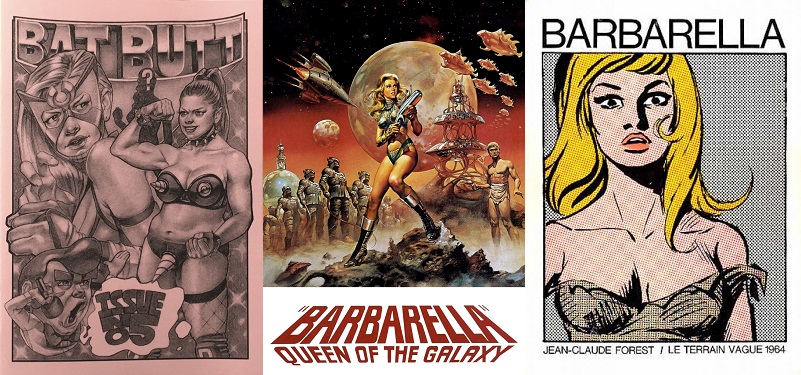
South African illustrator, Shaun Hill, has attained cult status in certain creative circles with his independently published Bat Butt. This zine is so sought after that it is normally sold-out within the first few days of its release, mostly due to its limited-edition print run and its low-brow, anti-aesthetic that appeals to a growing offbeat artistic sensibility in South Africa. The release of issue 5 was announced last week on social media for pre-order, and all copies have already been sold.
Using a low-budget, DIY aesthetic and A5 in size, the cover stays true to many independent comics and punk-inspired zines which have come before it. B-grade in nature, the front cover is illustrated by US-based illustrator Marquis Fortune and recalls the poster for the 1968 sci-fi film Barbarella, starring Jane Fonda. This classic poster was illustrated by American illustrator Robert McGinnis, known for his prolific work in advertising, book covers, and film posters. The film itself was based on the original French comic published in 1964, also called Barbarella, created by Jean-Claude Forest.
International in its scope, paying homage to a variety of historic sources and contemporary trends and with contributors from across the globe, this issue comes in a pack that includes two stickers, two prints, and other extras.
New Philosopher (Australia), Issue 17, August/September 2017

With all the developments in global politics, particularly in the US, it seems apt that the latest issue of independent quarterly, New Philosopher, is themed “communication”. The magazine is known for its investigation of contemporary philosophical ideas, and this issue places emphasis on the oft-quoted notion of fake news. As the cover illustration suggests, ambiguity exists between journalism and propaganda, portrayed here as crossed fingers; resonating, broadcasting. Reminiscent of a beacon transmitting information to the world, the beaming crossed fingers may be seen as a metaphor that describes either a conceited attempt at misinformation (fingers hidden behind one’s back), or a gesture of hoping for the best (fingers in plain view).
The cover recalls the iconic work of American designer, Lance Wyman, known for his logo and campaign work for the Mexico Summer Olympic Games in 1968. These games are important to South African history, as the country was provisionally invited to them during a time of increasing protest against the apartheid regime. Most African countries and many black American athletes threatened to boycott the games if SA were included. Our country was ultimately not included because it failed to guarantee that all forms of segregation and discrimination in sport would be eradicated by the 1972 gGames.
Online
Berlin Quarterly, Issue 6, Summer 2017
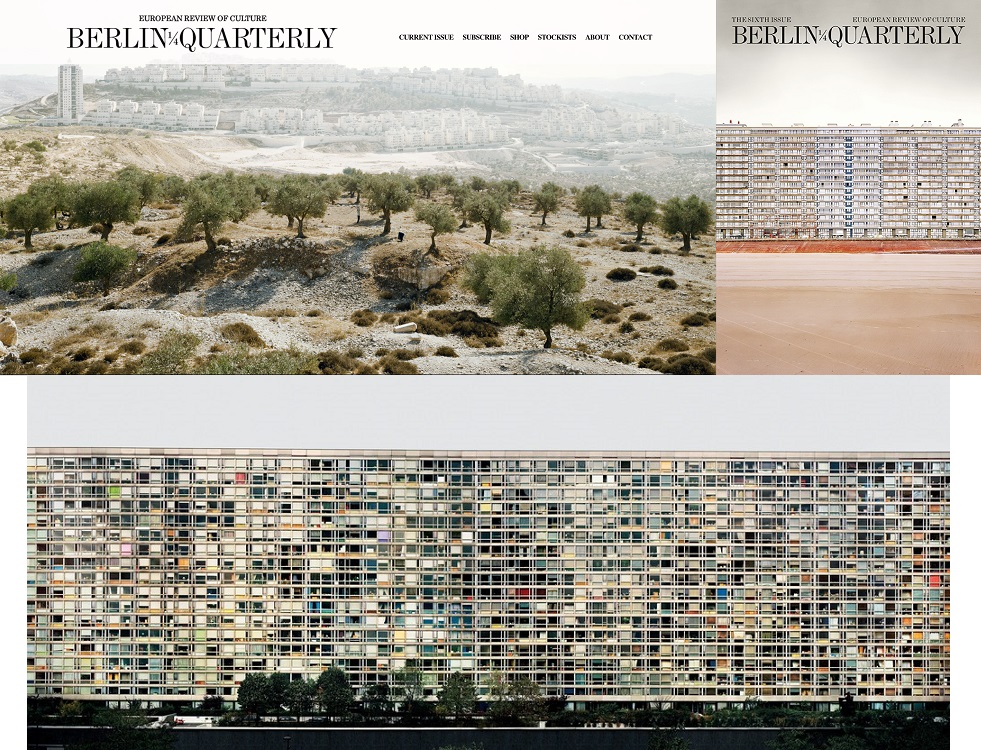
The sixth issue of German-based Berlin Quarterly continues to present culturally charged, quality, long-form journalism from across the globe. Notably, this issue includes a short story titled “Remedies” by SA writer, and PEN International New Voices winner, Masande Ntshanga.
The cover is visually breathtaking, with a detail of an image shot by Milan-based photographer Francesco Jodice, titled “Ostend, T43” (2005). Taken from Jodice’s “What We Want” photographic atlas, the picture is a commentary on the fluctuating social landscape today. The influence of German photographer, Andreas Gursky, is visible, reminding one of his work titled “Paris, Montparnasse” (1993): a panorama compiled from various images of a vast housing estate that makes a similar comment about geopolitical states in constant flux.
The striking photographic visuals extend over onto Berlin Quarterly’s website, where the landing page continues to showcase of Jodice’s striking What We Want portfolio of work, starting with “Bethlehem, T62” (2010).
Iconic
The Face (UK), Issue 1, May 1980

The rise of alternative culture during the ’80s and ’90s is synonymous with The Face. As the first magazine to focus on the youth market and urban identity, particularly in Margaret Thatcher’s Britain, The Face stood out because it focused on broader cultural issues, rather than placing all emphasis on music culture alone. It soon became the voice of indie and style culture in the UK, setting standards for trends in music, fashion, photography and film.
The magazine introduced the world to the work of artists such as Robert Mapplethorpe, Bruce Weber and Cindy Sherman, alongside musicians such as Spandau Ballet, Boy George, Wham!, David Bowie, Annie Lennox, Prince, and Adam Ant, to name a few. Historic covers include a young Kate Moss on her first-ever cover campaign in 1990, and Gisele Bunchen photographed by David LaChapelle on the 20-year anniversary cover.
In its infancy, The Face called upon the pioneering graphic design, typography and art direction of Neville Brody, currently dean of the School of Communication at the Royal College of Art in London, known for his visual identity work on Arena magazine (1987–1990), and his own cult independent magazine, Fuse, among a plethora of other important executions. The fashion photography of legendary photographer, Nick Knight, and fashion stylist, Ray Petri, is also worth mentioning here.
After surviving the dystopic acid house years, and the rococo-esque Britpop era, The Face saw its downfall in 2004. It was cemented in the annals of history in 2011 when it was included in the Design Museum’s permanent collection, and formed part of the Club to Catwalk exhibition at the V&A in 2013.
 Shane de Lange (@shanenilfunct) is a designer, writer, and educator currently based in Cape Town, South Africa, working in the fields of communication design and digital media. He works from Gilgamesh, a small design studio, and is a senior lecturer in graphic design at Vega School in Cape Town. Connect on Pinterest and Instagram.
Cover Stories, formerly MagLove, is a regular slot deconstructing media cover design, both past and present.
— Sign up now for the MarkLives email newsletter every Monday and Thursday, now including headlines from the Ramify.biz company newsroom service!