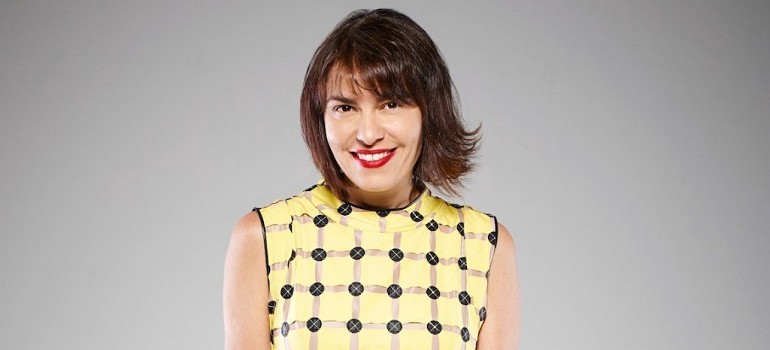

by Mark Tungate (@MarkTungate) In this edition of creative stars making headlines, we chat to Joanna Monteiro, the chief creative officer of FCB Brasil. Among other things, she shares her thoughts on the challenges facing women in advertising.
The prospect of interviewing Monteiro was initially daunting. After all, a couple of years ago, Business Insider named her “the most creative woman in the world”. She regularly appears on lists of creative personalities, not just in advertising but in the entire spectrum of the arts and show business. In reality, the CCO of FCB Brasil is gratifyingly down to earth. When I raise the irony that she works in Sao Paulo, the city that actually banned outdoor advertising, she laughs. “It didn’t really help,” she says. “Sao Paulo was never beautiful! But it also has the best-ever restaurants and a lot of culture. It’s a vibrant place.”
Women in advertising
Monteiro joined FCB in 2012 as executive creative director — in 2015 she became chief creative officer. Which brings us to the thorny subject of the moment: women in advertising. Is the situation still as bad as all that?
“I think that things are starting to change. There’s still a lot to do — especially in the creative department. We have a lot of women at high levels here in Brazil, but in other departments: as planners, as account directors, within clients. There seems to be a specific problem within the creative department.”
Monteiro puts it down to the somewhat macho culture that thrived during Brazil’s advertising boom years in the 90s. “When I started, 20 years ago, the profession was tougher for women than it is nowadays. At that time, Brazilian advertising creativity was becoming more respected all over the world. We were number three after the UK and the US. It was a time when you could make a lot of money and become a star.”
Status as a price
But that status came at a price. “Working every night, often at the weekends. Nobody got married; nobody had kids. This put many women out of the game, because they wanted to have a life. It wasn’t that you couldn’t compete — it was that you didn’t want to compete. The situation was disrespectful and unprofessional.”
Now, she says, thanks to the globalisation of the industry, more professional standards apply. “It’s about whether you deliver or not, rather than how you do that.”
Monteiro started out as a copywriter at Ogilvy after a post-graduate course in advertising. “I originally wanted to be an art director, but I realised it would require far more patience than I possessed. I want everything to move fast. Since I loved writing and telling stories, I decided to try copywriting. I’ve never regretted that decision,” she explains.
Stamp of approval
Initially asked to work on a project at legendary Brazilian agency DPZ, she also heard that Ogilvy was recruiting. As DPZ had already given her its stamp of approval, the rival agency didn’t hesitate — and pretty soon she’d been hired by Ogilvy.
Today, her CV resembles a list of Brazil’s most-iconic agencies: after Ogilvy she definitively joined DPZ, then moved on to W/Brasil and Africa. “I never imagined I’d work for all these great people,” she says, recalling the time W/Brasil founder Washington Olivetto — a true legend in her country — called her at work to offer her a job. “I was stunned. I mean, nobody gets a phone call from Washington Olivetto.”
Next, she became one of the founding members of Africa, hired by Nizan Guanaes and Sergio Gordilho before the agency even existed. One thing that links all three agencies, she points out, is that they are run by creative people.
“Founders were creatives”
“DPZ was the place where both Washington and Nizan started. A lot of great people have passed through there — all the big names. Why? Because two of its three founders were creatives; they were art directors. It was the first agency in Brazil that was really focused on creative.”
She describes the move to FCB as “a huge gamble” for her, because “it was definitely not a creative agency in terms of reputation”. Her job was to change that. “It was the kind of challenge that only a crazy and irresponsible person like myself would accept.”
More seriously, she suggests it was a chance to combine everything she’d learned at her previous agencies. “My goal was to bring together strategy, the relationship with the clients, and creativity. I knew I wouldn’t be able to succeed if I didn’t have the understanding of the clients, but it seemed to work.”
An early success
One of her early successes was the “Solar Ad Charger” for Nivea. It involved placing ultra-flat solar cells and a phone socket in magazine ads for Nivea’s sun screens, enabling beach-goers to charge their phones while tanning (safely, of course).
She also took Brazilian supermodel, Gisele Bündchen, to Los Angeles to shoot a spot for broadcaster SKY featuring a “horror household” along the lines of The Addams Family. “I wanted to focus the brand on entertainment,” she explains.
In 2014, Monteiro and her team won the Mobile Grand Prix at Cannes for another Nivea campaign. This time, the giveaway in the ad was a wristband that could be synchronised with an app, so parents could track their kids’ movements at the beach.
“Only Nivea could run these ads, because they’re all about protection. I’ve always tried to come up with things that are relevant for the client. I think that comes from Nizan, who would reject even the most-wonderful creative idea if it didn’t make sense for the brand.”
Demanding more
At the same time, consumers are demanding more, whether it’s an entertaining experience or a useful tool. “Technology is great in that respect because it gives us a chance to do something new that really connects people with brands.”
One of her favourite recent campaigns is once again for SKY, inspired by high-definition TV. The brand took an optometrist to schools all around Brazil to test kids’ eyesight. Those who were unable to see clearly were given glasses.
Like many creatives, she has an ambiguous relationship with awards. “They allow good work to become better known globally, but of course we don’t work for them. We work to make something great for the client, to make them more famous — and above all, if we can, to change peoples’ lives.”
 Mark Tungate (@MarkTungate) is the editorial director of the Epica Awards (@EpicaAwards), the only global creative prize judged by the specialist press. A British journalist based in Paris, Tungate is also the author of six books about branding and advertising, including Luxury World and Adland: A Global History of Advertising. He has a weekly column in the French magazine, Stratégies, and has written for leading newspapers and magazines in the UK and the US.
This “Global Headline Makers” column, which profiles creative stars making headlines in their home markets, is syndicated monthly from Epica.
— MarkLives’ round-up of top ad and media industry news and opinion in your mailbox every Monday and Thursday. Sign up here!